

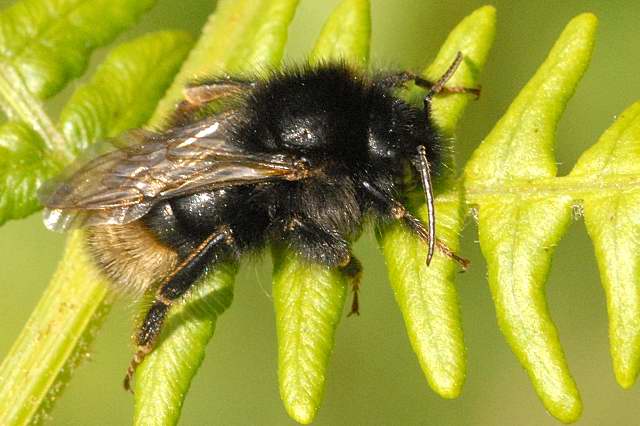
James Lindsey at Ecology of Commanster, CC BY-SA 2.5, via Wikimedia Commons
Field Cuckoo Bee
Bombus campestris
Panzer, 1801 • Apidae • Psithyrus
The field cuckoo bee is the social parasite of the carder bees, the most variable cuckoo bumblebee in Britain and one of the most frequently seen of the six British cuckoo bumblebee species. Bombus campestris Panzer, 1801 ranges from almost entirely black to a pattern of two yellow thorax stripes and extensive greenish-yellow patches on the abdomen, with every combination in between. It primarily targets the common carder bee but probably attacks all five British carder bee species: B. pascuorum, B. humilis, B. muscorum, B. ruderarius and B. sylvarum. Widespread across most of Britain, it has declined significantly since 1990 in parallel with the carder bees it depends on. Like all cuckoo bumblebees it has no worker caste, collects no pollen, and makes no honey. Explore its range on the UK Native Bee Species Map or read about cuckoo bees worldwide in the World Bee Atlas.
Quick Facts
Taxonomy and Classification
The field cuckoo bee was described by Georg Wolfgang Franz Panzer in 1801. Like all British cuckoo bumblebees, it belongs to the subgenus Psithyrus within Bombus. BWARS notes it was "until recently known as Psithyrus campestris" and that Psithyrus has now been reduced to a subgenus of Bombus following phylogenetic evidence.[1] The species name campestris is Latin for "of fields," a reference to its habitat rather than to any specific behaviour.
| Kingdom | Animalia |
| Phylum | Arthropoda |
| Class | Insecta |
| Order | Hymenoptera |
| Family | Apidae |
| Tribe | Bombini |
| Genus | Bombus Latreille, 1802 |
| Subgenus | Psithyrus Lepeletier, 1833 |
| Species | Bombus campestris Panzer, 1801 |
Identification: Britain's Most Variable Cuckoo Bee
The field cuckoo bee is described by BWARS as "a very variable species, colours ranging from forms which are all-black to those where the black is broken by two yellow stripes on the thorax and a yellowish tail."[1] This extreme variability makes identification more challenging than for most other cuckoo bees. The following characters apply across all colour forms:
Dark, strongly tinged wing membranes, especially in females; hairy hind tibiae rather than smooth pollen baskets; sparser, less dense body hair with the black cuticle visible between hairs. These are the universal cuckoo bee characters shared with all six British species. Among cuckoo bees, the extent of greenish-yellow on the apical abdomen varies from total absence to extensive, and the tail may range from black to pale yellow.[2]
Separating from Bombus sylvestris
Males of B. campestris can resemble males of the forest cuckoo bee (B. sylvestris). The diagnostic difference is the tail tip: in B. campestris the very tip of the abdomen always has black hairs; in B. sylvestris it has red hairs. Additionally, male B. campestris have a pair of large hair tufts on sternite six, absent in B. sylvestris.[2]
The field cuckoo bee is confirmed in Bombus pascuorum nests and recorded from B. humilis. BWARS states it is "likely that it will attack all the carder bumblebees": B. humilis, B. muscorum, B. pascuorum, B. ruderarius and B. sylvarum. If the threatened carder bees continue to decline, the field cuckoo bee loses potential hosts accordingly.
Invasion Behaviour and Life Cycle
Overwintered females emerge in April, linked to the phenology of the host species: the common carder bee must already have an established colony for the cuckoo to invade. The female enters the host nest, where she may be attacked and killed by workers; if the usurpation is successful, she dominates or kills the host queen and begins laying her own eggs.[3] Host workers continue provisioning the colony but raise B. campestris reproductives rather than their own species' offspring.
New female and male B. campestris are produced from July into August. Females mate and enter hibernation. Males forage on flowers through August before dying. Unlike female true bumblebees, female B. campestris do not collect pollen for brood cells, though BWARS notes they may consume pollen directly to aid ovary development. A wide range of flowers are visited for nectar, including thistles, knapweeds, bramble and various garden flowers.[1]
Distribution and Decline
The field cuckoo bee is widely distributed throughout almost the entire area of Britain covered by the BWARS atlas, with the notable exception of the far north of the Highland Region of Scotland.[1][4] This distribution closely mirrors that of its primary host, B. pascuorum, confirming the obligate relationship. The Darwin Tree of Life genome paper (2023) notes it has "declined significantly since 1990," tracking the decline of carder bee populations driven by agricultural intensification and loss of flower-rich grassland.[3]
A parasite index for carder bee health
Because the field cuckoo bee is entirely dependent on established carder bee colonies, its presence at a site implies a sufficient density of carder bee nests to support parasitism. Conversely, its absence from sites with apparent B. pascuorum populations may indicate that colony density is too low to sustain the cuckoo. Recording the field cuckoo bee is therefore a useful indirect indicator of host population health.
Does Bombus campestris parasitise Bombus sylvarum?
BWARS states it is "likely" that B. campestris attacks all carder bees including B. sylvarum, but confirmed nest records from B. sylvarum in Britain are lacking. Given that B. sylvarum now survives in only five isolated UK population areas and B. campestris is absent from or very rare in some of these sites, the host relationship cannot be studied easily. The Genome paper lists B. sylvarum as a probable host but does not cite confirmed British nest records.[3]
Carder Bees and Our Raw Honey
The field cuckoo bee, like all cuckoo bumblebees, makes no honey and collects no pollen. It depends entirely on the productivity of the carder bees it parasitises. The carder bees in turn depend on flower-rich grassland, the same landscape that produces the most expressive British wildflower honeys.
Our Acacia Honey comes from a different landscape entirely: the managed black locust forests of Transylvania, tended by the Nistor family across six generations. Pale, mild and slow to crystallise, it is single-origin raw honey at its most concentrated. The British Honey Bundle brings Wildflower, Soft Set and Heather together from our SALSA-certified British supplier in one gift.
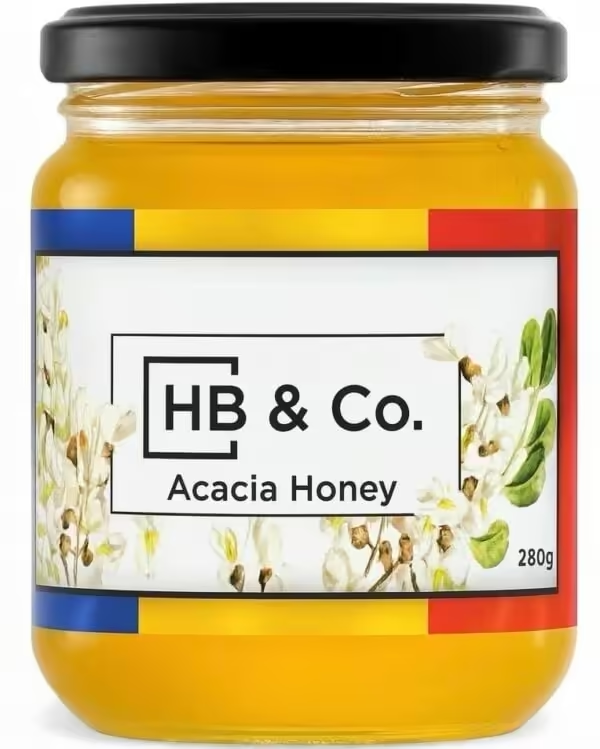
Pale, mild and slow to crystallise. Raw Transylvanian acacia honey from six generations of family beekeeping in the Nistor family apiaries. Cold-extracted. 280g.
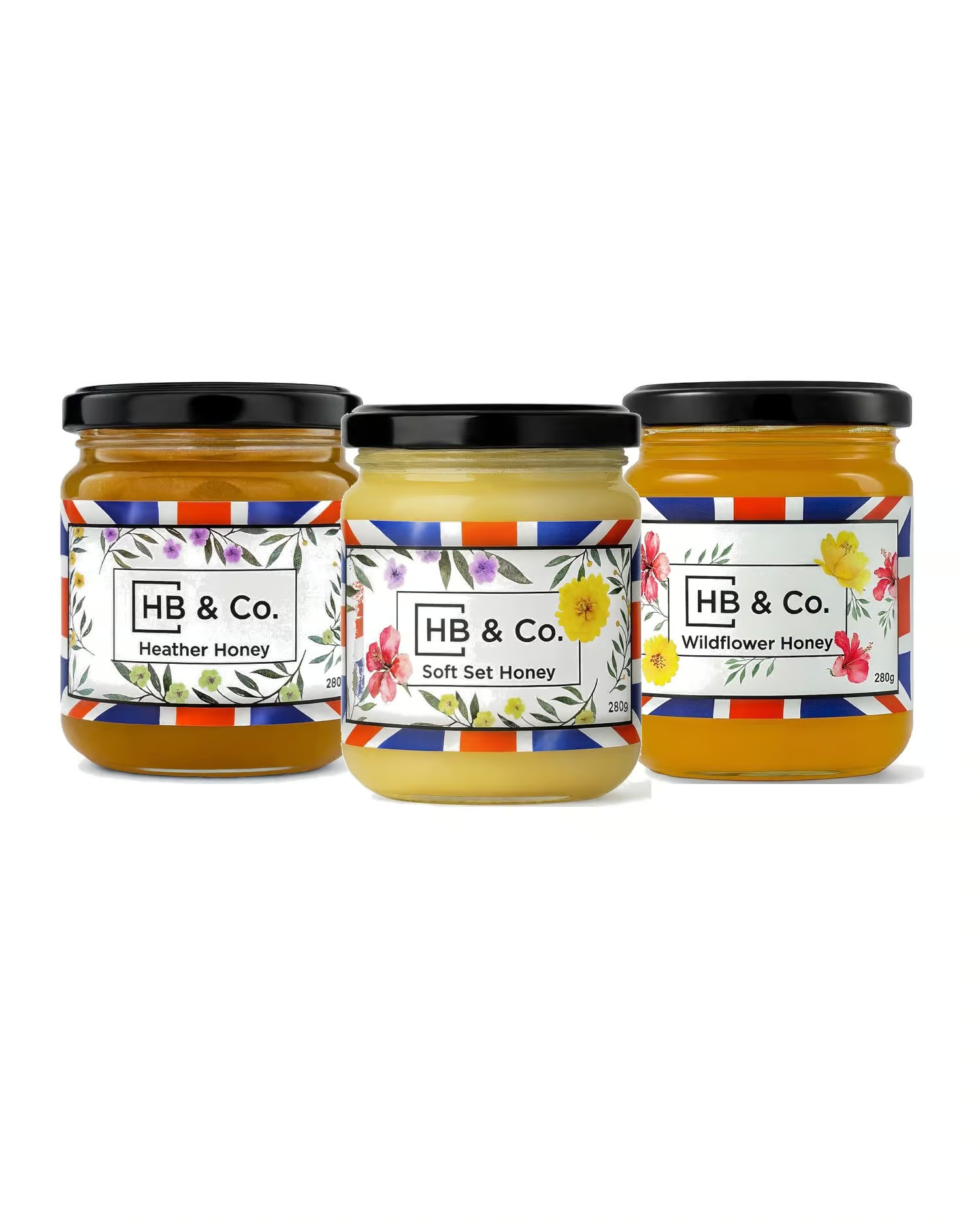
Wildflower, Soft Set and Heather from our SALSA-certified British supplier. Three landscapes, one gift.
Shop British Bundle
Raw single-origin honey every month. Acacia, Wildflower, Heather and more. From £8.79/month.
Start SubscriptionFrequently Asked Questions
How do I identify a field cuckoo bee?
Look for dark, strongly tinged wing membranes, hairy (not smooth and shiny) hind tibiae, and sparser body hair than a true bumblebee. Colour is extremely variable: forms range from almost entirely black to two yellow thorax stripes and greenish-yellow abdominal patches. It is medium-sized at around 18 mm. Context helps: seeing it near a carder bee nest, or finding it on thistles and knapweeds in late summer, is consistent with the species. Males can be separated from the forest cuckoo bee by the black-tipped tail (not red-tipped as in B. sylvestris).
Which bees does the field cuckoo bee parasitise?
Its confirmed primary host in Britain is the common carder bee (Bombus pascuorum), the most widespread carder bee. It has also been recorded from B. humilis nests. BWARS considers it likely to attack all five UK carder bee species: B. pascuorum, B. humilis, B. muscorum, B. ruderarius and B. sylvarum. See the Common Carder Bee profile, the Moss Carder Bee profile and the Shrill Carder Bee profile for the host species in detail.
When does the field cuckoo bee fly?
Females emerge in April. New females and males appear from July into August. The overall flight season runs April to August or early September. Females emerge after the common carder bee queens have already founded colonies, since an established colony is needed for invasion.
Why is the field cuckoo bee so variable in colour?
Colour variation in cuckoo bumblebees is thought to result partly from the relaxation of selection pressure. True bumblebees have co-evolved with flower and predator recognition systems that may maintain consistent colour patterns. Cuckoo bees, which benefit from resembling their hosts during nest invasion, face different selection pressures, and individual variation within a population is wide. The variation in B. campestris is extreme even by cuckoo bee standards and is not correlated with subspecies or geography in Britain.
Is the field cuckoo bee declining?
Yes, significantly since 1990, tracking the decline of its carder bee hosts. As flower-rich grassland has been lost to agricultural intensification, carder bee colony densities have fallen, and with them the number of host colonies available for invasion. The field cuckoo bee's abundance is a direct function of its hosts' abundance.
Does the field cuckoo bee sting?
Females have a sting, used during the nest invasion process to fight and subdue the host queen. They do not sting humans unless directly handled or trapped. Males cannot sting.
Does the field cuckoo bee make honey?
No. It collects no pollen, builds no nest and stores no nectar. Its offspring are raised entirely by the workers of its host colony. Only honeybees (Apis mellifera) store honey in commercial quantities.
Where can I find field cuckoo bees?
In gardens, hedgerows, flower meadows and anywhere the common carder bee is present in good numbers, across most of Britain except the far north of Scotland. Look for foraging individuals on thistles, knapweeds, bramble and garden flowers from July onwards, or searching females near carder bee nests in April and May. See the UK Native Bee Species Map for recorded distribution.
Sources and References
- Bees, Wasps and Ants Recording Society (BWARS). Bombus campestris Panzer, 1801: species account, colour variation, host species, distribution. bwars.com
- Bumblebee Conservation Trust. Field cuckoo bumblebee: identification, male separation from B. sylvestris, cuckoo bee characters. bumblebeeconservation.org
- Darwin Tree of Life Project (2023). The genome sequence of the Field Cuckoo-bee, Bombus campestris (Panzer, 1801). Wellcome Open Research. Decline since 1990; host species confirmed and probable. pmc.ncbi.nlm.nih.gov
- Powney, G. D. et al. (2019). Widespread losses of pollinating insects in Britain. Nature Communications 10:1018. doi.org