

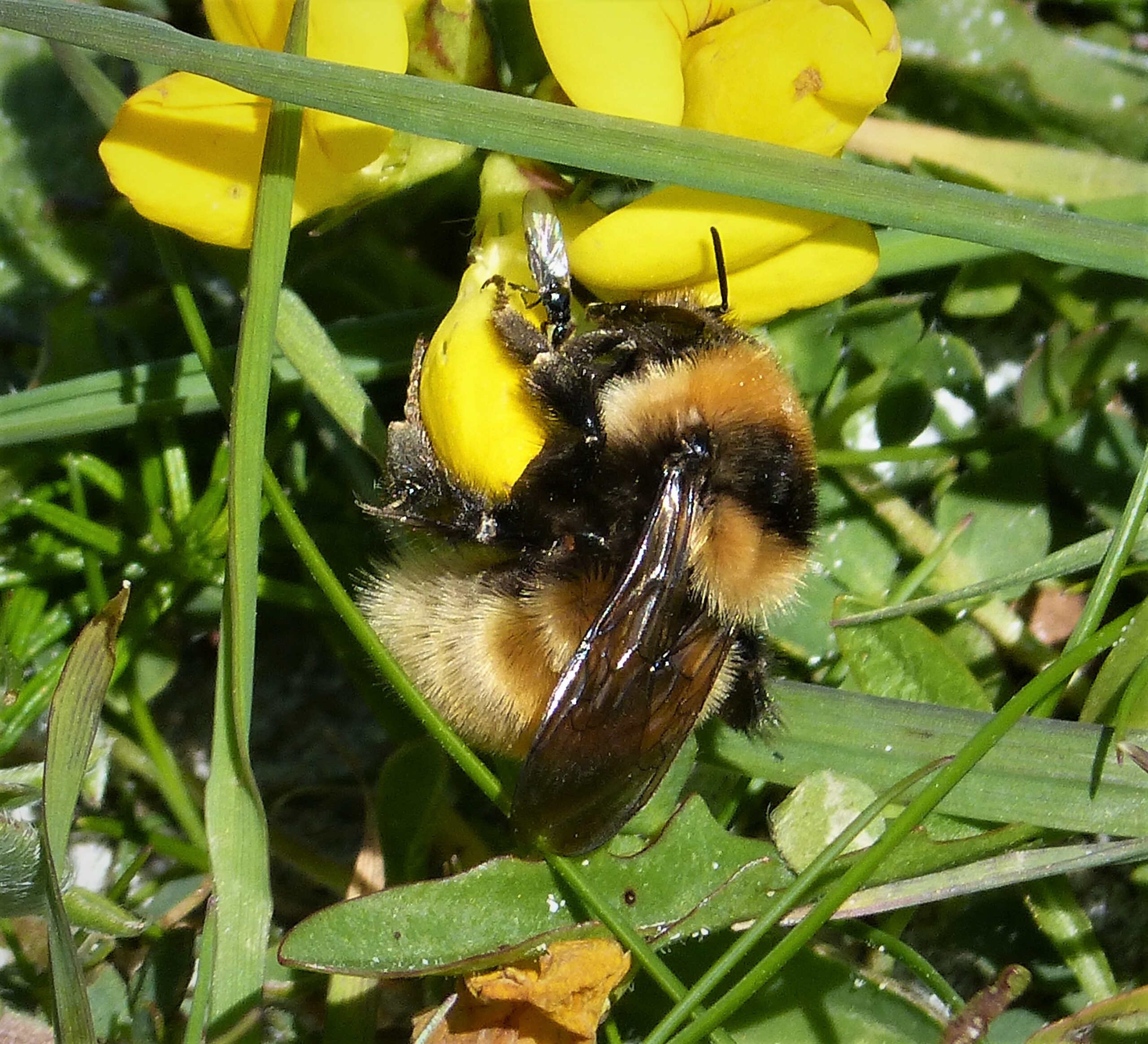
Great Yellow Bumblebee
Bombus distinguendus
Morawitz, 1869 • Apidae • Subterraneobombus
The great yellow bumblebee is one of the most striking and most threatened bumblebees in Britain. Entirely sandy-yellow except for a broad black band across the top of the thorax between the wing bases and black patches below them, Bombus distinguendus Morawitz, 1869 is unmistakable when seen well. It was once widespread across Britain and Ireland; it is now confined to Orkney, the Outer Hebrides, the north Highlands coast, and a handful of other northern and western Scottish sites. Its last Irish population survives in north-west Ireland, where it is classified as Endangered. It is a Priority species under the UK Biodiversity Action Plan, a Species on the Edge priority in four Scottish regions, and the subject of active conservation work by the Bumblebee Conservation Trust and Plantlife. Queens forage in overcast conditions less readily than most other bumblebees, making it particularly vulnerable to the cool, cloudy summers that are already becoming more frequent at northern latitudes. Explore its surviving range on the UK Native Bee Species Map or read about bumblebees worldwide in the World Bee Atlas.
Quick Facts
Taxonomy and Classification
The great yellow bumblebee was described by Franz Morawitz in 1869. It belongs to the subgenus Subterraneobombus, which contains bumblebees with a predominantly northern Palearctic distribution. The species has a wide range across central and northern Europe from Britain east to Sakhalin, but has declined severely at the western and southern edges of its range, including Britain and Ireland, while remaining more common in parts of Scandinavia and central Europe.[1]
The species name distinguendus is Latin for "distinguished" or "remarkable," a reference to its striking all-yellow colouration. It was described from continental material and recognised as occurring in Britain on the basis of specimens collected in the nineteenth century. BWARS notes a complex synonymy including Apis nemorum Fabricius 1775 (not of Scopoli) and Bombus elegans Seidl, 1837.[1]
| Kingdom | Animalia |
| Phylum | Arthropoda |
| Class | Insecta |
| Order | Hymenoptera |
| Family | Apidae |
| Tribe | Bombini |
| Genus | Bombus Latreille, 1802 |
| Subgenus | Subterraneobombus Vogt, 1911 |
| Species | Bombus distinguendus Morawitz, 1869 |
Identification
The great yellow bumblebee is one of Britain's most distinctive bumblebees and, in its remaining range, one of the least confusable. All three castes are sandy or golden-yellow across the entire body, broken only by a broad band of black hairs on the top of the thorax between the wing bases (the inter-alar band) and black patches at the sides of the thorax below the wing bases. There is no white tail, no red tail, and no yellow-and-black banding of the type seen in most other bumblebees.[2]
Queens average around 18 to 20 mm and have a neat, dense coat described as "lapidarius-sized" in field guides, referring to their similarity in body size to red-tailed bumblebee queens, though the colouration is entirely different. Workers and males have somewhat longer, more loosely arranged hairs and appear slightly scruffier than queens. The face is relatively long, consistent with the long-tongued foraging the species practises. The principal confusion risk is with faded or worn carder bees (B. muscorum, B. humilis, B. pascuorum) whose ginger coats can bleach to a yellowish hue in worn specimens, and with male field cuckoo bees (B. campestris) which have a shorter face and lack pollen baskets.[2]
Distribution: A Catastrophic Retreat
The great yellow bumblebee was formerly widespread across Britain, with historical records from much of England, Wales, Scotland and Ireland, though with a northern and western bias even in the nineteenth century. By 1999 it had contracted to the Inner and Outer Hebrides, Orkney, and the north coast of mainland Scotland, with an older Shetland record unconfirmed in modern surveys.[1]
Current strongholds are the machair grasslands of the Outer Hebrides, where it remains locally common, and Orkney. On the Scottish mainland it persists in small numbers along the north Highlands coast between Cape Wrath and John o'Groats, and in Argyll. The Bumblebee Conservation Trust's Species on the Edge project works across four regions: Orkney, North Highlands Coast, Argyll Coast and Inner Hebrides, and Outer Hebrides. In Ireland, the last known population is in north-west Ireland and is classified as Endangered on the Irish Red List.[3]
Charman et al. (2010) used microsatellite markers to estimate population genetic parameters for the great yellow bumblebee in Britain. The minimum average effective population size at sampling sites was approximately 25 individuals, among the lowest recorded for any British bumblebee and consistent with the severe fragmentation and isolation of surviving populations.
Machair: The Habitat That Sustains It
The great yellow bumblebee is most abundant on machair, the shell-sand coastal grassland of north-west Scotland and western Ireland that supports some of the most flower-rich plant communities in Europe. Machair managed under traditional low-intensity crofting systems provides the dense stands of legumes, particularly bird's-foot trefoil, red and white clover, and kidney vetch, that the species requires for a successful colony cycle.[2]
BWARS notes that the species requires large expanses of natural and semi-natural grassland with high densities of flowering legumes, alongside stands of knapweed and areas of tussocky grass for nesting. The combination of these requirements means that fragmented or degraded machair is significantly less suitable even if individual plant species are still present. Agricultural intensification, reseeding, overgrazing and drainage have eliminated this combination across most of the species' former range.
Foraging: Sunshine-Dependent and Long-Tongued
Queens emerge in late May and June and forage initially on bird's-foot trefoil, kidney vetch and white clover before switching to red clover as it becomes available. Workers, which appear from mid-July onwards, forage heavily on clovers and knapweed. The species persists until early September, visiting devil's-bit scabious as one of the last foraging plants of the season.[2]
A distinctive and ecologically important trait is its sensitivity to weather. Unlike the closely related moss carder bee, which forages readily in overcast conditions, the great yellow bumblebee forages at much reduced rates when the sun is obscured, even in otherwise suitable weather. This means that colony foraging time is compressed on cloudy days, making it more vulnerable than other species to the cool, cloudy summers increasingly typical of Atlantic Scotland.[2]
391 m modal foraging range
Charman et al. (2010) used microsatellite-based genetic methods to estimate foraging distances in machair populations of the great yellow bumblebee. The modal foraging distance was 391 m, with 95% of foraging activity occurring within 955 m of the nest. This is a shorter foraging range than estimated for many other British bumblebees, reinforcing the importance of dense flower resources close to nest sites and the vulnerability of the species to habitat gaps in the landscape.[4]
Is the great yellow bumblebee the same species as the North American Bombus distinguendus?
Williams and Thomas (2005) reported Bombus distinguendus as new to the New World from Alaska, where it has a disjunct population.[5] Some sources treat the Alaskan population as the same species as the European one; others have proposed that further study may support treating it as a separate taxon. The current consensus in GBIF and the major European checklists treats them as conspecific, but the question has not been definitively resolved using modern genomic methods.
Upland Scotland and Our Heather Honey
The great yellow bumblebee and our Yorkshire Heather Honey share an ecological moment: late summer in northern British uplands, where the last flowers of the season carry the greatest ecological weight. The bee forages on devil's-bit scabious and knapweed in September on the same northern grassland landscapes where our honeybee colonies work heather in August. Different landscapes, same season, same dependence on what the land produces in its final weeks of flower.
Our Heather Honey is gathered from the Yorkshire Moors: bold, thixotropic, gathered in a single annual harvest. For a gift that spans the range of what British and Transylvanian beekeeping produces together, the British Honey Bundle brings Wildflower, Soft Set and Heather into one box.
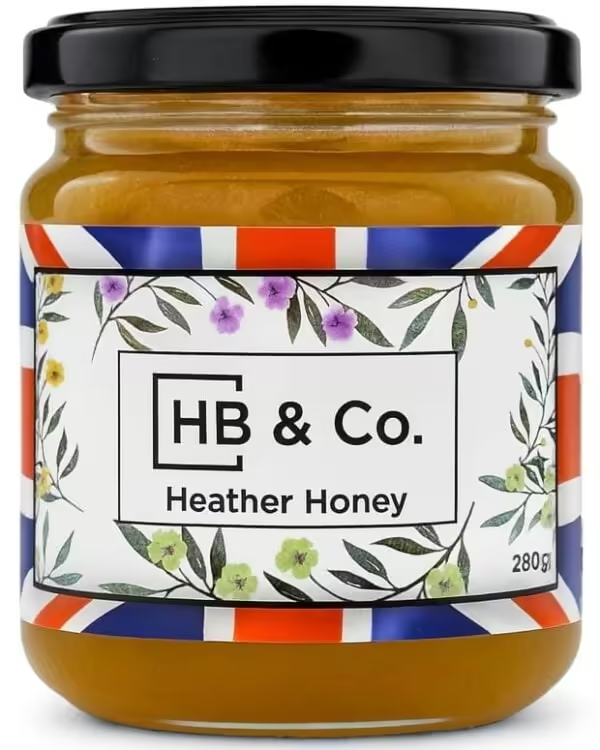
Bold, thixotropic and distinctive. Raw Yorkshire heather honey gathered from late-summer upland moorland, the same season the great yellow bumblebee makes its final foraging push. One harvest, one season. 280g.
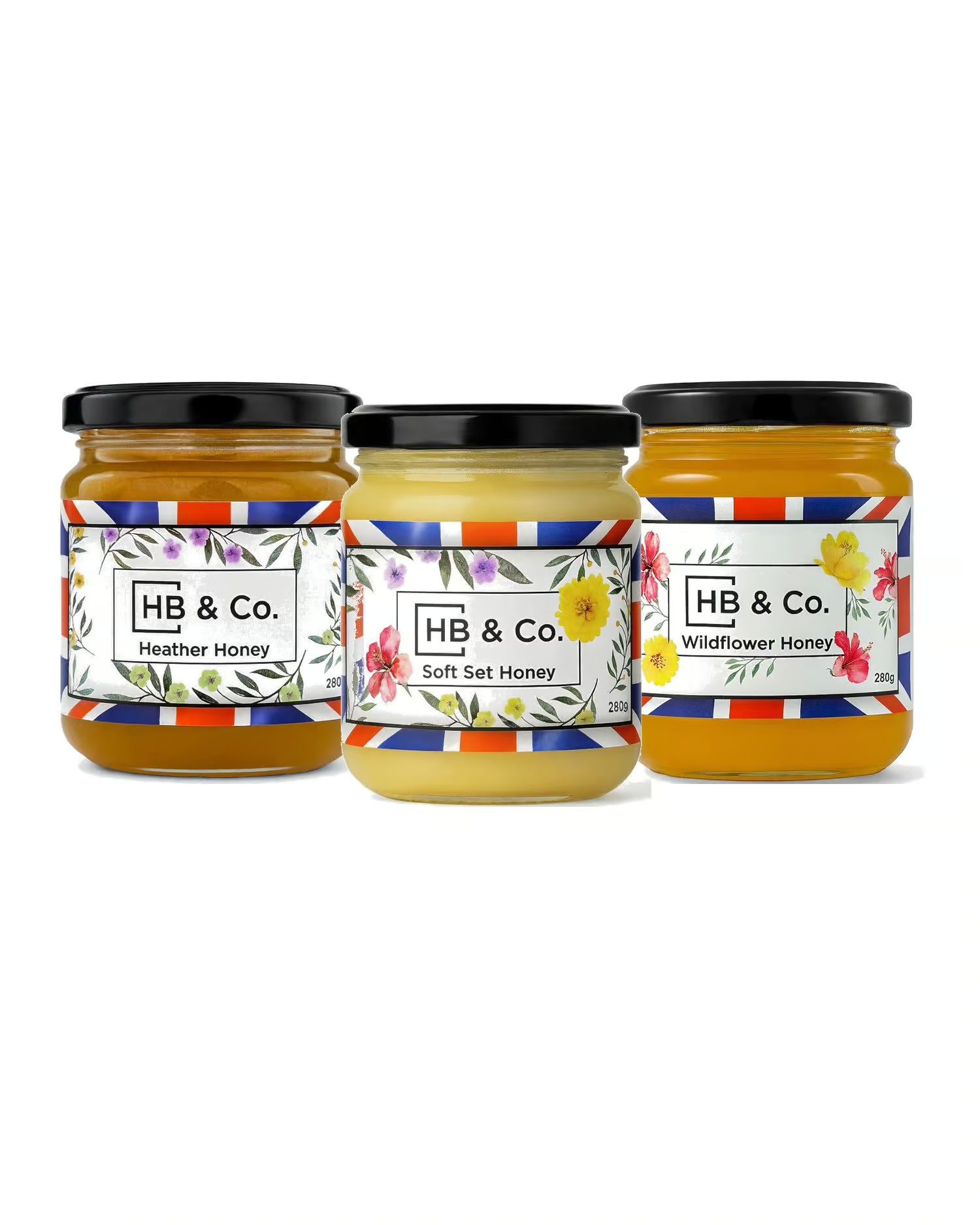
Wildflower, Soft Set and Heather from our SALSA-certified British supplier. Three landscapes, one gift.
Shop British Bundle
Raw single-origin honey every month. Heather, Acacia, Wildflower and more. From £8.79/month.
Start SubscriptionFrequently Asked Questions
How do I identify a great yellow bumblebee?
Look for a bumblebee that is entirely sandy or golden-yellow, broken only by a broad black band across the top of the thorax between the wing bases and black patches at the sides below the wings. There is no white tail, no red tail, and no banding. It is medium-large, with a neat dense coat in queens. In its remaining British range, on machair or northern Scottish coastal grassland in summer, there is nothing else quite like it. Worn carder bees can fade to a similar yellow hue but lack the defined black inter-alar band.
Where can I find great yellow bumblebees in the UK?
Only in northern and western Scotland: the Outer Hebrides (especially the machair of North and South Uist, Benbecula and the Uists), Orkney, and parts of the north Highlands coast. It is absent from southern Scotland, England and Wales. In Ireland it survives only in north-west Ireland. Use the UK Native Bee Species Map for recorded distribution. If you visit the Outer Hebrides between June and September you have a reasonable chance of encountering it on machair.
Why has the great yellow bumblebee declined so severely?
Primarily through loss of flower-rich grassland. It requires large, continuous areas of diverse grassland with abundant legumes from June to September. Agricultural intensification, reseeding, drainage, and overgrazing have eliminated most of this habitat across Britain and Ireland since the 1950s.[6] Unlike some bumblebees that can persist in gardens and disturbed habitats, the great yellow bumblebee is a specialist of open, extensive, unimproved grassland. Its short foraging range (modal 391 m) means it cannot cross habitat gaps that other species could manage. Its sensitivity to overcast conditions further restricts foraging time in Atlantic climates.
What is machair and why is it important?
Machair is a low-lying coastal grassland formed on shell-sand behind beaches in north-west Scotland and western Ireland. It is one of the rarest habitats in Europe, supporting extraordinarily diverse plant communities including dense stands of clovers, vetches, bird's-foot trefoil, yellow-rattle, red bartsia and many other wildflowers. Traditional low-intensity crofting management, including seasonal grazing and strip cultivation, maintains the open, flower-rich structure the great yellow bumblebee requires. The Outer Hebrides machair supports the strongest surviving British populations.
What is the Species on the Edge programme?
Species on the Edge is a conservation partnership led by Plantlife, working with the Bumblebee Conservation Trust and other organisations across Scotland's most threatened species. The great yellow bumblebee is a priority in four regions: Orkney, North Highlands Coast, Argyll Coast and Inner Hebrides, and Outer Hebrides. The programme works with crofters, landowners and communities to maintain and improve habitat quality for the species and to survey and monitor surviving populations.
Why does the great yellow bumblebee forage less in overcast conditions?
The exact mechanism is not fully understood, but the behaviour is well documented: foraging activity drops markedly when the sun is obscured compared with other species like the moss carder bee, which forages readily in overcast conditions at the same sites. One hypothesis is that the yellow colouration provides less thermal insulation in cool, cloudy conditions than darker colouration, reducing the bee's core temperature and making flight energetically costly. Whatever the cause, the effect is that colony foraging time is compressed in cloudy weather, making the species particularly vulnerable to the increasing frequency of cool, overcast summers in Atlantic Scotland.
Does the great yellow bumblebee make honey?
No. Like all bumblebees, colonies store only a few days' supply of nectar. There is no surplus and nothing to harvest. All commercial honey comes from managed honeybee (Apis mellifera) colonies.
How can I help the great yellow bumblebee?
If you visit the Outer Hebrides or Orkney, record any sightings with photographs via iRecord or BWARS. Support the Bumblebee Conservation Trust and Plantlife's Species on the Edge programme. If you manage land in the species' range, work with conservation advisers on appropriate grazing regimes and wildflower grassland management. The species' survival depends on landscape-scale habitat quality maintained through appropriate land management across the crofting and farming communities of north-west Scotland.
Sources and References
- Bees, Wasps and Ants Recording Society (BWARS). Bombus distinguendus Morawitz, 1869: species account, synonymy, distribution history, colony size, UK BAP status. bwars.com
- Bumblebee Conservation Trust / Plantlife. Great Yellow Bumblebee: identification, machair habitat, foraging behaviour, weather sensitivity, Species on the Edge programme. bumblebeeconservation.org
- Crowley, S. et al. (2021). Investigating the ecology of the Great Yellow Bumblebee within the wider bumblebee community in North-West Ireland. Journal of Insect Conservation. Endangered status, last Irish population. doi.org
- Charman, T. G. et al. (2010). Conservation genetics, foraging distance and nest density of the scarce Great Yellow Bumblebee (Bombus distinguendus). Molecular Ecology 19:2661–2674. Modal foraging 391 m, 95% within 955 m, effective population size ~25. doi.org
- Williams, P. H. & Thomas, J. C. (2005). A bumblebee new to the New World: Bombus distinguendus (Hymenoptera: Apidae). Canadian Entomologist 137(2):111–118. Alaskan population first record. doi.org
- Powney, G. D. et al. (2019). Widespread losses of pollinating insects in Britain. Nature Communications 10:1018. doi.org