

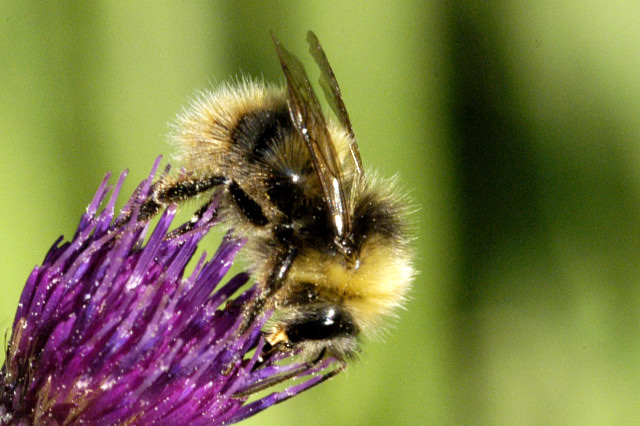
James Lindsey at Ecology of Commanster, CC BY-SA 2.5, via Wikimedia Commons
Heath Bumblebee
Bombus jonellus
Kirby, 1802 • Apidae • Pyrobombus
The heath bumblebee is a compact, small-faced bumblebee of heaths, moors, machair and coastal grassland, with a deceptively simple appearance that conceals genuine identification challenges and a fascinating geographic variation. Bombus jonellus Kirby, 1802 carries two yellow bands and a white tail in most of Britain, making it superficially similar to the white-tailed bumblebee complex, but its short rounded face, smaller size, and preference for heath and moorland over farmland and gardens set it apart ecologically. In the Northern Isles it replaces the white tail with a yellow one, creating a localised form that looks strikingly different from its mainland counterpart. Widespread across the whole of Britain including Shetland, Orkney, the Hebrides and Ireland, it is most abundant in northern and western Britain where heathland remains extensive, and is one of relatively few bumblebees that thrives at altitude and in exposed coastal conditions. Explore its range on the UK Native Bee Species Map or read about its close relatives in the World Bee Atlas.
Quick Facts
Taxonomy and Classification
The heath bumblebee was described by William Kirby in 1802 in his monumental work Monographia Apum Angliae, the first systematic treatment of British bees.[5] It belongs to the subgenus Pyrobombus alongside the early bumblebee (Bombus pratorum) and the tree bumblebee (Bombus hypnorum). Several subspecies are recognised: B. jonellus jonellus is the widespread nominate form; B. jonellus hebridensis Wild, 1871 occurs in the Outer Hebrides; B. jonellus vogtii Richards, 1928 occurs in Orkney; and additional forms have been described from Shetland and Faroe. The Northern Isles forms are particularly notable for their yellow rather than white tails.[2]
The species name honours Jonas Collin, a Danish patron of science, via the diminutive jonellus. Older British literature sometimes uses the synonym Bombus scrimshiranus Kirby, 1802, which refers to the same species; B. jonellus has priority.[1]
| Kingdom | Animalia |
| Phylum | Arthropoda |
| Class | Insecta |
| Order | Hymenoptera |
| Family | Apidae |
| Tribe | Bombini |
| Genus | Bombus Latreille, 1802 |
| Subgenus | Pyrobombus Dalla Torre, 1880 |
| Species | Bombus jonellus Kirby, 1802 |
| UK subspecies | B. j. jonellus; B. j. hebridensis; B. j. vogtii |
Identification: The Short Face and the Yellow Tail Problem
The heath bumblebee has two yellow bands (collar and scutellum) and a white tail in most of Britain, a pattern shared with the white-tailed bumblebee complex (B. lucorum, B. cryptarum, B. magnus). The critical distinguishing feature is the face: the heath bumblebee has a short, broad face, clearly wider than it is long, giving it a rounded appearance quite unlike the longer-faced members of the lucorum complex.[3] The yellow bands in the heath bumblebee tend to be slightly paler and more extensive than in the lucorum complex, and the species is consistently smaller, with queens averaging around 16 mm compared with 18 to 22 mm in lucorum queens.
The Northern Isles yellow-tail form
In Orkney and the Outer Hebrides, the subspecies vogtii and hebridensis have a yellow tail rather than white, making them look quite different from the mainland nominate form. Males from Orkney and the Western Isles may have orange tails, creating a pattern that superficially resembles the early bumblebee (B. pratorum).[2] The 2025 genome paper notes that this variation means a heath bumblebee in Orkney could be confused with B. pratorum if that species were to colonise the Northern Isles, which it currently has not. The short face remains the most reliable character across all forms.
Habitat and Distribution
The heath bumblebee is widespread across Britain and Ireland, but its distribution is strongly weighted toward heathland, moorland and exposed coastal habitats in northern and western Britain.[1][6] In southern England it is largely restricted to heathland: the Surrey and Hampshire heaths, the New Forest, Dartmoor and Exmoor, and the coastal heaths of Norfolk and Suffolk. Further north it becomes more common, with a broad distribution across moorland Wales, northern England, Scotland and all the island groups including Shetland, Orkney, the Hebrides and Ireland. In Scotland it is one of the commoner bumblebees on machair and upland grassland.
This northerly and upland bias reflects both a preference for heath and ericaceous vegetation and a greater tolerance of exposed, cool conditions than most other British bumblebees. BWARS notes that in southern England it is associated primarily with heather (Calluna vulgaris) and cross-leaved heath (Erica tetralix), while in Scotland and Ireland it uses a wider range of moorland and coastal habitats.[1]
The heath bumblebee has at least four named British forms: the nominate jonellus across mainland Britain; hebridensis in the Outer Hebrides; vogtii in Orkney; and additional Shetland material sometimes treated separately. The Orkney and Hebridean forms have yellow rather than white tails, making them look quite different from mainland birds without changing their ecological role.
Colony Life Cycle and Foraging
Queen heath bumblebees emerge from hibernation from March and are active through to September. Workers appear from around May, and new queens and males are produced from July, with males active through to October in mild years. The colony cycle is broadly similar to that of the early bumblebee, reflecting their shared membership of subgenus Pyrobombus: relatively small colonies, a shorter season than larger species, and a tendency to conclude early in upland sites where the season is compressed.[3]
The short face limits tongue length, and the heath bumblebee forages most effectively on open or shallowly tubular flowers. In heathland, the principal foraging plants are heather (Calluna vulgaris), cross-leaved heath (Erica tetralix), bell heather (Erica cinerea), bilberry and various willows in early spring. On machair and coastal grassland it uses clovers, vetches, bird's-foot trefoil, knapweeds and devil's-bit scabious. In gardens in southern England it visits a wider range of flowers including lavender, bramble, cotoneaster and thistles.[1]
Kirby's 1802 monograph: where the heath bumblebee entered science
William Kirby's Monographia Apum Angliae (1802) was the first comprehensive account of British bees and described dozens of species new to science, including Bombus jonellus. It remains a foundational text in British entomology. Kirby is also the authority for Bombus subterraneus, the short-haired bumblebee, and several other British species described in the same work.
The Forest Cuckoo Bee Connection
The forest cuckoo bumblebee (Bombus sylvestris) is the primary social parasite of the heath bumblebee in Britain. Female B. sylvestris invade established heath bumblebee colonies, suppress or kill the queen, and use the existing workers to raise their own reproductive offspring. The association between B. sylvestris and the heath bumblebee has been documented in BWARS records and confirmed through geographic co-occurrence studies.[1]
The forest cuckoo bee is itself of some conservation interest, as its persistence depends on the presence of sufficient host colonies. In southern England, where heath bumblebee colonies are limited to fragmented heathland patches, B. sylvestris is correspondingly scarce. In northern and western Britain, where heath bumblebee populations are larger and more continuous, the cuckoo bee is more regularly recorded.
Is the heath bumblebee declining in southern England?
BWARS describes it as widespread, but several sources note contraction at the southern edge of the range in England, consistent with heathland loss. The Powney et al. 2019 analysis placed it among species showing weakly negative trends in England but stable or positive trends in Scotland and Wales.[4] Whether this represents a genuine decline or reflects improved recording in the north masking apparent southern losses is debated. The species is not listed as threatened nationally, but southern heathland populations are considered more vulnerable than northern moorland populations.
Heathland Honey and the Heath Bumblebee's Season
The heath bumblebee and our Yorkshire Heather Honey share the same landscape. Both are creatures of late summer moorland: the bee foraging on heather from August, the honeybee colonies working the same flowers at full strength to fill the heather honey harvest. Our Heather Honey is bold, thixotropic and gathered from a single Yorkshire moor in a single annual harvest. The heath bumblebee makes no honey, but it is part of the same ecological moment.
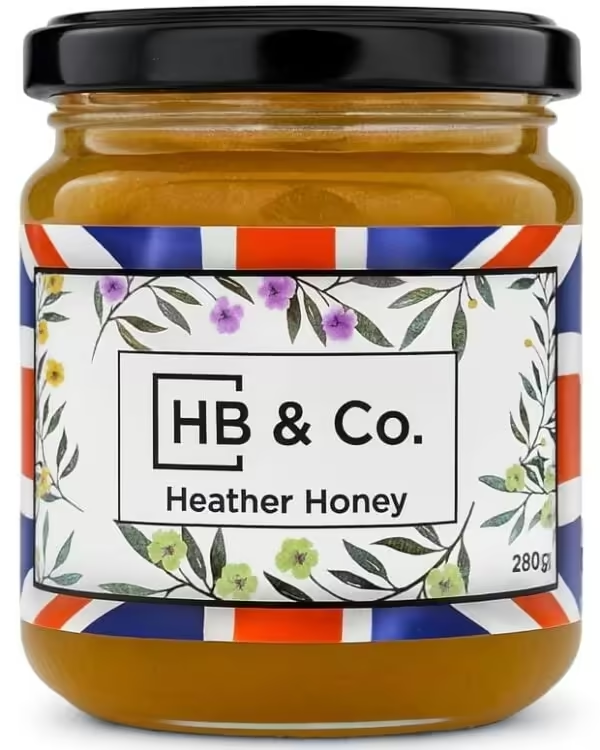
Bold, thixotropic and distinctive. Raw Yorkshire heather honey from the same moorland landscape the heath bumblebee calls home. One harvest, one season. 280g.
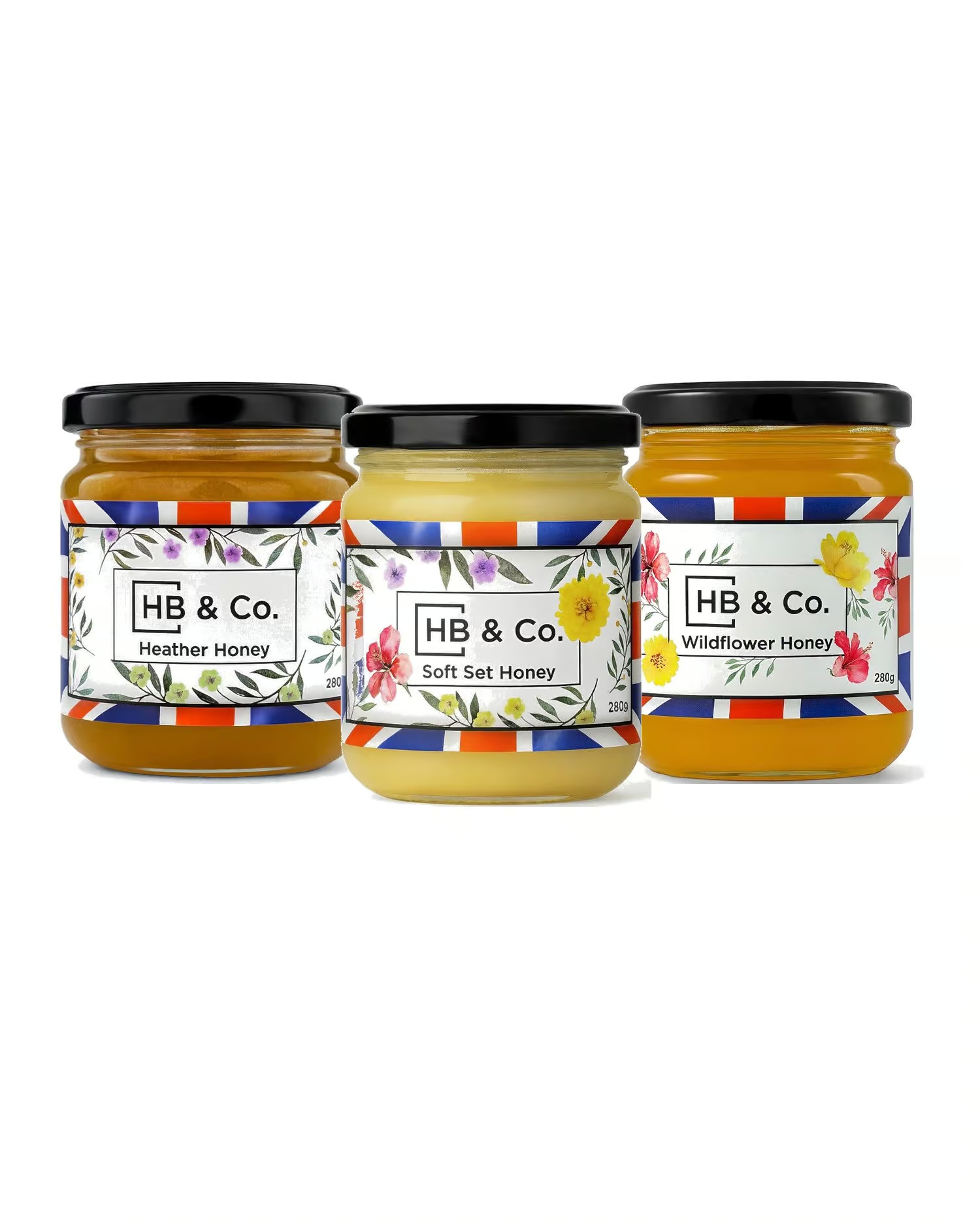
Wildflower, Soft Set and Heather from our SALSA-certified British supplier. Three landscapes, one gift.
Shop British Bundle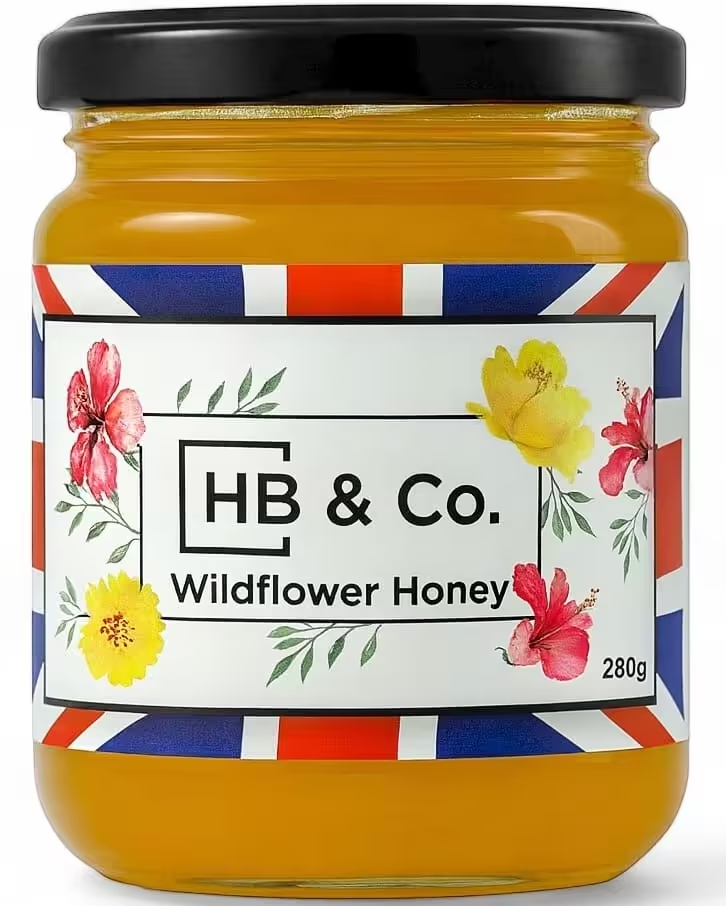
Raw single-origin honey every month. Heather, Wildflower, Acacia and more. From £8.79/month.
Start SubscriptionFrequently Asked Questions
How do I identify a heath bumblebee?
Two yellow bands (collar and scutellum) and a white tail, similar to the white-tailed bumblebee complex, but with a distinctively short, broad, rounded face that is at least as wide as it is long. This face shape is the most reliable field character. The species is also noticeably smaller than the white-tailed bumblebee. In the Northern Isles (Orkney, Outer Hebrides), the tail is yellow rather than white.
How do I tell the heath bumblebee apart from the white-tailed bumblebee?
The face is the key. The heath bumblebee has a short, rounded face that is wider than long; the white-tailed bumblebee complex has a distinctly longer face. The heath bumblebee is also consistently smaller. In habitat, the heath bumblebee is most often found on heathland, moorland and exposed coastal grassland; the white-tailed bumblebee is common in gardens, farmland and a much wider range of habitats. See the White-tailed Bumblebee profile for a full comparison.
Where can I find heath bumblebees?
On heaths, moorland, machair and exposed coastal grassland across Britain and Ireland. In southern England it is largely restricted to heathland sites. In northern England, Wales, Scotland and Ireland it is more widespread on moorland and grassland. It is present throughout the island groups including Shetland, Orkney and the Hebrides. See the UK Native Bee Species Map for regional distribution.
Why does the heath bumblebee have a yellow tail in the Northern Isles?
The Northern Isles populations (Orkney, Outer Hebrides) belong to distinct subspecies that evolved in geographic isolation. The subspecies vogtii (Orkney) and hebridensis (Outer Hebrides) have yellow tails rather than white, and males from these islands may have orange tails. This is a form of island divergence, where isolated populations gradually develop different characteristics from the mainland form. The short rounded face and other diagnostic features remain consistent across all forms.
When does the heath bumblebee fly?
Queens emerge from March and are active through September. Workers appear from May. New queens and males are produced from July, with males persisting to October in mild years. In upland sites the season is often compressed, with earlier colony conclusions than in lowland sites at similar latitudes.
What flowers does the heath bumblebee visit?
In heathland: heather, cross-leaved heath, bell heather, bilberry and sallows in spring. On machair and coastal grassland: clovers, vetches, bird's-foot trefoil, knapweeds and devil's-bit scabious. In gardens: lavender, bramble, cotoneaster and thistles. The short tongue means it concentrates on open or shallowly tubular flowers and is less able to exploit deep corollas than long-tongued species.
Does the heath bumblebee make honey?
No. Like all bumblebees, colonies store only enough nectar for a few days. There is no surplus and nothing to harvest. All commercial honey comes from managed honeybee (Apis mellifera) colonies.
Is the heath bumblebee related to the early bumblebee?
Yes, closely. Both belong to the subgenus Pyrobombus and share several traits including small colony size, a relatively short season, and above-ground or shallow nesting. The early bumblebee (B. pratorum) is distinguished by its orange-red tail and narrower yellow collar, and occurs across a wider range of habitats including gardens. Read the Early Bumblebee profile for a comparison.
Sources and References
- Bees, Wasps and Ants Recording Society (BWARS). Bombus jonellus Kirby, 1802 species account: identification, subspecies, habitat, distribution, foraging, cuckoo parasite. bwars.com
- Crowley, L. M. et al. (2025). The genome sequence of the Heath Bumblebee, Bombus jonellus (Kirby, 1802). Wellcome Open Research. Northern Isles subspecies, tail colour variation, face morphology. pmc.ncbi.nlm.nih.gov
- Bumblebee Conservation Trust. Heath bumblebee (Bombus jonellus): identification, distribution, habitat. bumblebeeconservation.org
- Powney, G. D. et al. (2019). Widespread losses of pollinating insects in Britain. Nature Communications 10:1018. doi.org
- Kirby, W. (1802). Monographia Apum Angliae. Ipswich. Original description of Bombus jonellus and B. scrimshiranus. Archive available via Biodiversity Heritage Library.
- GBIF. Bombus jonellus (Kirby, 1802): distribution records, subspecies. gbif.org