
Moss Carder Bee
Bombus muscorum
Linnaeus, 1758 • Apidae • Thoracobombus
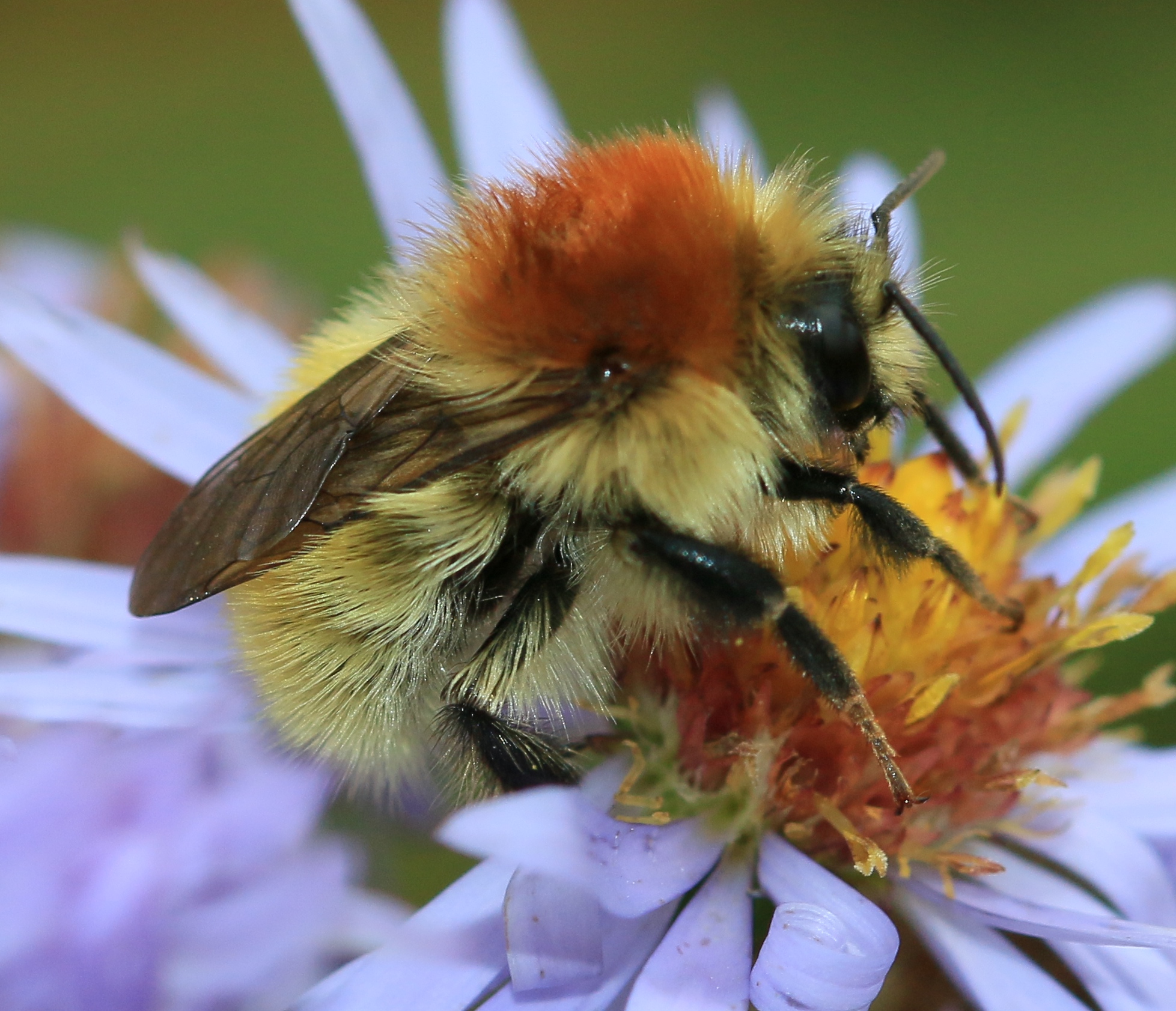
The moss carder bee is the all-tawny bumblebee of Britain's coastal grasslands, machair plains and upland flower meadows: entirely ginger from head to tail, with no black hairs visible on the top of the body in fresh specimens. Bombus muscorum Linnaeus, 1758 was once widespread across the British Isles, but has undergone severe decline since the 1970s, retreating to coastal strongholds in the Hebrides, Northern Isles, West Wales, Orkney and coastal Essex and Kent, and to scattered upland sites in northern England and Scotland. It is Vulnerable on the European Red List of Bees,[7] a Section 41 priority species in England, and one of the most genetically isolated bumblebee populations documented in Britain. Understanding it requires separating it from the two other all-brown bumblebee species and grasping why flower-rich coastal grassland has become its last refuge. Explore its range on the UK Native Bee Species Map or read about carder bees worldwide in the World Bee Atlas.
Quick Facts
Taxonomy and Classification
The moss carder bee was described by Carl Linnaeus in 1758, originally placed in the genus Apis as Apis muscorum, and subsequently transferred to Bombus. It belongs to the subgenus Thoracobombus, the carder bees, alongside the common carder bee (Bombus pascuorum), the brown-banded carder bee (B. humilis), and the shrill carder bee (B. sylvarum). The species name muscorum is Latin for "of mosses," a direct reference to the nesting behaviour.[1]
Several subspecies are recognised. In Britain and Ireland, B. muscorum muscorum is the widespread mainland form. B. muscorum agricolae Pittioni, 1942 is endemic to Shetland and is distinctly paler and more cream-coloured than the mainland form. B. muscorum smithianus White, 1851 occurs in the Outer Hebrides and Orkney, and is characterised by warmer, more rufous colouration. These island forms have evolved in geographic isolation, which has contributed to the high levels of inbreeding documented in separated populations.[2]
| Kingdom | Animalia |
| Phylum | Arthropoda |
| Class | Insecta |
| Order | Hymenoptera |
| Family | Apidae |
| Tribe | Bombini |
| Genus | Bombus Latreille, 1802 |
| Subgenus | Thoracobombus Dalla Torre, 1880 |
| Species | Bombus muscorum Linnaeus, 1758 |
| UK subspecies | B. m. muscorum; B. m. agricolae; B. m. smithianus |
Identification: All Tawny, No Black
The moss carder bee is entirely tawny or ginger on the dorsal surface of the thorax and abdomen, with no black hairs visible on top in fresh specimens. This uniform all-brown colouration is the primary identification feature and distinguishes it from the two other common all-brown bumblebees in Britain. The hair is dense and relatively neat in fresh specimens, giving queens in particular a clean, velvety appearance. Queens are 16 to 18 mm, slightly larger than the common carder bee. Workers are around 12 mm. Males are around 14 mm with a longer face than the queen and more extensively yellow hair on the head and face.[1]
Separating from Bombus pascuorum and Bombus humilis
The most important separation is from the common carder bee (B. pascuorum). The diagnostic difference is the presence of black hairs on the dorsal abdomen in B. pascuorum and their absence in B. muscorum. A fresh B. muscorum queen looks uniformly ginger from above; a fresh B. pascuorum queen shows at least some black hairs mixed into the ginger of the abdomen. This distinction is clearest in queens and early-season workers but can be obscured by wear later in the season, when hairs fade and fall out.[3]
The brown-banded carder bee (B. humilis) is the most difficult separation. Both species can appear all-ginger dorsally, and BWARS notes that reliable field identification requires close examination: B. humilis has a thin scattering of black hairs around and above the wing bases on the thorax, absent in B. muscorum. Under a microscope, the structure of the pits from which certain tergal hairs arise provides the best character. In practice, habitat context is helpful: B. humilis is most strongly associated with southern chalk and limestone grassland, while B. muscorum is predominantly coastal and upland in its remaining British range.[1]
Nesting: Carder Behaviour and Coastal Grassland
Like the common carder bee, B. muscorum builds an above-ground nest, gathering moss and dry grass and carding, or combing, these materials into a loose thatch that forms the insulating cover of the nest.[1] Nests are typically built at the base of dense tussocky vegetation in open grassland, coastal dunes, machair, or unimproved meadows. The nest structure is made entirely of collected plant material and is soft-sided, offering less physical protection than underground nests.
Colony size is modest: 40 to 120 workers, with a colony lifespan of around three months. The queen is monandrous, mating with only one male, a trait that reduces genetic diversity within colonies compared with polyandrous species and has implications for colony resilience.[2] Workers are notably aggressive in defence of the nest, a behaviour documented in multiple sources, which is unusual for a species with such a small and relatively exposed colony structure.
Genetic Isolation and Inbreeding
One of the most important findings from research on the moss carder bee is the extent of genetic isolation and inbreeding in its fragmented British populations. Darvill et al. (2006) used microsatellite markers to show that populations on Orkney and the Outer Hebrides showed significantly reduced genetic diversity compared with mainland populations, consistent with inbreeding caused by small effective population sizes and limited gene flow.[4] A follow-up study (Darvill et al., 2010) extended this finding to coastal English populations, showing that isolation by distance was structuring genetic variation even over relatively short distances in the fragmented landscape.
The moss carder bee queen is monandrous, mating with only one male. This reduces within-colony genetic diversity and, in isolated populations with few available mates, increases the risk of inbreeding depression. It contrasts with polyandrous species like the honeybee, where queens mate with up to 20 males.
The 2024 genome paper (Broad et al., Wellcome Open Research) notes that the limited dispersal capability of the species is likely a significant contributor to its decline: unlike some bumblebees that can move several kilometres between suitable patches, the moss carder bee tends to forage and nest very close together, making it poorly equipped to colonise new habitats or reconnect isolated populations without human-assisted habitat restoration connecting the gaps.[5]
Distribution: From Widespread to Coastal Refuge
Before the mid-twentieth century, the moss carder bee was widespread across the British Isles, occurring throughout lowland England, Wales, Scotland and Ireland wherever unimproved flower-rich grassland persisted. The intensification of British agriculture after 1945 eliminated or fragmented most of this habitat, and the species retreated rapidly. By the 1990s it had been lost from much of central and eastern England and from large parts of Wales and lowland Scotland.[1]
Today its British strongholds are: the Outer Hebrides and Orkney, where it remains relatively abundant, particularly the subspecies smithianus on machair and coastal heath; the Northern Isles generally; scattered coastal sites in West Wales; the North Pennines; and isolated coastal grassland and sea-wall sites in Essex and Kent, where surveys by Hymettus have shown it persisting on flood defence grasslands managed by the Environment Agency.[6] In Ireland it is widespread in coastal habitats but declining, and listed as Near Threatened on the Irish Red List.
Sea walls as last refuges
Research by Hymettus found that the moss carder bee persists on flood defence sea walls in Essex and Kent because these linear grassland strips, managed for structural stability rather than agricultural productivity, retain the kind of unimproved, flower-rich sward the species requires. They represent an accidental nature reserve: grassland that has never been fertilised or intensively managed because the Environment Agency needs it structurally intact.[6]
Foraging: Long Corollas and Legume Preference
The moss carder bee has a long tongue relative to species like the buff-tailed bumblebee, enabling it to exploit flowers with longer corollas. BWARS records a strong association with the legume family (Fabaceae), particularly red clover, white clover, vetches and bird's-foot trefoil; the dead-nettle family (Lamiaceae); and red-flowered composites (Asteraceae).[1] Spring queens particularly favour dead-nettles. Workers concentrate on legumes through summer, with knapweed, red bartsia, bird's-foot trefoil and clovers among the most frequently visited plants. Males visit ragworts, scabiouses, knapweeds and willowherbs in late summer.
The dependence on long-corolla flowers and diverse flower-rich grassland is a key reason the species declined so severely with agricultural intensification: fertilised and reseeded grassland typically contains only a few grass and broad-leaved species, none of which provide the deep-corolla foraging the bee requires in sufficient quantity to sustain a colony.
Is Bombus campestris a confirmed cuckoo parasite of B. muscorum?
BWARS states that B. muscorum "may be attacked" by the field cuckoo bumblebee (Bombus campestris) but that this "requires confirmation." The geographic overlap and the known host associations of B. campestris (which parasitises multiple Thoracobombus species) make it a plausible host. The common carder bee (B. pascuorum) is the primary confirmed host of B. campestris in Britain. Whether B. muscorum is parasitised at a meaningful rate, and whether this parasitism has any conservation significance given the species' decline, is not established.[1]
Coastal Grassland and Our Wildflower Honey
The moss carder bee makes no honey. Its colonies, modest in size and short in duration, store only enough nectar for a few days. But the flower-rich coastal grasslands and machair plains that sustain its remaining British populations are part of the same diverse, unimproved landscape that produces the most characteristic British wildflower honeys.
Our British Wildflower Honey is gathered from a mixed Midlands blossom landscape: clovers, bramble, hawthorn and hedgerow wildflowers from an unimproved supply chain managed by our SALSA-certified British supplier. The British Honey Bundle adds Soft Set and Heather to the mix, bringing three distinct British honey characters into a single gift.
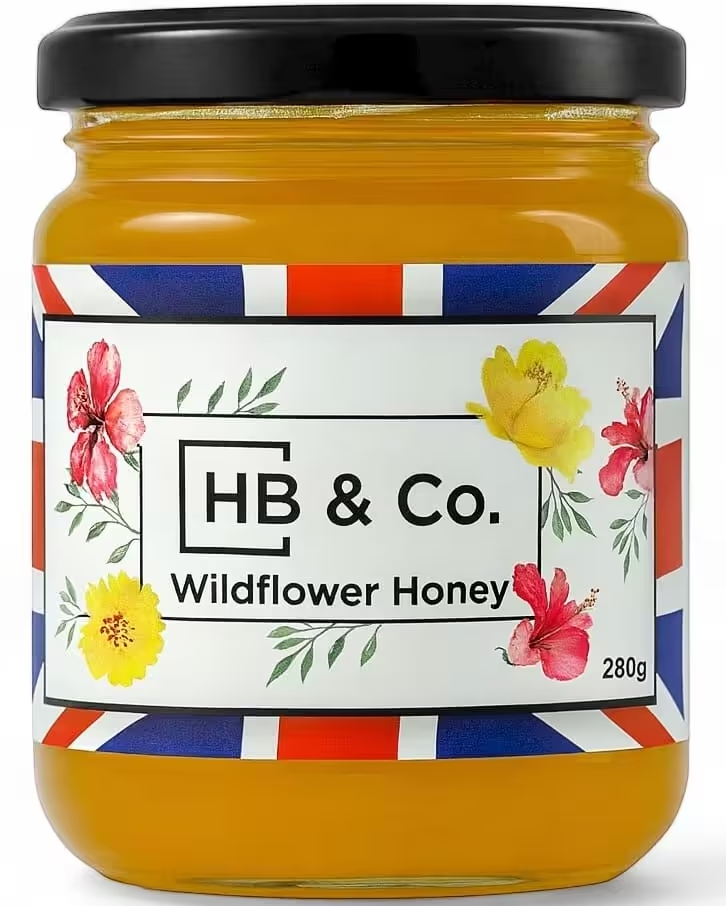
Raw, cold-extracted wildflower honey from the clover, bramble and hedgerow blossom of unimproved British grassland. The same flower-rich landscape the moss carder bee depends on. SALSA-certified. 280g.
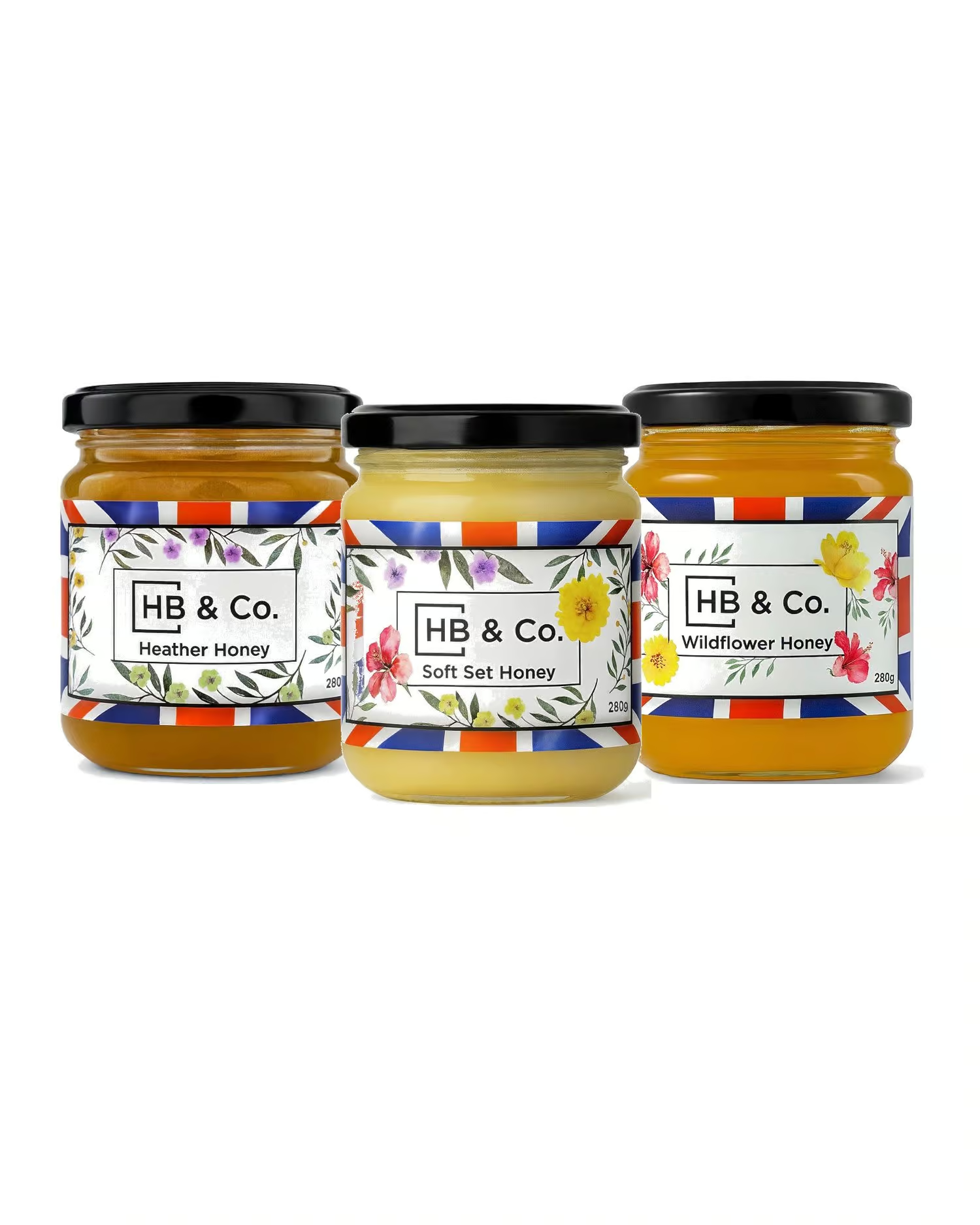
Wildflower, Soft Set and Heather from our SALSA-certified British supplier. Three landscapes, one gift.
Shop British Bundle
Raw single-origin honey every month. Wildflower, Heather, Acacia and more. From £8.79/month.
Start SubscriptionFrequently Asked Questions
How do I identify a moss carder bee?
Look for a bumblebee that is uniformly tawny or ginger on the entire dorsal surface, with no black hairs visible on top. Queens are 16 to 18 mm and have a particularly neat, velvety appearance when fresh. The key separation from the common carder bee (B. pascuorum) is the complete absence of black hairs on the abdomen. The separation from the brown-banded carder bee (B. humilis) is harder and requires checking for a thin scattering of black hairs above the wing bases, which are present in B. humilis but absent in B. muscorum.
Where can I find moss carder bees in the UK?
On flower-rich coastal grassland, machair, unimproved hay meadows, and upland grassland, predominantly in coastal areas. Current strongholds include the Outer Hebrides, Orkney and Shetland, West Wales coast, North Pennines, and coastal Essex and Kent sea-wall grasslands. It is largely absent from intensively farmed lowland England. See the UK Native Bee Species Map for recorded distribution.
Why is the moss carder bee declining?
The primary cause is loss of unimproved, flower-rich grassland through agricultural intensification, reseeding, fertiliser application, and drainage since the 1950s. Fertilised grassland dominated by a few grass species cannot provide the diverse legumes and long-corolla flowers the bee requires in sufficient quantity. Additional pressures include habitat fragmentation, which prevents genetic exchange between isolated populations, inbreeding depression in small isolated colonies, and the limited dispersal ability of the species which makes natural recolonisation of restored habitat slow.
What is the difference between the moss carder bee and the common carder bee?
The moss carder bee (B. muscorum) has no black hairs on the dorsal abdomen; the common carder bee (B. pascuorum) has at least some black hairs mixed into the ginger of the abdomen. The common carder bee is much more widespread and found in gardens and hedgerows across most of Britain; the moss carder bee is rare, coastal and upland in its current range. Both nest above ground and card plant material. Read the Common Carder Bee profile for a full comparison.
What is machair and why is it important for the moss carder bee?
Machair is a coastal grassland habitat unique to north-west Scotland and west Ireland, formed on shell-sand plains behind beaches. It is extraordinarily flower-rich, with dense stands of clovers, vetches, bird's-foot trefoil, yellow-rattle, red bartsia and other legumes that provide ideal foraging for the moss carder bee. The Outer Hebrides machair supports some of the strongest remaining British populations of the species. It is also one of the rarest habitats in Europe.
Does the moss carder bee make honey?
No. Like all bumblebees, colonies store only a few days' supply of nectar. The colony is small (40 to 120 workers) and short-lived (around 3 months), with no surplus. All commercial honey comes from managed honeybee (Apis mellifera) colonies.
Why does inbreeding matter for the moss carder bee?
In fragmented landscapes, isolated populations can no longer exchange genes with other populations. Over generations, inbreeding increases, which can reduce colony fitness, immune function and resilience to disease and stress. Research by Darvill et al. (2006, 2010) showed that British moss carder bee populations on islands and in isolated coastal sites already show measurably reduced genetic diversity compared with less fragmented populations. The queen is also monandrous, mating only once, which further limits within-colony genetic diversity compared with species like the honeybee where queens mate with many males.
How can I help the moss carder bee?
In coastal or upland areas within its range: maintain or create unimproved flower-rich grassland with abundant clovers, vetches, bird's-foot trefoil and knapweed. Avoid fertilising or reseeding grassland. Manage cutting regimes to leave areas of taller tussocky vegetation for nesting. Support Buglife, BWARS and the Bumblebee Conservation Trust, which run targeted conservation programmes for this species. Record any sightings via iRecord or BWARS to contribute to distribution mapping.
Sources and References
- Bees, Wasps and Ants Recording Society (BWARS). Bombus muscorum Linnaeus, 1758 species account: identification, subspecies, distribution, decline, foraging, probable cuckoo parasite. bwars.com
- Broad, G. R. et al. (2024). The genome sequence of the moss carder bee, Bombus muscorum (Linnaeus, 1758). Wellcome Open Research 9:397. Monandry, inbreeding, dispersal limitation, Darwin Tree of Life. doi.org
- Bumblebee Conservation Trust. Moss carder bee: identification, separation from B. pascuorum and B. humilis, distribution, decline. bumblebeeconservation.org
- Darvill, B., Ellis, J. S., Lye, G. C. & Goulson, D. (2006). Population structure and inbreeding in a rare and declining bumblebee, Bombus muscorum (Hymenoptera: Apidae). Molecular Ecology 15(3):601–611. doi.org
- Darvill, B., Lye, G. C. & Goulson, D. (2010). Isolation by distance and a commercial bumble bee introduction obscure invasive history in a native species. Molecular Ecology 19:5026–5039. Extended genetic isolation findings. doi.org
- Hymettus Ltd. Sea-wall grasslands as habitat for Bombus muscorum in coastal Essex and Kent: survey findings and management recommendations. hymettus.org.uk
- Nieto, A. et al. (2014). European Red List of Bees. European Commission, Brussels. Bombus muscorum assessed as Vulnerable. doi.org