

 English (UK)
  Italiano
  Français
  简体中文
简体中文  한국어
한국어 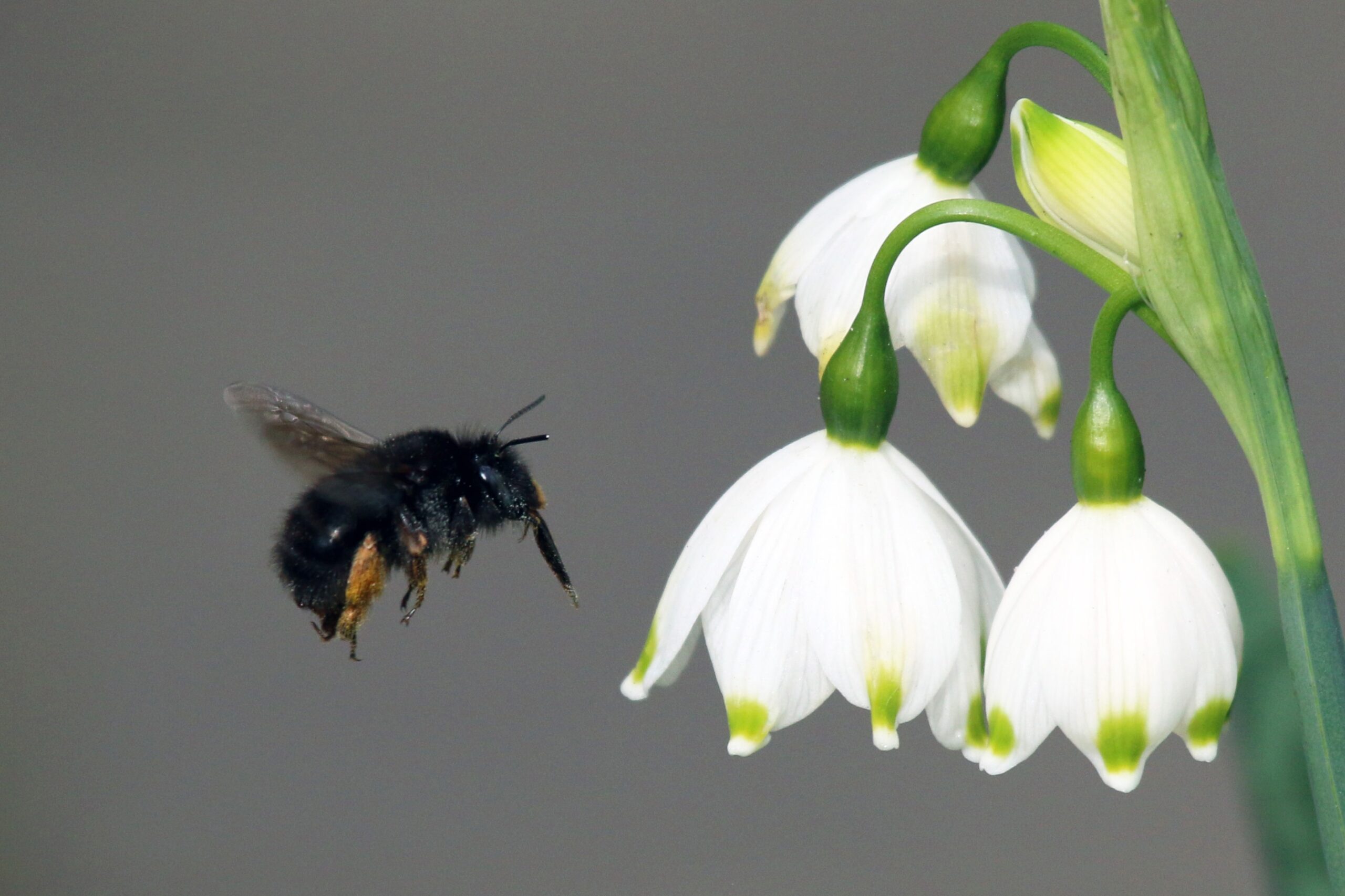
Hairy-footed Flower Bee
Anthophora plumipes
Pallas, 1772 • Apidae • Anthophorini
Few British bees generate as much springtime confusion as the hairy-footed flower bee. The male is a ginger-brown, fast-hovering, hoverfly-sized bee with a cream-yellow face and an almost comical pair of feathered middle legs; the female is jet black with orange hind legs and looks, at a distance, like a small dark bumblebee. They are the same species, and together they announce spring before almost any other solitary bee: males emerge in late February or early March, ahead of most bees and many flowers. Common and widespread across England and Wales, Anthophora plumipes Pallas, 1772 is one of Britain's most distinctive and most watchable spring bees. Find it on the UK Native Bee Species Map or read about flower bees worldwide in the World Bee Atlas.
Quick Facts
Taxonomy and Classification
The hairy-footed flower bee was described by Peter Simon Pallas in 1772 and belongs to the family Apidae, tribe Anthophorini, in the genus Anthophora. Five species of Anthophora are recorded in Britain, of which A. plumipes is by far the commonest and most widespread.[1] The species name plumipes is Latin for "feather-footed," a reference to the long hair tufts on the male's middle tarsi. The genus name Anthophora means "flower-bearer."
| Kingdom | Animalia |
| Phylum | Arthropoda |
| Class | Insecta |
| Order | Hymenoptera |
| Family | Apidae |
| Tribe | Anthophorini |
| Genus | Anthophora Latreille, 1803 |
| Species | Anthophora plumipes Pallas, 1772 |
Identification: Two Bees in One Species
The sexual dimorphism of the hairy-footed flower bee is extreme enough to cause genuine confusion. Females are 13 to 15 mm, all-black or very dark brown, with conspicuous bright orange or reddish-orange hairs on the hind tibiae forming the pollen scopa. At rest or foraging, a female in clean condition looks like a small, very dark bumblebee with vivid orange hind legs.[1]
Males are the same size but look entirely different: gingery-brown overall, with a cream-yellow face, pale hairs on the thorax sides and abdomen base, and extraordinarily long tufts of black hair on the middle tarsi, the feature that gives the species its common name. In flight, a male hovering in front of flowers moves with a rapid, darting action quite unlike the more sedate flight of bumblebees, and will often stop to hover motionlessly for a second or two before moving on.[2]
The hairy feet: what are they for?
The long hair tufts on the male's middle tarsi are used during mating: the male mounts the female and fans her with his middle legs, waving the feathered feet over her. The exact purpose is not fully understood but the behaviour is consistent enough to be used as a field identification feature for the species. It has been filmed for BBC Two's Springwatch and remains one of the more unusual mating rituals in British entomology.[3]
Nesting in Walls and Banks
The hairy-footed flower bee is one of Britain's few solitary bees that regularly nests in old walls and masonry. It favours the soft mortar of older stonework and the exposed cob of traditional earth walls, where it excavates burrows in which to provision its brood cells.[1] It also nests in compacted clay banks, soft coastal cliffs and quarry faces. Large aggregations can build up over decades at favoured sites, producing conspicuous clusters of nest entrances in sunlit, south-facing walls.
Each female is entirely solitary: she provisions her own cells, lays her own eggs, and dies before her offspring emerge. The species is univoltine, completing one generation a year. Adults overwinter in the natal cells and emerge in late February or early March, with males appearing first. Females emerge a week or two later and begin nesting and foraging in March. The flight season runs through to June.
Foraging: Lungwort, Dead-nettles and Speed
Anthophora plumipes has a long tongue and visits a wide range of spring and early-summer flowers with deep or tubular corollas. It is especially associated with lungwort (Pulmonaria) and red dead-nettle (Lamium purpureum) in gardens, and with ground ivy, comfrey, green alkanet, cowslip, primrose, gorse, sallows, blackthorn, cherry, apple and plum in wider habitats.[1] The hovering, darting flight style means it can move between flowers faster than most other solitary bees, visiting multiple flowers per minute.
Females also forage on more aggressive schedule: a female carrying a full pollen load on her orange hind legs is a reliable sight at any well-planted urban garden in March and April. The species has extended its range into Scotland in recent years, with records from Edinburgh, consistent with a general northward trend among spring-active solitary bees.[1]
The Common Mourning Bee
The primary cleptoparasite of the hairy-footed flower bee is the common mourning bee (Melecta albifrons), a striking black-and-white wasp-like bee that appears in flight at the same time as its host. Female mourning bees enter unguarded Anthophora burrows and lay eggs in provisioned cells; their larvae destroy the host egg and consume the pollen loaf. Melecta albifrons is worth watching for at any hairy-footed flower bee nesting site in April and May.[1]
Pallas 1772 or Scopoli 1763?
Some older sources cite the authority as Scopoli 1763 for Anthophora plumipes. The currently accepted authority is Pallas, 1772, following resolution of the synonymy with Apis acervorum Linnaeus 1758 and related names. BWARS, GBIF and the current European checklist all use Pallas, 1772.[4]
Spring Bees and Spring Honey
The hairy-footed flower bee begins its season in the same late-winter window as our beekeepers start preparing for the year ahead. It makes no honey. But the spring connection is real: both this bee and the honeybee colonies that produce our Linden Honey and Acacia Honey are at their most active in the season of long-tongued flowers and early warmth. Both honeys come from the Nistor family apiaries in Transylvania, where six generations have kept bees in the same linden and acacia forests.

Pale, aromatic raw honey from Transylvanian linden forests, gathered by the Nistor family apiaries. A floral, fragrant honey unlike any other in our range. Raw, cold-extracted. 280g.
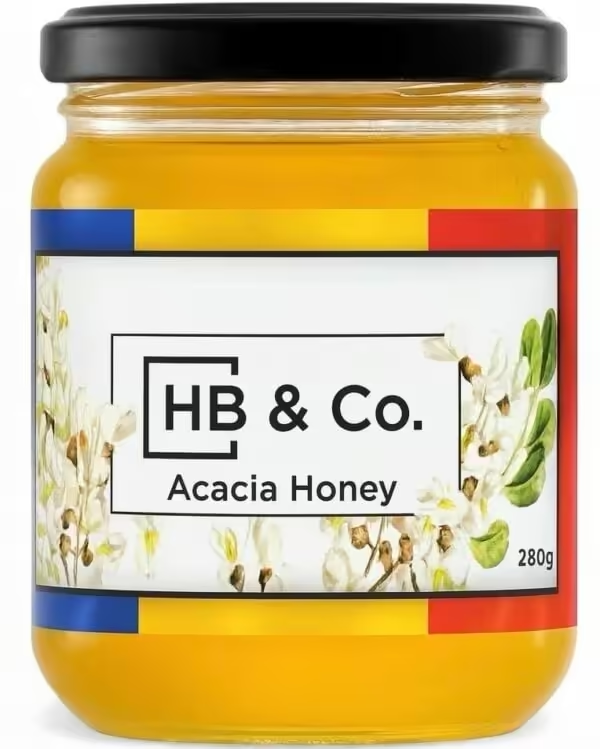
Pale, mild and slow to crystallise. Raw Transylvanian acacia honey from six generations of family beekeeping. 280g.
Shop Acacia Honey
Raw single-origin honey every month. Choose Linden, Acacia, Wildflower and more. From £8.79/month.
Start SubscriptionFrequently Asked Questions
How do I identify a hairy-footed flower bee?
Females are jet black with vivid orange hairs on the hind legs, about the size of a small bumblebee, with a fast hovering flight. Males are ginger-brown with a cream-yellow face and extraordinary long hair tufts on their middle legs. Both sexes have a rapid, darting flight style quite unlike bumblebees. In early spring on lungwort or red dead-nettle, this is almost certainly the species.
When does the hairy-footed flower bee fly?
Males emerge from late February; females from early March. Both sexes are active through April and May, with females persisting into June. It is one of Britain's earliest-emerging solitary bees, appearing before most spring flowers have opened and before most other solitary bee species are active.
Why does the male hairy-footed flower bee have feathered feet?
The long hair tufts on the male's middle tarsi are used during mating: the male fans the female with his feathered legs while mounted. The exact function is not fully established, but the behaviour is consistent and species-specific. It is one of the most unusual mating rituals among British bees and has been filmed on BBC Springwatch.
Is the hairy-footed flower bee a bumblebee?
No. It is a solitary bee in the family Apidae, tribe Anthophorini, not closely related to bumblebees despite the superficial resemblance. Females look like small dark bumblebees and males resemble carder bumblebees at a glance, but the fast hovering flight, the orange hind legs on the female, the feathered middle legs on the male, and the much earlier flight season distinguish them. There is no colony, no queen and no workers.
Where does the hairy-footed flower bee nest?
Primarily in the soft mortar of old walls and the exposed cob of traditional earth construction, and in compacted clay banks and soft cliff faces. Females excavate individual burrows and provision cells with pollen and nectar. Nesting aggregations can build up over decades at favoured sunny, south-facing walls. The species does not nest in the ground as freely as many solitary bees.
What flowers does it visit?
Lungwort (Pulmonaria) and red dead-nettle are the most reliably visited garden plants in spring. Also comfrey, green alkanet, ground ivy, cowslip, primrose, gorse, sallow, blackthorn, cherry, apple and plum. The long tongue gives it access to deep-tubed flowers. Planting lungwort in a south-facing garden bed near an old wall is the most reliable way to attract it.
Does the hairy-footed flower bee make honey?
No. It is a solitary bee: each female provisions only her own brood cells with pollen and nectar. There is no colony, no surplus, and nothing to harvest. All commercial honey comes from managed honeybee (Apis mellifera) colonies.
Is it found across the whole UK?
It is common and widespread across England and Wales, with a concentration in southern and central England.[5] It also occurs in the Channel Islands. Records from Scotland have increased in recent years, with confirmed sightings from Edinburgh, consistent with a northward range expansion. It is not yet established in Scotland as it is in England. See the UK Native Bee Species Map for regional distribution.
Sources and References
- Bees, Wasps and Ants Recording Society (BWARS). Anthophora plumipes species account: identification, nesting, distribution. bwars.com
- BWARS. Beginners' bees: Anthophora plumipes -- hairy-footed flower bee. bwars.com
- BBC Two Springwatch (2017). The incredible mating habits of the hairy-footed flower bee. bbc.co.uk
- GBIF. Anthophora plumipes (Pallas, 1772): occurrence records and taxonomy. gbif.org
- Buglife. Hairy-footed Flower Bee (Anthophora plumipes): species account. buglife.org.uk