

 English (UK)
  Italiano
  Français
  简体中文
简体中文  한국어
한국어 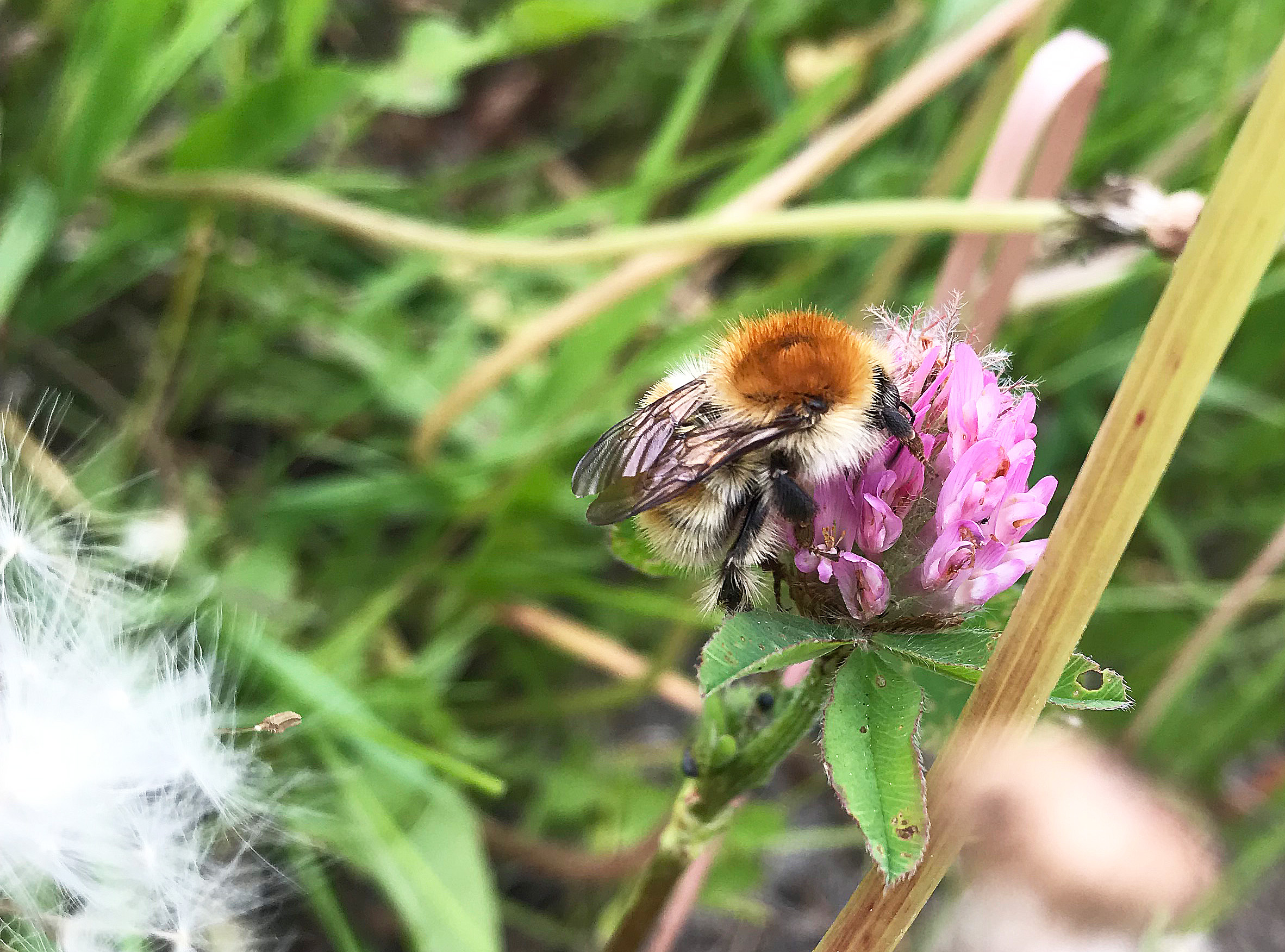
Brown-banded Carder Bee
Bombus humilis
Illiger, 1806 • Apidae • Thoracobombus
The brown-banded carder bee is one of Britain's most difficult bumblebees to identify with confidence and one of its most important to find. Bombus humilis Illiger, 1806 is a ginger-buff bee with a distinctive darker chestnut band across the second abdominal segment, a bright ginger thorax that contrasts sharply with its pale sides, and a scattering of black hairs near the wing bases that, in theory, separates it from its near-identical cousin the moss carder bee. In practice, the separation requires careful examination and sometimes cannot be made in the field at all. Formerly widespread across southern England and Wales, it has retreated sharply since the 1950s to scattered coastal grassland sites, with its strongest remaining populations in the Thames Estuary and on Salisbury Plain. It is a UK BAP Priority species, a Section 41 species in England, and a flagship for the kind of tall, botanically diverse, unimproved grassland that supports the most diverse invertebrate communities in the British lowlands. Explore its range on the UK Native Bee Species Map or read about carder bees worldwide in the World Bee Atlas.
Quick Facts
Taxonomy and Classification
The brown-banded carder bee was described by Johann Karl Wilhelm Illiger in 1806. It belongs to the subgenus Thoracobombus alongside the other carder bees: the common carder bee (B. pascuorum), the moss carder bee (B. muscorum), and the shrill carder bee (B. sylvarum). It is most closely related to the moss carder bee; BWARS states it is "very closely related to Bombus muscorum but is more southerly in its distribution."[1]
The British subspecies is Bombus humilis anglicus Yarrow, 1978, which tends to show slightly paler colouration than some continental populations. The species name humilis is Latin for "low" or "humble," possibly a reference to its low-growing grassland habitat or to a perceived modesty of appearance compared with more boldly marked species.[2]
| Kingdom | Animalia |
| Phylum | Arthropoda |
| Class | Insecta |
| Order | Hymenoptera |
| Family | Apidae |
| Tribe | Bombini |
| Genus | Bombus Latreille, 1802 |
| Subgenus | Thoracobombus Dalla Torre, 1880 |
| Species | Bombus humilis Illiger, 1806 |
| British subspecies | B. h. anglicus Yarrow, 1978 |
Identification: The Hardest Carder
The brown-banded carder bee is one of the most challenging British bumblebees to identify, and the separation from the moss carder bee in particular is considered expert-level even with a specimen in hand. Both species are all-ginger bees with no black hairs on the abdomen, and both occur in similar habitats in the south of England. The critical diagnostic features require close examination.[3]
The key characters
In fresh specimens, the brown-banded carder bee has a bright ginger-chestnut thorax that contrasts sharply with the pale whitish-buff hair on the sides of the thorax, whereas the moss carder bee tends to have more uniform colouration across the entire thorax. The abdominal band of the common name, a chestnut-darker patch across tergite 2 (and sometimes 3), is usually visible and can appear as a distinct "cummerbund" in flight, particularly in queens. Most importantly, B. humilis typically has a few black hairs scattered above the wing bases on the thorax: these are absent in B. muscorum. However, BWARS explicitly notes that these black hairs "can be absent in some individuals" of humilis, making the separation incomplete even under close examination.[1]
Microscopic confirmation
The definitive separation of B. humilis from B. muscorum requires microscopic examination. In females, the form of the pits from which certain tergal hairs arise provides the most reliable character. In males, the genitalia are diagnostic.[1] This means that for recording purposes, many individuals found in the field cannot be assigned to species with full confidence, and BWARS recommends submitting supporting photographs and, where possible, voucher specimens.
Bombus humilis, B. muscorum and B. pascuorum are the three all-brown British carder bees. B. pascuorum is separated by black hairs on the abdomen. B. humilis and B. muscorum are separated by a scattering of black hairs above the wing bases in humilis absent in muscorum, plus thorax contrast and the abdominal band, but the separation can fail in worn or atypical individuals. All three occur in southern England.
Distribution and Decline
Bombus humilis was formerly intermittently present along the southern and western coasts of England and Wales, with a few inland populations, most notably on Salisbury Plain.[1] It is absent from Ireland and has not been established in Scotland. Since the 1950s it has declined sharply, and most remaining British populations are concentrated on extensive but sometimes narrow strips of coastal grassland. The Thames Estuary sea-wall and grazing-marsh grasslands in Essex and Kent support what are now considered among the strongest remaining populations, alongside Salisbury Plain, the South Wales coast, and a handful of other southern English sites.
The species is near the northern edge of its latitudinal range in Britain, which makes it particularly sensitive to habitat changes. Goulson et al. noted that species at the edge of their range are less well adapted to local conditions and thus more susceptible to habitat deterioration than more central populations of the same species.[4] This means that even modest habitat degradation that a more centrally distributed population could tolerate can be sufficient to eliminate a marginal British population.
Salisbury Plain: an accidental stronghold
Like the shrill carder bee, the brown-banded carder bee persists in parts of Salisbury Plain, Wiltshire, where Ministry of Defence land management has inadvertently preserved large areas of unimproved chalk grassland that would otherwise have been ploughed and reseeded. The military training requirements that prevent intensive agricultural use of the Plain have made it one of the most important areas for rare lowland bumblebees in southern England.
Habitat and Foraging
The brown-banded carder bee requires tall, open, flower-rich grassland with a diverse mix of long-corolla flowers. BWARS notes that suitable sites are "characterised by large and well-connected flowery habitat mosaics," and that viable populations need areas in the order of 10 square kilometres to remain stable.[1] Habitats used include chalk downland, coastal levels, dunes and shingle, brownfield sites, heath grassland mosaics, and occasionally arable field margins adjacent to flower-rich grassland.
Overwintered queens emerge in May and June, later than most British bumblebees, and forage initially on white dead-nettle, kidney vetch and everlasting-peas. Workers fly from June to September, foraging primarily on legumes (clovers, bird's-foot trefoils, vetches), Lamiaceae (wild basil, woundworts, black horehound), composites (knapweeds, cat's-ear, oxtongues) and scabiouses.[3] The species is long-tongued relative to many bumblebees and can exploit deep-corolla flowers.
Can Bombus humilis and Bombus muscorum be reliably separated in the field?
BWARS states that field identification relies "in the main" on black hairs above the wing bases but that "this distinction is not complete" and that microscopic examination of tergal hair pit structure is the best character in females.[1] Buglife's account says they "can be few and hard to see." Several expert field entomologists recommend that without definitive characters, ambiguous individuals in the south of England where both species occur should be recorded as humilis/muscorum rather than assigned to either species. The two species co-occur at some sites, further complicating matters. There is no consensus on whether field separation is reliably achievable without microscopy.
Raw Honey and the Grasslands That Support It
The brown-banded carder bee makes no honey. Its colony, like all bumblebee colonies, stores only a few days' nectar at any time. But the botanically rich coastal grasslands and chalk downs that sustain its remaining populations are part of the same unimproved landscape tradition that produces the most characterful and varied honeys. Raw, single-origin honey from a diverse flower landscape is the direct equivalent of what these bees require to survive.
Our Acacia Honey comes from a very different landscape: the managed linden and black locust forests of Transylvania, tended by the Nistor family across six generations. It is pale, mild and slow to crystallise, the cleanest expression of single-origin raw honey we produce. The Discovery Trio brings Acacia together with Wildflower and Heather to show the range of what single-origin honey can be.
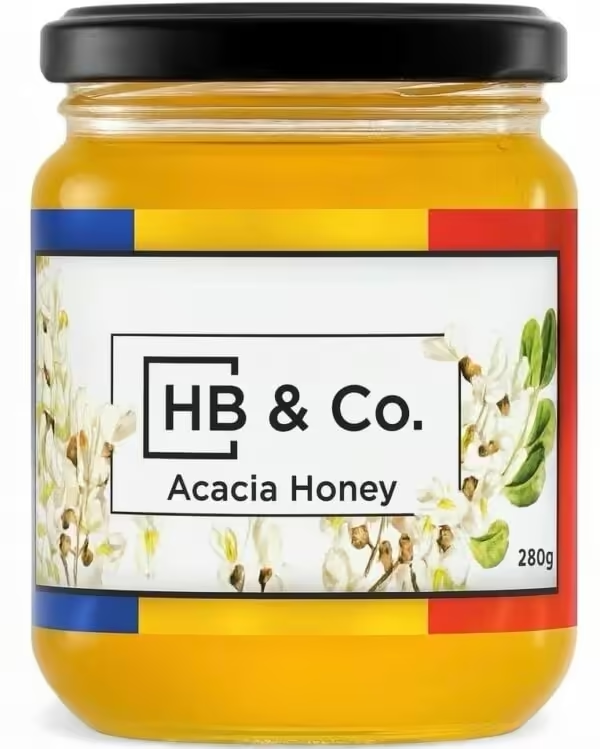
Pale, mild and slow to crystallise. Raw Transylvanian acacia honey from six generations of family beekeeping in the Nistor family apiaries. Cold-extracted. 280g.
Acacia, Wildflower and Heather in one box. Three of our most distinct raw honeys, 280g each.
Shop Discovery Trio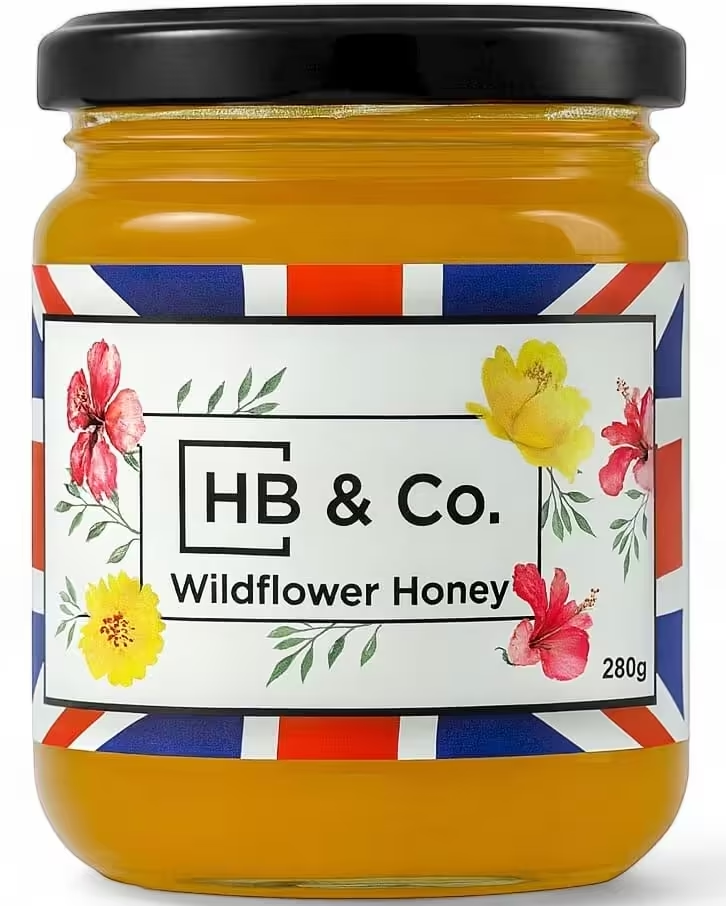
Raw single-origin honey every month. Acacia, Wildflower, Heather and more. From £8.79/month.
Start SubscriptionFrequently Asked Questions
How do I identify a brown-banded carder bee?
Look for a ginger-buff bumblebee with a bright ginger thorax that contrasts clearly with the pale whitish sides of the thorax, and a darker chestnut band across the second abdominal segment. Most individuals have a few black hairs above the wing bases, though these can be very few and hard to see. It is very similar to the moss carder bee (B. muscorum), which lacks the black hairs above the wing bases and tends to have more uniform thorax colouration. Separation from common carder bee (B. pascuorum) relies on the absence of black hairs on the abdomen. If in doubt in the field, photograph from multiple angles and submit as humilis/muscorum.
Where can I find the brown-banded carder bee?
On coastal grassland, chalk downland, brownfield sites and flower-rich grassland mosaics in southern England and Wales. Current strongholds include Thames Estuary sea-wall grasslands in Essex and Kent, Salisbury Plain in Wiltshire, and parts of the South Wales coast. It is absent from Ireland and very rare in Scotland. See the UK Native Bee Species Map for recorded distribution.
What is the difference between the brown-banded carder bee and the moss carder bee?
Both are all-ginger bumblebees with no black hairs on the abdomen. The brown-banded carder bee typically has a few black hairs scattered above the wing bases (absent in B. muscorum), a brighter ginger thorax that contrasts with pale sides, and a visible darker band on the second abdominal tergite. However, the black hairs can be absent in some humilis individuals, and the separation can fail even under examination. Microscopic characters (tergal hair pit structure in females; genitalia in males) provide the most reliable separation. In the field, habitat context helps: B. muscorum is more northerly and coastal; B. humilis is more southerly and chalk downland-associated. Read the Moss Carder Bee profile for a full comparison.
When does the brown-banded carder bee fly?
Queens emerge in May and June, later than most British bumblebees. Workers fly from June to September, and males appear from August. The colony concludes in September or October. The relatively late emergence and short season mean the species is particularly dependent on flower-rich grassland that remains productive through summer and into early autumn.
Why is it called the brown-banded carder bee?
The common name refers to the darker chestnut-brown band across the second abdominal tergite, which contrasts with the paler buff colouration of the rest of the abdomen. This band is the most visible distinguishing feature in the field, appearing as a darker "cummerbund" around the bee's waist, particularly conspicuous in flight in well-marked queens.[5] The "carder" part refers to the nest-building behaviour shared with all Thoracobombus species: gathering and teasing plant fibres into a mat to cover the nest.
Is the brown-banded carder bee declining?
Yes. It is a UK BAP Priority species and a species of Principal Importance in England, reflecting a documented decline linked primarily to loss of unimproved, flower-rich grassland. Being near its northern range limit in Britain makes it more vulnerable than continental populations to habitat changes. It is not as critically threatened as the shrill carder bee, but is considerably scarcer than the common carder bee and restricted to a limited number of sites.[6]
Does the brown-banded carder bee make honey?
No. Like all bumblebees, colonies store only a few days' supply of nectar. There is no surplus and nothing to harvest. All commercial honey comes from managed honeybee (Apis mellifera) colonies.
How can I help the brown-banded carder bee?
If you manage or own grassland near known sites: maintain or create unimproved, flower-rich swards with legumes, Lamiaceae and composites; delay cutting until after September; avoid fertiliser and reseeding. Record any sightings with photographs via iRecord or BWARS. Support the Bumblebee Conservation Trust, Buglife and BWARS, which run surveys and conservation projects for this and other declining carder bees.
Sources and References
- Bees, Wasps and Ants Recording Society (BWARS). Bombus humilis Illiger, 1806: species account, identification, separation from B. muscorum, distribution, habitat, decline. bwars.com
- NBN Atlas. Bombus humilis Illiger, 1806: subspecies B. h. anglicus Yarrow, 1978, taxonomy. nbnatlas.org
- Buglife. Brown-banded Carder Bee (Bombus humilis): identification, foraging plants, habitat, UK distribution. buglife.org.uk
- Goulson, D., Hanley, M. E., Darvill, B., Ellis, J. S. & Knight, M. E. (2005). Causes of rarity in bumblebees. Biological Conservation 122(1):1–8. Northern range limit vulnerability. doi.org
- Worcestershire Biological Records Centre. Bombus humilis in Worcestershire: identification notes, separation from B. pascuorum and B. muscorum. wbrc.org.uk
- Powney, G. D. et al. (2019). Widespread losses of pollinating insects in Britain. Nature Communications 10:1018. doi.org