

 English (UK)
  Italiano
  Français
  简体中文
简体中文  한국어
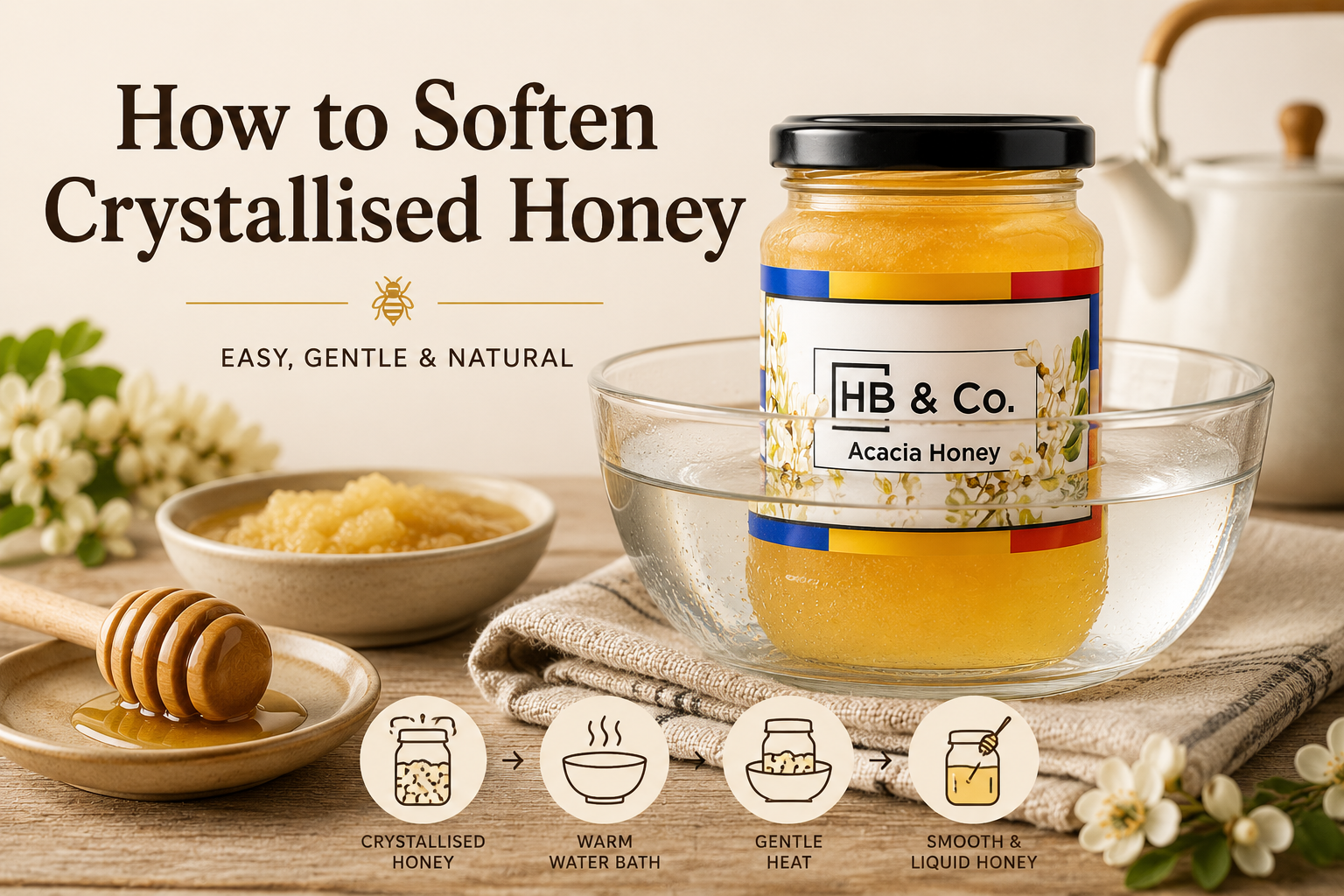
한국어 If your honey has turned thick, grainy, or solid, it has not gone off. Crystallisation is a natural sign of real, raw honey. To bring it back to a smooth, pourable state, warm the sealed jar gently in warm water kept below 40C. That is the whole trick, and this guide walks through it step by step, plus the mistakes that ruin good honey.
Key takeaways
- Crystallised honey is safe, natural, and a sign of genuine raw honey.
- The best method is a warm-water bath with the water kept below 40C.
- Stir every few minutes and repeat until the honey is smooth again.
- Never microwave, boil, or overheat honey. It destroys the enzymes and aroma.
- Store honey at room temperature, not in the fridge, to slow it happening again.
First, your honey is fine
Before you do anything, know that crystallised honey has not spoiled. Honey is a supersaturated sugar solution, and over time the glucose naturally separates out and forms tiny crystals. Raw honey does this sooner than processed honey because the pollen and fine particles it still contains give the crystals something to form on. In other words, crystallisation is a feature of good honey, not a fault. You can eat it exactly as it is, spread it on toast, or stir it into a bake. But if you would rather have it smooth and pourable, here is how.
The best method: a warm-water bath
Gentle, even warmth is all you need. This method loosens the crystals while keeping the honey raw.
- Loosen the lid, or keep it sealed. If the jar is glass and fairly full, keep the lid on so no water gets in. You will remove it to stir.
- Warm some water to below 40C. That is warm to the touch, not hot. A thermometer helps; if you do not have one, aim for comfortably warm bath water, never steaming.
- Stand the jar in the water. Use a bowl or pan and fill it so the water sits at roughly the level of the honey, without reaching the lid.
- Wait and stir. Leave it for five to ten minutes, then stir. Swap for fresh warm water if it cools. Repeat until the crystals have dissolved.
- Cool and seal. Once smooth, lift the jar out, let it cool, and seal it. Done.
A small jar can take fifteen minutes; a large, fully set one can take the best part of an hour. Patience beats heat every time. If you are not in a hurry, simply leaving the jar somewhere gently warm, like an airing cupboard or a sunny windowsill, over a day or two works too.
| Method | How | Time |
|---|---|---|
| Warm-water bath | Sealed jar in water below 40C, stir every few minutes | 15 to 60 minutes |
| Gentle ambient warmth | Leave in an airing cupboard or warm spot | 1 to 2 days |
| Embrace it | Use it set, on toast or in baking | No wait |
What never to do
- Do not microwave honey. It heats unevenly, creates hot spots, and destroys the natural enzymes.
- Do not boil it or use very hot water. Anything much above 40C strips out the flavour, aroma, and enzymes you paid for.
- Do not heat honey in a plastic container over a hot source; use glass.
- Do not decrystallise the same jar over and over. Warm only what you will use soon.
Keep honey below this and it stays raw. Roughly the temperature of a working beehive, 40C is the line past which heat begins to degrade the enzymes, aromas, and character that make raw honey worth buying in the first place.
Why honey crystallises in the first place

Honey is mostly two sugars, glucose and fructose, held in a little water. Glucose is less stable in solution, so over time it drops out and forms crystals, and the more glucose a honey contains, the faster it sets. That is why our Soft Set honey is naturally spreadable while our Acacia, which is high in fructose, is slow to crystallise and stays smooth for far longer.
Storage matters too. Cool temperatures speed crystallisation up, which is one reason a fridge is the worst place for honey. If any raw honey firms up, take it as reassurance: it is the real thing, retaining the pollen that processed, heavily filtered honey has had removed. Our guide to raw versus regular honey explains what that processing actually removes, and runny versus set honey covers the difference in texture.
Crystallised honey is not honey going bad. It is honey proving it was real all along.
How to slow it down
You cannot stop crystallisation forever, and you would not want to, but you can slow it. Keep honey sealed, at room temperature, in a cupboard away from direct sunlight and heat sources. Do not refrigerate it, and use a clean, dry spoon so you never introduce moisture. Stored well, honey keeps for an extraordinarily long time, as our piece on whether honey expires explains, and it will not freeze solid in a normal kitchen either.
If you would rather choose a honey that stays smooth for longer, acacia is the slowest in our range to crystallise. If you love a naturally spreadable set, soft set is made for it.
Choose your texture
Smooth and slow, or naturally set
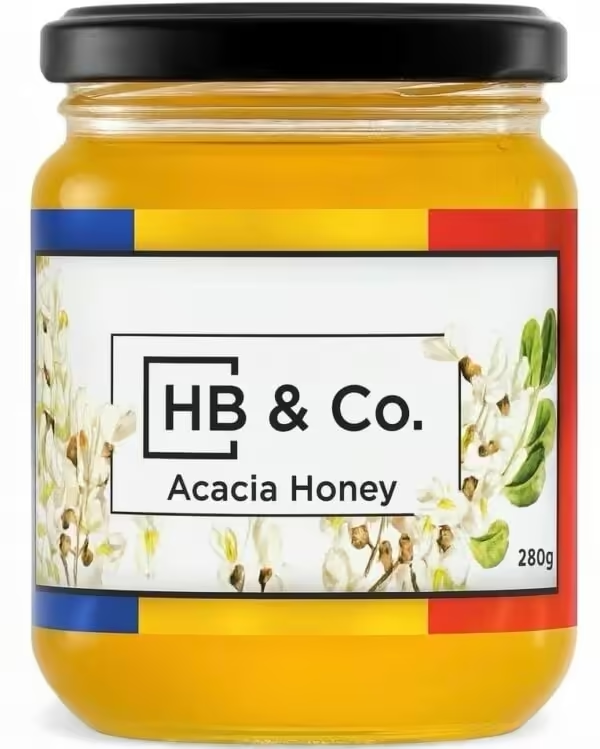
Acacia Honey
The slowest in our range to crystallise. Stays smooth and pourable.
£10.99
Shop Acacia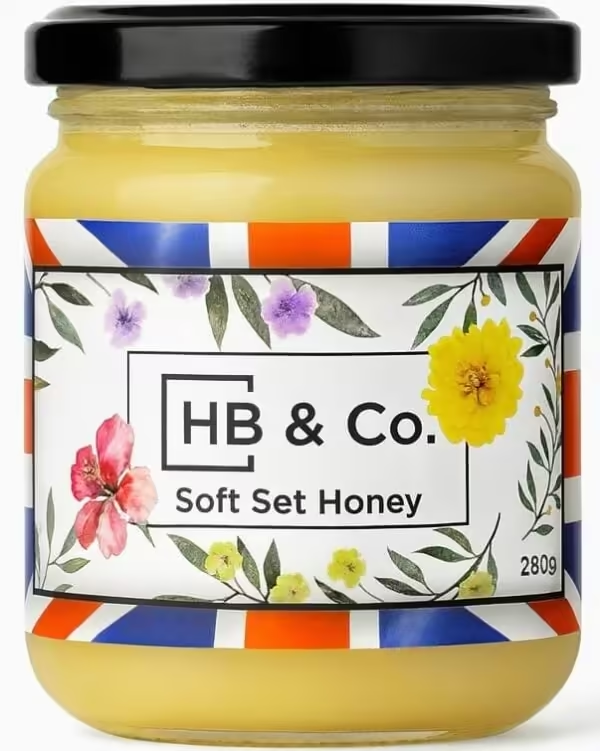
Soft Set Honey
Naturally crystallised to a smooth, spreadable set. No softening needed.
£10.99
Shop Soft SetFrequently asked questions
Is crystallised honey still safe to eat?
Yes, completely. Crystallisation is a natural process, not spoilage. The honey is exactly as good as it was, just thicker. Many people prefer the texture and spread it straight onto toast.
Can I microwave honey to soften it?
We would not. Microwaves heat unevenly and create hot spots that push part of the honey well above 40C, destroying its enzymes and aroma. A gentle warm-water bath is safer and just as easy.
Why has my honey gone solid or grainy?
The glucose in the honey has crystallised, which raw honey does naturally over time. Pollen and fine particles give the crystals something to form on, and cool storage speeds it up. It is a sign of a genuine, minimally processed honey.
Does crystallising mean my honey is real?
It is a good sign. Raw, unfiltered honey crystallises readily because it still contains pollen. Honey that never sets, even after many months, has usually been heated and heavily filtered.
Which honey crystallises the slowest?
Acacia. Its high fructose-to-glucose ratio keeps it smooth and pourable far longer than most honeys, which is part of why it is such a popular everyday jar.
Can I soften the same jar more than once?
Ideally not repeatedly. Each gentle warming is fine, but decrystallising the same jar again and again can dull the flavour over time. Warm only the amount you will use in the near future.
Should I keep honey in the fridge?
No. Cold speeds up crystallisation. Store honey sealed at room temperature in a cupboard away from sunlight and heat. There is no benefit to refrigerating it.