

 English (UK)
  Italiano
  Français
  简体中文
简体中文  한국어
한국어 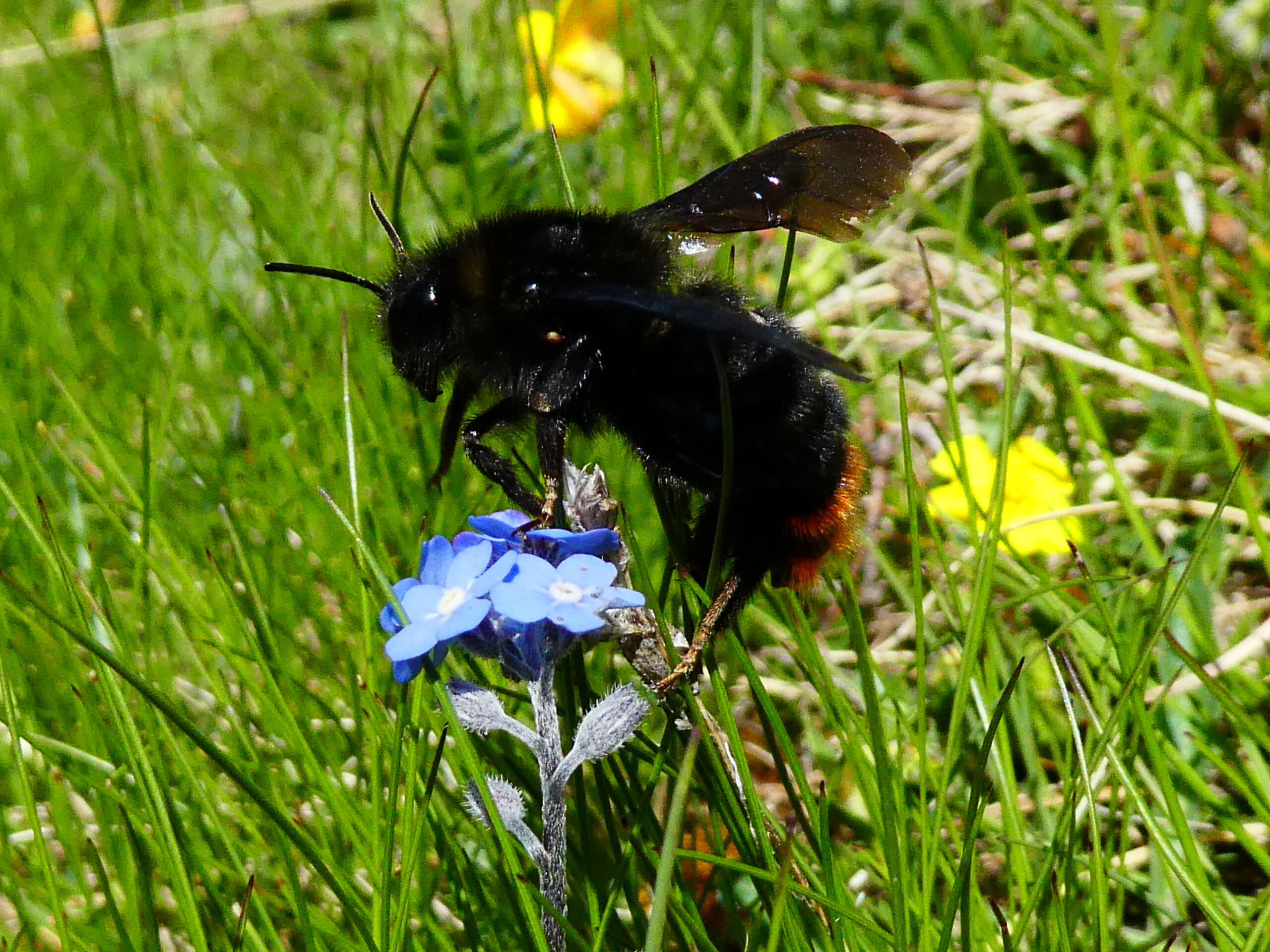
Red-tailed Cuckoo Bee
Bombus rupestris
Fabricius, 1793 • Apidae • Psithyrus
The red-tailed cuckoo bee is the social parasite of the red-tailed bumblebee, and it has evolved a striking solution to the problem of entering a host's nest undetected: it looks almost exactly like its host. Both female red-tailed cuckoo bees and female red-tailed bumblebees are all-black with a vivid red or orange-red tail; both are large; both fly at similar times. Bombus rupestris Fabricius, 1793 is one of Britain's largest cuckoo bumblebees, widespread across England and Wales, and it produces the most impressive mimicry of any British cuckoo bee. It has no worker caste, collects no pollen, and makes no honey. Its entire reproductive strategy depends on fooling the workers of Bombus lapidarius colonies long enough to take control. Explore its UK range on the UK Native Bee Species Map or read about cuckoo bees worldwide in the World Bee Atlas.
Quick Facts
Taxonomy and Classification
The red-tailed cuckoo bee was described by Johan Christian Fabricius in 1793 and belongs to the subgenus Psithyrus within Bombus. It is one of the larger British cuckoo bumblebees, with females approaching the size of red-tailed bumblebee queens. The species name rupestris is Latin for "of rocks or cliffs," possibly a reference to the rocky habitats where it was first collected, or to the nest sites of its host which often occur in stone walls and rocky ground.[1]
| Kingdom | Animalia |
| Phylum | Arthropoda |
| Class | Insecta |
| Order | Hymenoptera |
| Family | Apidae |
| Tribe | Bombini |
| Genus | Bombus Latreille, 1802 |
| Subgenus | Psithyrus Lepeletier, 1833 |
| Species | Bombus rupestris Fabricius, 1793 |
Identification: Mimicry of the Host
Female red-tailed cuckoo bees are all-black with a vivid red or orange-red tail, closely mimicking the appearance of female red-tailed bumblebees (B. lapidarius). Several characters separate them reliably. The wing membranes in B. rupestris are distinctly darker, brownish-grey rather than the clearer wings of B. lapidarius. The hind tibiae are hairy and convex rather than smooth and flattened with a corbicular plate: there are no pollen baskets. The hair on the body is sparser, and in fresh specimens the shiny black cuticle is visible through the hair on the abdomen.[2]
Female separation
Female B. rupestris are large, comparable in size to B. lapidarius queens at 20 to 22 mm. The tail is typically a slightly more orange-red rather than the pure scarlet of a fresh lapidarius queen, but this is subjective and varies with age and wear. The wing membrane darkness is the most reliable single field character. BWARS recommends checking the hind tibia: the shininess and convexity of the bare pollen basket in lapidarius females contrasts clearly with the hairy convex tibia of rupestris once the character is known.[1]
Male separation
Male red-tailed cuckoo bees look quite different from females. They are black with yellow hairs on the face and often scattered yellow on the thorax. This yellow colouration means they do not mimic their host males, which are all-black with a red tail. The combination of yellow face and dark wings with no pollen baskets distinguishes them from other bumblebees.[2]
The red-tailed cuckoo bee is highly host-specific, targeting almost exclusively Bombus lapidarius, the red-tailed bumblebee, whose distribution it closely mirrors in Britain. Unlike the field cuckoo bee (B. campestris) which attacks multiple carder bee species, B. rupestris is a specialist parasite tied to a single host.
The Mimicry Strategy: Why It Works
The near-identical appearance of female B. rupestris and female B. lapidarius is a product of Batesian mimicry: the cuckoo bee resembles its host closely enough to reduce the chance of being detected and killed by host workers during nest invasion. Red-tailed bumblebee workers guard the nest entrance and will attack unfamiliar bees; a cuckoo bee that closely resembles a returning worker has a better chance of entering undetected, or at least of not being immediately and decisively attacked.[3]
The mimicry is reinforced by chemical camouflage: the invading cuckoo bee acquires the host nest's chemical signature by spending time near the entrance before attempting entry, much as B. bohemicus does with lucorum-complex nests. The combination of visual and chemical mimicry gives the cuckoo bee a window of reduced aggression during which the invasion can succeed.[3][4]
Distribution and Life Cycle
The red-tailed cuckoo bee is distributed across England and Wales, mirroring the range of its host B. lapidarius, and is recorded from Scotland but becomes scarcer there, particularly in the Highlands. It is not recorded in Ireland. Females emerge in April and May, seeking established red-tailed bumblebee colonies. Males appear from July. New females and males are produced through August, mate, and new females enter hibernation by September.[1]
Foraging is primarily on open flowers with accessible nectar. BWARS records visits to thistles, knapweeds, bramble, heathers, lavender, phacelia and various garden composites. Both sexes feed on nectar for their own energy needs; females consume pollen directly (without basket-carrying) to support ovary development. Favoured habitats include chalk downland, coastal grassland, heathland edges and gardens wherever B. lapidarius colonies occur.[1]
Mimicry and the cuckoo bee diversity hypothesis
The red-tailed cuckoo bee's close mimicry of its host is more developed than in most other British cuckoo bees, which tend to share only general colour patterns with their hosts. The evolutionary hypothesis is that tighter mimicry evolves when host colonies have more aggressive workers, since looser mimicry would more frequently result in cuckoo bee death at the nest entrance. Red-tailed bumblebee colonies are noted for relatively vigorous nest defence, consistent with this prediction.
Does Bombus rupestris also parasitise Bombus lapidarius females or males?
BWARS records B. rupestris as a parasite of B. lapidarius. Some continental sources mention occasional records from B. pratorum and B. sylvarum nests in Europe. BWARS does not list these as confirmed British hosts and the red-tailed bumblebee is treated as the primary and in Britain essentially sole host. Whether the mimicry is specific enough to prevent invasion of non-lapidarius nests, or whether occasional non-host invasions occur without leaving confirmed records, is not established.[1]
A Parasite's Honey
The red-tailed cuckoo bee makes no honey and collects no pollen. Its reproduction is entirely subsidised by the labour of Bombus lapidarius workers. Our honeys come from the opposite end of the spectrum: from honeybee colonies that overproduce, storing far more than the colony consumes, creating a genuine harvestable surplus.
Our Acacia Honey is gathered from the black locust forests of Transylvania by the Nistor family apiaries, where six generations of beekeeping have produced raw, cold-extracted honey from a landscape managed with continuity and care. Pale, mild and slow to crystallise. For the full range, the Discovery Trio brings Acacia, Wildflower and Heather together in one box.
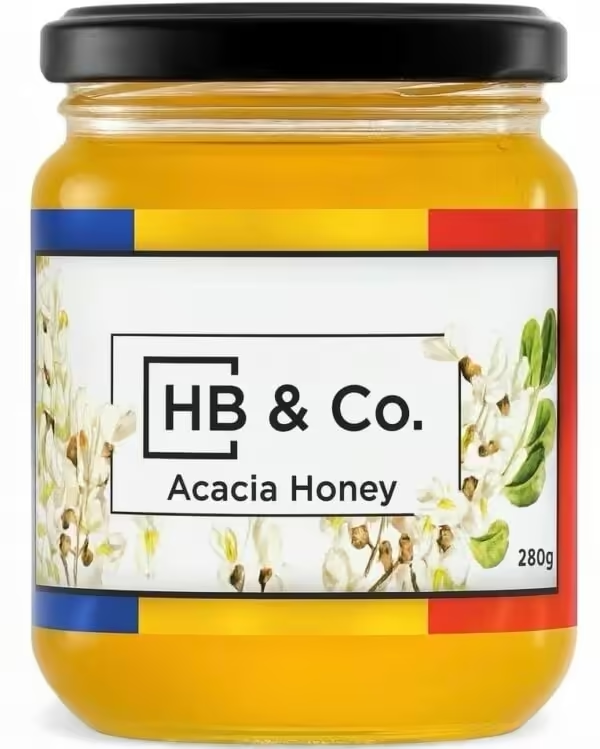
Pale, mild and slow to crystallise. Raw Transylvanian acacia honey from six generations of family beekeeping in the Nistor family apiaries. Cold-extracted. 280g.
Acacia, Wildflower and Heather in one box. Three of our most distinct raw honeys, 280g each.
Shop Discovery Trio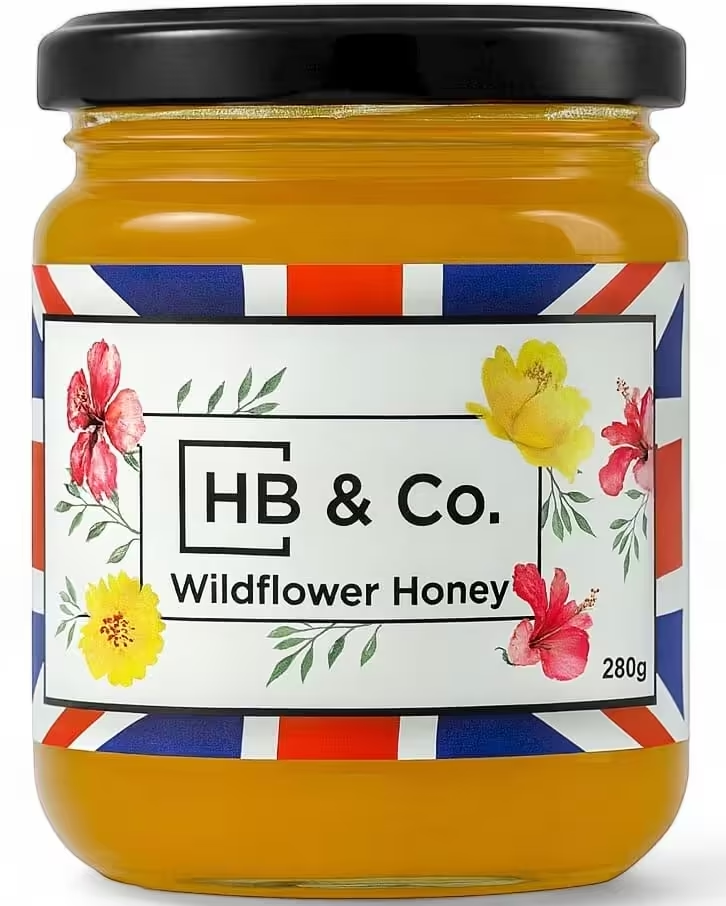
Raw single-origin honey every month. Acacia, Wildflower, Heather and more. From £8.79/month.
Start SubscriptionFrequently Asked Questions
How do I identify a red-tailed cuckoo bee?
Females are all-black with a vivid red or orange-red tail, closely resembling the red-tailed bumblebee. The key separating characters are: distinctly darker, brownish-grey wing membranes (red-tailed bumblebees have clearer wings); hairy and convex hind tibiae rather than smooth pollen baskets; and sparser body hair with visible black cuticle. Males are very different: black with yellow face hair and scattered yellow on the thorax, with the same dark wing membranes and no pollen baskets. A close look at the hind leg is the most reliable field check.
Why does the red-tailed cuckoo bee look like its host?
It is a form of Batesian mimicry: by resembling its host species closely, the cuckoo bee reduces the risk of being detected and attacked by nest-guarding workers during colony invasion. Red-tailed bumblebee workers guard the nest entrance; a bee that looks like a returning worker is less likely to trigger immediate aggressive defence. The mimicry is supported by chemical camouflage, with the cuckoo bee acquiring the host nest's scent before attempting entry.
Which bees does the red-tailed cuckoo bee parasitise?
Almost exclusively the red-tailed bumblebee (Bombus lapidarius) in Britain. It is a specialist parasite, unlike some cuckoo bees that attack multiple host species. Its British distribution closely mirrors that of its host.[5] See the Red-tailed Bumblebee profile for information on the host species.
When does the red-tailed cuckoo bee fly?
Females emerge in April and May. New females and males appear from July, and males can be seen foraging through to September. The flight season April to September broadly corresponds with the active season of its host species.
Where can I find red-tailed cuckoo bees?
Wherever the red-tailed bumblebee is present in good numbers: chalk downland, coastal grassland, heathland edges, and gardens across England and Wales. Females can sometimes be seen patrolling the entrances to known red-tailed bumblebee nest sites in April and May, or foraging on thistles and knapweeds in summer. See the UK Native Bee Species Map for distribution.
What is the difference between a male and female red-tailed cuckoo bee?
Females are all-black with a red tail and closely mimic female red-tailed bumblebees. Males look completely different: black with yellow facial hair and often some yellow on the thorax, without a red tail. Both sexes have dark wing membranes and hairy hind tibiae without pollen baskets. The sexual dimorphism in this species is as pronounced as in any British bee.
Does the red-tailed cuckoo bee make honey?
No. It collects no pollen, builds no nest and stores no nectar. Its offspring are raised by the workers of its red-tailed bumblebee host colony. Only honeybees (Apis mellifera) store honey in commercial quantities.
Is the red-tailed cuckoo bee the same as the hill cuckoo bee?
Yes. "Hill cuckoo bee" is an alternative common name for Bombus rupestris, less frequently used than "red-tailed cuckoo bee." Both names refer to the same species. BWARS and the Bumblebee Conservation Trust use "red-tailed cuckoo bee" as the primary English name.
Sources and References
- Bees, Wasps and Ants Recording Society (BWARS). Bombus rupestris Fabricius, 1793: species account, identification, host species, distribution, foraging. bwars.com
- Bumblebee Conservation Trust. Red-tailed cuckoo bee: identification, separation from B. lapidarius, cuckoo bee field characters. bumblebeeconservation.org
- Fisher, R. M. (1988). Inability of the social parasite Psithyrus ashtoni to suppress ovarian development in workers of Bombus affinis. Journal of Insect Physiology 34(3):331–335. Nest invasion mechanisms, chemical mimicry and worker suppression in cuckoo bees. doi.org
- Pouvreau, A. (1984). Les abeilles parasites du genre Psithyrus. Biologie comparee et comportement parasitaire. Apidologie 15(1):1–16. Invasion behaviour, mimicry and host specificity across cuckoo bumblebees. doi.org
- Powney, G. D. et al. (2019). Widespread losses of pollinating insects in Britain. Nature Communications 10:1018. doi.org