

 Français
 English (UK)
 Italiano
 简体中文
 한국어

Recipe: sweet and savoury
Honey Butter: A Sweet and Savoury Recipe, and How Long It Keeps
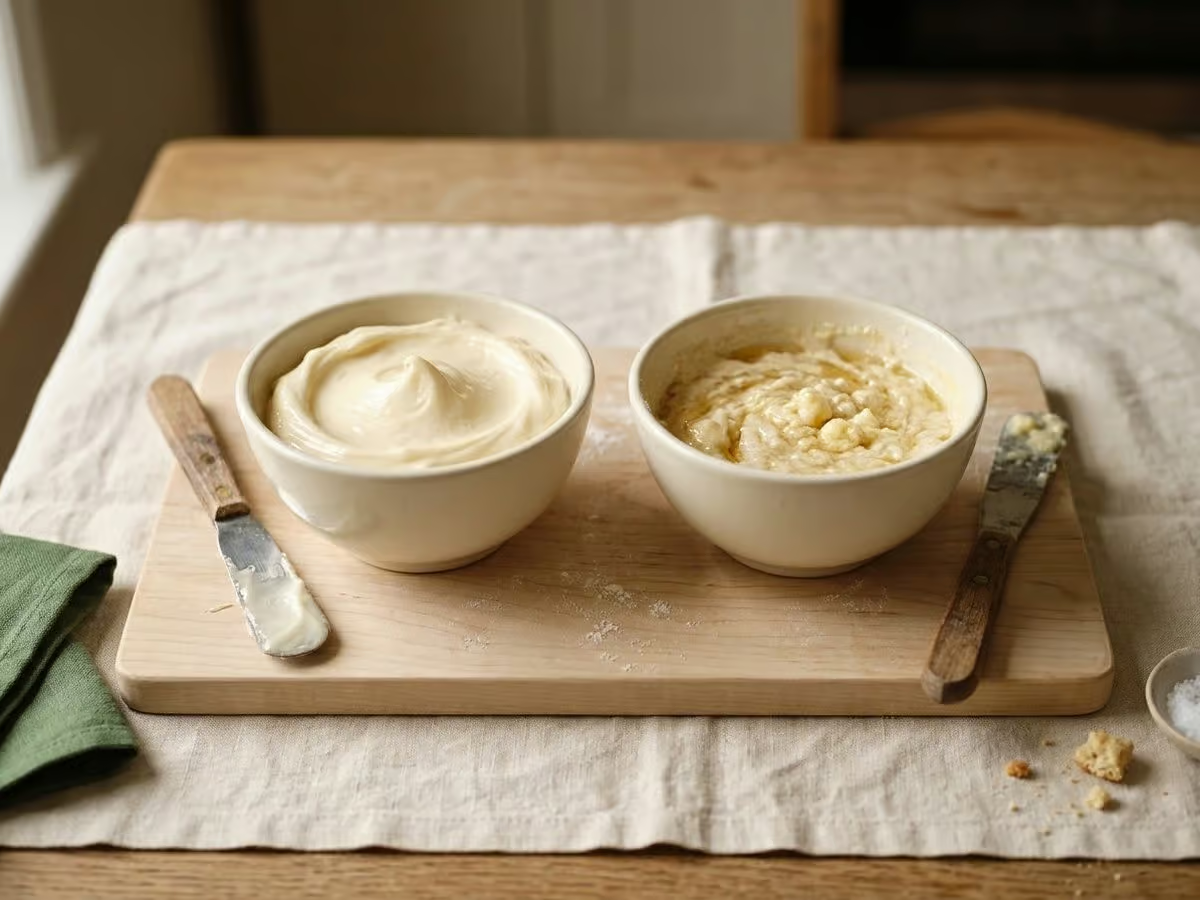
Honey butter is softened butter beaten with honey until pale and smooth. Our ratio is 250g butter to 60g honey (about 3 tablespoons) with a pinch of salt: sweet enough for crumpets and scones, restrained enough to melt over roast carrots. Beat the butter first, add the honey in three goes, chill for an hour, and keep it in the fridge.
Sur cette page
Timings
The only part that takes real time is softening the butter. Do not rush it in the microwave: melted patches will not hold air and the honey will weep out later.
| Scène | Heure | What you are looking for |
|---|---|---|
| Soften the butter at room temperature | 45 to 60 minutes | A finger presses in easily but the block still holds its shape |
| Beat the butter alone | 2 minutes | Paler in colour, lighter, slightly fluffy |
| Add honey in three additions | 2 minutes | No streaks; the mix looks glossy, not wet |
| Season and fold in flavourings | 1 minute | Salt or herbs evenly through |
| Shape into a dish or a log | 3 minutes | Smooth top, or a tight log in baking paper |
| Refroidir | 1 hour | Firm enough to slice or scoop cleanly |
The recipe: classic sweet honey butter
Ingrédients
- 250g unsalted butter, softened
- 60g honey (about 3 tablespoons); we use sunflower honey
- Quarter of a teaspoon of flaky sea salt, plus a pinch to finish
Using salted butter? Leave out the salt and taste at the end.
Méthode
- Soften. Leave the butter out until it is soft enough to press but not shiny or greasy. If your kitchen is cold, cut it into cubes to speed things up.
- Beat the butter. Use an electric hand whisk, a stand mixer with the paddle, or a wooden spoon and some patience. Beat for about 2 minutes until the butter turns noticeably paler.
- Add the honey in three goes. Add a third, beat until it disappears, then repeat. Adding it all at once is the most common reason honey butter looks curdled.
- Season. Beat in the salt. Taste on a piece of bread, not off the spoon, because butter on its own tastes sweeter than it does on toast.
- Shape. Spoon into a ramekin and smooth the top, or roll into a log in baking paper and twist the ends.
- Refroidir. Refrigerate for an hour to firm up. Take it out 15 minutes before serving so it spreads.
Cooking for a family? Honey butter is not suitable for babies under one. The NHS is clear: “Do not give your child honey until they’re over 1 year old.” Keep a separate plain butter for little ones.
Five flavours, sweet and savoury
Make the base, then fold in one of these at step 4. Each makes enough for one batch.
Cinnamon and orange
Half a teaspoon of ground cinnamon and the finely grated zest of half an orange.
For: hot cross buns, crumpets, French toast.
Brown butter and vanilla
Brown 50g of the butter first, chill until set, then beat in with the rest and a few drops of vanilla.
For: pancakes, waffles, warm banana bread.
Thyme and sea salt
One tablespoon of fresh thyme leaves and a full half teaspoon of flaky salt.
For: roast carrots and parsnips, roast chicken, cornbread.
Chilli and lime
Half a teaspoon of chilli flakes and the zest of one lime. For more heat, see our miel chaud method.
For: corn on the cob, grilled prawns, flatbreads.
Roasted garlic and rosemary
Four cloves of roasted garlic, mashed, and one teaspoon of finely chopped rosemary. Roasting makes garlic sweet and mellow.
For: steak, jacket potatoes, garlic bread.
For the savoury versions we lean on a stronger honey, because thyme and garlic can bury a delicate one. A spoon of Miel de bruyère britannique in the thyme butter is our favourite pairing with roast roots. If you cook over coals in summer, our guide to the best honey for BBQ has more glaze ideas that this butter fits straight into.
Why it works, and why it sometimes splits
Butter is mostly fat with a small amount of water held in tiny droplets. When you beat soft butter, you work air into the fat and make room for more liquid. Honey is mostly sugars with some water, and it is heavy. Beaten in slowly, it breaks into fine droplets that the butter can hold. Poured in all at once, it pools, and the butter cannot wrap round it fast enough: that is the curdled look.
Temperature decides the rest. Too cold, and the butter is too stiff to take the honey, so it streaks. Too warm, and the fat cannot hold air or honey, so it turns greasy and the honey sinks while it chills.
Set honey brings its own texture. Its fine sugar crystals make a butter that is a little thicker and almost fudgy; runny honey makes a softer, glossier one. Both work. Our explainer on miel liquide ou miel cristallisé covers why one honey sets and another does not.
Quel miel choisir ?
Any honey makes honey butter. The honey you choose decides whether it tastes of honey or just of sweet.
| Miel | What it does in butter | Use it for |
|---|---|---|
| Tournesol | Golden colour, warm and buttery flavour; it crystallises quickly into fine grains, which gives a thick, creamy butter | Our default: toast, scones, cornbread |
| Ensemble souple britannique | Unpasteurised, minimally strained, no heat applied; already smooth and spoonable, so it beats in with no streaks | The smoothest, most whipped result |
| Acacia | Very mild and slow to crystallise; the butter tastes clean and sweet | Pastries and anything where butter should lead |
| Heather | Strong, floral, slightly bitter edge | Savoury butters for roast roots and game |
Sunflower is our pick because its flavour is closest to butter itself. We describe it in detail in the sunflower honey taste explained. If yours has set firm in the jar, that is normal for sunflower: stand the jar in warm, not hot, water for a few minutes, or simply beat it in set. More on that in miel cristallisé.
Storage, by the FSA’s rules
Honey on its own keeps very well and remains safe to eat well beyond its best-before date. Once it is beaten into butter, though, you are storing a dairy product, so treat it like butter, not like honey. The Food Standards Agency’s home guidance sets the temperatures: “Your fridge should be set between 0 and 5°C”, and a freezer should run at around minus 18°C (FSA, How to chill, freeze and defrost food safely).
| Version | Fridge (0 to 5°C) | Freezer (around minus 18°C) |
|---|---|---|
| Sweet, butter and honey only | Up to 2 weeks, and never past the butter’s own date | Up to 3 months; slice from a frozen log |
| With citrus zest or spices | Up to 1 week | Up to 3 months |
| With fresh herbs or roasted garlic | Up to 1 week; keep covered and cold | Up to 3 months; the best way to keep a big batch |
Our guidance, not a legal limit: the fridge times above are our own conservative rule of thumb for homemade butter. The FSA adds that you can freeze food right up to its use-by date, and that frozen food should be defrosted in the fridge so it does not get too warm. Once defrosted, use it promptly and do not refreeze. Label the dish or log with the date you made it.
“Occasionally, honey contains bacteria that can produce toxins in a baby’s intestines, leading to infant botulism, which is a very serious illness.”NHS, Aliments à éviter pour les bébés et les jeunes enfants
Dépannage
| Problem | Pourquoi | Fix |
|---|---|---|
| Looks curdled or wet | Honey added too fast, or butter too cold | Keep beating for a minute; if it stays split, warm the bowl briefly over warm water and beat again |
| Greasy, honey pooling at the bottom after chilling | Butter was too warm or partly melted | Chill for 10 minutes, then re-beat until it comes back together |
| Grainy | Firmly set honey that did not break down | Use soft set honey, or beat longer; the grains soften overnight in the fridge |
| Rock hard from the fridge | Butter fat firms right up when cold | Out of the fridge 15 minutes before use, or keep a small dish in a cool cupboard for the day you are serving it |
| Too sweet | Honey reads sweeter than sugar | Beat in 25g more butter and an extra pinch of salt |
A note on the name
Why do some shop versions call themselves a honey spread rather than honey butter? Labelling rules. Under the retained rules on spreadable fats, a composite product may only use the name butter if it contains at least 75% milk fat (Regulation 445/2007, Article 3). Our recipe, with a fifth of its weight in honey, lands below that. At home, call it what you like.
What to put it on
Crumpets, toasted sourdough, warm scones and cornbread, obviously. Less obviously: a slice melted over grilled salmon, stirred through hot greens, or brushed on a ham in its last ten minutes in the oven. A dish of it on a cheese board next to a hard cheese is a quiet hit; see our grazing board honey guide. For baking with honey rather than spreading it, start with the meilleur miel pour la pâtisserie.
Make it with sunflower honey
Our Sunflower Honey is golden, warm and buttery, from the Transylvanian sunflower fields. It sets quickly into a fine, creamy texture that beats beautifully into butter. Every jar is 280g. Building a breakfast shelf? The Sélection de miel pour le petit-déjeuner pairs it with Wildflower and Soft Set.
Acheter le miel de tournesol See all honeysQuestions
Does honey butter need to be refrigerated?
Yes. Once honey is mixed into butter, store it like butter: in the fridge between 0 and 5°C, covered. Bring a small amount out 15 minutes before serving so it spreads.
How long does homemade honey butter last?
Our rule is up to two weeks in the fridge for plain honey butter, and up to a week for versions with fresh herbs, garlic or zest, never past the butter’s own date. It freezes well for up to three months.
Can I use salted butter?
Yes. Leave out the added salt and taste at the end. Salted butter makes a slightly firmer honey butter.
Can I make whipped honey butter?
Yes. Beat the butter for 4 to 5 minutes instead of 2 before adding the honey, and use soft set honey. It will be lighter and paler, and it softens faster at room temperature.
Can children eat honey butter?
Children over one, yes. Babies under one should not have honey in any form, including in butter or baked goods, because of the small risk of infant botulism.