

 Français
 English (UK)
 Italiano
 简体中文
 한국어

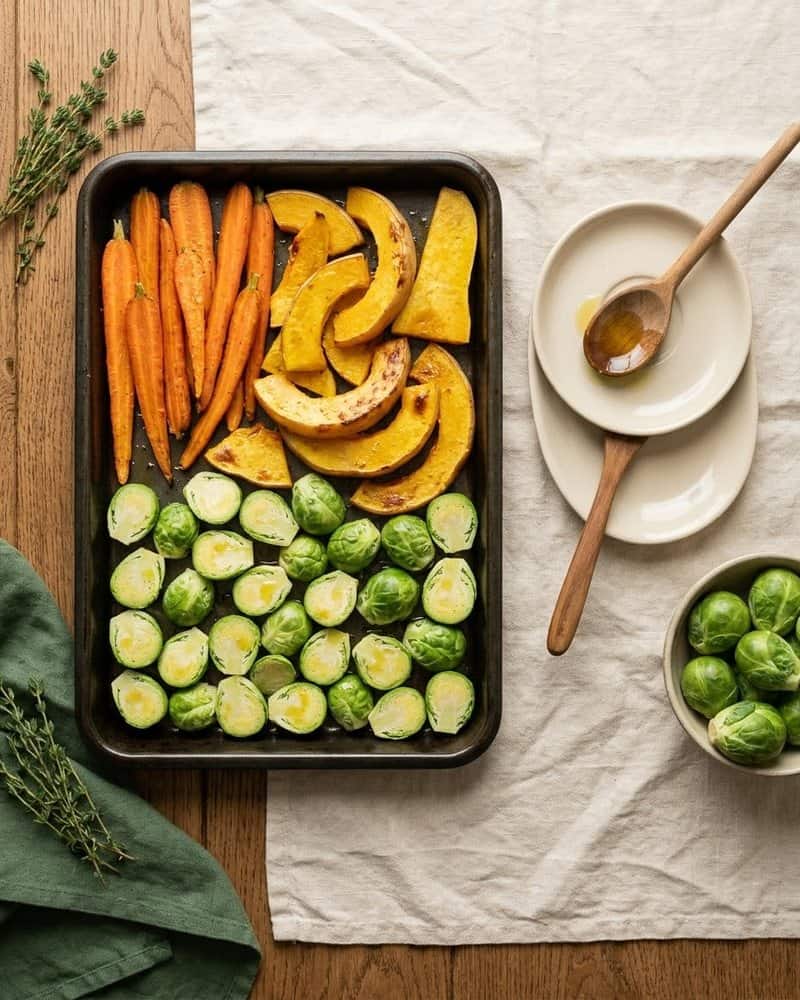
One tray, three vegetables, one glaze. Carrots and squash go in first, the sprouts later, and the wildflower honey last of all.
Accompagnement de Noël
Légumes de Noël nappés de miel : carottes, choux de Bruxelles et courges, le tout dans un seul plat
Three vegetables that cook at three different speeds can share one tray if they go in at three different times. Squash and carrots first at 200 degrees for 25 minutes; halved sprouts in for the next 15; then a honey, butter and thyme glaze for the last 8. Forty-eight minutes, one oven shelf, and nothing boiled. The method is below, then the reason each vegetable is treated the way it is.
The recipe
Serves 8 as a side. Prep 15 minutes. Cook 48 minutes.
- 600 g carrots, scrubbed, halved lengthways
- 1 butternut squash, about 900 g, in 3 cm wedges, skin on
- 500 g Brussels sprouts, trimmed and halved
- 3 tbsp olive oil
- 1 cuillère à café de sel en cristaux
- 3 tbsp British wildflower honey
- 25 g butter
- 1 tbsp cider vinegar
- Leaves from 5 thyme sprigs
- Poivre noir
- 0 min Heat the oven to 200 degrees (180 fan) with your largest roasting tray inside. Toss the carrots and squash in 2 tablespoons of the oil and half the salt.
- 5 min Tip the carrots and squash onto the hot tray in one layer, cut sides down. Roast 25 minutes.
- 30 minutes Toss the sprouts in the remaining oil and salt. Push the roots to one side, add the sprouts cut side down, and roast 15 minutes. Do not stir the sprouts; the flat face browns against the metal.
- 40 min Melt the honey, butter and vinegar in a small pan until it bubbles. Pour over the tray, scatter the thyme, and turn everything once.
- 45 minutes Roast 8 minutes more until the glaze is sticky and the edges are deep gold. Pepper, and serve from the tray.
Carrots: roast, never boil, and here is the number
Boiled carrots lose their sweetness to the water. A Swedish study of four carrot cultivars found that seven minutes of boiling cost the roots about 39 percent of their sugars on average, and that boiling mattered more than storage time or root size: “Root weight and storage were consistently of less significance than boiling and cultivar” (Andersson and colleagues, Journal of the Science of Food and Agriculture, 2005). Roasting does the opposite: the water leaves as steam, the sugars stay behind at a higher concentration, and the flat cut face browns against the metal. That is why a roast carrot needs so little honey, and why this recipe uses 3 tablespoons across two kilos of vegetables rather than the 4 to 6 some glazes call for.
Halve carrots lengthways rather than cutting coins. The long cut face sits flat on the tray and caramelises; coins roll, steam and stay pale. Leave the skins on a scrubbed carrot; the skin is where most of the colour forms.
Sprouts: why they taste bitter, and what honey does about it
Sprout bitterness is not imaginary and it is not the same in every bag. Dutch researchers tested cultivars on a tasting panel and found that two sulphur compounds, sinigrin and progoitrin, drove both the bitterness scores and how much people disliked a cultivar once the pair rose above about 2.2 g per kilo: “The glucosinolates, sinigrin and progoitrin, are related to the bitterness observed in Brussels sprouts” (van Doorn and colleagues, Journal of the Science of Food and Agriculture, 1998). Modern varieties are bred lower in both, which is why sprouts taste milder than the ones many of us remember.
The kitchen has two levers. Dry, high heat browns the cut face and gives the sprout a nutty, savoury layer that boiling never produces, and a small amount of honey and butter at the end rounds off whatever bitterness remains, the same way a little sugar balances a vinaigrette. Halve them, cut side down, do not move them for 15 minutes, and add the honey only at the end so it coats rather than burns.
Squash: the skin stays on
Peeling a butternut is the most dangerous ten minutes of Christmas cooking and it is unnecessary. Roasted at 200 degrees in wedges, the skin softens enough to eat and, more usefully, holds the wedge in one piece when the glaze goes on. Peeled chunks slump into a sweet mash that disappears under the carrots.
In our family the squash was the vegetable that never needed honey; it was grown for the pigs as much as the table and came in sweeter than anything else in the cellar. We still glaze it here because the vinegar in the glaze is what makes squash taste of something other than sugar. Honey without an acid is one-note on a vegetable this sweet.
The glaze, and which honey
Honey, butter and a spoon of cider vinegar, melted together until they bubble, is the whole glaze. The butter carries the honey across the vegetables and stops it setting into a hard shell; the vinegar keeps three sweet vegetables from tasting like dessert. We use Miel de fleurs sauvages britanniques because it sits in the middle of the range: fuller than acacia, softer than heather, with the slightly floral finish that suits carrots and squash. Our British honey supplier holds SALSA Certification. If you want to understand where wildflower sits against the strongest honey we sell, wildflower versus heather tastes them side by side; for the full spread, types de miel brut.
A jar that has thickened in a cold cupboard is fine, since the glaze is melted anyway; miel liquide ou miel cristallisé explains why that is normal rather than a fault. For a Boxing Day tray with cold meats, swap one tablespoon of the honey for miel chaud. For a vegan table, replace the butter with 2 tablespoons of olive oil; the glaze is thinner but coats just as well.
Timings if you change the vegetables
These are from our own trays over several Decembers, not from a laboratory, so treat the minutes as a starting point for your oven.
| Vegetable | Couper | Goes in at | Total roast at 200 |
|---|---|---|---|
| Carrots | Halved lengthways | 0 minutes | 48 minutes |
| Butternut squash | 3 cm wedges, skin on | 0 minutes | 48 minutes |
| Parsnips | Batons a finger thick | 10 minutes | 38 minutes |
| Red onion | Wedges, root left on | 15 minutes | 33 minutes |
| Brussels sprouts | Halved | 25 minutes | 23 minutes |
| Tenderstem broccoli | Whole | 35 minutes | 13 minutes |
Whatever the mix, the glaze goes on at 40 minutes and gets 8. Two kilos of vegetables need two trays; a crowded tray steams and never browns.
Ahead, frozen, leftovers
Everything up to the 40-minute mark can be done on Christmas Eve: roast, cool, cover and refrigerate the tray, then glaze and finish from cold for 15 minutes at 200 on the day. Frozen sprouts can go straight onto the tray from the freezer at the 25-minute mark, which is the charity WRAP’s own advice for cutting waste at Christmas. Their wider point is worth hearing in a week when vegetables are bought by the sackful:
Leftover glazed vegetables keep two days in the fridge and are best the next day in a frittata or blitzed with stock into soup; the honey on the sprouts stops them tasting of leftover sprout. If there is a baby at the table, lift out some plain carrot and squash before the glaze goes on at 40 minutes. The NHS says not to give honey to a child until they are over one year old, because it can occasionally contain bacteria that cause infant botulism (NHS, Aliments à éviter de donner aux bébés et aux jeunes enfants).
The honey on the tray
British wildflower honey is raw, unblended and the jar we use most in the kitchen. It comes on its own, in the L'offre groupée de miel britannique with heather and soft set, or three at a time in the wildflower stock-up pack. For December, the coffrets cadeaux miel arrive boxed. Every jar is 280 g. Free UK delivery on 3 or more jars on any order type, standard delivery 2 to 5 working days; 55 Google reviews at 4.9 stars.
Miel de fleurs sauvages britanniques See the whole shopQuestions
Puis-je faire cuire les légumes dans le même four que la dinde ?
Oui, sur la grille du dessous, mais un four partagé fonctionne à une température plus basse et avec plus d'humidité. Laissez les racines cuire 30 minutes avant les pousses, au lieu de 25, puis terminez la cuisson de la plaque seule à 200 pendant les 8 dernières minutes, une fois que la volaille est sortie du four et repose.
Pourquoi mes légumes glacés au miel ont-ils brûlé ?
Le miel a été ajouté trop tôt. Trois légumes qui nécessitent 48 minutes de cuisson ne peuvent pas rester recouverts de miel pendant 48 minutes ; à cette température, le miel noircit au bout d'environ 15 minutes. Badigeonnez-les de miel au bout de 40 minutes, et terminez la cuisson au bout de 48 minutes.
Dois-je blanchir les carottes ou les choux de Bruxelles ?
Non. Les carottes coupées en deux dans le sens de la longueur sont tendres en 48 minutes à 200, et les choux de Bruxelles en 23. Le blanchiment fait perdre du sucre aux carottes et rend les choux de Bruxelles détrempés et malodorants.
Puis-je utiliser du sirop d'érable à la place du miel ?
You can, in the same quantity. Maple is thinner and browns less, so expect a lighter coat. Our honey versus agave piece covers the other common swap.
Quelle quantité de miel faut-il pour un plateau plus grand ?
Respectez les proportions suivantes : 1 cuillère à soupe de miel pour 700 g de légumes, un tiers de cette quantité en beurre et une cuillère à café de vinaigre par cuillère à soupe de miel. Au-delà, le plat aura un goût de miel plutôt que de carotte.