
 English (UK)
  Italiano
  Français
  简体中文
简体中文  한국어
한국어 
Honey, Honestly
Honey vs Agave: What the Low GI Number Does Not Tell You
Agave is sold on one statistic, and that statistic is true. It is also the least useful thing you could know about it. Here is the fuller picture, without either side's marketing.
Walk down the sweetener aisle and agave nectar has one argument, repeated everywhere: a very low glycaemic index. Honey's counter-argument is usually the word "natural", plus a vague suggestion of health benefits. Both pitches are doing more work than the evidence supports.
We sell honey, so you know where our interest lies. What follows is still the honest version, including the part where we tell you honey is not a health food either.
This matters more than a normal shelf comparison because the two products are sold on completely different logic. Agave is sold on a laboratory measurement. Honey is sold on romance. Neither pitch tells you what you are actually buying, which is a shame, because the real differences between them are far more interesting than the marketing: one is a syrup invented in the last thirty years by breaking a plant fibre down in a factory, and the other is a food that predates agriculture.
Rated by 55 customers on Google
Agave syrup is not an ancient sweetener
This is the first thing worth knowing, and almost nobody mentions it. Agave syrup as you buy it today is a modern industrial product. Peer-reviewed reviews of agave syrup date it as a post-1990 development, made from blue agave and salmiana agave by breaking down the plant's stored fructans.
Agave plants have been used in Mexico for centuries, but for pulque, for fibre, and for the distilled spirits the plant is famous for. The pourable low-GI syrup in a squeezy bottle is a recent invention created for a health-food market that wanted an alternative to sugar. That does not make it bad. It does make the ancestral, back-to-nature framing you often see on the label rather difficult to justify.
Both are mostly sugar dissolved in a little water. The difference that drives everything else is the ratio of the two main sugars, fructose and glucose. Agave is not a mild version of honey; it is a fundamentally different mix.
How old is each of these, really?
Developed as a commercial sweetener within the last few decades, produced by hydrolysing agave fructans into fructose. The agave plant is ancient. This particular product is not.
Rock paintings in Spain show people harvesting honey from wild colonies thousands of years ago, before farming existed. The method has changed. The substance has not.
Start with what they are actually made of
Both are mostly sugar dissolved in a little water. The difference that drives everything else is the ratio of the two main sugars, fructose and glucose. Agave is not a mild version of honey; it is a fundamentally different mix.
Fructose and glucose, by proportion
Approximate composition. Exact figures vary by brand, floral source and processing.
Agave is more fructose-dominant than table sugar, and considerably more than high-fructose corn syrup, which sits around 55%.
That single fact explains both agave's marketing and its problem. Fructose is much less effective at raising blood glucose than glucose is, because it is handled largely by the liver rather than passing straight into the bloodstream. So a syrup that is overwhelmingly fructose will, by definition, score low on the glycaemic index.
What the GI number hides
The low score is real. It is also the wrong question.
Glycaemic index measures one narrow thing: how quickly a carbohydrate raises blood glucose compared with a reference. It does not measure how much sugar you are eating, and it says nothing about what happens to fructose after it leaves the stomach.
Agave scores low precisely because it is mostly fructose. Buying it for the low number means choosing the sweetener with the highest fructose load in the aisle, on the strength of a measurement that does not track fructose. High fructose intake has been associated in research with raised triglycerides and effects on liver fat and insulin sensitivity, particularly at high habitual intakes. That is a reason for moderation with agave rather than a reason for alarm about one spoonful.
It is worth noting honey is not uniform either. A single-origin acacia sits far lower on the scale than a typical blended honey, which is one of the few places where knowing your floral source genuinely changes the number. Supermarket honey is blended precisely to be consistent, which means you cannot know where on that 35 to 87 range your jar actually sits.
There is a second thing the number misses. Glycaemic index is measured on a fixed portion of carbohydrate eaten alone. Almost nobody eats sweetener that way. Stirred into porridge, spread on bread, or baked into something containing fat and protein, the curve flattens for both syrups, and the differences between them narrow further. For most people, in most meals, the choice between these two changes very little about blood sugar and a great deal about flavour.
How each one is actually made
This is the part the labels tend to skip, and it is where the word "natural" starts doing unearned work. One of these is decanted. The other is manufactured.
Raw honey
- Bees collect nectar and reduce its moisture in the comb until it is ripe, then cap it with wax.
- The beekeeper removes capped frames and spins the honey out cold.
- It is strained to take out wax and debris, then jarred.
- Nothing is added, and in raw honey nothing is heated above hive temperature.
Agave syrup
- The core of the agave plant is harvested and pressed for its sap.
- The sap is rich in inulin, a fibre, which is not sweet on its own.
- The inulin is broken down into fructose using heat, enzymes or acid, a process called hydrolysis.
- The result is filtered and concentrated into syrup. The high fructose content is created by the processing, not found in the plant.
That last line is the one worth carrying to the shop. Agave's defining characteristic is a product of industrial conversion. It is a perfectly legitimate food, but "natural" is a stretch for a syrup whose main constituent has to be manufactured out of a fibre. Our guide to raw honey and natural syrups covers the wider category, and honey versus refined sugar handles the sugar comparison in detail.
Both categories have an adulteration problem
Here is a section most honey brands would skip, because it does not flatter us either. Cheap sweeteners are among the most commonly faked foods in the world, and that applies on both sides of this comparison.
Honey is the more notorious case. The European Commission's Joint Research Centre reported in 2023 that a large share of honey sampled entering the EU was suspected of adulteration, typically by cutting genuine honey with cheap sugar syrups. It is the reason we go on about traceability rather than treating it as a marketing flourish: pollen and origin data are what makes fraud detectable in the first place, and ultra-filtration removes exactly that evidence.
Agave has a quieter version of the same problem. Because the syrup is already a manufactured fructose product, cutting it with other cheap fructose sources is both easy and hard to spot by taste. Academic reviews of agave syrup spend real effort on the analytical methods needed to tell genuine agave from adulterated agave, which tells you the concern is not hypothetical.
The practical defence is the same for both: buy from a producer who will tell you exactly where the product came from, and be suspicious of any sweetener sold far below the going rate for its category.
Neither of these is a health food
You will find pages claiming honey boosts immunity, fights disease, or should be treated as a remedy. We are a honey company and we are telling you to ignore them. Honey is sugar with character. It carries trace compounds that refined sweeteners do not, and that is a difference in food quality, not a medical benefit.
Both honey and agave count as added sugars in your diet, and both should be used in modest amounts. If you have diabetes or are managing blood sugar, the choice between them matters far less than the total quantity, and that is a conversation for your GP or a dietitian rather than a honey website.
The same scepticism should be applied in the other direction. Agave marketed as a diabetic-friendly sugar substitute is leaning on the glycaemic number while staying quiet about the fructose load that produces it. Neither of these products deserves a health halo.
What honey can honestly offer over agave is flavour, provenance and the ability to tell you exactly which landscape it came from. That is the argument we are prepared to make, and it is the only one we will.
The pollinator question
We are a bee company, so treat this section as interested testimony and check it yourself. But it is a real difference, and one that almost never appears in a sweetener comparison.
Both plants depend on pollinators in the wild. Agave is pollinated primarily by nectar-feeding bats, which follow the flowering spikes north through Mexico and the southern United States. Honey, obviously, comes from a pollinator directly.
The difference is what commercial production does to that relationship.
What commercial production does to the pollinator
One system removes the flower before the pollinator can use it. The other depends on the pollinator staying healthy.
Commercial agave
Agave is harvested for its sugar-rich core, and that core is at its richest just before the plant sends up its flowering spike. Commercial growers therefore cut the plant before it flowers, because letting it bloom spends the sugar they are farming.
Large plantations are also propagated from clones rather than seed, which narrows genetic diversity across the crop. Conservation groups have raised both points in relation to the bats that depend on agave blossom, which is why bat-friendly certification schemes exist at all.
Honey
A beekeeper's entire livelihood depends on colonies staying alive and on there being enough varied forage for them to work. The incentives point the same way as the pollinator's interests, which is not something you can say about most food production.
That is not a claim that all beekeeping is good for bees. Industrial migratory pollination is demanding on colonies, and we have said so elsewhere. But a hive on mixed forage is a pollinator being fed, not a flower being prevented.
If this matters to you, the practical version is simple: for agave, look for organic or bat-friendly certification; for honey, look for a named apiary rather than a blend.
Sweetness, flavour, and how much you actually use
Both are sweeter than granulated sugar, so most people reach for less of either than they would of sugar. That matters more than it sounds: a sweetener you use less of is a sweetener you buy less often, which quietly closes a lot of the price gap between a cheap syrup and a jar of single-origin honey.
Where they part company is flavour. Agave is deliberately neutral. That is its selling point and its limitation: it sweetens without announcing itself, which is exactly right in a cocktail and exactly wrong on a cheese board. Honey is the opposite. A raw single-origin honey tastes distinctly of where it came from, and that character survives being stirred into things.
This is the practical reason to keep both, if you cook seriously. Neutral sweetness and characterful sweetness are different tools. What is not defensible is buying agave because you believe it is the healthier of the two, then using it in places where honey would have tasted better.
So which should you reach for?
Setting health claims aside, they behave differently in a kitchen. Here is the practical split.
Reach for honey when
- You want the sweetener to taste of something. Honey brings floral, malty or herbal character depending on its source.
- You are finishing a dish: drizzling over yoghurt, cheese, porridge or warm toast.
- You are glazing or roasting and want colour and caramelisation.
- Provenance matters to you and you want to know who produced it.
Reach for agave when
- You want sweetness with no flavour of its own, for instance in a cocktail or a delicate drink.
- You need it to dissolve instantly in something cold.
- You are cooking vegan and honey is off the table.
- You want a pourable syrup that will never crystallise.
If you avoid honey on ethical grounds
Some people choose agave over honey not for health but because honey is an animal product. That is a coherent position and it deserves a straight answer rather than a sales pitch.
Vegans avoid honey because it is produced by managed animals, and because beekeeping practices vary enormously in how much they prioritise the colony. Both of those observations are accurate. We would only add that the range is wide: a small apiary leaving colonies enough stores and not moving them between crops is a very different proposition from an industrial pollination operation, and treating the whole category as one thing loses that.
If you have decided honey is not for you, agave is a perfectly reasonable substitute and this article is not trying to talk you out of it. In that case the useful part above is the sourcing section: look for organic or bat-friendly agave, and apply the same scepticism to sweetener marketing that you would apply to ours. Maple and date syrup are the other obvious options, and our guide to natural syrups and sweeteners covers where each one sits.
The crystallisation trade-off
Agave stays liquid indefinitely, which is genuinely convenient. Raw honey does not: over time the glucose in it forms fine crystals and the jar turns thick or grainy. People often read that as a fault. It is the opposite, a sign the honey has not been processed to hold it artificially clear.
If you want honey that pours for a long time, choose a high-fructose variety like raw Acacia, which is slow to crystallise. If you would rather it were spreadable from the start, Soft Set is guided through crystallisation deliberately. Our guide to crystallised honey explains what is happening.
To loosen a set jar, stand it closed in warm water no hotter than 40 degrees. Never microwave raw honey, and never boil it: the heat that makes it pour is the same heat that destroys what made it worth buying.
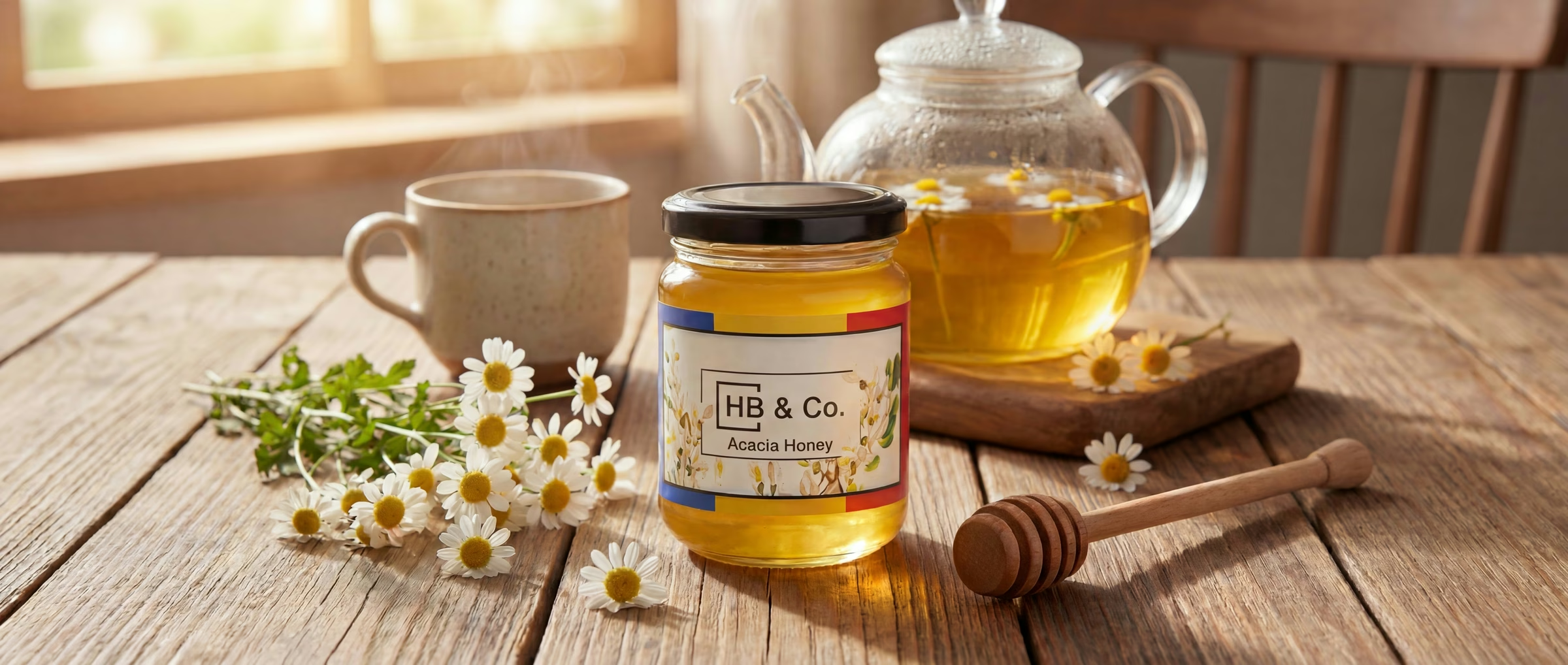
Four honeys, four different sweetening jobs
Chosen for what they actually do in a kitchen, not for a number on a chart.
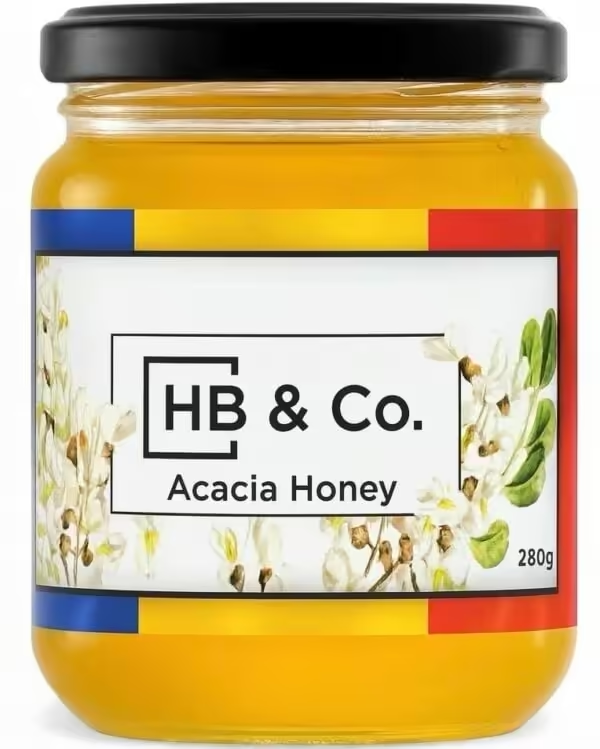 AcaciaThe closest to agave in behaviour: mild, pale, dissolves cleanly, slow to crystallise.£10.99or £8.79/mo
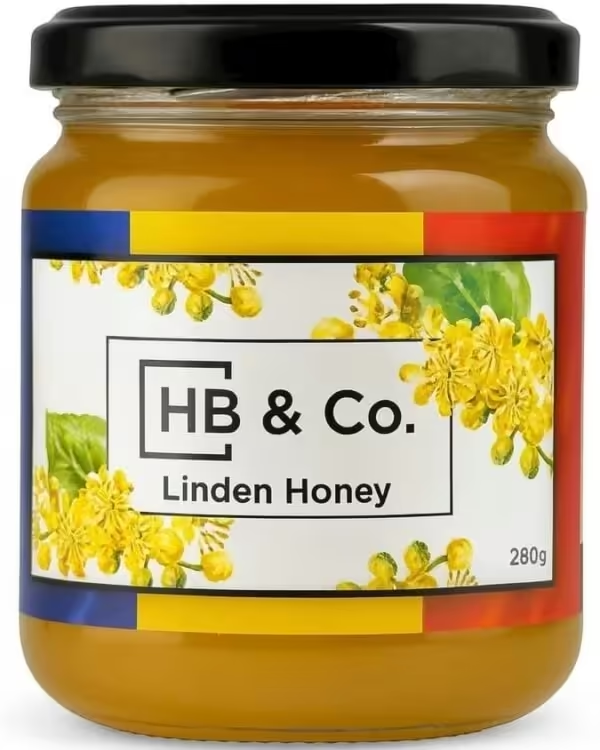 LindenHerbal and lime-blossom aromatic. Made for tea, where you want the sweetener to add something.£10.99or £8.79/mo
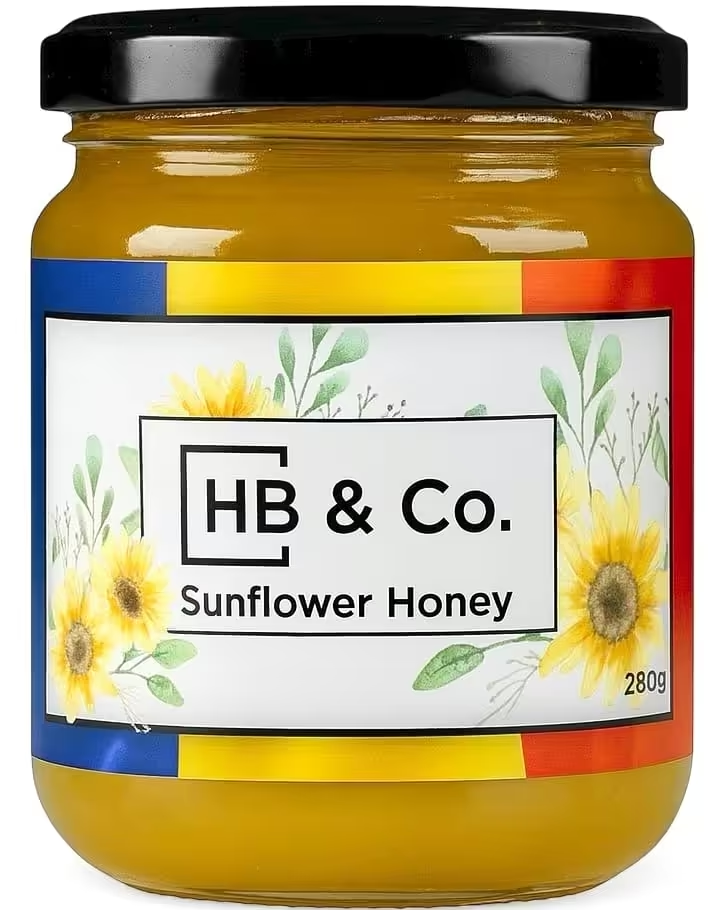 SunflowerWarm and caramel-buttery. The cook's honey, for glazes and bakes.£10.99or £8.79/mo
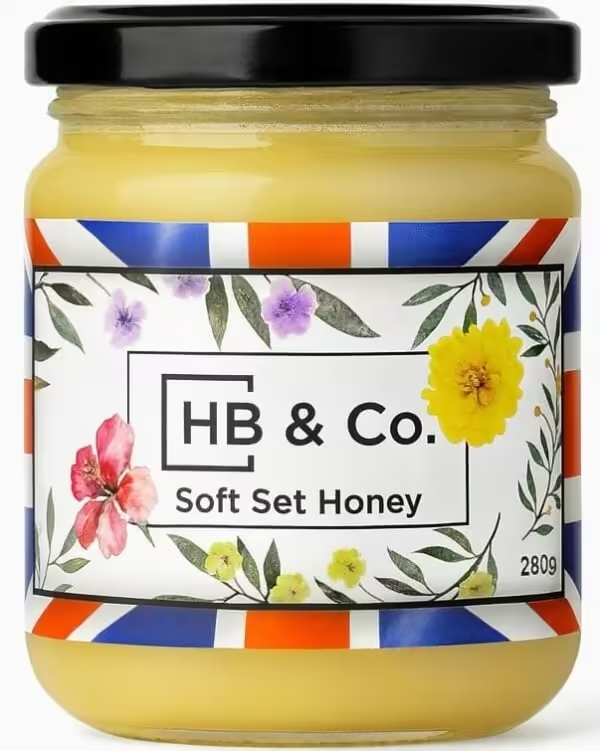 Soft SetSpreadable rather than pourable. Unpasteurised and minimally strained.£10.99or £8.79/mo
Swapping one for the other in baking
Both are liquid sweeteners, so the same rules apply when replacing granulated sugar: use roughly three quarters of the volume, cut the other liquid slightly, and drop the oven temperature a little, because both brown faster than sugar does.
Between the two, honey brings flavour and colour while agave stays neutral, so a swap is not like for like in taste. If you are baking with honey specifically, Sunflower caramelises beautifully, and the Baker's Kitchen selection was put together for exactly this.
One thing worth knowing if you bake with raw honey: the enzymes that make it raw do not survive an oven, so a bake is not the place to pay a premium for raw. Save the good jar for the things you eat cold or barely warm, where the character actually reaches you, and use it in baking for flavour and colour rather than for anything else.
The short version
- Agave syrup is a post-1990 industrial product, not an ancient sweetener. The plant is old; the syrup is not.
- Agave is roughly 85% fructose. Honey is roughly 40% fructose and 30% glucose. Table sugar splits 50:50.
- Agave's low glycaemic index is real, and it is caused by that fructose dominance rather than by the syrup being gentler.
- Agave's fructose is produced by breaking down a plant fibre with heat, enzymes or acid. It is a manufactured characteristic.
- Raw honey is spun out of the comb cold, strained and jarred, with nothing added.
- Both are added sugars. Neither is a health food, and anyone telling you honey is medicine is overselling.
- Both categories have documented adulteration problems, so traceability matters more than any label claim.
- Commercial agave is cut before it flowers, which removes the blossom its bat pollinators rely on. Beekeeping depends on the pollinator surviving.
- Choose on flavour, behaviour in the kitchen and whether the producer can tell you where it came from.
- Never give honey of any kind to babies under twelve months.
Sweetness you can trace to a landscape
Six raw honeys, each from a named origin, cold-extracted and never blended. Free UK delivery on orders of three jars or more.
See the subscription rangeCommon questions
Is agave healthier than honey?
Why does agave have such a low glycaemic index?
Is agave more processed than honey?
Which is better for baking?
Does agave crystallise like honey?
Is agave syrup a traditional Mexican product?
Is agave better for the environment than honey?
Can agave be adulterated like honey?
Should I bake with expensive raw honey?
Is agave suitable for vegans when honey is not?