

Red Mason Bee
Osmia bicornis
Linnaeus, 1758 • Megachilidae • Osmiini
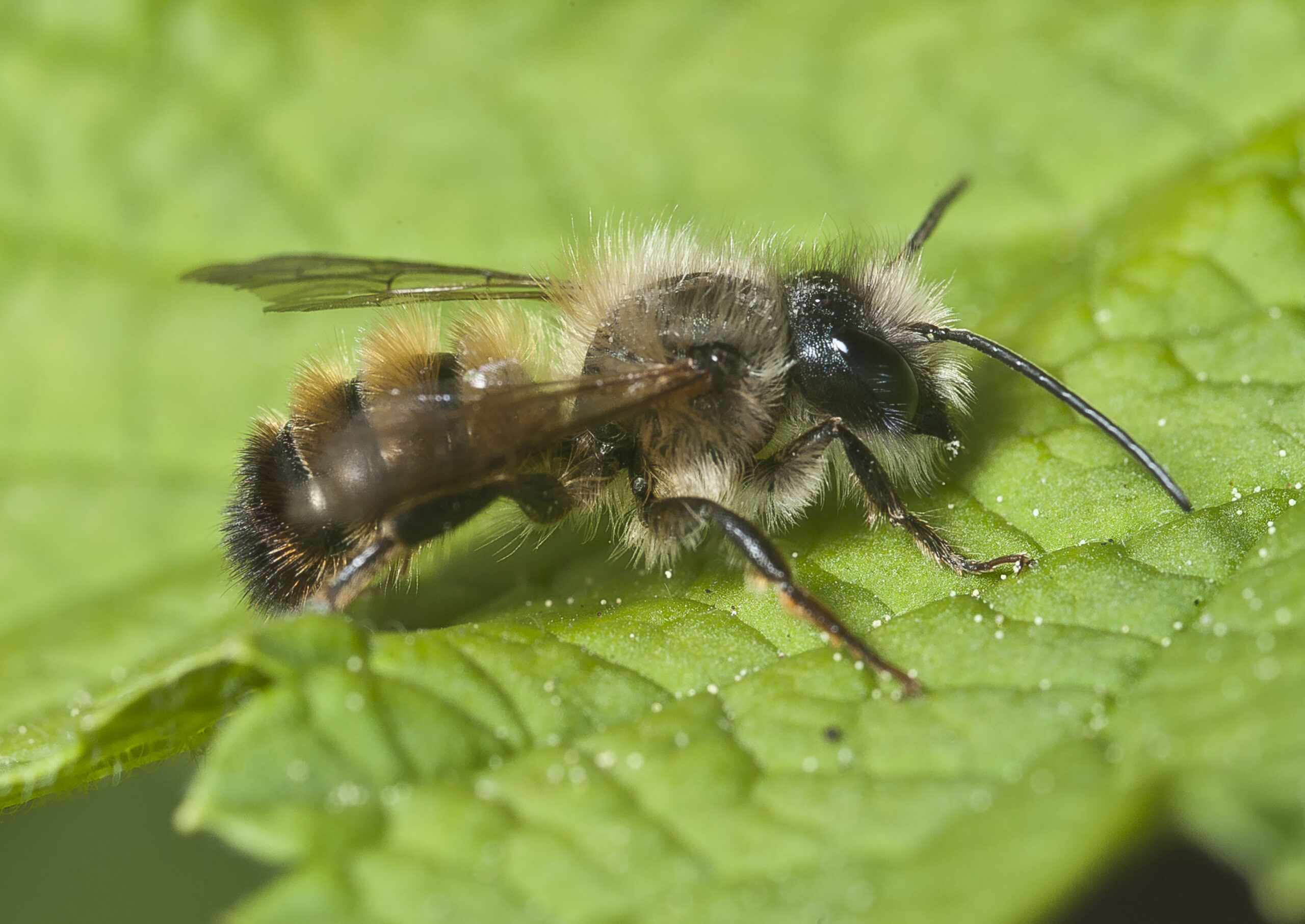
Osmia bicornis Linnaeus, 1758, the red mason bee, is Britain's most familiar solitary bee and the one most likely to move into a garden bee hotel. About the size of a honeybee, it is clothed in dense gingery hair, and the female carries two small black horns on her face, the feature that gives the species its name (bicornis means "two-horned"). It is a solitary, cavity-nesting bee: every female is her own queen, building and provisioning her own nest in hollow stems, holes in wood, soft mortar, and bee hotels, sealing each cell with mud. Gentle, abundant and an exceptional pollinator of orchard fruit, it is one of the easiest and most rewarding wild bees to welcome into a garden. See where it lives among Britain's other wild bees on the UK Native Bee Species Map, or explore the wider world of bees in the World Bee Atlas.
Quick Facts
Taxonomy and Classification
Carl Linnaeus described the red mason bee in 1758 in the tenth edition of Systema Naturae.[1] It belongs to the family Megachilidae, the mason, leafcutter and carder bees, within the tribe Osmiini and the genus Osmia. For most of the twentieth century the British bee was known as Osmia rufa, and a great deal of older literature still uses that name; Osmia bicornis is now the accepted name and O. rufa is treated as a synonym.[2] Of the eleven Osmia species recorded in England, the red mason bee is both the largest and the most common.
| Kingdom | Animalia |
| Phylum | Arthropoda |
| Class | Insecta |
| Order | Hymenoptera |
| Family | Megachilidae |
| Subfamily | Megachilinae |
| Tribe | Osmiini |
| Genus | Osmia Panzer, 1806 |
| Subgenus | Osmia (Osmia) |
| Species | Osmia bicornis Linnaeus, 1758 |
Is it Osmia bicornis or Osmia rufa?
Both names refer to the same bee. Linnaeus actually described it twice in 1758, as Apis bicornis and Apis rufa, and for decades British and European authors used Osmia rufa. Under the rules of zoological nomenclature, bicornis was selected as the valid name, so Osmia bicornis is now standard and Osmia rufa is a synonym.[2] If you are reading an older field guide or a commercial bee-hotel leaflet that says Osmia rufa, it is describing this same species.
Physical Description
The red mason bee is roughly the size of a honeybee but stockier, covered in dense gingery to orange-brown hair, greyish-brown across the thorax and warmer orange-red on the abdomen.[3] Females and males are easy to tell apart. The female has a black-haired face bearing two small, inward-curving horns on the clypeus, a feature unique among British Osmia and the origin of the name bicornis. She is the larger sex, at 10 to 12 mm, and carries pollen in a brush of hairs, the scopa, on the underside of her abdomen rather than on her legs.[4]
Males are smaller, 8 to 10 mm, with no horns, no pollen scopa, a tuft of pale grey-white hair on the face, and noticeably longer antennae.[4] Females are larger than males because their larvae are fed more pollen; brood-cell temperature also affects adult size, with bees reared in hotter cells emerging smaller.[5] The species is sometimes confused with the tawny mining bee (Andrena fulva), which is a similar fox-red but has a sharply contrasting black-and-red pattern and nests in the ground rather than in cavities.
Nesting: A Mason That Builds With Mud
The red mason bee is a solitary, aerial cavity-nester. Unlike the bumblebees and honeybees, there is no colony, no queen and no workers: every female is fertile and builds her own nest alone.[1] She does not excavate fresh tunnels but uses existing cavities, hollow plant stems, beetle holes in dead wood, gaps under roof tiles, soft or crumbling mortar joints, and, very readily, the tubes of a garden bee hotel. More unusual sites on record include keyholes and empty snail shells.
Inside a chosen tube she builds a row of separate cells, end to end. Each cell is stocked with a loaf of pollen and nectar, an egg is laid on it, and the cell is then walled off with a partition of mud. The bee is one of only two British Osmia that build with mud rather than chewed leaf, gathering wet soil as small pellets in her jaws and packing it into place with the horns on her face.[1] When the tube is full she seals the entrance with a thick, characteristic mud plug. The young develop through the summer, spin tough reddish-brown silken cocoons, and overwinter inside them as fully formed adults, ready to emerge the following spring.[6]
Want red mason bees in your garden?
Offer a bee hotel of hollow stems or tubes around 6 to 10 mm wide, in a sunny, sheltered, south-facing spot, and a patch of bare damp soil nearby for nest-building mud. The bees are gentle, do not swarm, and the males cannot sting, so a nest is safe near a doorway or window and makes an ideal way to watch wild bees up close.
Life Cycle and Behaviour
The red mason bee is univoltine, completing one generation a year, and is on the wing from late March or April through to June, sometimes into July.[2] Males emerge first and wait near the nest sites for the females to appear. Once a female has mated, usually only once, she sets about building her nest. She allocates the sexes deliberately: female eggs, which need more provisions, are laid in the deeper cells at the back of the tube, and the smaller male cells nearer the entrance, so the males emerge first the following spring.[5]
As a forager the red mason bee is polylectic, visiting a wide range of spring flowers including fruit blossom, willow, oak, buttercups, dandelions and many garden plants. It is active in cooler, duller conditions than the honeybee, foraging from around 10 degrees Celsius and flying in light rain and wind, which makes it a dependable early-season pollinator.[7] Because it carries dry pollen loosely on its belly scopa, pollen brushes off readily onto each flower it visits, making it an unusually effective pollinator per bee.
The Orchard Pollinator
The red mason bee is one of very few wild bees managed commercially in Britain, and it is prized for fruit pollination. For tree fruit such as apples, pears, plums and cherries, individual red mason bees are far more efficient pollinators than honeybees, and they are now reared and sold specifically for orchard and soft-fruit pollination.[7] Their early flight season, tolerance of cool weather, and belly-carried pollen all add up to reliable fruit set even in a poor British spring.
This usefulness, rather than rarity, is the red mason bee's claim to fame. It is the bee behind the explosion of garden bee hotels, and increasingly part of how commercial orchards are pollinated, a rare example of a wild solitary bee working alongside the managed honeybee in food production.
Red Mason Bees, Honey and HoneyBee & Co.
Like all solitary bees, the red mason bee makes no honey. Each female provisions only her own nest cells with pollen and nectar for her young, with no colony and no surplus to store, so there is nothing to harvest. Its gift is pollination, and a particularly valuable one for the orchards and gardens of Britain.
For us as a honey company, the red mason bee is a reminder that a thriving garden runs on more than one kind of bee. The honey in our jars comes from managed Apis mellifera colonies, but those hives share the same blossom-filled spring landscape with solitary bees like Osmia bicornis, and all of them depend on continuous flowering forage and undisturbed nesting places. Our British Wildflower Honey, gathered in the Midlands from hawthorn, clover, bramble and other native blossom, comes from exactly the kind of mixed forage that supports mason bees too. Planting for bees and offering a bee hotel helps the honeybee and the solitary bee alike. To understand what a world with fewer pollinators would look like, visit Your Plate Without Bees.
Source Conflicts and Open Questions
Does the red mason bee damage buildings?
The alternative name "red mortar bee" comes from the female's habit of nesting in soft, crumbling mortar joints, and some older accounts describe her as excavating mortar and so, over time, weakening masonry.[1] In practice the bee overwhelmingly uses cavities that already exist rather than digging fresh ones, and only exploits mortar that is already soft and decayed. It does not attack sound pointing. Modern guidance treats it as a harmless garden bee, not a structural pest; sound, well-maintained mortar is of no interest to it.
How big is a red mason bee, exactly?
Sources give slightly different figures. Most agree females are larger than males, but the quoted ranges vary: females around 10 to 12 mm and males 8 to 10 mm in many accounts, while others cite figures as low as 6 mm for small males or use forewing length rather than body length.[4] The variation is real, not just disagreement: adult size depends on how much pollen the larva received and how warm its brood cell was, so red mason bees genuinely emerge at a range of sizes.[5]
Frequently Asked Questions
How do I identify a red mason bee?
Look for a stocky, honeybee-sized bee covered in gingery, orange-brown hair, greyish on the thorax and warmer orange-red on the abdomen. The female has a black face with two small inward-curving horns, unique among British mason bees. Males are smaller, with a pale grey-white face and much longer antennae. You will most often see them around a garden bee hotel in spring.
Do red mason bees sting?
Barely. Red mason bees are extremely gentle and only the female has a sting, which she will use only if she is roughly handled. There is no colony to defend, so they are not aggressive, and the males cannot sting at all. They are safe to observe at close range, which makes a bee hotel an excellent way for children to watch wild bees.
How do I attract red mason bees to a bee hotel?
Provide hollow tubes or stems around 6 to 10 mm in diameter, mounted in a warm, sunny, sheltered, south-facing spot at least a metre off the ground. Keep a patch of bare, damp soil or mud nearby, since the females need wet mud to build their cell partitions. Avoid treating any wood with chemicals. Spring-flowering plants close by will give them forage.
Why is it called the red mason bee?
"Red" refers to its gingery, orange-red hair, and "mason" to its building habit: the female constructs walls of mud between her brood cells, working like a tiny bricklayer. The species name bicornis means "two-horned", after the pair of small horns on the female's face that she uses to pack the mud into place.
Is the red mason bee the same as Osmia rufa?
Yes. Osmia rufa is the old name for the same bee, now correctly called Osmia bicornis. Many older field guides and some bee-hotel products still use Osmia rufa, but they are describing exactly this species.
Do red mason bees make honey?
No. Red mason bees are solitary: each female provisions only her own nest cells with pollen and nectar for her offspring, with no colony and no surplus to store. There is no honey to harvest. All harvestable honey, including ours, comes from managed honeybee (Apis mellifera) colonies.
Are red mason bees good pollinators?
Exceptionally good. Because they carry dry pollen loosely on the underside of the abdomen, pollen brushes onto almost every flower they visit, and they fly in cooler, duller weather than honeybees. For orchard fruit such as apples and pears, individual red mason bees are far more efficient than honeybees, and they are now reared commercially for fruit pollination.
Is the red mason bee found across the UK?
It is common and widespread across England and Wales and through the lowlands of central Scotland, becoming scarcer further north. It is the most common of England's eleven Osmia species. See our UK Native Bee Species Map for a full picture of Britain's bee fauna.
Sources and References
- Bees, Wasps and Ants Recording Society (BWARS). Osmia bicornis species account: nesting biology, mud construction, distribution and status. bwars.com
- BWARS. Beginners' bees and wasps: Osmia bicornis, red mason-bee (identification, flight period, former name Osmia rufa). bwars.com
- USDA Exotic Bee ID. Osmia bicornis: morphology, colouration and taxonomy. idtools.org
- Amiet, F., Herrmann, M., Müller, A. & Neumeyer, R. (2004). Apidae 4 (Fauna Helvetica 9). Sex differences, facial horns, scopa and size. Summarised via Exotic Bee ID and NatureSpot. naturespot.org
- Seidelmann, K. et al.; Szentgyörgyi, H. & Woyciechowski, M. (2013). Sex allocation, body size and cocoon orientation in Osmia bicornis. Apidologie 44:334–341. ncbi.nlm.nih.gov
- Giejdasz, K. & Wilkaniec, Z.; via Wasielewski, O. et al. (2023). Development and univoltine life cycle of Osmia bicornis L. PLoS ONE / Insects. ncbi.nlm.nih.gov
- Vicens, N. & Bosch, J. (2000), and subsequent reviews. Foraging temperature thresholds and orchard pollination efficiency of Osmia versus Apis mellifera. Summarised in: The population development of the red mason bee for different nesting materials (2024). Insects. ncbi.nlm.nih.gov