

 English (UK)
  Italiano
  Français
  简体中文
简体中文  한국어
한국어 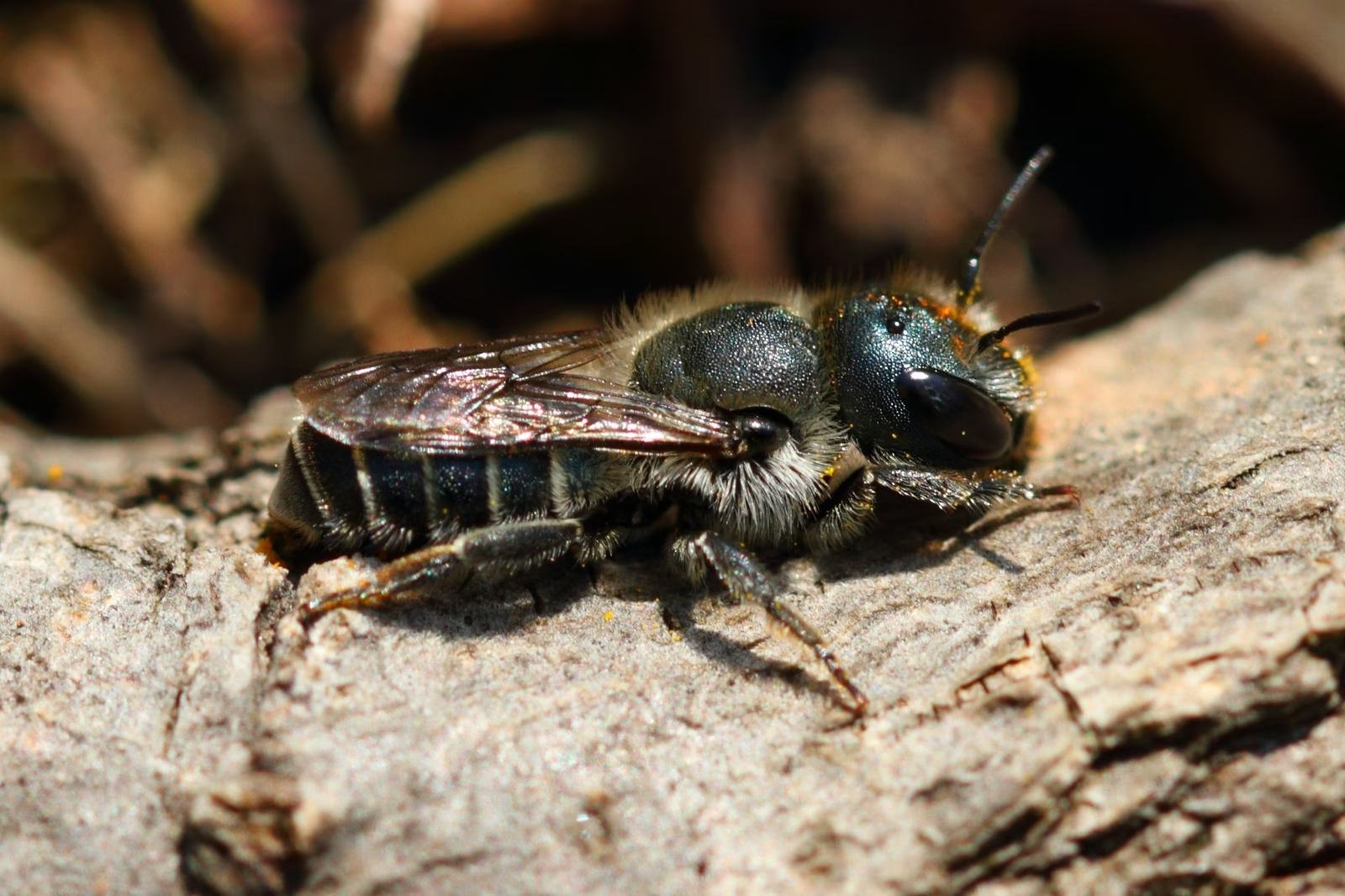
UK Bee Species
Blue Mason Bee (Osmia caerulescens)
Osmia caerulescens (Linnaeus, 1758) · subfamily Megachilinae · family Megachilidae
The blue mason bee comes in two forms so different they look like separate species: a dark, metallic blue-black female and a slim, coppery green-bronze male. Both are barely ten millimetres long, both are common in gardens and old brick walls, and both belong to one of the few British mason bees that builds not in mud, but in a paste of chewed leaves.
It is a cavity nester that takes readily to a bee hotel with the right size of tube, and turns out two broods a year in most of the country. See where it sits among Britain's bees on the UK Native Bee Species Map, or among the world's bees in the World Bee Atlas.
"Becoming blue"
Linnaeus described the bee in 1758, in the founding work of zoological naming.[3] Its species name, caerulescens, is Latin for "becoming blue", after the striking metallic sheen of the female, and the root of both its English name and its Continental one, the steel-blue mason bee.[3] The genus name Osmia is Greek for "scent", after the citrus-and-honey odour some mason bees use to mark their nest entrances.[7]
The mason that builds in leaves, not mud
Two common garden Osmia, two very different nest plugs
Where the red mason bee uses pure mud, the blue mason chews leaves into a green pulp, sometimes with a little grit added. The finished plug is the quickest field tell between them.
The bee at a glance
Full taxonomy
| Kingdom | Animalia |
| Phylum | Arthropoda |
| Class | Insecta |
| Order | Hymenoptera |
| Family | Megachilidae |
| Subfamily | Megachilinae |
| Genus | Osmia |
| Species | Osmia caerulescens |
Female and male: almost two bees
Few British bees show as sharp a difference between the sexes. Seen side by side, the metallic blue-black female and the coppery male are hard to place as the same species until you watch them fly to the same nest tube.
Female
- 10 to 11 mm, dark and dense-bodied
- Metallic steel-blue to blue-black sheen
- Box-shaped head, strong jaws for chewing leaves
- Jet-black scopa (pollen brush) under the belly
Male
- 8 to 9 mm, slimmer and smaller
- Bright copper-green to bronze body
- Lit with pale hair, especially on the face
- First to emerge each spring, from mid-April
Both carry the family signature of the Megachilidae: pollen carried dry in a brush of hairs beneath the abdomen rather than packed on the legs, so a foraging female shows a broad belt of pollen along her belly.[7] You can see where the family sits alongside the others in the World Bee Atlas.
Chewed leaves, and where she builds
The "mason" in the name comes from the masonry a female packs into her nest: for this species, a paste of chewed leaves, sometimes mixed with a little mud or grit.[1] A returning female can be seen with a small ball of green leaf pulp clamped in her jaws.[7] She builds in whatever cavity is at hand: old beetle burrows in dead wood, drilled holes in wooden blocks, hollow bramble or bamboo stems, cracks in mortar, even old nail holes in a garden shed.[1] A bee hotel with tubes four to eight millimetres wide, set against a warm south or south-east wall, will often be adopted within days.[5]
Two broods a year
In warm parts of Britain the blue mason bee is bivoltine, running two generations in a single summer.[1] Males of the first brood emerge from mid-April, followed by females; a second peak flies through August, before overwintering as adults inside the sealed cells.[1] Adults visit a wide range of flowers, with a marked liking for the pea family such as bird's-foot trefoil and vetches, along with campion, brambles and garden herbs like sage and lavender.[5]
Where and when you will see it
Blue mason bee is widespread across England and Wales, thinning northwards and reaching central Scotland, but has not been recorded from Ireland.[1][6] It is a bee of many habitats: coastal cliffs and dunes, private gardens, urban brownfield land, sunny woodland edges and old buildings.[1] Its main natural enemy is the striking black-and-white sapygid wasp Sapyga quinquepunctata, a specialist parasite that lays its eggs in the mason's sealed cells so its larvae can eat the pollen store.[1] A wider Palaearctic species, it also occurs across Europe, North Africa and central Asia, and, apparently as a human-assisted introduction, parts of North America.[6]
Telling it apart
Once seen well, the blue mason bee is hard to confuse with any other native bee. The female's steel-blue body, box-shaped head and jet-black belly scopa are collectively distinctive, and the coppery male looks almost like a different insect.[5] The one honest trap is the smaller, greener male of the two-coloured mason bee, which shares a coppery sheen but whose female is a very different bee: much smaller, with a bright orange abdomen, and specialised on empty snail shells for nesting.[7] If the bee you are watching is a plain metallic dark bee working a bee hotel, and the nest plugs are muddy-green rather than red, blue mason is the safest call across most of southern and central England.[1]
Why the blue mason bee matters
Blue mason bees are among the most efficient pollinators of the many flowers they visit, because, like all Megachilidae, they carry pollen dry and loose on the underside of the belly rather than packing it into wetted balls on the legs, so far more pollen brushes off onto each flower.[8] Their fondness for cavities in old wood, walls and stems is a reminder that a good wildlife garden is often the messier one: dead standing stems, sunny fence posts, a bee hotel and a few square metres of long grass will support blue masons and dozens of other solitary bees at very little cost.[5] See how those small choices add up in The Plate Without Bees.
British Soft Set Honey
Naturally set and spreadable, unpasteurised and minimally strained, drawn from British apiaries in the same open, blossom-rich country a blue mason bee works from April to August. Our British honey supplier holds SALSA Certification. 280g. £10.99.
Shop Soft Set Honey
Raw Acacia Honey
Our flagship raw Acacia: pale, delicate and slow to crystallise. From the Nistor family's Transylvanian apiaries. 280g. £10.99.
Shop Acacia
Subscribe & Save 20%
Choose any single honey and save 20% on every delivery. Free UK delivery on any order of 3 or more jars. Browse the full shop.
Start a SubscriptionFrequently asked questions
What is a blue mason bee?
Why is it called a mason bee?
How is it different from the red mason bee?
Will blue mason bees use a bee hotel?
When are blue mason bees active?
Do blue mason bees sting?
Do blue mason bees make honey?
What are the tiny black-and-white wasps around my bee hotel?
Related species
Red Mason Bee
Osmia bicornisRead more → Fellow OsmiaTwo-coloured Mason Bee
Osmia bicolorRead more → MegachilidaeWool Carder Bee
Anthidium manicatumRead more →Sources & references
- BWARS (Bees, Wasps & Ants Recording Society). Species account: Osmia caerulescens (Linnaeus, 1758): distribution across England and Wales, bivoltine flight, cavity-nesting in dead wood and stems, and the sapygid parasite Sapyga quinquepunctata. bwars.com.
- Falk, S. Field Guide to the Bees of Great Britain and Ireland, Bloomsbury, and the Steven Falk Flickr collection: female and male identification, size, colour and the black belly scopa.
- Linnaeus, C. (1758), Systema Naturae, 10th edition, original description. Etymology: Latin caerulescens, "becoming blue"; genus Osmia, from Greek osme, "scent" (NBN Atlas; GBIF).
- Ungricht, S., Muller, A. & Dorn, S. (2008). A taxonomic catalogue of the Palaearctic bees of the tribe Osmiini (Hymenoptera: Apoidea: Megachilidae). Zootaxa 1865: 1 to 253.
- NatureSpot (Leicestershire & Rutland Wildlife Trust) species profile, Osmia caerulescens: field identification, habitats, flight period and forage. naturespot.org.
- Wikipedia contributors, Osmia caerulescens: Palaearctic distribution, subspecies (caerulescens and cyanea), and record of introduction into North America.
- Else, G.R. & Edwards, M. (2018). Handbook of the Bees of the British Isles. Ray Society (Megachilidae biology, belly scopa, mason-bee sealing behaviour and separation of British Osmia).
- Wilson, J.S. & Carril, O.M. (2016). The Bees in Your Backyard. Princeton University Press: relative pollination efficiency of Megachilidae, comparative flower visits and cavity-nesting behaviour.

Dragos Nistor
Founder, HoneyBee & Co. · Guest Lecturer, University of Greenwich
HoneyBee & Co. draws on six generations of family beekeeping heritage, with honey from the Nistor family apiaries and from carefully chosen British producers. Our British honey supplier holds SALSA Certification, and we offer a 15% NHS Discount. Every jar is raw, unfiltered and traceable to the hive.