

 English (UK)
  Italiano
  Français
  简体中文
简体中文  한국어
한국어 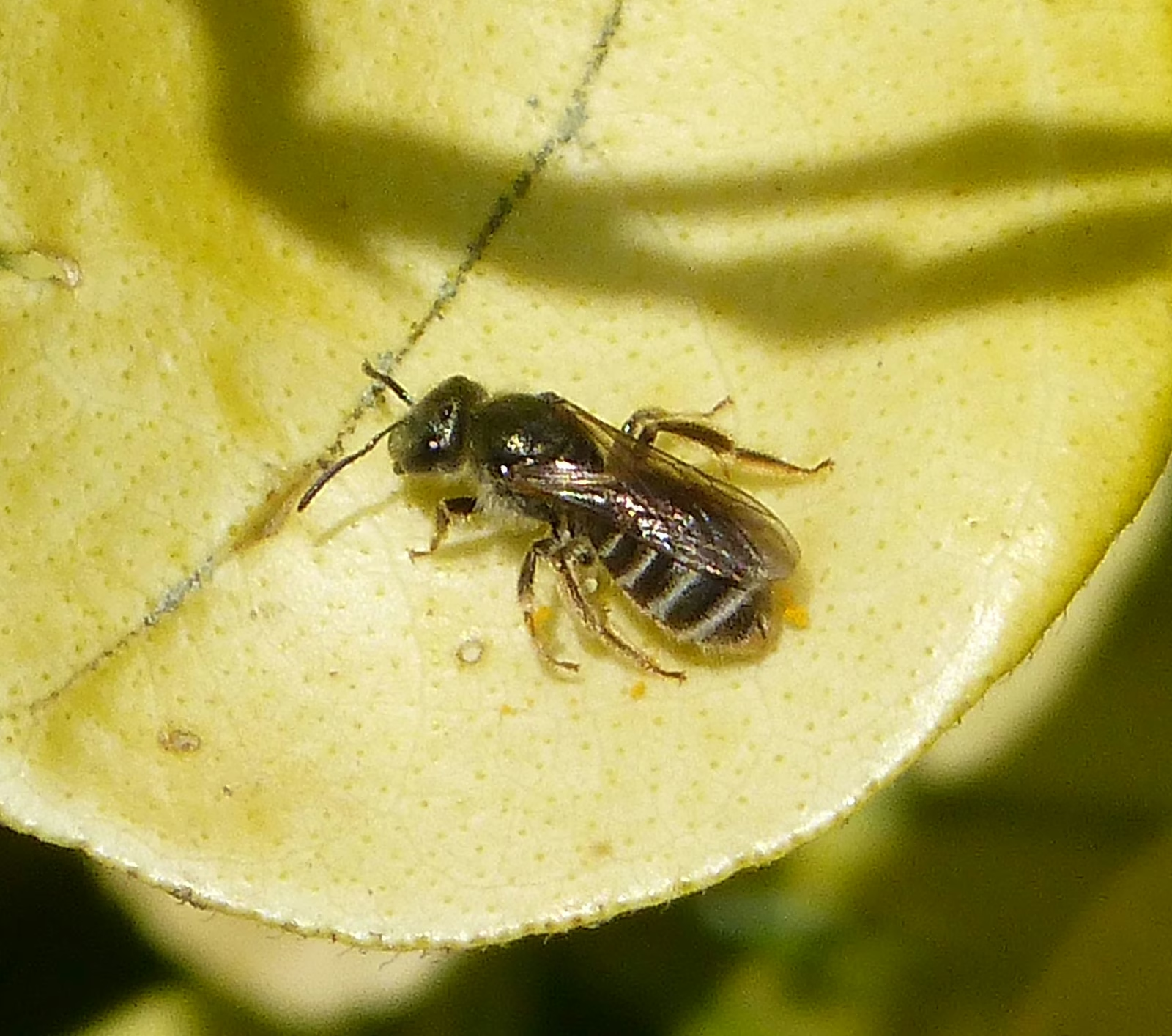
UK Bee Species
Bronze Furrow Bee (Halictus tumulorum)
Halictus tumulorum (Linnaeus, 1758) · subgenus Seladonia · family Halictidae
Bronze furrow bee is a small, tidy, metallic-green sweat bee, one of only two members of the genus Halictus commonly found in Britain and the smallest of the group by a clear margin. Barely six millimetres long and lit by a soft green-bronze sheen, it works garden and hedgerow flowers from spring right through to autumn and, if you slow down enough to look, gives away a small clue in its abdomen bands that reveals which side of the sweat bee family it belongs to. See where it sits among Britain's bees on the UK Native Bee Species Map, or among the world's bees in the World Bee Atlas.
Quick Facts
| Kingdom | Animalia |
| Phylum | Arthropoda |
| Class | Insecta |
| Order | Hymenoptera |
| Family | Halictidae |
| Subfamily | Halictinae |
| Genus | Halictus (subgenus Seladonia) |
| Species | Halictus tumulorum |
A small green bee of the mounds
The bronze furrow bee was described by Carl Linnaeus in 1758 in the founding work of zoological naming.[3] Its species name, tumulorum, is Latin for "of the mounds", a fitting name for a bee that digs its burrow into low earth banks and gently raised patches of bare, sunlit soil.[3] It sits in the subgenus Seladonia, a group of small, brightly metallic sweat bees; some modern authors treat Seladonia as a full genus, but here we follow the traditional placement in Halictus.[5] At only five to seven millimetres long it is a good deal smaller than most bees people notice in the garden, which is why it so often gets missed.[5][6]
Halictus or Lasioglossum? A tiny giveaway
The bronze furrow bee is the first member of the genus Halictus to be profiled here, and gives us a chance to explain the neatest trick for telling the two big sweat-bee genera apart. Both Halictus and Lasioglossum carry pale bands of felt-like hair across the abdomen, but the position of those bands is opposite between the two.[8] On a Halictus such as this one, the bands sit on the back (apical) edge of each abdominal segment; on a Lasioglossum, on the front (basal) edge of the following segment.[8] Look at a photo of the abdomen straight from above: the shining edges of the segments interrupt the pale bands in Lasioglossum, while Halictus bands sit right on those edges.[8]
Same family, opposite hair bands: Halictus at the back of the segment, Lasioglossum at the front. Once you have seen it, you never miss it.[8]
Sweat bees and furrow bees
The bronze furrow bee belongs to the Halictidae, the family known worldwide as sweat bees because some of its members are drawn to the salt in perspiration and will land harmlessly on skin to lap at it.[7] In Britain the family goes by the tidier name furrow bee, after a fine hairless groove, the rima, on the female's last abdominal segment.[7] You can see where the Halictidae sit alongside the other bee families in the World Bee Atlas.
A small social bee
Like many sweat bees, the bronze furrow bee is primitively eusocial: an overwintered female founds a nest in spring and raises a first brood, and some of those daughters stay on as workers to help rear a second brood of males and next-year females.[4] Its colonies are on the smaller side, and unusually the foundress and workers are not sharply different in size, an oddity called weak polyphenism that first drew researchers to the species half a century ago.[4] Females can be on the wing from April; workers appear by early summer, and males and new females fly late into the year, with records into October in warm years.[1]
Where and when you will see it
The bronze furrow bee is a genuine generalist, taking pollen and nectar from a very wide range of flowers, with a documented spring preference for the catkins of sallows and later visits to umbellifers, brambles and daisies of every kind.[5] It nests in short, sunlit turf and bare ground, often in small groups, and turns up in gardens, parks, brownfield, coastal cliffs and open country alike.[1] It is widespread and common through southern Britain, becoming scarcer as one moves north into the Central Highlands of Scotland, and is also present on the Isles of Scilly and the Channel Islands.[1] Its parasites are members of the blood-bee genus Sphecodes, small red-and-black cleptoparasites that enter unguarded nests to lay their own eggs in the host's cells.[7]
How to tell it apart
The one bee that reliably fools the eye is the closely related and much rarer Halictus confusus, a heathland species confined to a handful of sites in southern England.[1] Females of the two are so alike that identification is often only certain by dissecting a male and examining the genitalia.[1] The best field clue is the pale hair band on the third abdominal segment of the female: in the bronze furrow bee it does not fill the whole apical depression and is noticeably narrower in the middle than at the sides, whereas in H. confusus it fills the depression fully and is even in width across.[2] Males of the bronze furrow bee usually have dark middle and hind trochanters, while H. confusus males have them largely yellow.[2] Outside its rare relative's range, a small metallic-green Halictus is almost always this species.[2]
Why the bronze furrow bee matters
Because it is so widespread, active for so much of the year and so unfussy about the flowers it visits, the bronze furrow bee is one of the quiet background pollinators of gardens, parks and open flowery country across much of the Palaearctic.[5] It is also a model for understanding how bee societies work: as a primitively eusocial species with weak worker/foundress differences, it sits close to the crossover between solitary and social living, and its behaviour has been studied in detail as part of that story.[4] Recent work has produced a chromosome-level genome sequence for the species, which will feed further research into the origins of social behaviour in bees.[5]
Discovery Trio
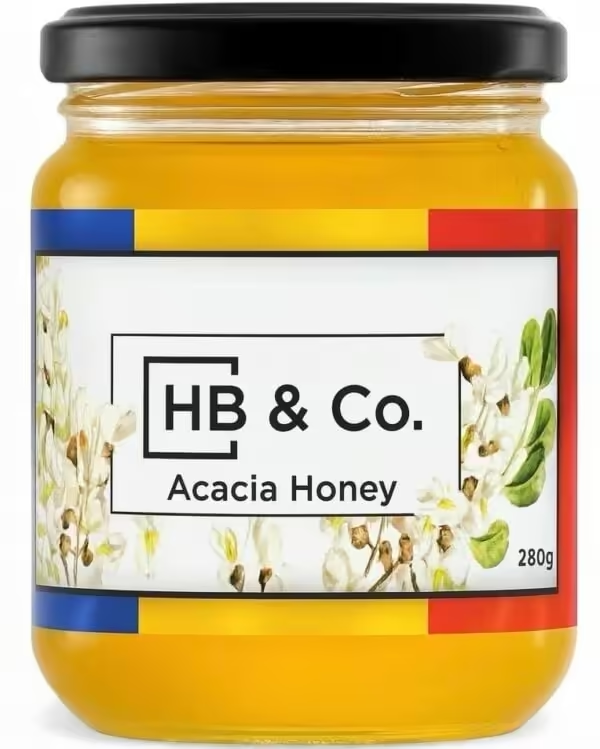
Three of our most delicate raw honeys in a single set: perfect if you are exploring the range and want to compare the mild summer honeys a bronze furrow bee helps to make possible. All 280g jars, all raw and unfiltered, all traceable.
Shop Discovery Trio
Raw Acacia Honey
Our flagship raw Acacia honey: pale, delicate and slow to crystallise. Drawn from the Nistor family's Transylvanian apiaries. 280g. £10.99.
Shop Acacia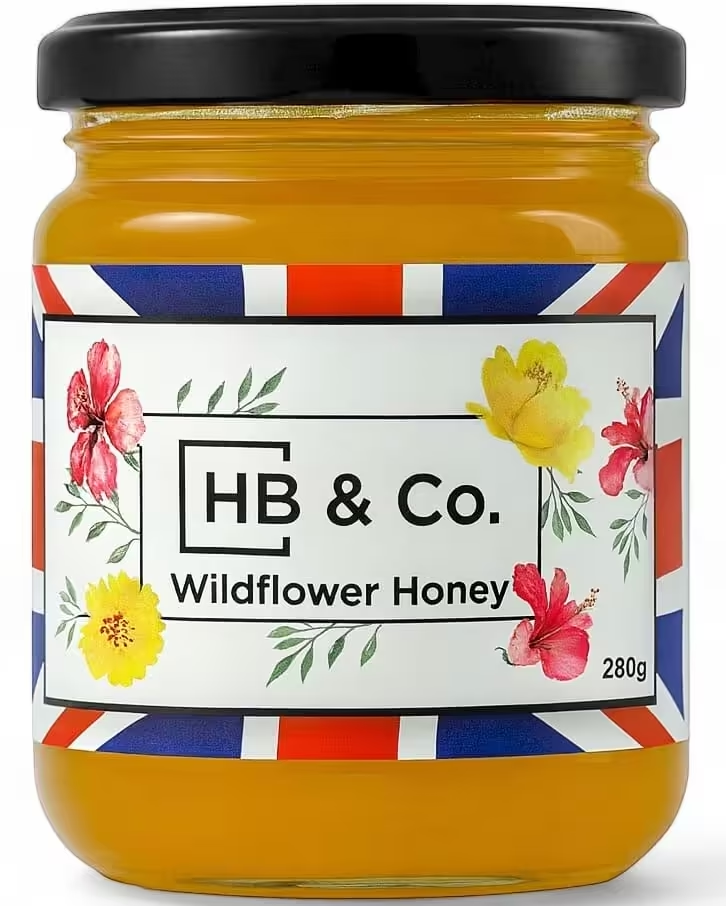
Subscribe & Save 20%
Choose any single honey and save 20% on every delivery, with free UK delivery on every subscription order. Browse the full shop.
Start a SubscriptionFrequently asked questions
What is a bronze furrow bee?
How is Halictus different from Lasioglossum?
Is the bronze furrow bee really green?
Is it social or solitary?
When are bronze furrow bees active?
Do bronze furrow bees sting?
Is this the same bee as the common furrow bee?
Does the bronze furrow bee make honey?
Related species
Orange-legged Furrow Bee
Halictus rubicundusRead more → Furrow beeCommon Furrow Bee
Lasioglossum calceatumRead more → Metallic greenGreen Furrow Bee
Lasioglossum morioRead more →Sources & references
- BWARS (Bees, Wasps & Ants Recording Society). Species account: Halictus tumulorum (Linnaeus, 1758): small metallic-green sweat bee, white tomentose hair bands on the gaster, near-identical to H. confusus, widespread through southern Britain to the Central Highlands. bwars.com.
- Falk, S. Field Guide to the Bees of Great Britain and Ireland, Bloomsbury, and the Steven Falk Flickr collection: separation from H. confusus using the hair band on tergite 3 and the colour of male trochanters.
- Linnaeus, C. (1758), Systema Naturae, 10th edition, original description. Etymology: Latin tumulorum, genitive plural of tumulus, "of the mounds", after the small mounds around the burrow entrance (NBN Atlas; GBIF).
- Plateaux-Quenu, C. & Plateaux, L. (1994). Polyphenism of Halictus (Seladonia) tumulorum (L.) (Hymenoptera, Halictinae). Insectes Sociaux 41(2): 219 to 222 (primitively eusocial with weak worker/foundress polymorphism).
- Falk, S. et al. (2025). The genome sequence of the bronze furrow bee, Seladonia tumulorum (Linnaeus, 1758). Wellcome Open Research 7:105 (small size, Palaearctic distribution from the UK to Japan, spring use of sallows, near-identical to H. confusus and separation by male genitalia).
- Benton, T. (2017). Solitary Bees. Naturalists' Handbooks 33, Pelagic Publishing (distribution, ecology and identification of British sweat bees).
- Else, G.R. & Edwards, M. (2018). Handbook of the Bees of the British Isles. Ray Society (the Halictidae, sweat-bee habit, furrow on the female's last tergite, blood-bee cuckoos in Sphecodes).
- Vermont Atlas of Life: Furrow Bees (genus Halictus), with the key field character separating Halictus from Lasioglossum by the position of abdominal hair bands (apical in Halictus, basal in Lasioglossum).

Dragos Nistor
Founder, HoneyBee & Co. · Guest Lecturer, University of Greenwich
HoneyBee & Co. draws on six generations of family beekeeping heritage, with honey from the Nistor family apiaries and from carefully chosen British producers. Our British honey supplier holds SALSA Certification, and we offer a 15% NHS Discount. Every jar is raw, unfiltered and traceable to the hive.