

 English (UK)
  Italiano
  Français
  简体中文
简体中文  한국어
한국어 
UK Bee Species
Common Furrow Bee (Lasioglossum calceatum)
Lasioglossum calceatum (Scopoli, 1763) · subfamily Halictinae · family Halictidae
The common furrow bee is the largest and most widespread of Britain's small sweat bees. Around seven to ten millimetres long, dark, and quietly ordinary at a glance, it is one of the busiest garden pollinators of the whole summer, flying from March into October and turning up on almost every open flower. What makes it remarkable is not its looks but its private life: the same species can raise a small worker colony in the warm south and go it alone as a solitary bee further north, all in a single season. See where it sits among Britain's bees on the UK Native Bee Species Map, or among the world's bees in the World Bee Atlas.
Quick Facts
| Kingdom | Animalia |
| Phylum | Arthropoda |
| Class | Insecta |
| Order | Hymenoptera |
| Family | Halictidae |
| Subfamily | Halictinae |
| Genus | Lasioglossum |
| Species | Lasioglossum calceatum |
A large sweat bee with Latin stockings
The common furrow bee was described by the Italian naturalist Giovanni Antonio Scopoli in 1763.[7] Its species name, calceatum, is Latin for "shod" or "wearing shoes", a nod to the neat pale hind legs of the female.[7] The genus name Lasioglossum is Greek for "hairy tongue", after the fine hairs on the mouthparts that let these small bees mop up thin nectar, and the English "furrow bee" comes from a fine hairless groove, the rima, running down the tip of the female's last abdominal segment, a feature shared across the genus.[4] At seven to ten millimetres long, this is the largest of Britain's dozens of Lasioglossum, a fraction bigger than a small honeybee-like sweat bee should be, which is often the first clue to identity.[6]
Sweat bees and furrow bees
The common furrow bee belongs to the Halictidae, called sweat bees around the world because some of the family are drawn to the salt in perspiration and will land on skin to lap at it, harmlessly.[5] In Britain the same bees usually go by the tidier name furrow bee, after the tiny groove on the female's tail.[5] Around 32 species of Lasioglossum live in the UK, part of a global genus of more than 1,700; the common furrow bee is the one most people will meet in a garden.[8] You can see where the Halictidae sit alongside the other bee families in the World Bee Atlas.
A society that changes with the weather
For all its ordinariness, the common furrow bee is a star of evolutionary biology. It is socially polymorphic: in warm places the same species runs a small annual colony with a queen and worker daughters, while in cool places it lives as a solitary bee, each female raising her own brood and no more.[3] A famous Japanese study on Mount Yokotsu found nests solitary above 1,000 metres and social lower down, all within a single mountain and a single species.[3] In Britain, southern populations tend to run the small social colonies while the far north sees the solitary form; the whole story runs on the length of the summer.[1]
Because the same species crosses from solitary to social living within its own range, the common furrow bee is one of a handful of model organisms in the study of how bee societies first arose.[3]
A common bee, all summer long
The common furrow bee has one of the longest flight seasons of any British bee. Overwintered females appear from mid-March; workers from the first social brood are out by early summer; new males and next-year females fly from July to late October, at least in the south.[1][6] Nests are dug in short turf and other open, sunny ground, and are usually founded by a single female rather than in the huge, dense aggregations some furrow bees form.[1] It is polylectic, working a wide range of flowers: spring sallow catkins and dandelions, garden shrubs, umbellifers in high summer, and, late in the year, knapweeds and thistles favoured by the males.[6]
Where and when you will see it
It is genuinely widespread, found across the whole of the United Kingdom and Ireland, and is regarded as the commonest Lasioglossum in most of Britain.[1] It is frequent in urban green spaces, gardens, parks, brownfield land and open dry habitats rich in wild flowers.[8] Its main cuckoo bee is the box-headed blood bee, Sphecodes monilicornis, and the smaller bare-saddled blood bee, S. ephippius, is a possible parasite; both are red-and-black cleptoparasites that enter the furrow bee's cells to lay their own eggs.[1] On a lawn or a warm south-facing path in July, a small dark bee shuttling between clover, thistle and knapweed is likely to be this species.
How to tell it apart
The nearest source of confusion is the bloomed furrow bee, Lasioglossum albipes, which is almost identical from a photograph.[2] The female common furrow bee is a little larger on average, has a rounder face, a shinier and darker abdomen with no strong grey bloom, and a brighter orange-brown pile on the top of the thorax.[2] Males of the two species overlap heavily; the common furrow bee male usually has a dark labrum, longer black antennae, and more obvious white patches at the base of the second and third abdominal segments.[1] For most casual records the safe course is to log a "common furrow bee group" and leave the certain identification to a hand lens or microscope.[2]
Why the common furrow bee matters
It is one of the most abundant wild bees in Britain and Europe, and, because it flies for so long and visits so many flowers, an important background pollinator of gardens, hedgerows and open flowery ground.[8] Its main charm, though, is scientific: this is one of the bees that has helped researchers understand how animal societies come into being, because it stands with one foot in solitary life and one in social life, and switches between them across its range.[3] Looking after the flower-rich lawns, meadows and quiet corners it uses is one of the easiest wins for garden biodiversity.[8]
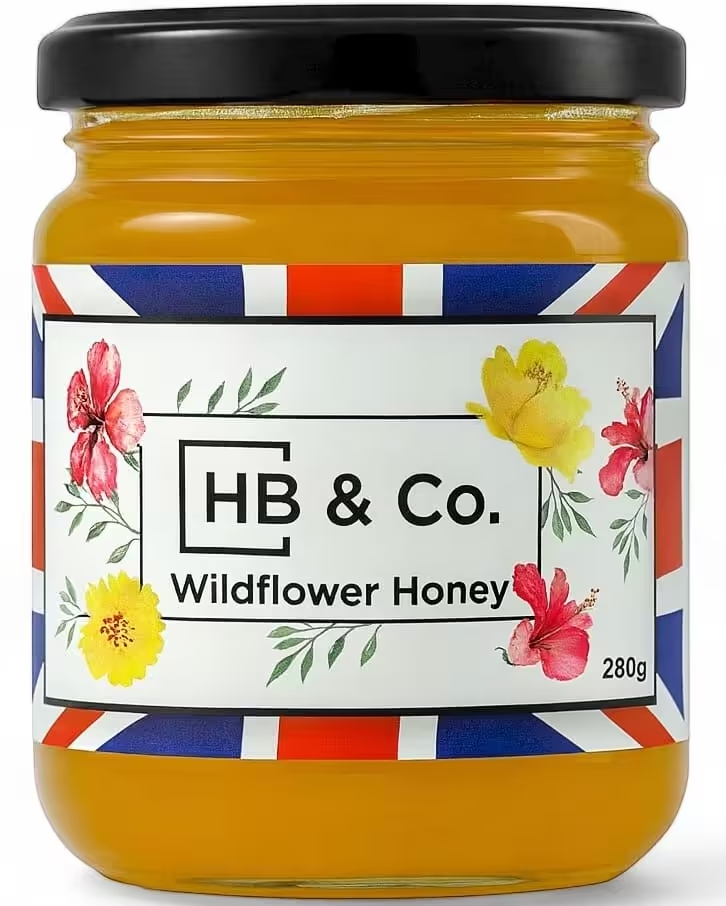
Raw British Wildflower Honey
Honey from Midlands meadows and hedgerows, the same open, flower-rich ground a common furrow bee works from spring to autumn. Raw, unfiltered and full of character. Our British honey supplier holds SALSA Certification. 280g. £10.99.
Shop Wildflower Honey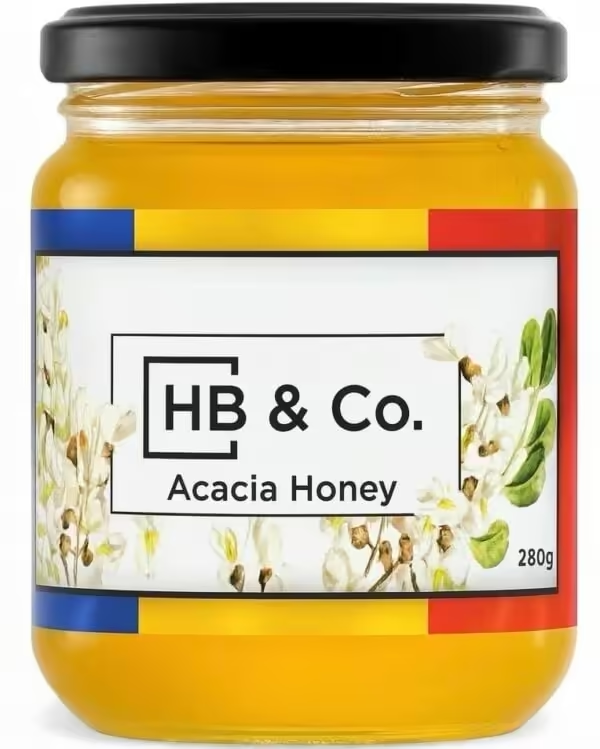
Raw Acacia Honey
Our flagship raw Acacia honey: pale, delicate and slow to crystallise. Drawn from the Nistor family's Transylvanian apiaries. 280g. £10.99.
Shop Acacia
Subscribe & Save 20%
Choose any single honey and save 20% on every delivery, with free UK delivery on every subscription order. Browse the full shop.
Start a SubscriptionFrequently asked questions
What is a common furrow bee?
Why is it called a furrow bee and a sweat bee?
How is it different from the green furrow bee?
Is the common furrow bee social or solitary?
When are common furrow bees active?
Do common furrow bees sting?
What is the tiny dark bee on my summer flowers?
Does the common furrow bee make honey?
Related species
Green Furrow Bee
Lasioglossum morioRead more → Furrow beeOrange-legged Furrow Bee
Halictus rubicundusRead more → Ground nesterAshy Mining Bee
Andrena cinerariaRead more →Sources & references
- BWARS (Bees, Wasps & Ants Recording Society). Species account: Lasioglossum calceatum (Scopoli, 1763): commonest British Lasioglossum, flight period, nesting in short turf, primitively eusocial in the south and solitary in the north, cuckoo Sphecodes monilicornis. bwars.com.
- Falk, S. Field Guide to the Bees of Great Britain and Ireland, Bloomsbury, and the Steven Falk Flickr collection: female and male identification, separation from L. albipes, punctation and tomentum characters.
- Boulton, R.A., Zuk, M. & Field, J. (2016). Social polymorphism in the sweat bee Lasioglossum (Evylaeus) calceatum: caste-size dimorphism and the origin of eusociality. Insectes Sociaux, and the earlier work of Sakagami & Munakata (1972) on Mount Yokotsu.
- Else, G.R. & Edwards, M. (2018). Handbook of the Bees of the British Isles. Ray Society (the Halictidae, the sweat-bee habit, and the furrow (rima) on the female's last tergite).
- Insect Week / Buglife. Common furrow bee (Lasioglossum calceatum): family context, UK abundance and behaviour. insectweek.org; buglife.org.uk.
- Nature accounts after BWARS and Falk (Wildlife Natural species profile): size 7 to 10 mm, flight period, forage preferences from spring blossom to late-season thistles.
- Scopoli, J.A. (1763), Entomologia Carniolica, original description. Etymology: Latin calceatum, "shod" or "wearing shoes", after the marked hind legs of the female; Greek Lasioglossum, "hairy tongue" (NBN Atlas; GBIF).
- Insect Week (Royal Entomological Society) and the Scottish Bees information sheet (Buglife): 32 UK Lasioglossum, common in Scottish urban greenspace, and the broad garden importance of common furrow bees.

Dragos Nistor
Founder, HoneyBee & Co. · Guest Lecturer, University of Greenwich
HoneyBee & Co. draws on six generations of family beekeeping heritage, with honey from the Nistor family apiaries and from carefully chosen British producers. Our British honey supplier holds SALSA Certification, and we offer a 15% NHS Discount. Every jar is raw, unfiltered and traceable to the hive.