
 English (UK)
  Italiano
  Français
  简体中文
简体中文  한국어
한국어 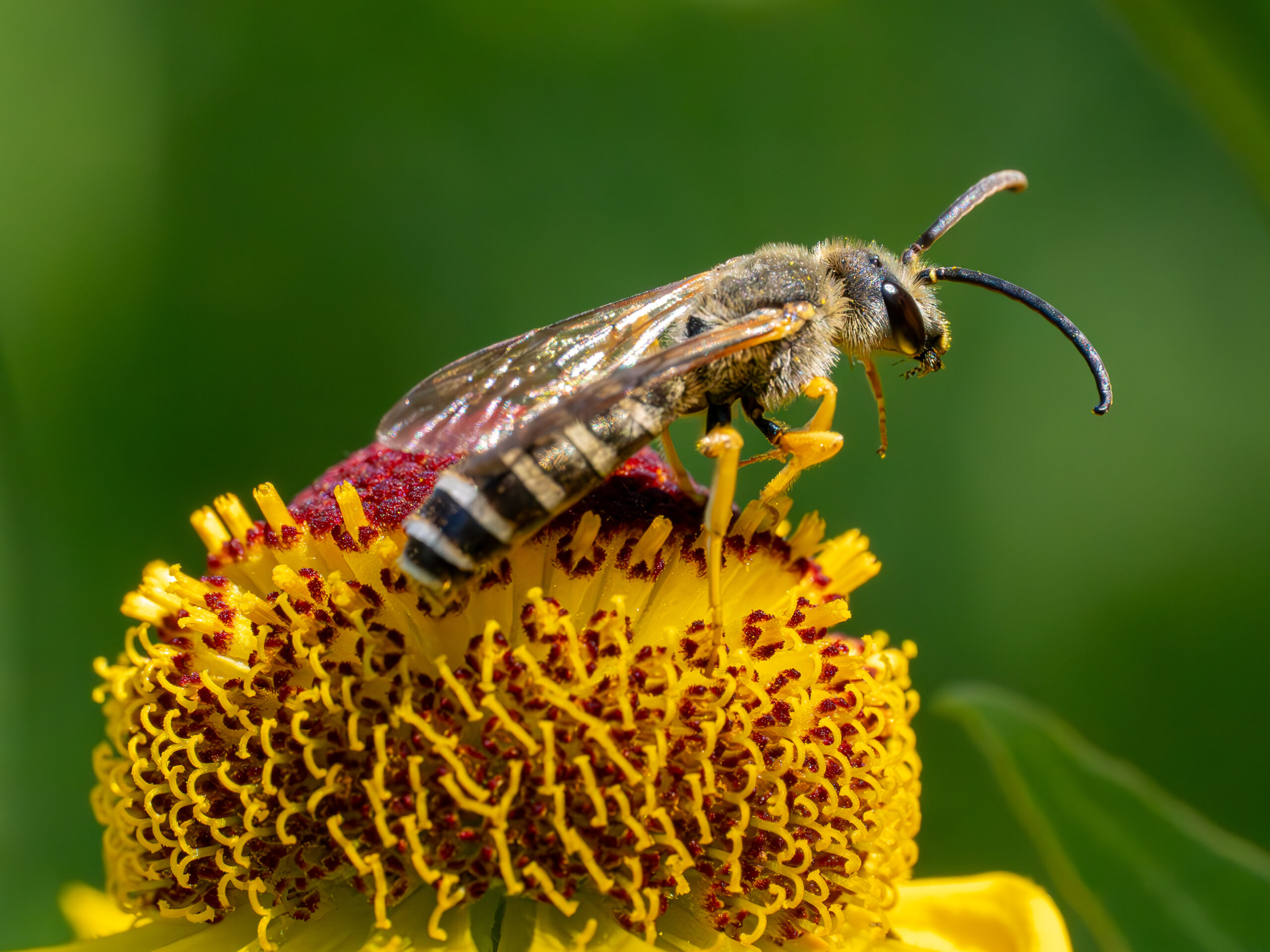 Halictus rubicundus, the orange-legged furrow bee. Reinhold Moller (Ermell), CC BY-SA 4.0, via Wikimedia Commons.
UK Bee Species
Orange-legged Furrow Bee (Halictus rubicundus)
Halictus rubicundus (Christ, 1791) · family Halictidae
The orange-legged furrow bee is a small, ground-nesting sweat bee with a remarkable trick: in the warm south it lives socially, with a queen and workers, but in the cool north the very same species nests alone. That flexibility has made it one of the most studied bees in the world for understanding how social life evolves. Look for it on bare, sunny banks from spring to autumn. Place it among Britain's bees on the UK Native Bee Species Map, or among the world's bees in the World Bee Atlas.
Quick Facts
| Kingdom | Animalia |
| Phylum | Arthropoda |
| Class | Insecta |
| Order | Hymenoptera |
| Family | Halictidae |
| Genus | Halictus |
| Species | Halictus rubicundus |
A sweat bee with orange legs
The orange-legged furrow bee is a member of the Halictidae, the sweat bees, so named because some are drawn to perspiration on warm days. Furrow bees take their name from a fine groove down the tip of the female's abdomen.[1] This is a fairly small bee, around a centimetre long, dark brown rather than metallic, with neat pale hair bands across the hind margins of the abdominal segments and, as the name promises, reddish-orange hind legs.[2] Fresh females show a reddish-brown pile on top of the thorax.
In the warmer south of its range the orange-legged furrow bee is eusocial, with a foundress queen and a brood of workers. In the cooler north the same species nests solitarily, each female working alone. This switch makes it a living model for how social behaviour evolves.[4]
How to identify the orange-legged furrow bee
Look for a small, striped, brownish bee with thin pale bands at the rear edges of the abdominal segments and rusty-orange hind legs.[2] Females are most easily confused with the larger furrow bee Lasioglossum xanthopum, but on that species the pale bands sit at the front of each segment rather than the rear.[1] Males are slimmer, with longer antennae and yellow markings on the face and legs; they can be separated from the very rare Halictus eurygnathus by their entirely dark antennae.[1] As with most small solitary bees, certain identification can require a close look at a specimen.
Nesting, lifecycle and society
Nests are dug in bare or sparsely vegetated ground, typically in light soils on warm, south-facing banks and slopes, either singly or in loose aggregations.[1] In social populations a mated queen emerges from hibernation in spring and founds a nest, rears a first brood of mostly small workers, and the colony then produces males and new queens towards the end of summer.[3] Those new queens mate, overwinter, and begin the cycle again. In solitary populations there are no workers at all; each female provisions her own cells.[4]
Adults are on the wing from April to October. The bee visits a wide range of flowers but shows a clear preference for the daisy family, including ragworts, thistles, knapweeds, mayweeds and dandelions.[3]
Whether a population is social or solitary is not fixed by geography alone. Transplant experiments have shown that orange-legged furrow bees retain the flexibility to switch strategy with local conditions, so the simple north-equals-solitary, south-equals-social picture is a useful generalisation rather than a hard rule. There is also long-standing debate over whether a second generation is produced in some warm years.[3][4]
Why it matters
The orange-legged furrow bee is both a useful generalist pollinator of meadow and verge flowers and a scientific treasure. Because the same species can be social or solitary, biologists use it to test ideas about why animals live in groups at all. Practically, it needs two simple things: open, flower-rich grassland for forage, and patches of bare, sunny, well-drained ground to nest in. Leaving a south-facing bank or path edge unplanted, and letting daisies, knapweeds and dandelions flower, gives this bee exactly what it needs.
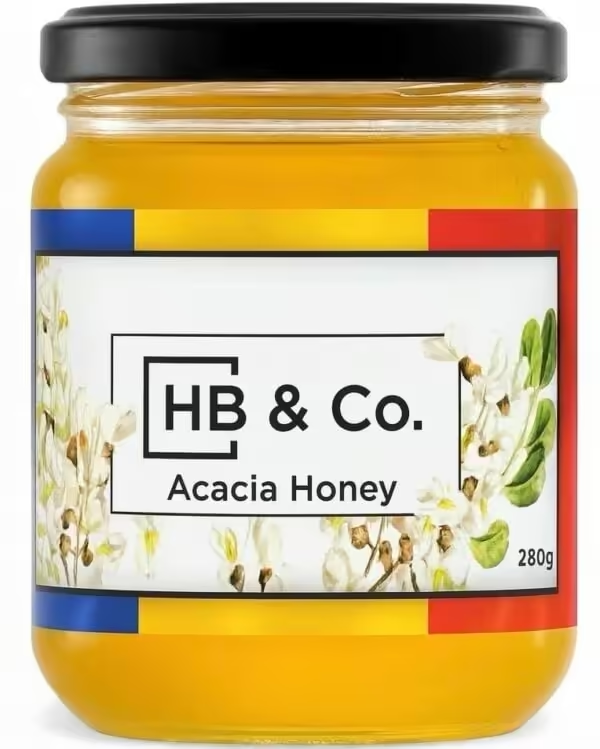
Raw Acacia Honey
Our flagship raw Acacia honey: pale, delicate and slow to crystallise. Six generations of family beekeeping heritage in every 280g jar. £10.99.
Shop Acacia Honey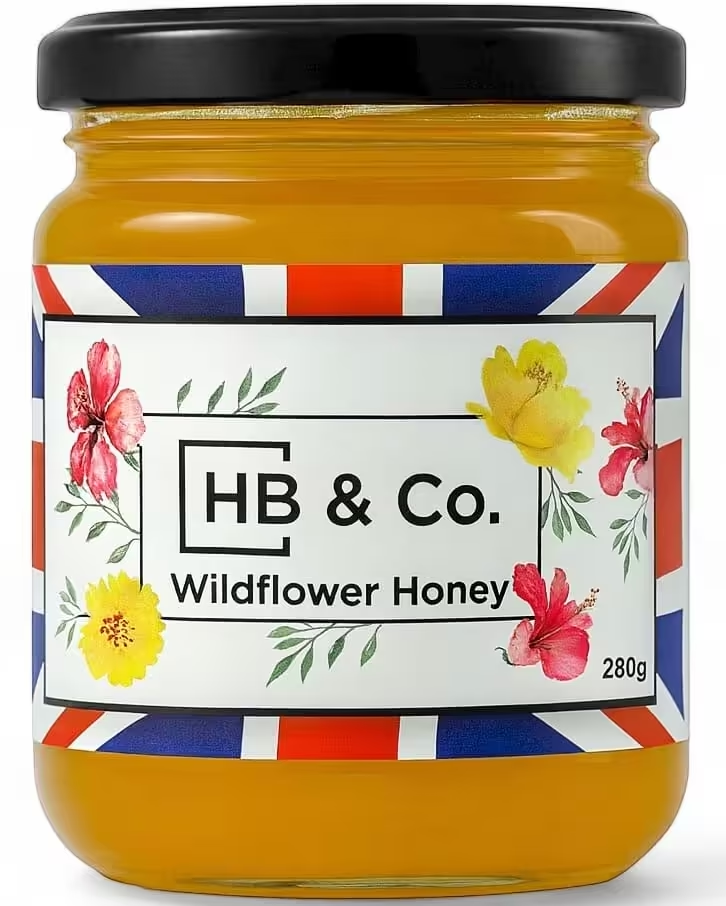
British Wildflower Honey
Raw honey from flower-rich Midlands meadows, the same daisy-and-knapweed grassland furrow bees forage. Our British honey supplier holds SALSA Certification. 280g. £10.99.
Shop Wildflower Honey
Subscribe & Save 20%
Choose any single honey and save 20% on every delivery, with free UK delivery on every subscription order.
Start a SubscriptionFrequently asked questions
How do I identify an orange-legged furrow bee?
What is a furrow bee or sweat bee?
Is the orange-legged furrow bee social or solitary?
Where does it nest?
When is it active?
Do orange-legged furrow bees sting?
What flowers does it visit?
Does the orange-legged furrow bee make honey?
Related species
Tawny Mining Bee
Andrena fulvaRead more → Ground-nesting beeAshy Mining Bee
Andrena cinerariaRead more → Solitary beeRed Mason Bee
Osmia bicornisRead more →Sources & references
- Falk, S. Field Guide to the Bees of Great Britain and Ireland, Bloomsbury, with identification notes for Halictus rubicundus (size, hair bands, separation from Lasioglossum xanthopum and Halictus eurygnathus). Steven Falk Flickr collection.
- BWARS (Bees, Wasps & Ants Recording Society). Species account: Halictus rubicundus (Christ, 1791), eusocial biology, nesting and flight period. bwars.com.
- NatureSpot and BWARS field accounts for Halictus rubicundus: habitat, forage (Asteraceae) and colony cycle.
- Field, J. et al. Studies on social plasticity in Halictus rubicundus, including transplant experiments showing climate-linked switching between social and solitary nesting (University of Sussex / published research on social plasticity).
- GBIF Secretariat. Halictus rubicundus (Christ, 1791): Holarctic distribution and taxonomy. gbif.org.
Dragos Nistor
Founder, HoneyBee & Co. · Guest Lecturer, University of Greenwich
HoneyBee & Co. draws on six generations of family beekeeping heritage, with honey from the Nistor family apiaries and from carefully chosen British producers. Our British honey supplier holds SALSA Certification, and we offer a 15% NHS Discount. Every jar is raw, unfiltered and traceable to the hive.