

 English (UK)
  Italiano
  Français
  简体中文
简体中文  한국어
한국어 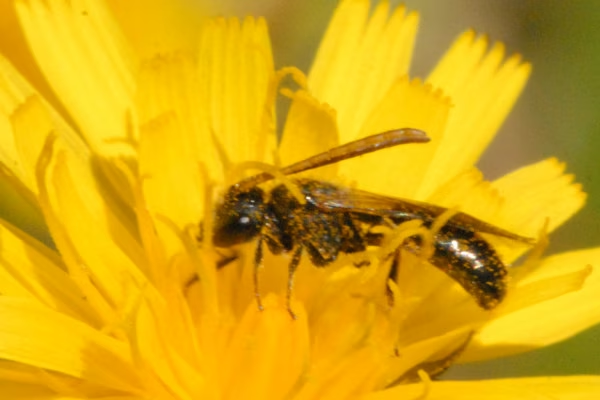
UK Bee Species
Green Furrow Bee (Lasioglossum morio)
Lasioglossum morio (Fabricius, 1793) · subfamily Halictinae · family Halictidae
The green furrow bee is one of the commonest bees in Britain, and one of the easiest to overlook. It is tiny, only about 5 mm long, dark, and lit by a faint metallic green sheen that you usually only notice in good light. It is a furrow bee, one of the group often called sweat bees, and it turns up in gardens, parks and waste ground almost everywhere, working a huge range of flowers from spring to autumn. See where it sits among Britain's bees on the UK Native Bee Species Map, or among the world's bees in the World Bee Atlas.
Quick Facts
| Kingdom | Animalia |
| Phylum | Arthropoda |
| Class | Insecta |
| Order | Hymenoptera |
| Family | Halictidae |
| Subfamily | Halictinae |
| Genus | Lasioglossum |
| Species | Lasioglossum morio |
A tiny green bee of gardens and banks
At only around 5 mm long, the green furrow bee is one of our smallest bees, a slim, dark insect whose body carries a metallic green to bronze sheen, strongest on the head and thorax.[2][3] It is the commonest of four small, metallic-green Lasioglossum in Britain, and telling these four apart for certain needs a lens and a look at the fine sculpture of the thorax.[1] For most purposes, a very small dark bee with a green glint, busy on garden flowers, is this species more often than not.
Sweat bees and furrow bees
The green furrow bee belongs to the family Halictidae, known around the world as the sweat bees because some are drawn to the salt in human perspiration and will land on bare skin to lap at it, doing no harm.[4] In Britain the same bees are usually called furrow bees, after a fine, hairless groove that runs down the centre of the female's last abdominal segment.[4] You can see where the Halictidae sit alongside the other bee families in the World Bee Atlas.
A bee with a simple society
For all its plainness, the green furrow bee has a more interesting private life than most of our solitary bees. It is primitively eusocial, a halfway house between solitary and fully social living.[3] A female that has overwintered starts a nest in spring and raises a first brood; some of these daughters then stay on as small helpers, or workers, while the foundress continues to lay, before males and new females appear later in the year.[5] Females are on the wing from March, males join them around June, and both can be found into October.[3] Many females nest close together, so that aggregations on warm, south-facing banks, and sometimes in soft mortar walls, can be large.[1]
Neither fully solitary nor fully social, the green furrow bee runs small annual colonies with a foundress and a few helper daughters, a simple society that hints at how bee social life may have begun.[3]
An everyday pollinator
The green furrow bee is a generalist, or polylectic, taking pollen and nectar from a wide range of flowers, with a particular fondness in spring for the catkins of sallows and the blossom of blackthorn.[3] Because it is so abundant, active for so much of the year and at home in gardens, parks and brownfield, it is one of the unseen workhorses of everyday pollination, especially in towns and cities.[3] Its success supports its own hangers-on: the nests are entered by cuckoo bees of the genus Sphecodes, the blood bees, named for their red-and-black bodies, which lay in the furrow bee's cells.[1]
Where and when you will see it
The green furrow bee is common across southern England and Wales, with scattered records into northern England and Scotland, and it uses a wide range of habitats, being especially at home in gardens and other urban green space.[5] It flies in a long season from March to October, so there is a good chance of meeting it on almost any sunny day through spring, summer and autumn.[3] It is not regarded as scarce or threatened.[1][6] Despite the sweat-bee name it is harmless: the sting is tiny and weak, and the bee is not aggressive.[4]
One of the longest seasons of any British bee, March to October, so the green furrow bee is on the wing across most of the year in gardens and on warm banks.[3]
Hairy tongues and a hidden furrow
The green furrow bee carries two clues to its identity in its names. Lasioglossum comes from the Greek for "hairy tongue", and the English "furrow bee" refers to a fine groove, the rima, running down the tip of the female's abdomen, a feature shared across the genus.[7] It belongs to the Halictidae, the sweat bees, so called because the family's members are sometimes drawn to perspiration on warm days. The species was first described by the Danish entomologist Johan Christian Fabricius in 1793.[7]
How to tell it apart
This is the commonest of four tiny, metallic green-bronze Lasioglossum in Britain, all in the subgenus Dialictus, with a forewing only about four millimetres long.[8] Telling them apart is a job for a hand lens: the green furrow bee is recognised by its dull, densely pitted upper thorax, the surface roughened between the punctures.[8] It is widespread and often abundant across England and Wales, scarcer in the north, and so far unrecorded from Scotland and Ireland.[8]
Why the green furrow bee matters
It is easy to value rare and showy bees and to miss the common ones, but sheer abundance is its own kind of importance. The green furrow bee is so numerous and so widespread that, taken together, its tiny bodies move a great deal of pollen, particularly in the gardens and green spaces where many showier bees are scarce.[3] Like all our solitary and semi-social bees it needs two simple things: a steady supply of flowers from spring to autumn, and patches of warm, bare or sparsely vegetated ground to nest in. Leaving some sunny bare soil and a long succession of flowers is the easiest way to keep this small green workhorse, and the cuckoos that depend on it, thriving.
Tiny generalists like this keep gardens pollinated; honeybees turn the same flowers into raw honey. Explore the range in the HoneyBee & Co. shop.
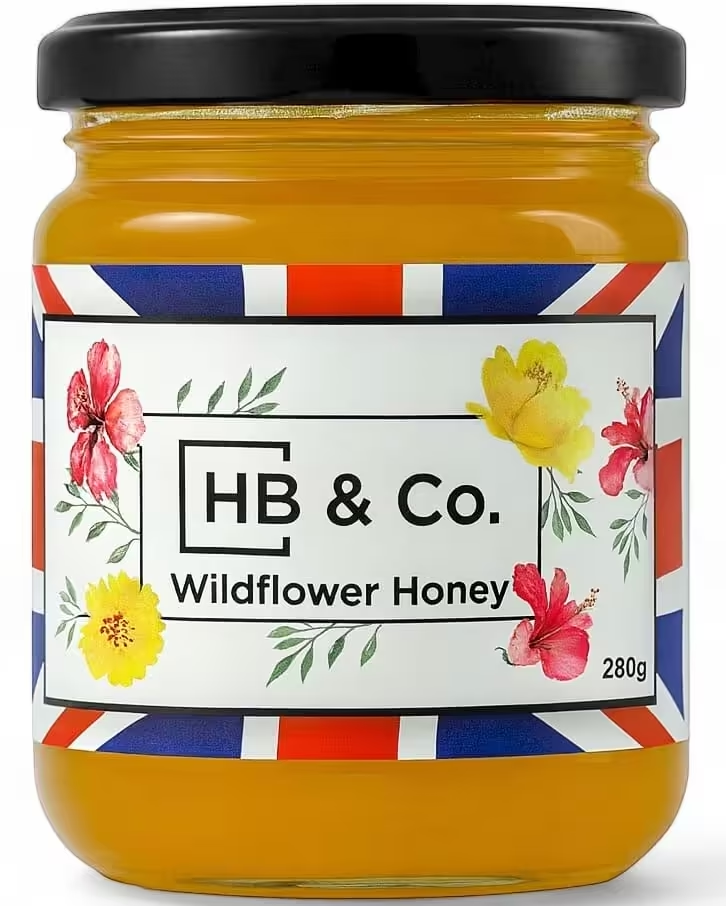
Raw British Wildflower Honey
Honey from Midlands meadows and hedgerows, the same garden and wild flowers a furrow bee works from spring to autumn. Raw, unfiltered and full of character. Our British honey supplier holds SALSA Certification. 280g. £10.99.
Shop Wildflower Honey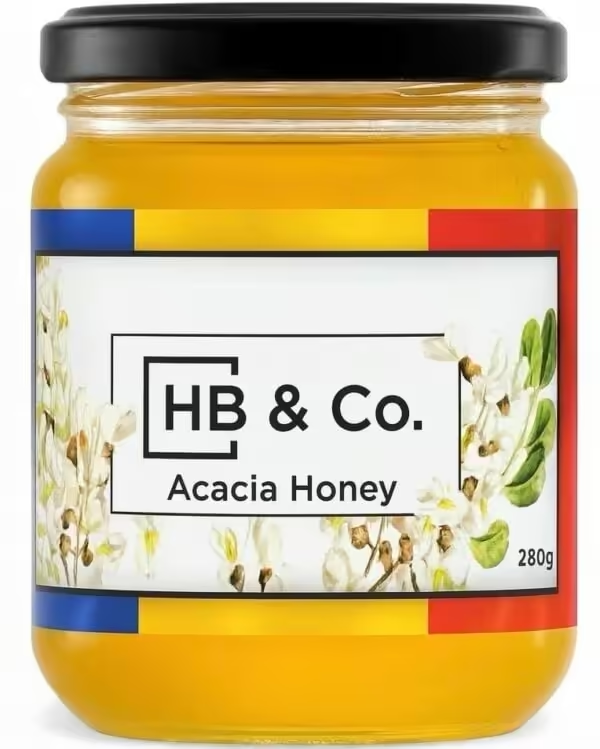
Raw Acacia Honey
Our flagship raw Acacia honey: pale, delicate and slow to crystallise. Drawn from the Nistor family's Transylvanian apiaries. 280g. £10.99.
Shop Acacia
Subscribe & Save 20%
Choose any single honey and save 20% on every delivery, with free UK delivery on every subscription order.
Start a SubscriptionFrequently asked questions
What is a green furrow bee?
Why are they called sweat bees and furrow bees?
Are green furrow bees common?
Do green furrow bees sting?
Are green furrow bees social or solitary?
When are green furrow bees active?
What is the tiny metallic green bee in my garden?
Does the green furrow bee make honey?
Related species
Orange-legged Furrow Bee
Halictus rubicundusRead more → Garden beeTawny Mining Bee
Andrena fulvaRead more → Ground nesterAshy Mining Bee
Andrena cinerariaRead more →Sources & references
- BWARS (Bees, Wasps & Ants Recording Society). Species account: Lasioglossum morio (commonest of the small metallic-green Lasioglossum, wide habitats, nesting including soft mortar walls, cuckoos Sphecodes niger and others). bwars.com.
- Falk, S. Field Guide to the Bees of Great Britain and Ireland, Bloomsbury, and the Steven Falk Flickr collection: Lasioglossum morio (very small metallic-green body, separation from close relatives, nesting aggregations on south-facing slopes).
- Falk, S., Monks, J., Richards, M. et al. (2024). The genome sequence of the common green furrow bee, Lasioglossum morio. Wellcome Open Research / Darwin Tree of Life (small size, polylectic with a spring preference for sallows and blackthorn, primitively eusocial, flight from March to October).
- Else, G.R. & Edwards, M. (2018). Handbook of the Bees of the British Isles. Ray Society (the Halictidae, the sweat-bee habit and the furrow on the female's last tergite).
- Monmouthshire Bees (Bees for Development). Lasioglossum morio: ground-nesting, primitively eusocial, large aggregations, and common British status. beesfordevelopment.org.
- Nieto, A. et al. (2014). European Red List of Bees. IUCN / Publications Office of the European Union (conservation status context).
- Fabricius, J.C. (1793), original description. Name etymology: Greek Lasioglossum, "hairy tongue"; the English "furrow bee" refers to the rima, a groove on the female's apical tergite (NBN Atlas; BWARS).
- Boyes, D. et al. (2024), Wellcome Open Research (Darwin Tree of Life genome note), and Falk, S. (2015): the four British Dialictus, separation by scutum punctation, and distribution.

Dragos Nistor
Founder, HoneyBee & Co. · Guest Lecturer, University of Greenwich
HoneyBee & Co. draws on six generations of family beekeeping heritage, with honey from the Nistor family apiaries and from carefully chosen British producers. Our British honey supplier holds SALSA Certification, and we offer a 15% NHS Discount. Every jar is raw, unfiltered and traceable to the hive.