

 English (UK)
  Italiano
  Français
  简体中文
简体中文  한국어
한국어 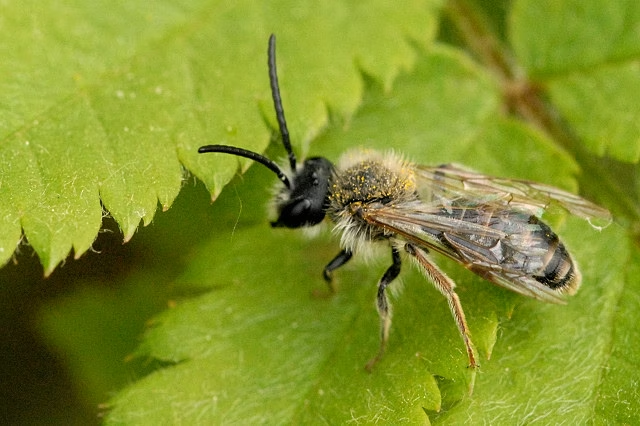
UK Bee Species
Grey-backed Mining Bee (Andrena vaga)
Andrena vaga Panzer, 1799 · subgenus Melandrena · family Andrenidae
The grey-backed mining bee is one of the most exciting recent additions to the British bee fauna: a large, handsome, grey-and-black spring bee that feeds only on willow, and that has crossed the Channel to colonise our south-east coast within the last decade. Long known as a great European miner that builds nesting cities of thousands of burrows, it is now a species to watch as it spreads through Britain. See where it sits among Britain's bees on the UK Native Bee Species Map, or among the world's bees in the World Bee Atlas.
Quick Facts
| Kingdom | Animalia |
| Phylum | Arthropoda |
| Class | Insecta |
| Order | Hymenoptera |
| Family | Andrenidae |
| Genus | Andrena |
| Species | Andrena vaga |
A big, grey-backed spring bee
The grey-backed mining bee is a large miner, the female 13 to 15 mm long, with the whole top of the thorax clothed in dense grey hair, sometimes with a faint buff tinge.[2] The abdomen is shiny, almost metallic black, with neat tufts of pale hair along the sides, and the pollen brushes on the hind legs are white.[2] It is a striking bee, and an obvious one where it occurs, but it can be mistaken for a close relative.
Grey-backed or ashy mining bee?
The bee it most resembles is the much commoner ashy mining bee (Andrena cineraria), with which it shares the black-and-grey colouring of the subgenus Melandrena.[5] The difference is in the thorax: the ashy mining bee has two separate grey bands with a black band between them, while the grey-backed mining bee has grey hair covering the entire top of the thorax.[2] The grey-backed mining bee is also larger, far rarer, a strict willow specialist, and at present confined to a few sites in the south-east.[1]
A willow specialist
This bee lives by the willow. It is oligolectic, meaning the female gathers pollen from one group of plants only, and for the grey-backed mining bee that group is the willows and sallows, genus Salix.[1][4] Its whole year is tuned to them: adults emerge in early spring, from March into May and sometimes late February in the warmest spots, to coincide exactly with the willow catkins, and the females provision their nests with willow pollen and nothing else.[2] Without willow-rich habitat, the bee simply cannot live.[4]
Willow is everything to this bee. Its spring emergence is timed to the catkins, and its young are reared on willow pollen alone.[4]
Nesting cities in the sand
The grey-backed mining bee nests in the ground, the female digging a vertical burrow in firm or sandy soil with sparse vegetation, on flat ground or on banks and slopes.[1] Although each female works her own nest, where the bee is common it gathers into enormous, dense aggregations: continental sites along the Rhine have held as many as ten thousand nests in one place.[1] Such colonies attract their own cuckoo: on the Continent the grey-backed mining bee is parasitised by Lathbury's nomad bee (Nomada lathburiana), the same nomad that attacks the ashy mining bee here in Britain.[1]
A new arrival, spreading
Here is what makes this bee such a talking point. It is widespread across much of Europe, yet for most of the twentieth century it was barely known in Britain, recorded just twice in Kent, in 1939 and 1946, and then not at all.[3][6] That changed in 2014, when numbers of the bee appeared at Dungeness in Kent and along the Solent coast in Hampshire, considered to be fresh arrivals from the near Continent rather than survivors of an old population.[3] Since then it has turned up at further sites in Kent, Sussex and Hampshire and begun to move inland, and it appears to be increasing.[1][3]
After only two old Kent records, the grey-backed mining bee arrived in numbers in 2014 at Dungeness and the Solent, and is now spreading through the south-east.[3]
A wandering name
The grey-backed mining bee was described by the German naturalist Georg Wolfgang Franz Panzer in 1799.[7] Its species name, vaga, is Latin for "wandering", an apt label for a large mining bee that has roamed back into Britain after vanishing for many years.[7]
How to tell it apart
The closest confusion is with the ashy mining bee, another grey, spring-flying Andrena that visits willows.[8] The two are easily separated on the thorax: the grey-backed mining bee has the whole top of the thorax clothed evenly in pale grey hair, whereas the ashy mining bee wears two distinct grey bands divided by a black one.[8] The grey-backed is also a strict willow specialist, gathering pollen from sallows alone, while the ashy mining bee takes a much wider range of flowers.[8]
Why the grey-backed mining bee matters
The grey-backed mining bee is a living example of how our wildlife is on the move as the climate shifts, a continental species establishing itself on British soil within living memory.[3] It also ties together two things every spring landscape needs: flowering willows and open, sunny ground to nest in.[4] Protecting coastal and brownfield sites with willow scrub and bare sandy ground gives this newcomer the foothold it needs, and recording it where you find it helps track one of the most interesting range expansions among British bees.[3]
Willow catkins are among the first food of spring for bees and honeybees alike. Taste the honeybee's work, and explore the range, in the HoneyBee & Co. shop.
Raw Honey Subscription
Choose any of our single-origin raw honeys and save 20% on every delivery, with free UK delivery on every subscription order. From £8.79 a month, and you can change or cancel anytime.
Start a Subscription
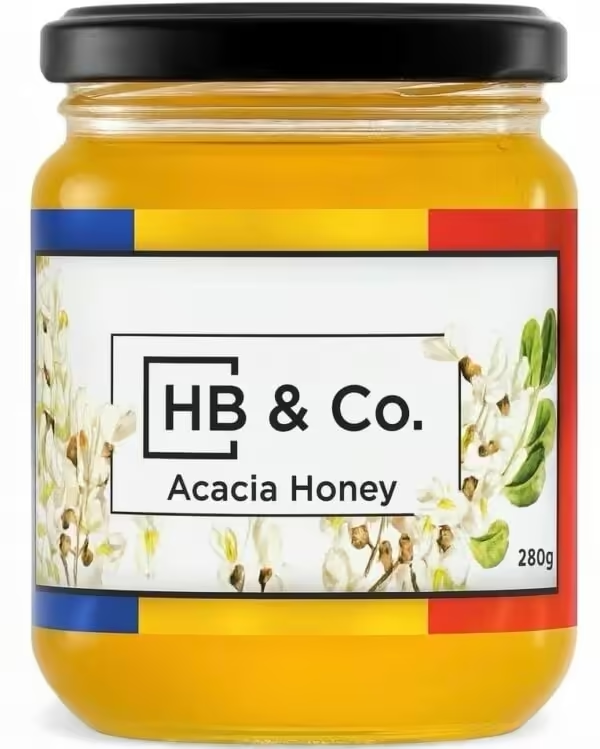
Raw Acacia Honey
Our flagship raw Acacia honey: pale, delicate and slow to crystallise, from the Nistor family's Transylvanian apiaries. 280g. £10.99.
Shop Acacia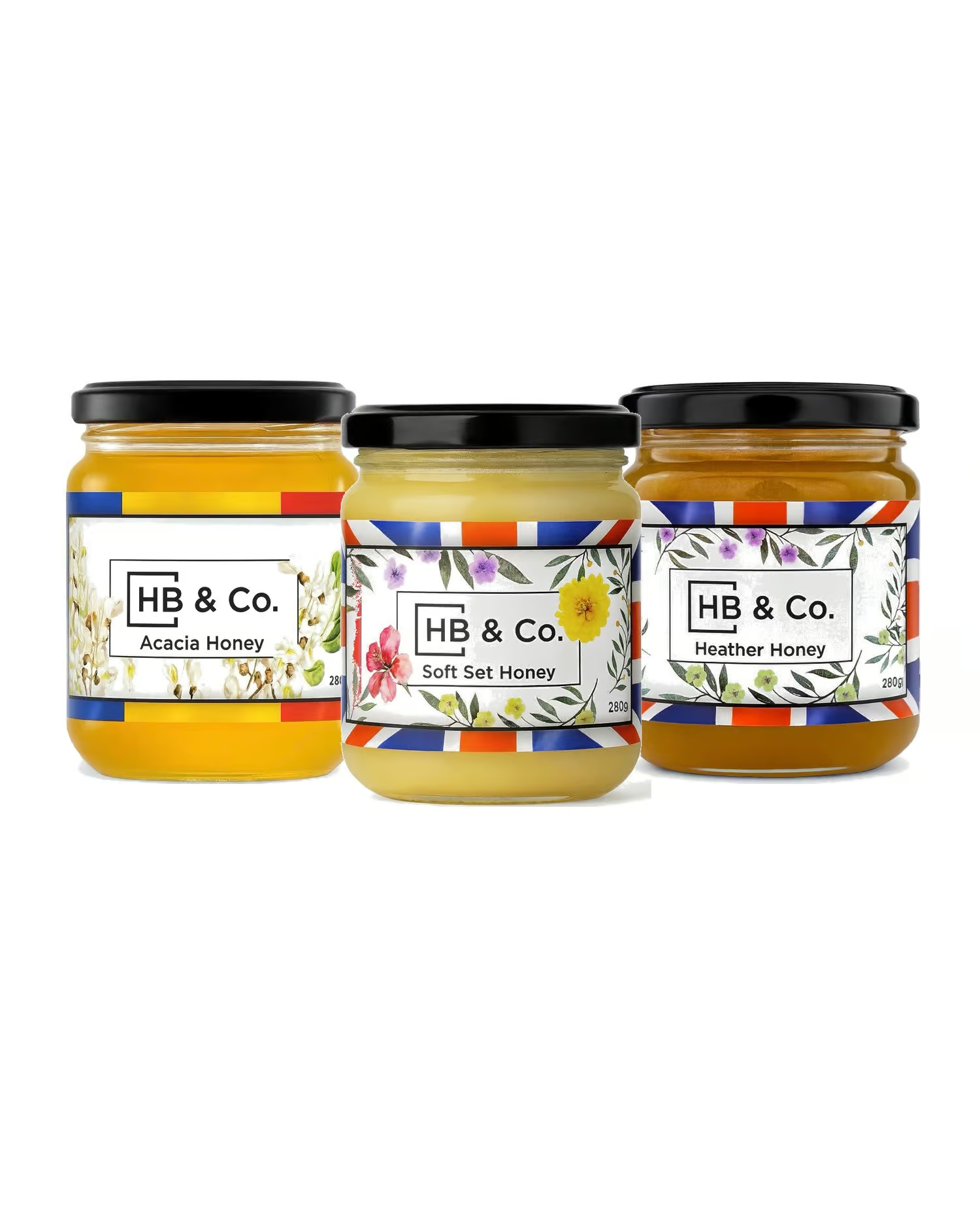
Discovery Trio
Three of our single-origin honeys in one set, the easy way to taste the range and find your favourite. £33.22.
Shop the TrioFrequently asked questions
What is the grey-backed mining bee?
How do I tell it from the ashy mining bee?
What does the grey-backed mining bee feed on?
Is the grey-backed mining bee new to Britain?
When is the grey-backed mining bee active?
Do grey-backed mining bees sting?
Why does it nest in such large groups?
Does the grey-backed mining bee make honey?
Related species
Ashy Mining Bee
Andrena cinerariaRead more → Spring minerTawny Mining Bee
Andrena fulvaRead more → Aggregation nesterYellow-legged Mining Bee
Andrena flavipesRead more →Sources & references
- BWARS (Bees, Wasps & Ants Recording Society). Species account: Andrena vaga (rare recent colonist, vertical nest burrows and very large aggregations, willow-pollen specialism, separation from the ashy mining bee, continental cuckoo Nomada lathburiana). bwars.com.
- Falk, S. Field Guide to the Bees of Great Britain and Ireland, Bloomsbury, and the Steven Falk Flickr collection: Andrena vaga (large grey-thoraxed female, separation from A. cineraria and other grey Andrena, flight March to May, willow-only pollen, aggregations of up to ten thousand nests).
- BWARS. Submit a sighting of Andrena vaga: British records (two Kent records in 1939 and 1946, then numbers at Dungeness and the Solent in 2014 as arrivals from the Continent, subsequently spreading inland). bwars.com.
- Bischoff, I., Feltgen, K. & Breckner, D. (2016). Foraging strategy and pollen preferences of Andrena vaga: the species' strict specialism on willow (Salix) pollen.
- Else, G.R. & Edwards, M. (2018). Handbook of the Bees of the British Isles. Ray Society (taxonomy, Andrena and the subgenus Melandrena).
- Nieto, A. et al. (2014). European Red List of Bees. IUCN / Publications Office of the European Union (European status and context).
- Panzer, G.W.F. (1799), Faunae Insectorum Germanicae initia, original description. Etymology: Latin vaga, "wandering" (GBIF; NBN Atlas).
- BWARS species account and Falk, S. (2015): the evenly grey thorax, strict willow (Salix) pollen specialism, recent recolonisation of south-east England, and separation from Andrena cineraria. bwars.com.

Dragos Nistor
Founder, HoneyBee & Co. · Guest Lecturer, University of Greenwich
HoneyBee & Co. draws on six generations of family beekeeping heritage, with honey from the Nistor family apiaries and from carefully chosen British producers. Our British honey supplier holds SALSA Certification, and we offer a 15% NHS Discount. Every jar is raw, unfiltered and traceable to the hive.