

 English (UK)
  Italiano
  Français
  简体中文
简体中文  한국어
한국어 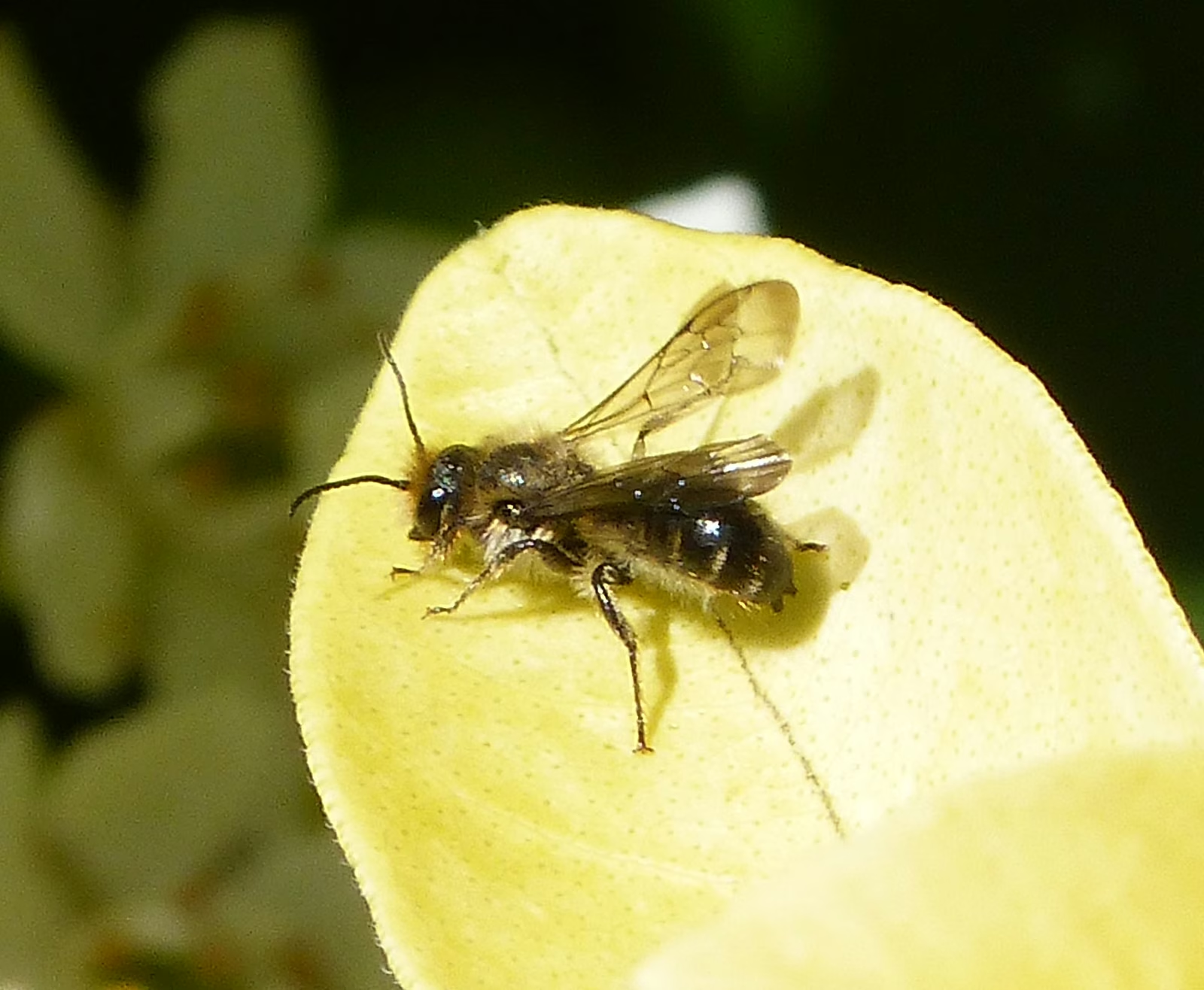
UK Bee Species
Sleepy Scissor Bee (Chelostoma florisomne)
Chelostoma florisomne (Linnaeus, 1758) · subfamily Megachilinae · family Megachilidae
Open a buttercup on a cool meadow morning and you may find a small dark bee still asleep inside it. That is the whole story of this insect, folded into its name. Linnaeus called it florisomne, "flower sleeper", in 1758, after the males that spend cold nights and grey afternoons curled up in the golden cups. And the flower is no accident: this is a bee that will feed from buttercups and nothing else, on pollen that would poison almost any other bee.
The sleepy scissor bee is a long, thin, matte-black insect barely ten millimetres long, easy to overlook in a hedgerow or a garden. See where it sits among Britain's bees on the UK Native Bee Species Map, or among the world's bees in the World Bee Atlas.
One bee, one flower
Why the sleepy scissor bee can live on a pollen that sickens other bees
Buttercup pollen carries compounds that irritate the gut of most bees. Chelostoma florisomne is one of a tiny handful that can tolerate them, so it has the flower almost to itself.
The bee that sleeps in a flower
Linnaeus described this bee in 1758, in the founding work of zoological naming, as Apis florisomnis, from the Latin flos, "flower", and somnus, "sleep".[3] The name records the habit of the males: in cool weather and at night they curl up inside the closed cups of buttercups, sometimes several together, and pass the poor hours in a torpid sleep.[5] The genus name Chelostoma, from Greek roots meaning "cloven mouth", refers to the long projecting jaws the females use to work leaves and shape mud in the nest.[7]
The bee at a glance
Full taxonomy
| Kingdom | Animalia |
| Phylum | Arthropoda |
| Class | Insecta |
| Order | Hymenoptera |
| Family | Megachilidae |
| Subfamily | Megachilinae |
| Genus | Chelostoma |
| Species | Chelostoma florisomne |
Three names, and what each one means
This bee travels under several English names, each pointing at a different feature. They are worth untangling, because two of them describe the physical bee and one describes its behaviour.
All three describe the same slim, cylindrical insect, which carries its pollen dry on a brush of hairs beneath the belly, the hallmark of the Megachilidae, rather than packed on the legs like a honeybee or bumblebee.[7] You can see where the family sits alongside the others in the World Bee Atlas.
A buttercup specialist
The sleepy scissor bee is oligolectic: it collects pollen only from a single, closely related group of flowers, and in this case only from buttercups. Bulbous, meadow and creeping buttercup are the main choices in Britain.[1] Buttercup pollen is toxic to most bees, containing chemicals that irritate the gut, but Chelostoma florisomne has evolved the ability to detoxify or tolerate those compounds, a rare and specialised trick that a 1997 study of its larval digestion set out in detail.[4] Wherever there is a good stand of buttercups within reach, and a piece of sunny dead wood or a bee hotel for nesting, the sleepy scissor bee can turn up in surprising numbers.[5]
Cavities, mud and one brood a year
The sleepy scissor bee is univoltine, with a single generation each year, and adults fly from May to July.[1] Females nest in narrow tubes: old beetle burrows in sun-warmed dead wood, dry hollow stems of reed or bramble, drilled holes in wooden posts, and, more unusually, thatched roofs and the timbers of old buildings.[1] The cell partitions and the nest plug are made of mud mixed with nectar, sometimes finished with small pebbles or sand grains set into the outer plug.[8] Each nest holds a linear row of small brood cells, from just a couple up to a couple of dozen in the best sites.[8]
Where and when you will see it
The sleepy scissor bee is widely recorded across England and eastern Wales, most often where meadows, woodland edges and gardens sit next to buttercup-rich pasture.[1] Look for it between mid-May and early July on meadow, bulbous and creeping buttercup, and check the closed flowers early in the morning or late in the day for sleeping males.[5] The main natural enemy is the sapygid wasp Monosapyga clavicornis, and, more occasionally, the ensign wasp Gasteruption jaculator, both of which parasitise the mud-plugged nests.[1]
Two slim black bees it is confused with
Britain has a few slim, dark bees that catch the eye in the same way. Two are worth learning, because the flower a bee is on will usually settle it before you reach for a lens.
| Species | Size | Tell it apart by |
|---|---|---|
| Sleepy scissor bee Chelostoma florisomne | ~10 mm | On buttercups only. White hair fringes on the first four abdominal segments; dense buff pollen brush beneath. Males have a wedge on the second underside segment. |
| Bellflower scissor bee Chelostoma campanularum | ~6 mm | Distinctly smaller, and on bellflowers (Campanula), not buttercups. The flower alone is usually the identification. |
| Large-headed resin bee Heriades truncorum | ~7 mm | A similar slim black bee, but less specialised and less densely fringed, and a summer flier favouring yellow composites. |
Why the sleepy scissor bee matters
Buttercups are visited by many insects, but the sleepy scissor bee is one of very few for which they are the entire diet, and one of an even smaller group that has evolved a way around their toxic pollen.[4] That makes it a small, elegant reminder that specialist pollinators depend on particular plants in particular places: a field with a few buttercups will support insects that a mown lawn simply cannot.[5] Lose the flower and you lose the bee outright, with no substitute to fall back on. See how those dependencies ripple outward in The Plate Without Bees. The species is also a favourite model for biologists studying solitary-bee nesting, pollen chemistry and cell construction.[6]
Raw Linden Honey
Linden honey is drawn from the pale, fragrant flowers of the lime tree in June and July, the very weeks the sleepy scissor bee is on the wing over its buttercup meadows. Delicate, slightly minty, richly floral. 280g. £10.99.
Shop Linden Honey
Raw Acacia Honey
Our flagship raw Acacia: pale, delicate and slow to crystallise. From the Nistor family's Transylvanian apiaries. 280g. £10.99.
Shop Acacia
Subscribe & Save 20%
Choose any single honey and save 20% on every delivery. Free UK delivery on any order of 3 or more jars. Browse the full shop.
Start a SubscriptionFrequently asked questions
What is a sleepy scissor bee?
Why is it called the "sleepy" scissor bee?
Why is it called a "scissor" bee?
Does it really only feed on buttercups?
When and where is it active?
Do sleepy scissor bees sting?
How is it different from the red mason bee?
Does the sleepy scissor bee make honey?
Related species
Red Mason Bee
Osmia bicornisRead more → Fellow MegachilidaeTwo-coloured Mason Bee
Osmia bicolorRead more → LeafcutterPatchwork Leafcutter Bee
Megachile centuncularisRead more →Sources & references
- BWARS (Bees, Wasps & Ants Recording Society). Species account: Chelostoma florisomne (Linnaeus, 1758): univoltine May to July, cavity nesting in dead wood, thatch and hollow stems, strict Ranunculus association, sapygid parasite Monosapyga clavicornis. bwars.com.
- Falk, S. Field Guide to the Bees of Great Britain and Ireland, Bloomsbury, and the Steven Falk Flickr collection: separation from C. campanularum and Heriades truncorum, male sternite characters, female mandibles.
- Linnaeus, C. (1758), Systema Naturae, 10th edition, original description as Apis florisomnis. Etymology: Latin flos + somnus, "flower sleeper", for the males that sleep in buttercup flowers (NBN Atlas; GBIF).
- Dobson, H.E.M. & Peng, Y.S. (1997). Digestion of pollen components by larvae of the flower-specialist bee Chelostoma florisomne (Hymenoptera: Megachilidae). Journal of Insect Physiology 43(1): 89 to 100 (buttercup pollen toxin tolerance).
- NatureSpot / Plantiary / Nature Journeys (species profiles): oligolecty on Ranunculus, cavity choice, male sleeping behaviour and general life history.
- Bees of Canada, species profile Chelostoma florisomne (Royal Saskatchewan Museum): sociality, nesting biology and pollen specialisation with references to Ungricht et al. (2008).
- Else, G.R. & Edwards, M. (2018). Handbook of the Bees of the British Isles. Ray Society (Megachilidae biology, belly scopa, tribe Chelostomini and shape).
- Muller, A. et al., Palaearctic Osmiine Bees resource (ETH Zurich): detailed nest architecture, cell partition composition of mud and nectar, and reference to the wider literature. blogs.ethz.ch/osmiini.

Dragos Nistor
Founder, HoneyBee & Co. · Guest Lecturer, University of Greenwich
HoneyBee & Co. draws on six generations of family beekeeping heritage, with honey from the Nistor family apiaries and from carefully chosen British producers. Our British honey supplier holds SALSA Certification, and we offer a 15% NHS Discount. Every jar is raw, unfiltered and traceable to the hive.