
 English (UK)
  Italiano
  Français
  简体中文
简体中文  한국어
한국어 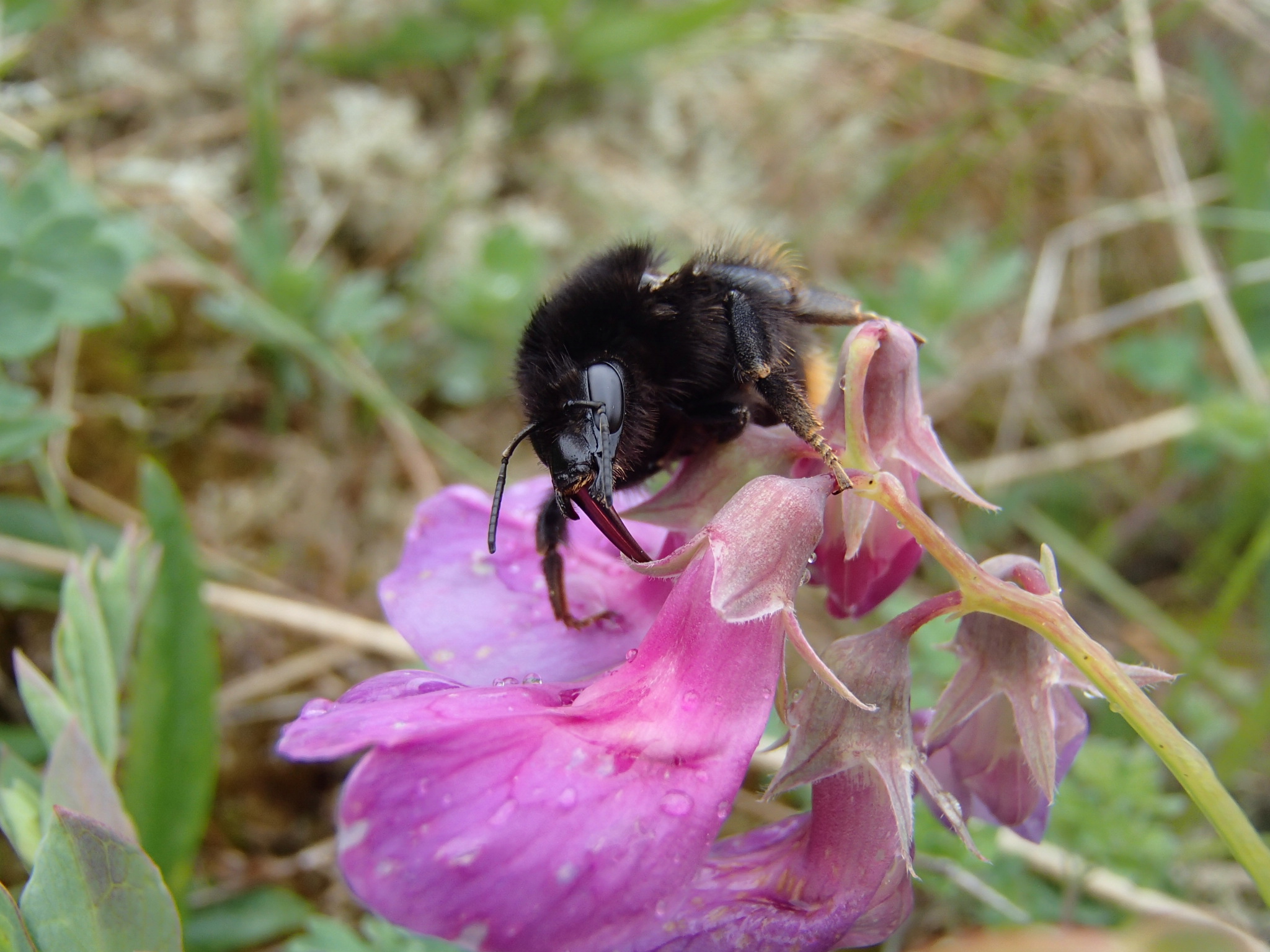 Bombus ruderarius, the red-shanked carder bee. Kjell Magne Olsen, CC BY 4.0, via Wikimedia Commons.
UK Bee Species
Red-shanked Carder Bee (Bombus ruderarius)
Bombus ruderarius (Müller, 1776) · subgenus Thoracobombus
The red-shanked carder bee is one of Britain's two surviving black bumblebees with a red tail, and the rarer of the pair. At a glance it is easily mistaken for the abundant red-tailed bumblebee, but a single feature gives it away: the fringe of orange hairs on its hind legs. Once widespread, it has retreated to flower-rich grasslands in southern Britain, with a surprising stronghold far to the north. Trace its range on the UK Native Bee Species Map, or place it among its relatives worldwide in the World Bee Atlas.
Quick Facts
| Kingdom | Animalia |
| Phylum | Arthropoda |
| Class | Insecta |
| Order | Hymenoptera |
| Family | Apidae |
| Genus | Bombus |
| Subgenus | Thoracobombus |
| Species | Bombus ruderarius |
A black bumblebee with a tell-tale red leg
The red-shanked carder bee looks, at first, like a smaller and rounder version of the familiar red-tailed bumblebee. Both queens and workers are velvety black with an orange-red tail.[1] The give-away is on the hind legs: in Bombus ruderarius the long hairs fringing the pollen basket (the corbicula) are bright orange, while in the red-tailed bumblebee they are black.[1] This is where the bee gets both its English name and its older folk name, the red-shanked bumblebee.
Telling it apart from the red-tailed bumblebee
Beyond the leg hairs, several features separate the two. The red-shanked carder bee is rounder and fluffier, without the sleek build of the red-tailed bumblebee, and its queens are noticeably smaller.[2] Its tail is orange-red rather than the deep crimson of lapidarius, its face and tongue are longer, and the abdomen is short, almost as broad as it is long.[2] Worn, sun-bleached red-tailed workers can confuse matters, so the safest approach in the field is to photograph the hind legs and enlarge the image to check the colour of the fringe.[4]
Where it lives in Britain
The red-shanked carder bee is found mainly across southern England, reaching into the Midlands and parts of south Wales.[3] Its most surprising population, given that southern bias, sits far to the north: the flower-rich machair and grasslands of the Hebridean islands of Coll and Tiree support some of the strongest colonies in Britain.[1] You can see how its scattered records line up against Britain's other bees on the UK Native Bee Species Map.
It occupies a wide range of open, flower-rich habitats, including chalk and neutral grasslands, coastal sites and flower-rich brownfield land.[2] The thread running through all of them is the same: extensive, undisturbed grassland with a long, unbroken succession of flowers from spring to late summer.
Records show a catastrophic decline in the abundance and range of the red-shanked carder bee across the British Isles since the first half of the twentieth century, driven by the loss of unimproved, flower-rich grassland.[1] In Ireland it is now formally assessed as Endangered.[5]
A nest of moss and an old mouse hole
This is a carder bee, and the name describes its nesting: the queen gathers, or cards, moss and dry grass to build a nest on or just below the surface of the ground, tucked under dense low vegetation.[4] She often founds the colony in an abandoned mouse or vole nest, which means the bee depends indirectly on grassland rich enough in cover to support small mammals.[6]
The first queens emerge from hibernation from mid to late April, with the occasional sighting in March. Historically this was recorded as the first of the carder bees to begin nesting each spring.[1] The colony grows through the summer, produces males and new queens from late July into August, and dies off during August or early September.[1]
What it feeds on
The red-shanked carder bee is a long-tongued bee, and its forage reflects that. It draws pollen and nectar especially from legumes such as red clover, bird's-foot-trefoils and vetches, and from members of the dead-nettle family including white dead-nettle, black horehound and ground-ivy, alongside knapweeds, scabious and teasel.[2] Its pollen comes mainly from three plant families: Fabaceae, Lamiaceae and the figworts.[1] The shared dependence on flower-rich meadows is exactly what links wild carder bees to the landscapes behind the most expressive British honeys.
The formal listing of this species lagged behind reality. It was not treated as scarce or threatened in Falk's 1991 review of British bees, yet by then its numbers had already fallen sharply, and concern over its true status grew only afterwards.[1] Today it is recognised as a Section 41 species of principal importance for conservation in England.[7] The lesson is that absence from an old list is not evidence of security.
Why it matters
As a long-tongued pollinator of clovers, vetches and other deep flowers, the red-shanked carder bee does work that short-tongued bees cannot, and its decline is a clear signal of the wider loss of species-rich grassland across lowland Britain. Protecting it means protecting the same habitat that supports the common carder bee, the moss carder bee and a host of other declining grassland insects. In the garden, leaving a patch of red clover and bird's-foot-trefoil to flower, and letting lawns grow longer, gives these bees exactly the late-season forage they need.
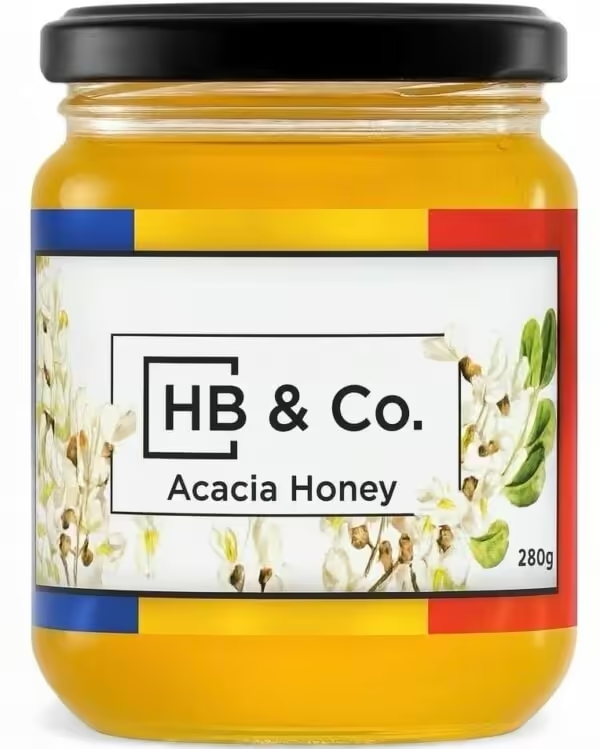
Raw Acacia Honey
Our flagship raw Acacia honey: pale, delicate and slow to crystallise. Six generations of family beekeeping heritage in every 280g jar. £10.99.
Shop Acacia Honey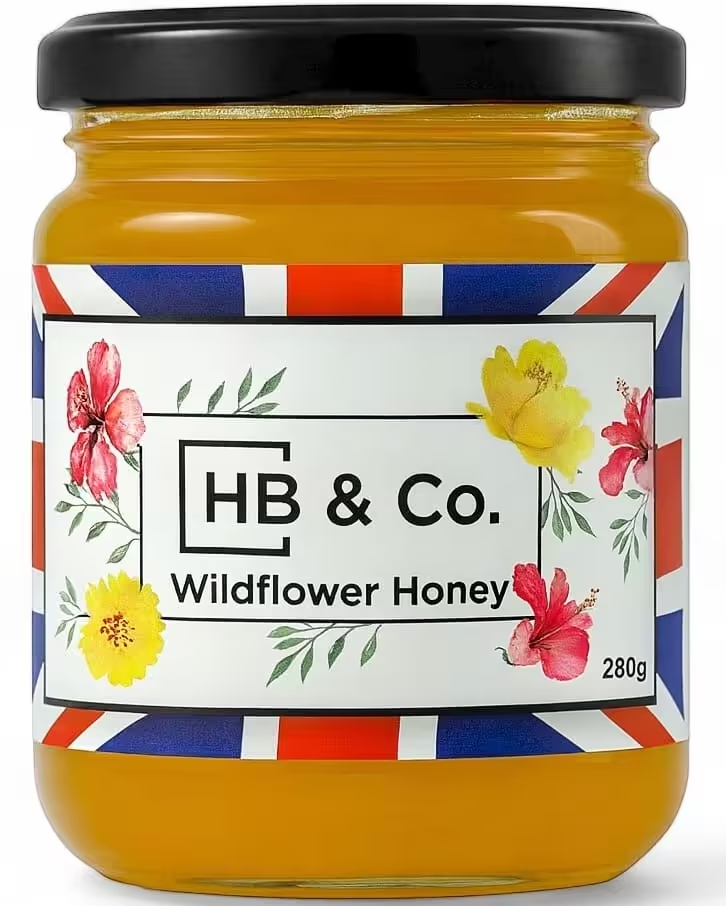
British Wildflower Honey
Raw honey from Midlands meadows, the same clover-and-bramble landscape wild carder bees forage. Our British honey supplier holds SALSA Certification. 280g. £10.99.
Shop Wildflower Honey
Subscribe & Save 20%
Choose any single honey and save 20% on every delivery, with free UK delivery on every subscription order.
Start a SubscriptionFrequently asked questions
How do I identify a red-shanked carder bee?
What is the difference between a red-shanked carder bee and a red-tailed bumblebee?
Where can I see red-shanked carder bees in the UK?
Is the red-shanked carder bee rare or endangered?
When are red-shanked carder bees active?
What flowers attract red-shanked carder bees, and how can I help them?
Do red-shanked carder bees sting?
Does the red-shanked carder bee make honey?
Related species
Red-tailed Bumblebee
Bombus lapidarius Read more → Carder beeCommon Carder Bee
Bombus pascuorum Read more → Cuckoo beeField Cuckoo Bee
Bombus campestris Read more →Sources & references
- BWARS (Bees, Wasps & Ants Recording Society). Species account: Bombus ruderarius (Müller, 1776). bwars.com.
- Falk, S. Field Guide to the Bees of Great Britain and Ireland, with accompanying identification notes for Bombus ruderarius. British Wildlife Publishing / Steven Falk Flickr collection.
- Bumblebee Conservation Trust and Buglife (Bees for the Future). Red-shanked carder bee (Bombus ruderarius) species information sheet and distribution summary.
- Buzz About Bees. Red-shanked carder bee, Bombus ruderarius: identification and habitat, summarising Falk and BWARS.
- Fitzpatrick, U., Murray, T.E., Byrne, A., Paxton, R.J. & Brown, M.J.F. (2006). Regional Red List of Irish Bees. National Parks and Wildlife Service (Ireland) and Environment and Heritage Service (Northern Ireland).
- Sladen, F.W.L. (1912). The Humble-bee: Its Life-History and How to Domesticate It. Macmillan, London (general carder-bee biology and nesting).
- Natural England / JNCC. Habitats and Species of Principal Importance in England (Section 41 of the Natural Environment and Rural Communities Act 2006), which lists Bombus ruderarius.

Dragos Nistor
Founder, HoneyBee & Co. · Guest Lecturer, University of Greenwich
HoneyBee & Co. draws on six generations of family beekeeping heritage, with honey from the Nistor family apiaries and from carefully chosen British producers. Our British honey supplier holds SALSA Certification, and we offer a 15% NHS Discount. Every jar is raw, unfiltered and traceable to the hive.