
 English (UK)
  Italiano
  Français
  简体中文
简体中文  한국어
한국어 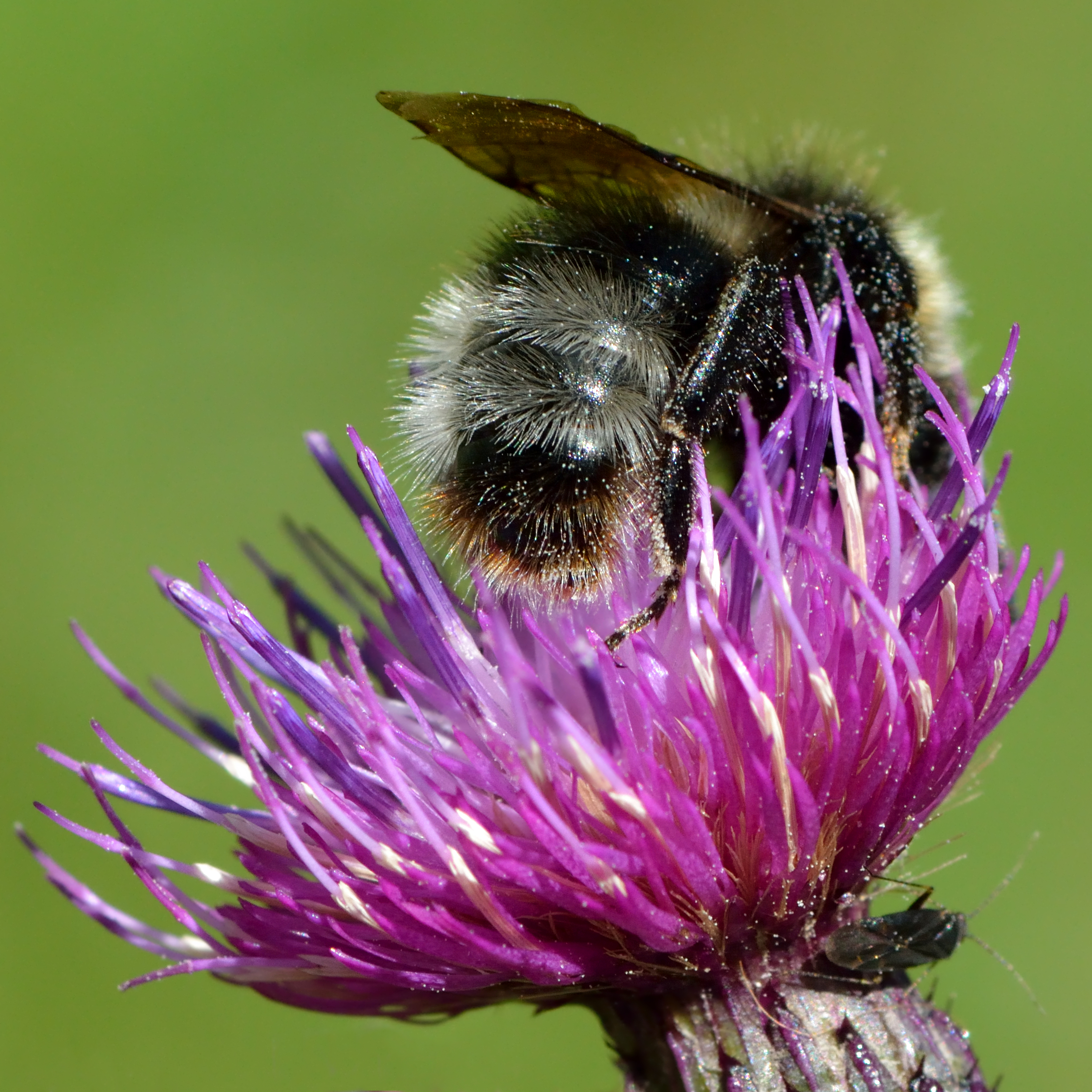 Bombus sylvestris, a male forest cuckoo bee on marsh thistle. Ivar Leidus, CC BY-SA 4.0, via Wikimedia Commons.
UK Bee Species
Forest Cuckoo Bee (Bombus sylvestris)
Bombus sylvestris (Lepeletier, 1832) · subgenus Psithyrus
The forest cuckoo bee builds no nest, raises no workers and collects no pollen. It is one of six cuckoo bumblebees in Britain, a group that survives entirely by invading the colonies of true bumblebees. The female slips into the nest of an early bumblebee, takes over from the resident queen, and leaves the host workers to raise her own young. Despite that ruthless lifestyle it is one of our most familiar cuckoo bees, common along sunny woodland edges. See where it overlaps with its hosts on the UK Native Bee Species Map, or place it among the world's bumblebees in the World Bee Atlas.
Quick Facts
| Kingdom | Animalia |
| Phylum | Arthropoda |
| Class | Insecta |
| Order | Hymenoptera |
| Family | Apidae |
| Genus | Bombus |
| Subgenus | Psithyrus |
| Species | Bombus sylvestris |
A bumblebee that builds no nest
The forest cuckoo bee belongs to the subgenus Psithyrus, the cuckoo bumblebees. These bees were once placed in their own genus, reduced to a subgenus of Bombus in the 1990s.[4] They are obligate social parasites: every cuckoo bumblebee depends completely on a host bumblebee species to provide a nest, food and a workforce. Cuckoo bees lack a worker caste, have only reduced wax glands, and produce just males and new females rather than the queen-worker structure of an ordinary colony.[5]
Because she never gathers pollen for her own brood, the female has no functional pollen basket on her hind legs. Where a true bumblebee queen carries a smooth, shiny corbicula fringed for pollen, a cuckoo bee's hind leg is hairy all over.[5] Cuckoo females also tend to look darker and more heavily armoured, with sparser body hair and often smoky wings, adaptations that help them survive the violent business of taking over a nest.
The forest cuckoo bee never founds a colony of its own. The female enters a host nest, dominates or kills the resident queen, and the host's own workers then unknowingly raise her brood of male and female cuckoo bees.[4]
How to identify the forest cuckoo bee
This is a small, dark cuckoo bee. Females are around 15 mm long and males a little smaller at about 14 mm.[7] Most have a single yellow collar band at the front of the thorax, a fainter yellow band at the front of the abdomen, and a black abdomen ending in a white or pale tail. In females the tip of the abdomen is strongly downcurved, a useful cuckoo-bee character.[3]
Males, red tails and a mousy scent
Males are the more variable sex. Many show a black-and-ginger tip to the tail, the feature visible in the male pictured above, while others have the pale tail replaced by yellow or buff, and some are almost entirely black.[2] Fully dark males cannot be told apart from melanic field cuckoo bee or red-tailed cuckoo bee males in the field, and unusual specimens need their genitalia checked under a microscope.[2] One field clue is behavioural: male forest cuckoo bees patrol sunny woodland edges and give off a distinctive mousy scent that no other British bumblebee produces.[2]
The hosts: early, heath and bilberry bumblebees
The forest cuckoo bee's primary host is the early bumblebee (Bombus pratorum).[1] The female searches out a small early bumblebee nest in spring, enters it and cohabits for a time before dominating the host queen and stopping her from laying. The cuckoo then lays her own eggs, which the host workers rear as their own.[4] She is also thought to attack other members of the same species group, including the heath bumblebee (B. jonellus) and the bilberry bumblebee (B. monticola).[1]
The exact host range is not fully settled. BWARS and Falk treat the early bumblebee as the confirmed primary host and the heath and bilberry bumblebees as probable additional hosts, while some other accounts add the tree bumblebee and, more tentatively, the garden and broken-belted bumblebees.[1][6] Confirmed British nest records remain limited, so the wider list is best read as plausible rather than proven.
Where and when you will see it
The forest cuckoo bee occurs in a wide range of habitats but is the most frequent cuckoo bumblebee of woodland, turning up along woodland edges and rides, in hedgerows, on heaths and in gardens and parks wherever its hosts are present.[1] It is widespread across Britain, though scarcer in the south-east, where heathland and its host bees are fragmented, and more regularly recorded in the north and west.[3]
Overwintered females appear from late March, occasionally earlier in mild springs, and fly into June. Males and new females are on the wing from July into September.[1] Where the early bumblebee produces two colony cycles in a year, the forest cuckoo bee can follow suit, so fresh females may be seen feeding on devil's-bit scabious and ivy well into the early autumn.[2]
Why a parasite matters
It is tempting to see a cuckoo bee as simply a thief, but its presence is a sign of a healthy bee community. A cuckoo bumblebee can only persist where its host colonies are common enough to sustain it, so a good population of forest cuckoo bees points to a landscape rich in early, heath and bilberry bumblebees, and rich in the flowers those bees depend on.[6] When host populations thin out, the cuckoo is among the first to disappear. That makes it a quiet but useful indicator of the wider flower-rich habitat that supports all of Britain's wild bees.
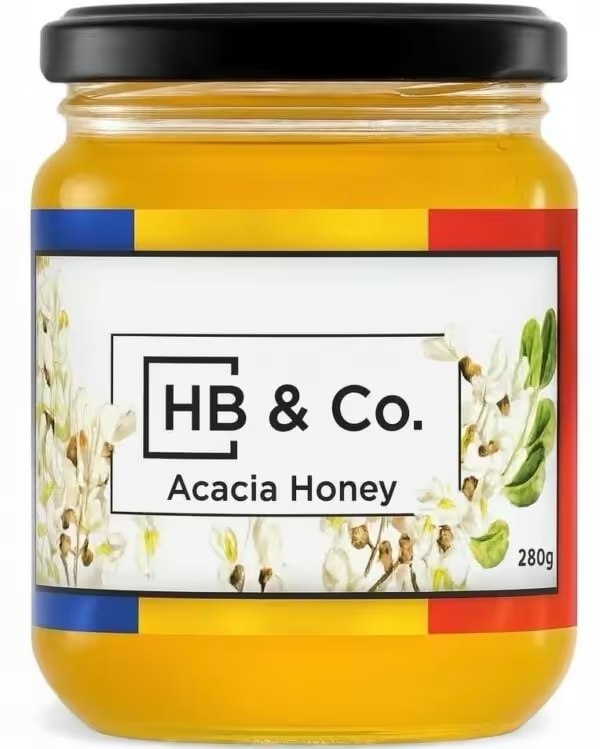
Raw Acacia Honey
Our flagship raw Acacia honey: pale, delicate and slow to crystallise. Six generations of family beekeeping heritage in every 280g jar. £10.99.
Shop Acacia Honey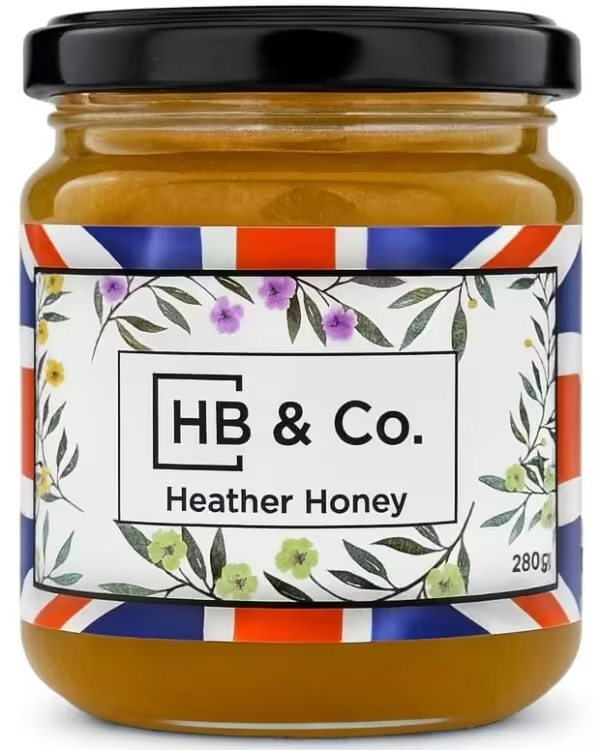
British Heather Honey
Rich, jelly-like honey from the heather moorland where the forest cuckoo bee's heath and bilberry hosts thrive. From a single annual harvest. 280g. £12.99.
Shop Heather Honey
Subscribe & Save 20%
Choose any single honey and save 20% on every delivery, with free UK delivery on every subscription order.
Start a SubscriptionFrequently asked questions
How do I identify a forest cuckoo bee?
What is a cuckoo bumblebee?
What bumblebees does the forest cuckoo bee parasitise?
Is the forest cuckoo bee rare?
When is the forest cuckoo bee active?
How do I tell a male forest cuckoo bee from other cuckoo bees?
Do forest cuckoo bees sting?
Does the forest cuckoo bee make honey?
Related species
Early Bumblebee
Bombus pratorum Read more → Host speciesHeath Bumblebee
Bombus jonellus Read more → Cuckoo beeField Cuckoo Bee
Bombus campestris Read more →Sources & references
- BWARS (Bees, Wasps & Ants Recording Society). Species account: Bombus sylvestris (Lepeletier, 1832). bwars.com.
- Falk, S. Field Guide to the Bees of Great Britain and Ireland, with accompanying identification notes for Bombus sylvestris (male variation, mousy scent, woodland habitat). British Wildlife Publishing / Steven Falk Flickr collection.
- Bumblebee Conservation Trust. Forest cuckoo bumblebee (Bombus sylvestris): identification, hosts and distribution. bumblebeeconservation.org.
- Crowley, L. et al. / Wellcome Sanger Institute, Darwin Tree of Life Project (2023). The genome sequence of the Forest Cuckoo Bee, Bombus sylvestris (Lepeletier, 1832). Wellcome Open Research (host biology; Kuepper & Schwammberger 1995; Pedersen 1996).
- Goulson, D. (2010). Bumblebees: Behaviour, Ecology and Conservation (2nd ed.). Oxford University Press (cuckoo bumblebee biology).
- Benton, T. (2006). Bumblebees. New Naturalist series, Collins (host associations and cohabitation).
- Buzz About Bees. Bombus sylvestris, the forest cuckoo bee: identification, size and phenology, summarising Falk and Benton.

Dragos Nistor
Founder, HoneyBee & Co. · Guest Lecturer, University of Greenwich
HoneyBee & Co. draws on six generations of family beekeeping heritage, with honey from the Nistor family apiaries and from carefully chosen British producers. Our British honey supplier holds SALSA Certification, and we offer a 15% NHS Discount. Every jar is raw, unfiltered and traceable to the hive.