

 English (UK)
  Italiano
  Français
  简体中文
简体中文  한국어
한국어 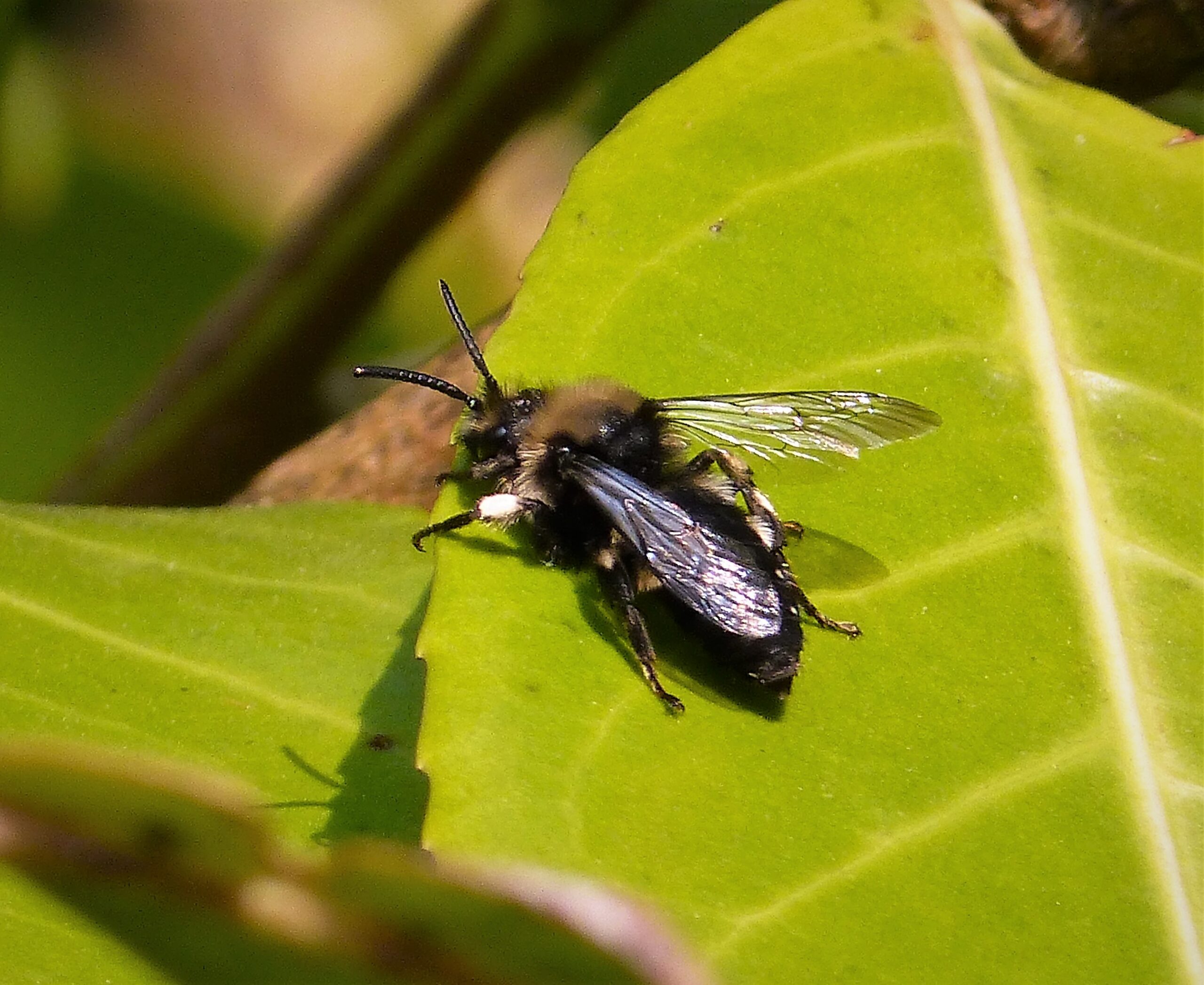 Melecta albifrons, the common mourning bee. gailhampshire, CC BY 2.0, via Wikimedia Commons.
UK Bee Species
Common Mourning Bee (Melecta albifrons)
Melecta albifrons (Forster, 1771) · tribe Melectini
The common mourning bee is a striking black bee flecked with white, named for its sombre, funereal colouring. It is a cleptoparasite, a cuckoo bee that raises no young of its own. Instead the female slips into the burrow of a hairy-footed flower bee and lays her egg in a sealed, pollen-stocked cell, where her larva does the rest. Watch for it in spring at any wall or bank where flower bees are nesting. Trace its southern range on the UK Native Bee Species Map, or set it among the world's cuckoo bees in the World Bee Atlas.
Quick Facts
| Kingdom | Animalia |
| Phylum | Arthropoda |
| Class | Insecta |
| Order | Hymenoptera |
| Family | Apidae |
| Tribe | Melectini |
| Genus | Melecta |
| Species | Melecta albifrons |
A bee dressed for a funeral
The mourning bees take their English name from their colouring: a deep, matt black broken by neat patches of white hair, like crepe and lace at a Victorian funeral. The common mourning bee belongs to the tribe Melectini, a worldwide group of cuckoo bees that are brood parasites of the digger bees, the Anthophorini.[7] Like all cuckoo bees, it gathers no pollen for its own brood, and the female has no scopa, the dense pollen brush that a true solitary bee carries on its hind legs.[1] She visits flowers only to drink nectar for herself.
The common mourning bee never digs a burrow or stocks a cell. Every one of its young is raised on pollen gathered by a hairy-footed flower bee, in a nest built by that flower bee, after the mourning bee's larva has destroyed the host's own egg.[4]
How to identify the common mourning bee
This is a fairly large, robust bee, broadly the size of its hairy-footed flower bee host. The head and body are black, with a grey collar and pairs of white, flattened hair patches along the sides of the upper abdomen, set off by dark, smoky wings.[1] The pattern is distinctive enough that a fresh individual is hard to mistake for anything else in spring. One quirk: some bees are entirely melanic, with the white patches replaced by black, so an all-dark mourning bee is not unusual.[2]
The sexes are unusually alike. Males and females are barely separable in the field, with males averaging only slightly smaller and less robust, and a reliable check comes down to counting antennal segments, thirteen in the male and twelve in the female.[2]
Telling it from the square-spotted mourning bee
Only two mourning bees have ever been recorded in Britain. The other, the square-spotted mourning bee (Melecta luctuosa), is larger and more boldly marked, with bigger, more rectangular white spots, and is now thought to be extinct in Britain, following the collapse of its own host, the potter flower bee.[3] In practice, any mourning bee seen in Britain today is almost certain to be the common mourning bee.
A cuckoo at the flower bee's door
The common mourning bee is a specialist cleptoparasite of the hairy-footed flower bee, and it follows its host across much of the same range, though always at far lower numbers and often turning up unpredictably from one year to the next.[2] Where the flower bee nests, in soft cliffs, earth banks, old walls and the soft mortar of buildings, the mourning bee comes hunting.
A female patrols the host's nesting aggregations, walking and flying over the surface and investigating burrows. When she finds a sealed cell already stocked with pollen, she breaks in, lays an egg, and reseals the cell behind her.[5] Her larva hatches armed with large mandibles: it kills the host egg or grub, eliminates any rival parasite, then settles down to eat the pollen loaf the flower bee had gathered for its own offspring, typically developing faster than the host would have done.[5][6]
Much of the fine detail of how the common mourning bee behaves at the nest is inferred rather than directly recorded in Britain. The most complete behavioural accounts come from studies of a related North American species, Melecta separata, and from general work on brood-parasitic bees, so some specifics, such as exactly how the egg is positioned in the cell, should be read as the best current understanding rather than confirmed British observation.[4][6]
Where and when you will see it
The common mourning bee is found through much of southern England, with a bias to the south-east, an old record or two from south Wales, and a presence in the Channel Islands.[1] It is on the wing from around mid-March to early June, timed to coincide exactly with its host, and turns up readily in towns and cities, in gardens and parks, as well as on natural coastal cliffs and banks.[1] Adults take nectar from spring flowers such as ground-ivy, dandelions, green alkanet and the blossom of early shrubs.[2] The simplest way to find one is to watch a known hairy-footed flower bee nest site on a warm spring day.
Why it matters
A cuckoo bee can only exist where its host thrives, so the presence of common mourning bees is a sign that a healthy population of hairy-footed flower bees, and the spring flowers and undisturbed nesting walls they depend on, is in place. Far from being a problem for its host, a sustainable parasite is part of a functioning ecosystem. Leaving old walls, banks and soft mortar undisturbed, and planting early-flowering plants such as lungwort and green alkanet, supports both the flower bee and the mourning bee that shadows it.
Raw Acacia Honey
Our flagship raw Acacia honey: pale, delicate and slow to crystallise. Six generations of family beekeeping heritage in every 280g jar. £10.99.
Shop Acacia Honey
Linden Honey
Pale, fragrant honey from the summer blossom of the lime, or linden, tree. A delicate, single-origin raw honey. 280g. £10.99.
Shop Linden Honey
Subscribe & Save 20%
Choose any single honey and save 20% on every delivery, with free UK delivery on every subscription order.
Start a SubscriptionFrequently asked questions
How do I identify a common mourning bee?
Why is it called a mourning bee?
What does the common mourning bee parasitise?
Is the common mourning bee rare?
When is the common mourning bee active?
Does the common mourning bee sting?
What is the difference between the common and square-spotted mourning bee?
Does the common mourning bee make honey?
Related species
Hairy-footed Flower Bee
Anthophora plumipes Read more → Spring solitary beeTawny Mining Bee
Andrena fulva Read more → Brood parasiteForest Cuckoo Bee
Bombus sylvestris Read more →Sources & references
- BWARS (Bees, Wasps & Ants Recording Society). Species account: Melecta albifrons (Forster, 1771), including description, distribution and host. bwars.com.
- Falk, S. Field Guide to the Bees of Great Britain and Ireland, Bloomsbury, with accompanying notes for Melecta albifrons (sexes, melanic forms, separation from M. luctuosa). Steven Falk Flickr collection.
- Buzz About Bees. Mourning bees (Melecta): the two British species and the status of Melecta luctuosa, drawing on Falk (2015).
- Thorp, R.W. (1969). Ecology and behavior of Melecta separata callura (Hymenoptera: Anthophoridae). American Midland Naturalist 82(2): 338-345. doi:10.2307/2423782.
- BEEhold, Eurac Research. Species profile: Melecta albifrons, common mourning bee (dimensions and brood-parasite behaviour).
- Litman, J.R. (2019). Under the radar: detection avoidance in brood parasitic bees. Philosophical Transactions of the Royal Society B 374: 20180196. doi:10.1098/rstb.2018.0196.
- GBIF Secretariat. Melecta albifrons (Forster, 1771): taxonomy (tribe Melectini) and occurrence records. gbif.org.
Dragos Nistor
Founder, HoneyBee & Co. · Guest Lecturer, University of Greenwich
HoneyBee & Co. draws on six generations of family beekeeping heritage, with honey from the Nistor family apiaries and from carefully chosen British producers. Our British honey supplier holds SALSA Certification, and we offer a 15% NHS Discount. Every jar is raw, unfiltered and traceable to the hive.