

 English (UK)
  Italiano
  Français
  简体中文
简体中文  한국어
한국어 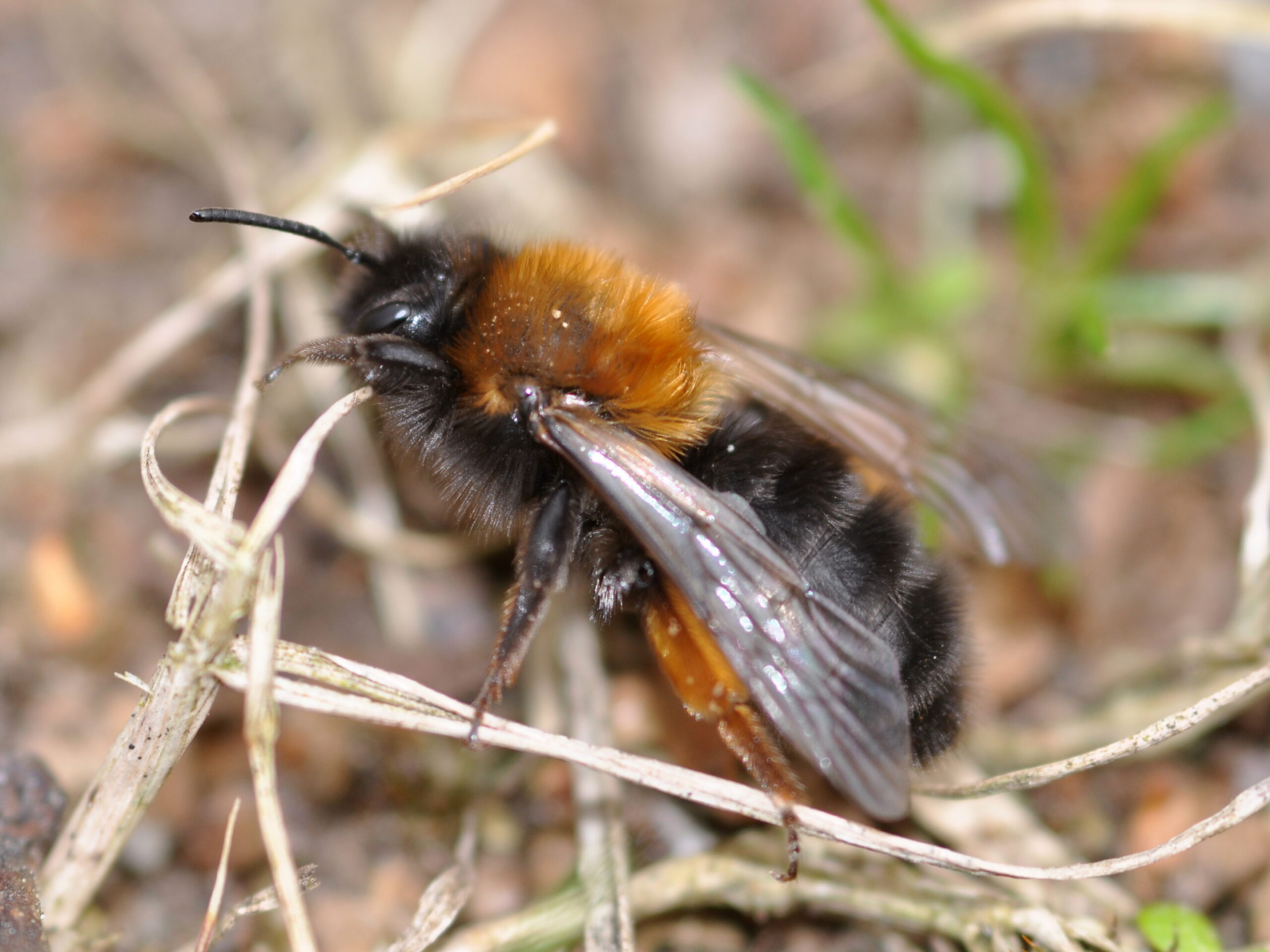 Andrena clarkella, Clark's mining bee. Aiwok, CC BY-SA 3.0, via Wikimedia Commons.
UK Bee Species
Clark's Mining Bee (Andrena clarkella)
Andrena clarkella (Kirby, 1802) · family Andrenidae
Clark's mining bee is often the very first solitary bee of the year, sometimes on the wing in mid-February and tied entirely to the catkins of willow. A furry, red-and-black bee of heaths, banks and woodland edges, it is a true willow specialist whose flight tracks the pussy willow bloom. See where it sits among Britain's bees on the UK Native Bee Species Map, or among the world's bees in the World Bee Atlas.
Quick Facts
| Kingdom | Animalia |
| Phylum | Arthropoda |
| Class | Insecta |
| Order | Hymenoptera |
| Family | Andrenidae |
| Genus | Andrena |
| Species | Andrena clarkella |
The first bee of spring
Clark's mining bee is frequently the first solitary bee anyone sees in a new year, sometimes flying in mid-February and peaking with the pussy willow catkins in late March and April.[1] It is one of a small group of early bees whose whole season is built around willow: pollen is gathered almost entirely from sallow and willow blossom, making it an oligolege, a specialist tied to a single group of plants.[3] The species is named after Bracy Clark, an English entomologist, and was first described by William Kirby in 1802.[5]
While most bees are still dormant, Clark's mining bee is already working the catkins. Its early flight, robust size and willow habit together make it one of the more recognisable spring mining bees despite its plain looks.[2]
How to identify Clark's mining bee
The female is a robust, medium-sized mining bee, larger than a honeybee and very furry, with a deep reddish-brown pile on the thorax and a dense black pile on the abdomen.[2] The hind tibiae and their pollen brushes are bright orange, though often hidden under a load of willow pollen, while the rest of the hind leg is black-haired and the face is densely black-haired across its width.[3] Males are less distinctive, with a red-brown thorax, greyer abdomen and a white-haired face marked by a black strip beside each eye; in woodland they have a characteristic zig-zagging flight up tree trunks.[1]
Habitat, nesting and range
Clark's mining bee is local but very widely distributed across the British Isles, with a range reaching north to Inverness, and it is Holarctic, found across northern Europe, Asia and North America.[1] It occurs in many habitats but favours compacted silty sands, especially in base-poor heathland districts, and nests in the soil either in small clusters or in extensive, dense aggregations on level and sloping ground, in earth banks and along well-trodden paths.[2] Each female digs her own burrow and, distinctively, covers the entrance while she is away foraging.[4]
Some historic records muddy the picture. Early authors reported the bee-fly Bombylius minor from Clark's mining bee nests, but the national recording society notes this is likely a misidentification of Bombylius major, since the former flies only in summer while Clark's mining bee is an early-spring species. Old associations at the edges of a species' biology are worth treating with care.[1]
Why it matters
As one of the earliest bees of the year, Clark's mining bee is an important pollinator of willows at a time when little else is flying, and willow catkins are in turn a vital early nectar and pollen source for many emerging insects. A specialist like this rises and falls with its foodplant, so keeping willows and sallows in the landscape, and leaving sunny, sandy banks undisturbed, supports both the bee and the wider spring web that depends on it.
Raw Acacia Honey
Our flagship raw Acacia honey: pale, delicate and slow to crystallise. Six generations of family beekeeping heritage in every 280g jar. £10.99.
Shop Acacia Honey
British Wildflower Honey
Raw honey from Midlands meadows and hedgerows, the spring landscape an early mining bee works. Our British honey supplier holds SALSA Certification. 280g. £10.99.
Shop Wildflower Honey
Subscribe & Save 20%
Choose any single honey and save 20% on every delivery, with free UK delivery on every subscription order.
Start a SubscriptionFrequently asked questions
How do I identify Clark's mining bee?
Why is it called Clark's mining bee?
When is it active?
What does it feed on?
Where does it nest?
What is the early nomad bee?
Do Clark's mining bees sting?
Does Clark's mining bee make honey?
Related species
Gwynne's Mining Bee
Andrena bicolorRead more → Mining beeTawny Mining Bee
Andrena fulvaRead more → Mining beeAshy Mining Bee
Andrena cinerariaRead more →Sources & references
- BWARS (Bees, Wasps & Ants Recording Society). Species account: Andrena clarkella (Kirby, 1802), early flight, willow forage, nesting, Nomada leucophthalma and the historic bee-fly record. bwars.com.
- Falk, S. Field Guide to the Bees of Great Britain and Ireland, Bloomsbury, notes for Andrena clarkella (female and male characters, flight, habitat, aggregation nesting). Steven Falk Flickr collection.
- NatureSpot. Andrena clarkella: female identification, black-haired clypeus, willow specialism and early flight. naturespot.org.
- Scottish Native Honey Bee Society and National Trust for Scotland field accounts: willow foraging, nest-covering behaviour and nesting away from the foodplant.
- GBIF Secretariat / NBN Atlas and species etymology: Andrena clarkella (Kirby, 1802), named for Bracy Clark; Holarctic distribution.

Dragos Nistor
Founder, HoneyBee & Co. · Guest Lecturer, University of Greenwich
HoneyBee & Co. draws on six generations of family beekeeping heritage, with honey from the Nistor family apiaries and from carefully chosen British producers. Our British honey supplier holds SALSA Certification, and we offer a 15% NHS Discount. Every jar is raw, unfiltered and traceable to the hive.