

 English (UK)
  Italiano
  Français
  简体中文
简体中文  한국어
한국어 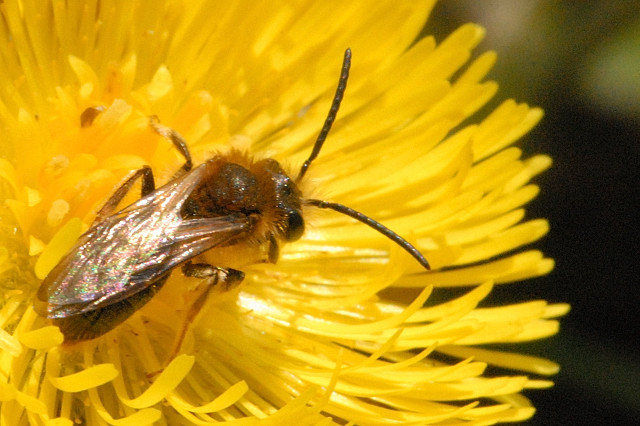 Andrena bicolor, Gwynne's mining bee. James Lindsey at Ecology of Commanster, CC BY-SA 2.5, via Wikimedia Commons.
UK Bee Species
Gwynne's Mining Bee (Andrena bicolor)
Andrena bicolor Fabricius, 1775 · subgenus Euandrena
Gwynne's mining bee is one of Britain's commonest and most widespread small mining bees, found from lowland gardens to the Scottish mountains. Unusually, it raises two generations a year, with each brood favouring different flowers, from spring primroses to late-summer bellflowers. See where it sits among Britain's bees on the UK Native Bee Species Map, or among the world's bees in the World Bee Atlas.
Quick Facts
| Kingdom | Animalia |
| Phylum | Arthropoda |
| Class | Insecta |
| Order | Hymenoptera |
| Family | Andrenidae |
| Genus | Andrena |
| Subgenus | Euandrena |
| Species | Andrena bicolor |
A small bee with two seasons
Gwynne's mining bee is a smallish Andrena and one of the most frequently encountered solitary bees in Britain, distributed across the whole of Great Britain including northern Scotland.[3][5] Its most striking trait is that it is bivoltine, raising two distinct generations in a year: a spring brood from March to early June and a summer brood from mid-June to late August.[3] Each generation has its own floral leanings, with spring females fond of primrose and summer females strongly associated with bellflowers such as harebell, as well as white bryony.[1]
Few British mining bees fit two full generations into a year. Gwynne's mining bee does, and it is extremely polylectic, recorded foraging from more than twenty genera of plants across many families, which helps it thrive almost everywhere.[3]
How to identify Gwynne's mining bee
Females have a reddish-brown pile on top of the thorax and a sparse covering of brownish hairs on the abdomen that form weak bands, with a dull orange pollen brush on the hind legs and a black-haired face.[2] Males are slimmer, lack a conspicuous pollen brush and have notably long black hairs on the face.[2] This is a tricky bee to name with certainty: females of Andrena angustior with black-haired faces look very similar, and small specimens of Clark's mining bee can also cause confusion, so reliable identification often needs a close look at fine characters.[2]
Lifecycle and associates
Like all mining bees, Gwynne's mining bee is solitary and ground-nesting: each female digs her own burrow and provisions cells with pollen and nectar.[3] Because it is double-brooded, adults can be seen across much of the warmer half of the year rather than for a single short window. Its larvae are attacked by a dedicated cuckoo, Fabricius' nomad bee (Nomada fabriciana), which is itself bivoltine to match its host, appearing in both the spring and summer flight periods.[1][4]
This is a notoriously hard bee to identify from photographs. It overlaps closely with Andrena angustior and, in small individuals, with Clark's mining bee, and separating them reliably can require microscopic features such as the form of the clypeus and the tergite margins. Many casual records of one of these species may include the others.[2]
Why it matters
Gwynne's mining bee is a quiet workhorse of the pollinating world: small, abundant and active across two seasons, spreading its visits across a huge range of wild and garden flowers. Its very ordinariness is its value, providing steady pollination from spring primroses to late-summer bellflowers. Letting gardens and grassland flower through the year, and tolerating a little bare, sunny ground for nesting, keeps common species like this one common.
Raw Acacia Honey
Our flagship raw Acacia honey: pale, delicate and slow to crystallise. Six generations of family beekeeping heritage in every 280g jar. £10.99.
Shop Acacia Honey
British Wildflower Honey
Raw honey from Midlands meadows and hedgerows, the broad mix of flowers a generalist mining bee loves. Our British honey supplier holds SALSA Certification. 280g. £10.99.
Shop Wildflower Honey
Subscribe & Save 20%
Choose any single honey and save 20% on every delivery, with free UK delivery on every subscription order.
Start a SubscriptionFrequently asked questions
How do I identify Gwynne's mining bee?
What does bivoltine mean?
What flowers does it visit?
Is it common?
What is Fabricius' nomad bee?
Why is it called Gwynne's mining bee?
Do Gwynne's mining bees sting?
Does Gwynne's mining bee make honey?
Related species
Clark's Mining Bee
Andrena clarkellaRead more → Also bivoltineYellow-legged Mining Bee
Andrena flavipesRead more → Mining beeAshy Mining Bee
Andrena cinerariaRead more →Sources & references
- BWARS (Bees, Wasps & Ants Recording Society). Species account: Andrena bicolor, generation-specific forage (primrose, white bryony, bellflowers) and the cuckoo Nomada fabriciana. bwars.com.
- Falk, S. Field Guide to the Bees of Great Britain and Ireland, Bloomsbury, notes for Andrena bicolor (female and male characters, separation from A. angustior, bivoltine flight). Steven Falk Flickr collection.
- Falk, S. et al. (2024). The genome sequence of Gwynne's mining bee, Andrena bicolor Fabricius, 1775. Wellcome Open Research 9:117 (subgenus Euandrena, bivoltine dates, polylecty, distribution).
- NatureSpot. Fabricius' nomad bee (Nomada fabriciana): bivoltine cuckoo of Andrena bicolor. naturespot.org.
- GBIF Secretariat / NBN Atlas. Andrena bicolor Fabricius, 1775: taxonomy and UK distribution. gbif.org; nbnatlas.org.
Dragos Nistor
Founder, HoneyBee & Co. · Guest Lecturer, University of Greenwich
HoneyBee & Co. draws on six generations of family beekeeping heritage, with honey from the Nistor family apiaries and from carefully chosen British producers. Our British honey supplier holds SALSA Certification, and we offer a 15% NHS Discount. Every jar is raw, unfiltered and traceable to the hive.