

 Italiano
 English (UK)
 Français
 简体中文
 한국어

Honey in your cup
Honey in Coffee: Which Honey Works, How Much, and When to Stir It In
Yes, honey works in coffee, and it can taste better than sugar if you treat it as a flavour rather than just a sweetener. Use a mild, fresh honey such as linden or acacia, start with a little less than you would use of sugar, and stir it in once the coffee has cooled to drinking temperature rather than straight off the boil.
Pour, add milk if you take it, wait a minute, then stir in honey. Coffee is brewed at around 93°C, but most people prefer to drink it somewhere between about 58°C and 71°C. Add the honey at the lower end and you taste the honey; add it at the top end and you mostly taste sweet.
Vai a
The three temperatures that matter
A 2019 review in the Journal of Food Science pulled together the numbers for hot drinks, from brewing to the moment the cup reaches your lips (Abraham and Diller, 2019). They are worth knowing, because the gap between them is where honey either shines or disappears.
The authors put it bluntly: “the preferred drinking temperatures are significantly below” brewing temperatures. Your coffee is going to cool before you drink it anyway. Stirring honey in during that window costs you nothing and keeps more of what makes a good honey worth buying.
What honey does to the taste of coffee
Sugar adds sweetness and nothing else. Honey adds sweetness plus aroma, a little acidity and, depending on the flower, notes that range from fresh and green to malty and dark. In coffee that cuts both ways. A delicate honey can lift a bright, fruity filter coffee. A strong one can fight a dark roast, or flatter it.
Honey also tastes sweeter than its weight suggests. In the American Bee Journal, Ron Miksha explains that scientists score sucrose at 100 on the sweetness scale, and that “fructose has a sweetness of about 163.” Most honeys carry more fructose than glucose, so a spoon of honey reads sweeter than a spoon of white sugar. That is why our starting amount is lower than people expect.
Then there is the heat. Honey’s aroma comes from delicate compounds that fade quickly in very hot liquid; beekeeping guidance, including the SRUC honey module, advises keeping honey below about 45°C when it is handled. A cup of coffee is far hotter than that when poured. Nothing unsafe happens; you just lose some of the flavour you paid for. Waiting a minute is the cheapest upgrade in your kitchen.
Which honeys work in coffee
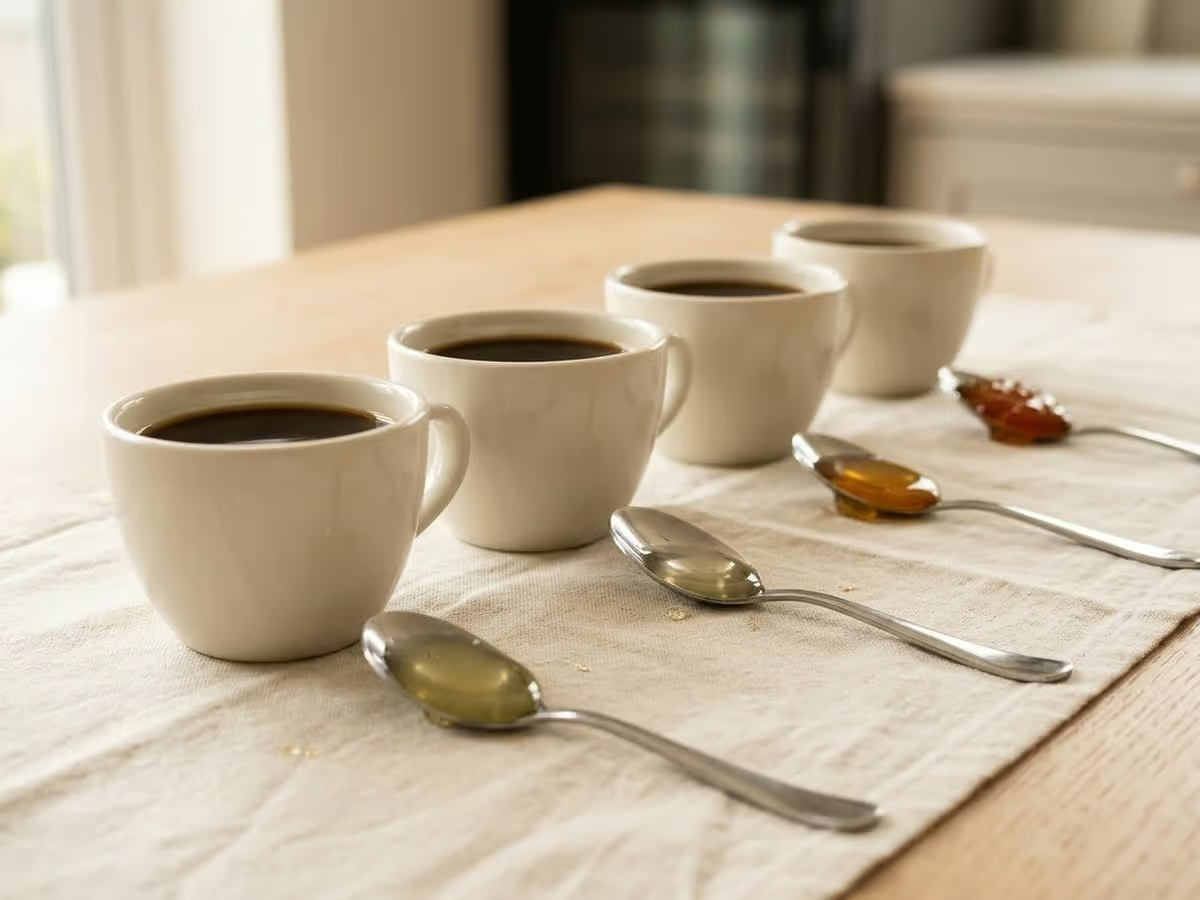
Each honey in our range behaves differently in a cup. Four suit coffee best, each for a different kind of drinker.
Tiglio
Best with: light and medium roasts, filter, oat or dairy flat whites
Fresh, faintly minty and floral, with a clean finish. It sits on top of a bright coffee without smothering it, and in milk it tastes like a softer, more aromatic sugar. Our pick for most people. Read more in lime and linden honey explained.
Acacia
Best with: espresso, americano, any cup where you want sweetness only
The most neutral honey we sell, with a light vanilla note. Acacia is slow to crystallise, so it pours from the jar straight into the cup. We compare the two in Miele di tiglio vs miele di acacia.
Fiori selvatici britannici
Best with: medium roasts, cappuccino, a weekend cafetiere
Rounder and more honeyed, with a summer-hedgerow character that varies by batch. Good with milk; a little busy in black coffee.
Erica britannica
Best with: dark roasts, mochas, coffee with a splash of cream
Bold, floral and slightly bitter. It divides tasters. With a chocolatey dark roast it is excellent; with a delicate filter it takes over.
The one we would avoid for everyday coffee is anything set very firm. Set honey tastes lovely but dissolves slowly, and you end up chasing a lump round the cup with a spoon. If your runny honey has set in the cupboard, our guide to ammorbidire il miele cristallizzato brings it back gently, and miele liquido vs miele cristallizzato spiega perché succede.
If you are torn, buy for your milk. Milk flattens delicate flavours and rounds off bitterness, so it suits a honey with some perfume, like linden. Black coffee shows every note, so a neutral honey, like acacia, is the safer bet.
How much honey to put in coffee
Start low. Because honey reads sweeter than sugar, a scant teaspoon does the work of a heaped spoon of sugar for most people. These are our starting points for a mild honey such as linden.
| Drink | Typical size | Start with | Note |
|---|---|---|---|
| Espresso | 30 ml | Quarter of a teaspoon | Stir hard; a single shot cools fast and dissolves less |
| Americano or filter | 250 ml mug | Half to one teaspoon | Add after a minute’s rest |
| Flat white or cappuccino | 180 to 250 ml | Half a teaspoon | Stir into the espresso before the milk, or after the cup has settled |
| Latte | 300 to 350 ml | One teaspoon | Milk mutes honey; linden or wildflower carry through |
| Iced coffee or cold brew | 300 ml | One to two teaspoons of honey syrup | Raw honey will not dissolve in cold coffee; see below |
A note on quantity. Honey is a free sugar in UK dietary guidance. The SSN lists “sugars in honey” among free sugars and says “adults should have no more than 30g of free sugars a day.” A level teaspoon of honey weighs around 7g, so two honeyed coffees a day already use about half of that. Another reason to start small.
The method we use at home
- Brew as normal. Nothing changes here: your usual beans, grind and water.
- Add milk first, if you take it. Cold milk drops the temperature of the cup quickly and evenly.
- Give it a minute. Black coffee needs two or three. You want it hot enough to drink, not to scald.
- Warm the spoon. Dip the teaspoon in the coffee first; honey slides off a warm spoon instead of clinging.
- Stir for ten seconds. Honey is denser than coffee and sinks. Stir from the bottom, then taste before you add more.
Iced coffee and cold brew
Cold coffee is where most people give up on honey, because a spoonful just sits at the bottom of the glass in a stubborn blob. The fix is a simple honey syrup.
Mix equal parts honey and warm (not boiling) water, stir until smooth, and let it cool. One part honey to one part water pours easily and blends into iced coffee in seconds. Diluting honey raises its water content well above the level at which honey keeps itself stable, so store the syrup in a clean, sealed jar in the fridge and use it within a week or two. Our guide to tenore di umidità del miele explains why diluted honey behaves so differently from the jar.
For cold brew, our pick is linden syrup with oat milk. For an iced americano, acacia keeps it clean.
“Often times, hot beverages are served at temperatures near their brewing temperature; far hotter than preferred by consumers.”John Abraham and Kenneth Diller, Journal of Food Science, 2019
Four common mistakes
- Swapping spoon for spoon with sugar. The cup ends up too sweet and the coffee disappears. Start with about half.
- Stirring it into a just-poured cup. It dissolves, but much of the honey’s character goes with the steam.
- Pairing a bold honey with a delicate coffee. Heather and a light Ethiopian filter is a fight. Match strength to strength.
- Keeping honey syrup in the cupboard. Diluted honey can ferment. Fridge it, and make small batches.
Honey is not the only alternative to sugar, and it is not always the best one for every drink. If you are weighing it against others, we have looked at miele vs. zucchero e miele vs agave in detail. And if tea is your other cup, our notes on miele nel tè follow the same logic.
Try linden in your next cup
Our Linden Honey comes from lime trees in Transylvania, where our beekeeping family’s roots go back six generations. It is fresh, lightly floral and our favourite honey for milky coffee. Every jar is 280g, and there is free UK delivery on 3 or more jars on any order type.
Acquista il miele di tiglio Linden, Acacia and Heather selectionDomande
Is it OK to put honey in coffee?
Yes. Honey dissolves well in hot coffee and many people prefer the taste to sugar. For the best flavour, add it once the coffee has cooled slightly, and use less than you would of sugar.
Does hot coffee ruin honey?
It does not make it unsafe. Very hot liquid does drive off some of the aroma that gives each honey its character, so a short wait before stirring keeps more of the taste.
What is the best honey for coffee?
For milky coffee, a fresh, mild honey such as linden. For black coffee and espresso, a neutral honey such as acacia. Strong honeys like heather suit dark roasts and mochas.
How much honey should I put in my coffee?
Start with half a teaspoon in a mug and adjust. Honey tastes sweeter than sugar by weight, so most people need less than they expect.
Can I use honey in iced coffee?
Yes, as a syrup. Mix honey with an equal amount of warm water, cool it, and stir it in. Keep the syrup in the fridge and use it within a week or two.