

 English (UK)
  Italiano
  Français
  简体中文
简体中文  한국어
한국어 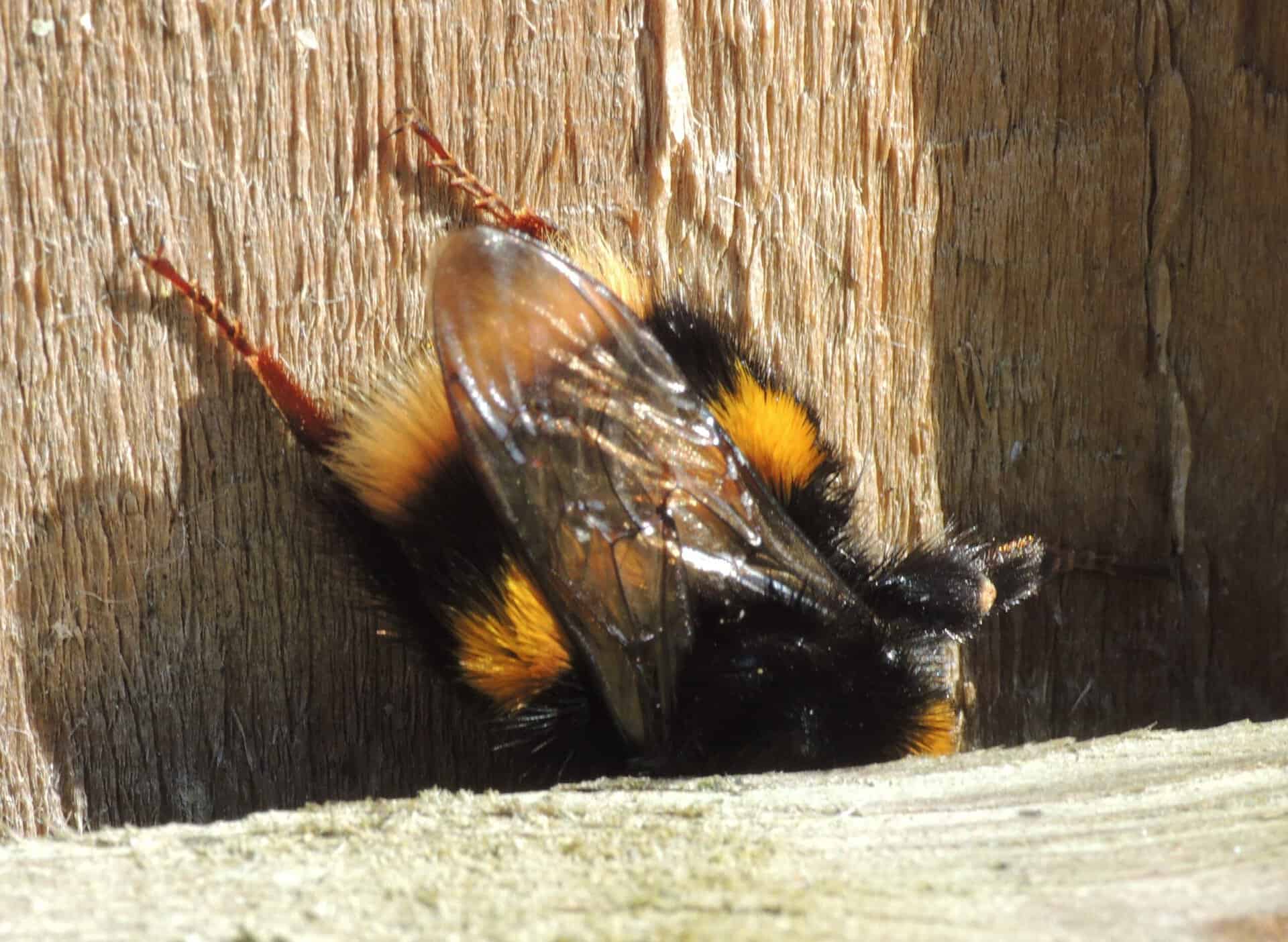
Orangeaurochs from Sandy, Bedfordshire, United Kingdom, CC BY 2.0, via Wikimedia Commons
Buff-tailed Bumblebee
Bombus terrestris
Linnaeus, 1758 • Apidae • Bombini
Bombus terrestris Linnaeus, 1758, the buff-tailed bumblebee, is the most numerous and ecologically dominant bumblebee species in Europe and the most widely used managed pollinator in commercial horticulture worldwide. A eusocial member of the family Apidae, it forms annual colonies of up to 400 workers, founded each spring by a single mated queen emerging from underground hibernation. Queens are the UK's largest bumblebee, reaching 20 to 22 mm. The British subspecies, B. t. audax, is named for the characteristically buff-coloured tail of the queen that distinguishes it from the closely related white-tailed bumblebee. Find B. terrestris on our UK Native Bee Species Map and explore bumblebee relatives worldwide in the World Bee Atlas.
Quick Facts
Taxonomy and Classification
Carl Linnaeus described the buff-tailed bumblebee in 1758 in Systema Naturae, 10th edition, originally as Apis terrestris before it was placed in the genus Bombus Latreille. The species belongs to the tribe Bombini, the sole extant tribe in the subfamily Apinae bearing the characteristic bumblebee body plan. Within Bombus, it sits in the subgenus Bombus sensu stricto, a group of closely related species including B. lucorum, B. cryptarum, and B. magnus, which can be extremely difficult to separate in the field.[1]
| Kingdom | Animalia |
| Phylum | Arthropoda |
| Class | Insecta |
| Order | Hymenoptera |
| Family | Apidae |
| Subfamily | Apinae |
| Tribe | Bombini Latreille, 1802 |
| Genus | Bombus Latreille, 1802 |
| Subgenus | Bombus (Bombus) sensu stricto |
| Species | Bombus terrestris Linnaeus, 1758 |
Nine subspecies are currently recognised, each with a distinct colour pattern, pheromone profile, and geographic distribution.[2] The British subspecies is B. t. audax Harris, 1776, characterised by the buff-coloured tail in queens that gives the species its common name. On the European continent, the nominate subspecies B. t. terrestris has a white tail in queens and workers, not buff. The commercially reared subspecies B. t. dalmatinus, used in greenhouse pollination across Europe and beyond, originates from the Balkans and Mediterranean and is now widely established as a feral or invasive population wherever commercial hives have escaped.
Separating Bombus terrestris from B. lucorum workers in the field
Bombus terrestris workers and B. lucorum (white-tailed bumblebee) workers are virtually identical in appearance and cannot be reliably separated without dissection or DNA analysis. Both have off-white to buff tails, yellow collar, and yellow abdominal band. Queens can usually be distinguished: B. terrestris queens have a buff-tinged or dull orange tail and warmer mustard-yellow bands, while B. lucorum queens have a clean white tail and brighter lemon-yellow bands. In practice, BWARS (Bees, Wasps and Ants Recording Society) recommends recording ambiguous workers as "Bombus lucorum/terrestris" unless identification is certain.
Physical Description
Bombus terrestris is the largest bumblebee in Britain. The queen is black-bodied with a yellow collar on the thorax and a yellow band across the second abdominal tergite, with a buff to orange-buff tip to the abdomen. Queens measure 20 to 22 mm in body length with a forewing length of 18 mm.[3] The pile (body hair) is dense, giving the characteristic bumblebee appearance of a robust, furred insect well suited to thermoregulation during the cold early-spring foraging season.
Workers are smaller and more variable in size, ranging from 11 to 17 mm. Worker size correlates with the stage of colony development: early-season workers, reared when the queen is feeding the first brood alone, are the smallest; later workers, produced when the colony has forager support, are larger and more capable foragers. The yellow bands of British workers tend to be slightly brighter than those of the queen.
Males (14 to 16 mm) are distinguished by a conspicuous yellow facial patch absent in females, broader yellow abdominal banding, and an overall less robust build than queens. Unlike female bumblebees, males cannot sting.
The buff tail: UK vs continental Europe
The "buff-tailed" name applies specifically to the British subspecies B. t. audax. On mainland Europe and the Channel Islands, queens of the nominate subspecies B. t. terrestris have a white tail. This distinction makes B. t. audax one of Britain's genuinely endemic bumblebee subspecies, found nowhere else in its pure form. UK regulations since 2015 require a Natural England licence to release non-native B. terrestris subspecies into commercial glasshouses, precisely to protect the integrity of the audax subspecies.
Distribution and Habitat
Bombus terrestris is a Palearctic species with one of the widest natural ranges of any bumblebee. Its native distribution spans from the Canary Islands and North Africa in the south to southern Scandinavia in the north, and from the British Isles in the west to Iran and Central Asia in the east. It is absent from arctic and high-alpine habitats but otherwise occupies a remarkably broad ecological range: gardens, farmland, woodland edge, coastal dunes, upland grassland, and urban parks all support populations.[4]
In Britain, B. t. audax is common throughout England and Wales. Records in Scotland are largely coastal, becoming sparse north of the central belt, although the species is present in suitable lowland habitats as far north as Edinburgh and the Firth of Forth. In Northern Ireland it is widespread in lowland areas. See the full UK regional distribution on our UK Native Bee Species Map, where B. terrestris is recorded across 10 of the 17 mapped regions.
Through deliberate introduction for commercial greenhouse pollination, B. terrestris is now established outside its native range in New Zealand (introduced in the 1880s), Tasmania, Japan, Chile (1997), and parts of Argentina, where it has become invasive with documented negative impacts on native bee communities.
Behaviour and Life Cycle
The colony cycle
Bombus terrestris is univoltine across most of its range, completing a single colony cycle per year. Mated queens, produced in late summer, enter diapause underground, emerging in late winter to early spring: in the UK, B. terrestris queens are typically the first bumblebees seen, with records from February onwards in southern England, ahead of all other species.[3]
A newly emerged queen must feed intensively on early pollen and nectar sources: sallow (Salix), dandelion, and cherry are favoured. Before locating a nest site. She excavates or adopts an old mammal burrow, typically constructed by a vole or mouse, and builds wax cells in which she lays her first eggs. During this initiation phase, the queen incubates the brood directly, maintaining a brood temperature of approximately 30 to 32°C through metabolic heat generation. To sustain this while foraging, she may visit up to 6,000 flowers per day.[5]
Colony growth and switch point
Once the first workers emerge, the colony enters a growth phase. Workers take over foraging, nest maintenance, and brood care, allowing the queen to remain in the nest and concentrate on egg-laying. Successful nests can accumulate up to 400 workers, though the average peak colony size is considerably smaller. At a genetically determined switch point, the queen shifts from producing workers to producing males (from unfertilised eggs) and new queens (gynes). Workers may also begin laying unfertilised eggs. Males and new queens disperse from the nest to mate; males die shortly after mating, and new queens enter diapause. The original queen and remaining workers die at the end of the season.[1]
Winter activity: a new behaviour
Since the 1990s, increasingly widespread reports have documented B. terrestris colonies remaining active through the British winter, with workers and queens foraging through November to February, primarily in urban southern England. The Bumblebee Conservation Trust confirmed that a proportion of summer queens are now establishing autumn colonies instead of entering hibernation, sustained by winter-flowering garden plants such as Mahonia, winter heather (Erica carnea), and winter honeysuckle.[6] This bivoltine behaviour appears to be a genuine response to the urban heat island effect and longer flowering seasons, and has been recorded as far north as Edinburgh. DNA analysis confirms this is not the result of introgression from commercial non-native subspecies: it is an adaptive behavioural shift in the native B. t. audax population.[7]
Foraging behaviour and nectar robbing
B. terrestris is a pollen-storer and a generalist forager with a relatively short tongue (approximately 8.2 mm), limiting access to deep-tubed flowers. A distinctive and well-documented behaviour is nectar robbing: rather than entering flowers through the opening, workers bite a hole at the base of the corolla to access nectar directly, bypassing the floral structure and delivering no pollination benefit to the plant. This is particularly common on flowers with corolla tubes longer than the bee's tongue, such as red clover and foxglove.
Conservation Status
Globally, Bombus terrestris is classified as Least Concern by the IUCN (2014 assessment), with a population trend assessed as stable to increasing. It is among the most abundant and adaptable bumblebee species in the Palearctic, and its wide habitat tolerance, long flight season, and capacity for urban foraging have allowed it to maintain or expand populations where many other bumblebee species have declined.[8]
However, the picture is more nuanced at the subspecies level. B. t. audax, the British subspecies, faces a specific genetic conservation concern: the commercial import of non-native B. terrestris subspecies for greenhouse pollination risks genetic dilution of the endemic British population through hybridisation. A 2020 study found no evidence of introgression between B. t. dalmatinus and wild B. t. audax in London and Bristol populations, suggesting the UK regulatory framework introduced in 2015 has been effective so far, but monitoring continues.[7]
The broader context of bumblebee decline in Britain is well documented. The 2025-2 IUCN Red List update added nearly 100 threatened wild European bee species, including more than 20% of bumblebee species. B. terrestris is not among them, but rarer relatives such as the Great Yellow Bumblebee (Bombus distinguendus) and the Shrill Carder Bee (Bombus sylvarum) are in serious decline across Britain.
Commercial Pollination and Invasive Spread
Since 1987, Bombus terrestris has been commercially bred in Belgium and the Netherlands for use as a greenhouse pollinator, initially for tomato crops. The commercial rearing of bumblebee colonies replaced hand pollination in European glasshouses and rapidly expanded globally. By the early 2000s, the global trade in B. terrestris colonies was estimated to exceed one million nests per year, used across North Africa, Japan, South Korea, Russia, and throughout Europe.[9]
This commercial spread has had significant ecological consequences outside the species' native range. In South America, B. terrestris introduced to Chile in 1997 for tomato pollination escaped into the wild and has since spread into Argentina at approximately 275 km per year. It is directly implicated in the catastrophic decline of Bombus dahlbomii, the only native bumblebee of Patagonia, through resource competition and pathogen spillover, specifically the microsporidian parasite Apicystis bombi, which the buff-tail carries without ill effect but which proves lethal to B. dahlbomii.[1] Australia banned live import in 2008. In East Asia, concerns over competitive displacement of native Bombus species have led South Korea and China to restrict or investigate alternative managed pollinators.
Bombus terrestris and the Honey We Make
Bombus terrestris does not produce commercial honey. Unlike Apis mellifera, bumblebee colonies are annual, small, and produce only enough honey-like nectar stores to sustain the colony through short periods of poor weather. A colony may hold a few grams of stored nectar at any time. There is no commercial bumblebee honey production.
What the buff-tailed bumblebee does do, however, is share the landscape with our Apis mellifera colonies. In the Transylvanian highlands where our acacia, linden, and sunflower honeys originate, B. terrestris and its relatives are present as wild foragers throughout the season. In the British Midlands where our wildflower, soft set, and heather honeys come from, B. t. audax is one of the most frequent bumblebee visitors to the same wildflower meadows and heathland that our partner's honeybee colonies work. A healthy population of wild bumblebees alongside managed honeybees is a sign of a functioning, flower-rich landscape, and it is the landscape that determines the quality of every jar.
Understanding the difference between the bumblebees foraging around your garden and the honeybees producing the honey in your jar is part of what makes British honey so connected to its environment. For a deeper look at what bee populations declining might mean for your diet, see our interactive Your Plate Without Bees.


Source Conflicts and Open Questions
How many subspecies does Bombus terrestris have?
Published sources vary between 7 and 9 recognised subspecies. Rasmont et al. (2008) is the most comprehensive recent review and describes 9 subspecies.[2] Some older sources list fewer. The discrepancy reflects ongoing taxonomic revision of island populations (Canary Islands, Corsica) and Mediterranean taxa. B. xanthopus, formerly treated as a subspecies, was elevated to full species status in 2015 following molecular analysis, reducing the count in some frameworks. Wikipedia's Bombus terrestris article (updated 2026) lists 9 subspecies, consistent with Rasmont et al.
Is winter activity in B. t. audax increasing due to climate change or introgression?
Winter foraging by B. t. audax has been documented with increasing frequency since the 1990s, predominantly in urban southern England. Two hypotheses were initially proposed: (1) it represents a behavioural adaptation to milder winters and longer urban flowering seasons, or (2) it results from introgression with commercial B. t. dalmatinus, which is naturally bivoltine in Mediterranean climates. A 2020 Apidologie study found no evidence of introgression in London and Bristol wild populations, supporting hypothesis 1.[7] However, the study was geographically limited and the authors note that monitoring should continue, particularly in areas close to commercial greenhouse operations.
Frequently Asked Questions
What is the difference between a buff-tailed and white-tailed bumblebee?
Both species are very similar and belong to the same subgenus. The key difference in the UK is the tail colour of the queen: Bombus terrestris (buff-tailed) queens have a buff to pale orange-brown tail and mustard-yellow bands, while Bombus lucorum (white-tailed) queens have a clean white tail and brighter lemon-yellow bands. Workers of both species are nearly identical and cannot reliably be told apart in the field without DNA analysis. When in doubt, BWARS recommends recording workers as "B. lucorum/terrestris."
When do buff-tailed bumblebees emerge in the UK?
Bombus terrestris queens are typically the first bumblebees to emerge from hibernation in Britain, with records from February onwards in southern England. Workers appear from April and the colony grows through spring and summer, with new queens and males emerging from late May or June. In warm urban areas, some colonies now remain active through the winter months, making the buff-tailed bumblebee potentially visible in every month of the year in southern England.
Do buff-tailed bumblebees sting?
Yes, but only the females (queens and workers). Unlike the honeybee, a bumblebee's sting has no barbs, so it can sting repeatedly without dying. In practice, buff-tailed bumblebees are not aggressive and rarely sting unless the nest is directly disturbed or the bee is handled. Males cannot sting at all. If you encounter a bumblebee in your garden, it will almost always simply fly away if given space.
Where do buff-tailed bumblebees nest?
Bombus terrestris nests underground, usually in pre-existing cavities such as abandoned mouse or vole nests. Queens prefer south-facing slopes or sheltered sites that warm up quickly in spring. In gardens, common nest sites include under sheds, in compost heaps, in loose soil at the base of hedges, and occasionally in loft insulation or cavity walls if accessible. The nest entrance is typically a narrow tunnel, sometimes 2 metres long, leading to the brood chamber. Successful nests may hold up to 400 workers, though the average is considerably smaller.
Do buff-tailed bumblebees produce honey?
Bumblebees produce a small quantity of nectar stores within the nest, enough to sustain the colony through a few days of bad weather, but nothing approaching commercial honey production. A typical bumblebee colony may hold just a few grams of stored nectar at any one time, compared to the tens of kilograms stored by a honeybee colony. All commercial honey is produced by honeybees, principally Apis mellifera. There is no commercial bumblebee honey.
Is the buff-tailed bumblebee endangered?
Bombus terrestris is classified as Least Concern by the IUCN globally, and it remains one of the most abundant bumblebee species in Britain. However, the British subspecies B. t. audax faces a specific conservation concern around genetic integrity, as commercial import of non-native B. terrestris subspecies for greenhouse pollination poses a hybridisation risk. UK regulations since 2015 require a Natural England licence for any release of non-native B. terrestris subspecies, and monitoring of wild populations continues.
Why is the buff-tailed bumblebee important to agriculture?
Bombus terrestris is the most widely used managed pollinator in European greenhouse horticulture, deployed in the production of tomatoes, peppers, strawberries, blueberries, and other crops where the vibration from bumblebee thorax muscles (buzz pollination, or sonication) dislodges pollen more effectively than wind or honeybees. As a wild species, it also contributes substantially to the pollination of wildflowers and agricultural crops throughout its range. Its long season, high colony density, and generalist foraging make it a significant component of ecosystem-level pollination services across Europe.
What is buzz pollination?
Buzz pollination (sonication) is a foraging technique used by bumblebees but not by honeybees. The bee grabs onto the flower's anthers and vibrates its indirect flight muscles at a specific frequency, causing the anthers to release pollen that would otherwise remain locked inside. This technique is particularly effective on poricidal flowers (those that release pollen through small pores rather than open slits), including tomatoes, aubergines, blueberries, and cranberries. It is one of the primary reasons B. terrestris is so valuable as a greenhouse pollinator: it can pollinate crops that Apis mellifera cannot.
Sources and References
- Wikipedia contributors. Bombus terrestris. Wikipedia, The Free Encyclopedia. Updated 2026. en.wikipedia.org [Secondary; primary sources cited therein include Aizen et al. 2018, Velthuis and Van Doorn 2006]
- Rasmont, P., Coppée, A., Michez, D., and De Meulemeester, T. (2008). An overview of the Bombus terrestris (L. 1758) subspecies (Hymenoptera: Apidae). Annales de la Société Entomologique de France, new series, 44(2), 243–250.
- Edwards, M. and Jenner, M. (2005). Field Guide to the Bumblebees of Great Britain and Ireland. Ocelli Ltd, Eastbourne. Morphological data verified against Bumblebee Conservation Trust species accounts, bumblebeeconservation.org.
- Falk, S. J. (2015). Field Guide to the Bees of Great Britain and Ireland. British Wildlife Publishing. Distribution data cross-checked against NBN Atlas (nbnatlas.org) occurrence records.
- Bumblebee.org. Colony initiation: daily foraging requirements of founding queens. bumblebee.org/lifecycle.htm
- Bumblebee Conservation Trust. Winter active bumblebees: species, behaviour and monitoring guidance. bumblebeeconservation.org
- Crowther, L. P., et al. (2020). Winter activity unrelated to introgression in British bumblebee Bombus terrestris audax. Apidologie. doi.org/10.1007/s13592-020-00822-w
- IUCN SSC Wild Bee Specialist Group. Bombus terrestris. IUCN Red List of Threatened Species. Version 2014.1. Least Concern. iucnredlist.org
- Velthuis, H. H. W. and Van Doorn, A. (2006). A century of advances in bumblebee domestication and the economic and environmental aspects of its commercialization for pollination. Apidologie, 37(4), 421–451.
- Natural England (2026). Licence CL28: Licence to permit the release of non-native sub-species of bumblebee (Bombus terrestris) in commercial glasshouses. gov.uk