
 English (UK)
  Italiano
  Français
  简体中文
简体中文  한국어
한국어 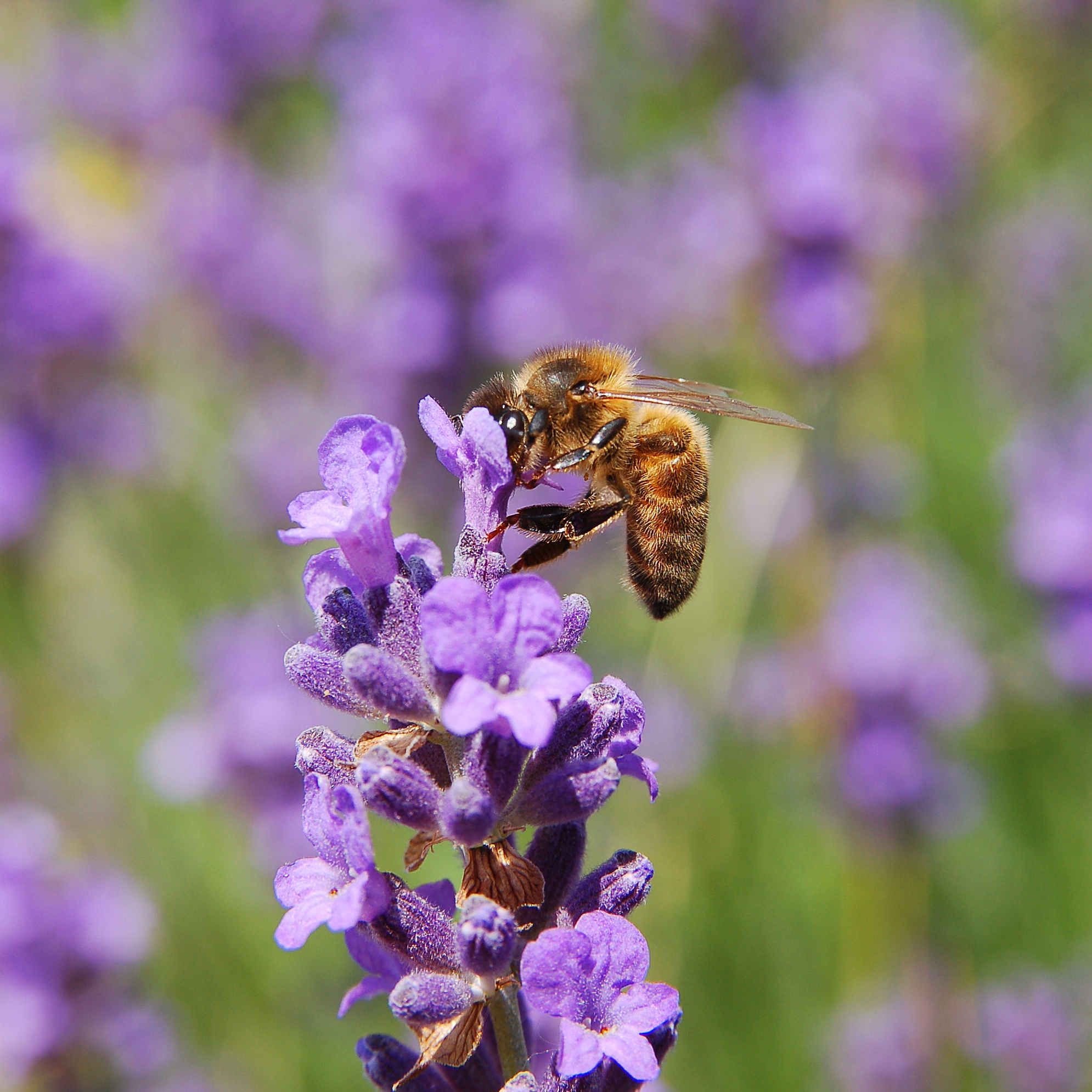
Western Honeybee
Apis mellifera
Linnaeus, 1758 • Apidae • Apini
Apis mellifera Linnaeus, 1758, the western honeybee, is the single most economically important insect on Earth. A eusocial species in the family Apidae, it is the primary managed pollinator of global agriculture and the only bee domesticated at industrial scale for honey production. Its native range spans Europe, the Middle East, and Africa; through deliberate human introduction it is now established on every inhabited continent. Workers measure 10 to 15 mm; queens 18 to 20 mm. The species is subdivided into more than 30 recognised subspecies arranged across four to five evolutionary lineages. Learn about the six-generation family behind our honey on the HoneyBee & Co. heritage page, explore relatives in the World Bee Atlas and see the UK regions where it is found at our UK Native Bee Species Map.
Quick Facts
Taxonomy and Classification
Carl Linnaeus formally described the western honeybee in 1758 in Systema Naturae, 10th edition (page 576), assigning it the name Apis mellifera, from the Latin mel (honey) and ferre (to carry). Linnaeus himself later proposed the synonym Apis mellifica (honey-making bee), which he considered more accurate, but under the International Code of Zoological Nomenclature the original name mellifera takes precedence and cannot be superseded.[1] The lectotype is held in the Linnean Collection, London.
| Kingdom | Animalia |
| Phylum | Arthropoda |
| Class | Insecta |
| Order | Hymenoptera |
| Family | Apidae |
| Subfamily | Apinae |
| Tribe | Apini Latreille, 1802 |
| Genus | Apis Linnaeus, 1758 |
| Species | Apis mellifera Linnaeus, 1758 |
The genus Apis comprises eight living species, of which A. mellifera is the sole western species; all others are native to Asia. Within A. mellifera, Engel (1999) recognised 28 subspecies in the most comprehensive formal revision to date.[2] Three further subspecies have been described since: A. m. pomonella (Sheppard and Meixner, 2003), A. m. simensis (Meixner et al., 2011), and A. m. sinisxinyuan (Ilyasov et al., 2016), bringing the current count to at least 31.[3] Some recent molecular analyses propose up to 33 subspecies; the taxonomy remains actively debated.
How many subspecies does Apis mellifera have?
Published sources cite figures ranging from 20 to 33 depending on the revision consulted and the criteria applied. Ruttner (1988) listed approximately 24 subspecies using morphometric analysis. Engel (1999) revised this to 28 using combined morphometric and molecular data. Subsequent descriptions have added further taxa, and Ilyasov et al. (2020) recognise up to 33. The discrepancy arises partly because some proposed subspecies have not been confirmed by independent molecular studies, and partly because different authors apply different species concepts to geographically intermediate populations. The figure of 30 or more subspecies is now most widely cited in the primary literature.[4]
The subspecies are divided into four to five major evolutionary lineages based on morphometric and molecular analysis. Lineage A encompasses African subspecies; lineage M the subspecies of western and northern Europe (including A. m. mellifera, the dark European honeybee native to Britain); lineage C the subspecies of eastern and southern Europe (including A. m. ligustica, the Italian bee widely kept by commercial beekeepers worldwide); and lineage O the subspecies of Turkey and the Middle East. A fifth lineage, Y, is recognised by some authors for Yemeni and East African populations.[5]
Physical Description
Apis mellifera exhibits the pronounced caste dimorphism typical of eusocial bees. The three castes (worker, queen, and drone) differ substantially in size, morphology, and function.
Workers
Workers are sterile females measuring 10 to 15 mm in length, though size varies across subspecies; northern and high-altitude subspecies tend to be larger than tropical ones. The body is broadly amber to brown-banded, with the degree of yellow colouration varying considerably between subspecies. Workers bear corbiculae (pollen baskets) on their hind tibiae, a barbed sting formed from a modified ovipositor, and a wax-secreting apparatus comprising four pairs of abdominal mirror glands. Workers have longer wings relative to body length than drones or queens. Worker lifespan is 6 to 7 weeks during summer; overwintering workers may live 4 to 6 months.[6]
Queens
The queen is the sole reproductive female in a colony. She measures 18 to 20 mm and is distinctly elongated through the abdomen, which extends well beyond the wing tips. Unlike the worker, the queen's sting is smooth and curved, allowing repeated use without self-injury. A mated queen stores between 3 and 7 million sperm in the spermatheca after her nuptial flights, which she uses to fertilise eggs throughout her reproductive life. Queen lifespan in most subspecies is 3 to 5 years, though individuals of the dark European A. m. mellifera subspecies have reportedly lived up to 8 years.[7]
Drones
Drones are unfertilised males measuring 15 to 17 mm. They are characterised by markedly enlarged compound eyes that meet at the dorsal midline of the head, a feature associated with visual tracking of queens during mating flights. Drones possess no sting and do not forage. They are present in the colony from spring through early autumn and are expelled by workers at the onset of winter.
Wax and honey production
Workers consume approximately 6 to 8 kg of honey to produce 1 kg of beeswax. A productive colony may produce 20 to 60 kg of surplus honey per season depending on forage availability, subspecies, and management. Our acacia and wildflower honeys are harvested from colonies managed by our six-generation family apiary in Transylvania, where nectar flows from black locust and wildflower meadows at altitude produce a distinctively light, aromatic harvest.
Distribution and Habitat
The natural range of Apis mellifera is the Old World landmass: Europe, Africa, and the Middle East. No native Apis species existed in the Americas, Australasia, or East Asia prior to human introduction. European colonisers introduced western honeybees to North America in the early 17th century, to Australia in 1822, and progressively to the rest of the world through the 19th and 20th centuries.[7] The species is now established on every continent except Antarctica.
In Britain, A. m. mellifera is the native subspecies, present since at least the medieval period and possibly earlier. The species is a cavity nester, occupying hollow trees, rock crevices, and building cavities in the wild, and managed hive boxes in beekeeping. Natural colonies in deciduous woodland occupy cavities of 20 to 80 litres, with a preference for sites 5 metres or more above ground, facing south or south-east, with a small entrance hole.[8]
See which UK regions host A. mellifera colonies and discover the solitary and bumblebee species that share the same habitats at our UK Native Bee Species Map. For the global distribution across Europe, Africa, and all introduced ranges, visit the World Bee Atlas.
Behaviour and Life Cycle
Colony structure and the superorganism
A mature Apis mellifera colony comprises a single queen, 20,000 to 80,000 workers, and seasonally a few hundred to several thousand drones. The colony functions as a superorganism: reproduction, thermoregulation, foraging, and defence are managed collectively rather than at the level of the individual. Colony fitness, rather than individual bee fitness, is the biologically significant unit of selection. For a detailed look at how workers convert nectar into honey within this superorganism, see our guide to how bees make honey.[7]
The waggle dance
Apis mellifera possesses the most sophisticated known communication system among non-human animals outside primates. The waggle dance, first described and decoded by Austrian ethologist Karl von Frisch (Nobel Prize in Physiology or Medicine, 1973), encodes both the direction and distance of a food source relative to the sun's azimuth. A forager returning to the hive performs a figure-eight pattern on the vertical comb surface: the angle of the waggle run relative to vertical corresponds to the angle between the food source and the sun, while the duration of the waggle phase encodes distance. A one-second waggle run represents approximately 1 kilometre.[9]
Swarming and reproduction
Colony reproduction occurs through swarming, typically in spring when the colony has reached peak population. The old queen departs with approximately half the workers to found a new colony; the remaining workers rear a new queen from existing larvae. A healthy colony may swarm once or occasionally twice per season. Swarming is the primary means by which free-living A. mellifera populations maintain themselves in the wild.[7]
Overwintering
Unlike most bee species, A. mellifera maintains a perennial colony that survives winter as a cluster of several thousand workers surrounding the queen. Workers generate heat through isometric contraction of flight muscles, sustaining the cluster at approximately 20 to 35°C even when external temperatures fall well below freezing. This adaptation, absent in all Asian Apis species, is a key feature that enabled the colonisation of temperate northern Europe and is a defining characteristic of the M lineage subspecies.
Conservation Status
The conservation status of Apis mellifera requires careful distinction between managed and wild populations, as their trajectories differ substantially.
Wild populations
In October 2025, an international team of 14 researchers coordinated by Honey Bee Watch formally updated the IUCN Red List assessment of wild Apis mellifera populations in the European Union from Data Deficient (2014) to Endangered.[10] The assessment, led by Arrigo Moro (University of Galway), found that free-living colony numbers have declined sufficiently to meet the IUCN threshold for Endangered status. The same Endangered designation was extended to south-east England and Switzerland; the wider European assessment (outside EU27) was classed as Data Deficient due to insufficient monitoring data.
For decades, wild honeybees in Europe were assumed to be functionally extinct, replaced entirely by managed colonies. Recent field surveys have confirmed this assumption is incorrect: free-living colonies persist in tree cavities across Ireland, the UK, France, Germany, Poland, Serbia, and elsewhere, representing an ecologically and genetically distinct wild subpopulation. Europe nevertheless has the lowest density of free-living colonies globally, and managed hives vastly outnumber wild nests.[11]
Primary threats to wild populations (IUCN 2025)
The Varroa destructor mite, which entered European A. mellifera populations via importation of Asian bees in the 20th century, is the single greatest driver of wild colony loss. Unaided colonies in Europe typically collapse within 1 to 3 years of Varroa infestation. Secondary threats include habitat loss, pesticide and fungicide exposure, loss of nesting cavities (particularly old-growth trees), invasive species such as the Asian hornet Vespa velutina, and genetic dilution through hybridisation with non-native subspecies introduced by beekeepers.
Managed populations
Managed A. mellifera populations are broadly stable globally, though subject to significant annual colony losses in North America and Europe. Colony Collapse Disorder, a syndrome of rapid and unexplained colony abandonment first documented widely from 2006, explored in depth in our article on why bee populations are declining, caused severe losses in the United States and parts of Europe in the late 2000s. The causes remain incompletely understood but are believed to involve interactions between Varroa, pathogens, pesticides (particularly neonicotinoids), and nutritional stress. Annual colony loss rates in the UK and EU typically range from 10 to 30%.
Relationship to Honey and Pollination
Apis mellifera is the most economically significant pollinator in global agriculture. The FAO estimates that 35% of global food production by volume depends on pollinators, with A. mellifera contributing the majority of managed pollination services. Between $235 billion and $577 billion worth of annual global food production relies on bee pollination according to IPBES data, with A. mellifera accounting for the dominant share of managed services.[12] In the United Kingdom, western honeybees contribute approximately 34% of domestic pollination service demand.[13]
Honey production by A. mellifera is entirely a function of nectar source, geography, and climate. Colonies foraging on black locust (Robinia pseudoacacia) produce the delicate, water-white acacia honey; colonies on heathland heather (Calluna vulgaris) produce the intensely aromatic, thixotropic heather honey; colonies on mixed wildflower meadows produce the complex, regional wildflower honeys. The flavour, colour, and crystallisation properties of each variety are a direct expression of the foraging choices made by tens of thousands of worker bees across a season.
Apis mellifera and HoneyBee & Co. Honey
Every jar of HoneyBee & Co. honey is produced by Apis mellifera colonies. Our range spans two distinct beekeeping traditions: a six-generation family apiary in the Transylvanian highlands of Romania, and a SALSA-certified British beekeeping partner supplying wildflower, soft set, and heather varieties from the UK Midlands and Yorkshire Moors. Understanding the species that makes our honey is inseparable from understanding what goes into each jar.
Transylvanian honeys: acacia, linden, and sunflower
Our Transylvanian apiary sits in a region of eastern Romania where Apis mellifera carnica (the Carniolan bee, lineage C) has been kept for generations alongside local mixed-lineage colonies. The landscape produces three distinct monofloral honeys, each tied to a single flowering event in the Transylvanian calendar.
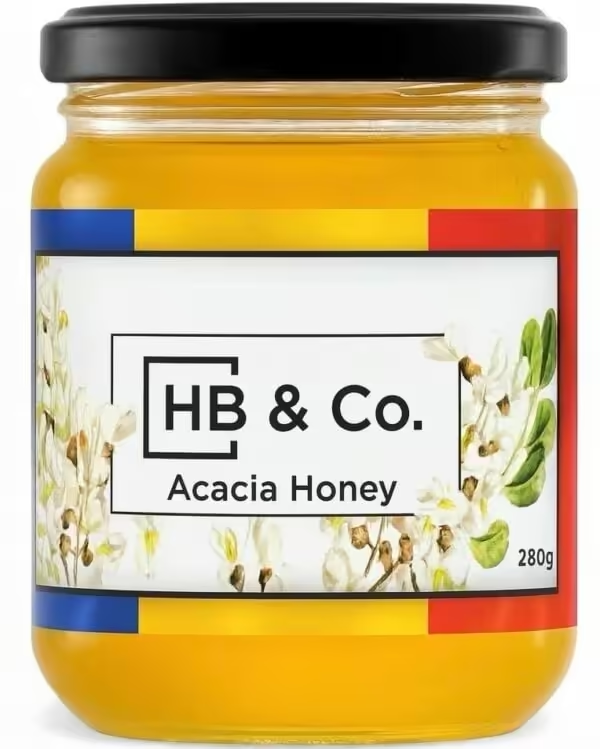
Acacia honey is harvested in early June from colonies foraging on black locust (Robinia pseudoacacia), an introduced tree that dominates the lower hillsides of Transylvania. The nectar is exceptionally high in fructose, which makes acacia honey the slowest to crystallise of any European variety and gives it its characteristic water-clarity and delicate floral sweetness. Our raw acacia honey is our lead product and our largest harvest, the same colonies, the same hillsides, managed by the same family since Dragos's grandfather Grigore first kept bees here in the 1950s.
Linden honey follows in late June and early July, when lime trees (Tilia spp.) flower across the valleys. Linden honey has a pronounced herbal character, slightly mentholated, with a greenish tinge in the fresh harvest, and is traditionally prized in central and eastern Europe as a tea honey. Our linden honey carries that same character from the Transylvanian lime forests.
Sunflower honey is harvested in August from colonies worked across the sunflower fields of the lower Transylvanian plains. Sunflower honey crystallises rapidly to a firm, pale yellow set, a natural property of its high glucose content, not a sign of adulteration or age. Our raw sunflower honey is harvested and jarred before crystallisation begins in the comb.

British honeys: wildflower, soft set, and heather
Our British range is produced by a SALSA-certified UK beekeeping partner whose colonies forage across the English Midlands and the Yorkshire Moors. British Apis mellifera populations are predominantly hybrid, with A. m. ligustica (Italian) and A. m. carnica (Carniolan) genetics dominant in managed hives, though traces of the native dark bee A. m. mellifera persist in feral and traditionally managed colonies in northern England.
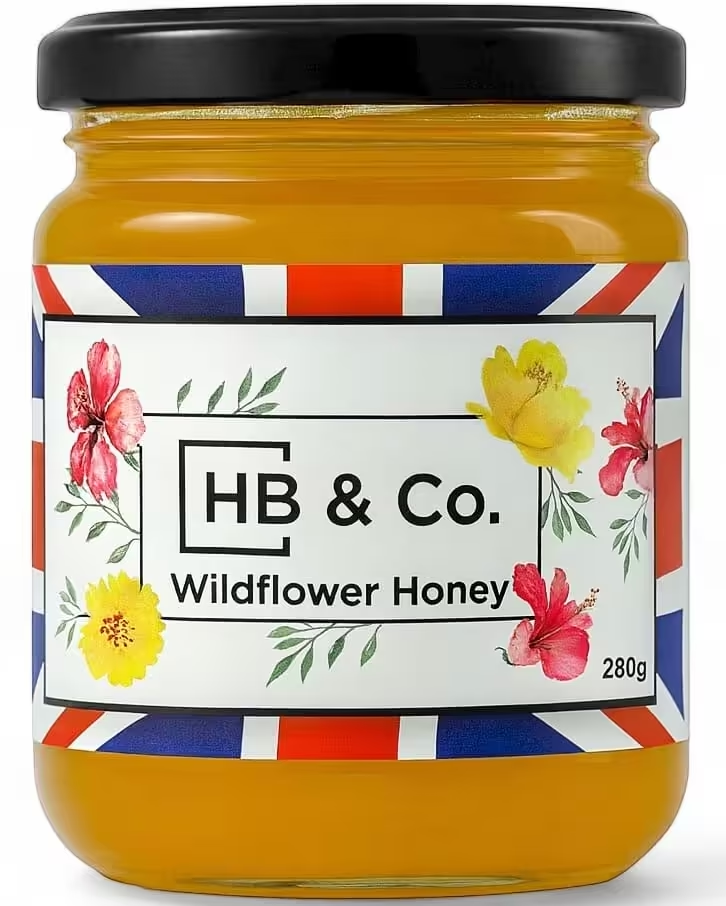
Wildflower honey reflects the full spectrum of whatever is flowering within foraging range across the season: clover, borage, phacelia, bramble, lime, and dozens of hedgerow species. No two harvests are identical. Our British wildflower honey is raw, unfiltered, and varies subtly year to year in colour and aroma, which is exactly as it should be.
Soft set honey is the same wildflower honey managed through a controlled crystallisation process that produces a smooth, spreadable consistency without heating. The enzymatic profile, pollen content, and raw character are preserved. It is simply a different physical form of the same harvest. Our soft set honey suits anyone who prefers honey that stays where you put it on toast.
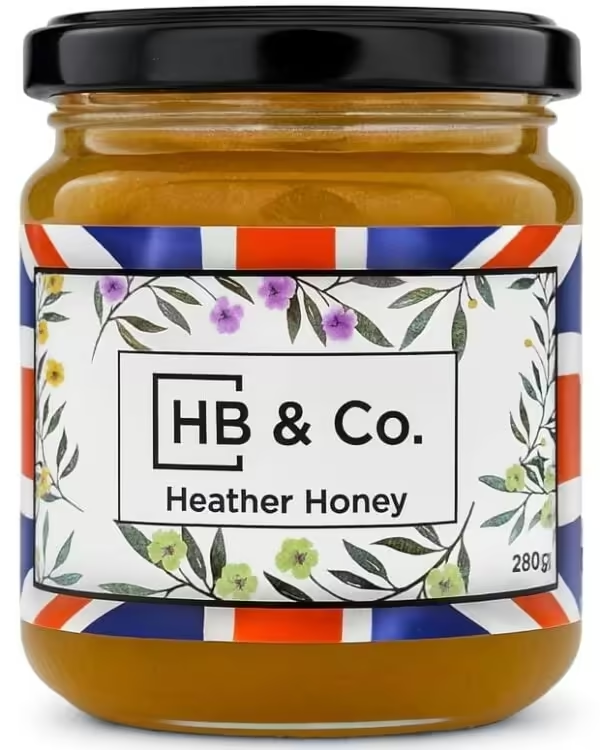
Heather honey is our most distinctive British variety and the only one in our range priced at a premium. Yorkshire Moors heather (Calluna vulgaris) flowers for a brief window in August, and colonies must be moved onto the moorland at precisely the right time to catch the flow. The resulting honey is thixotropic, it gels in the jar and liquefies when stirred, a property unique to heather honey caused by protein structures in the nectar. Our British honey supplier holds SALSA Certification, and our Yorkshire heather honey is harvested from a single annual yield. When it is gone, it is gone until the following August.
All six varieties are available as a monthly honey subscription with 20% off and free UK delivery on every order. If you want to try the range before committing, our honey gift sets are a good place to start. For a deeper look at how Apis mellifera colonies turn nectar into the finished jar, read our guide to how bees make honey.
Source Conflicts and Open Questions
Where did Apis mellifera originate?
The evolutionary origin of A. mellifera remains one of the most contested questions in bee biology. The principal competing hypotheses propose Africa, West Asia (the Middle East), or, in a dissenting 2023 mitogenome study, Europe as the ancestral centre. Whitfield et al. (2006) used SNP data to argue for an African origin with two subsequent colonisations of Europe. Wallberg et al. (2014) supported an African origin but with different colonisation routes. Han et al. (2012) found evidence consistent with a West Asian origin. A 2024 analysis of 251 genomes across 18 subspecies concluded that West Asia was the most probable origin, with at least three adaptive radiations into Africa and Europe.[14]
A 2023 mitochondrial study by multiple authors found evidence suggesting a European origin around 780,000 years ago, challenging both the Africa and Asia hypotheses. The paper explicitly notes that Out-of-Africa and Out-of-Asia models both fail to accommodate the full mitogenomic dataset.[15] As of 2025, the question is genuinely unresolved, and articles or field guides that state the origin categorically are overstating the current consensus.
Is Apis mellifera native to Britain?
The status of A. m. mellifera in Britain is debated. Archaeological and palynological evidence confirms the presence of honeybees in Britain during interglacial periods. A 2008 paper by Carreck in the Journal of Apicultural Research reviewed the evidence and concluded that while feral colonies existed before recorded beekeeping, the extent to which modern British A. m. mellifera populations are truly native versus derived from centuries of importation and hybridisation cannot be established with certainty. The BIBBA (Bee Improvement and Bee Breeders Association) maintains that the dark bee is native; many commercial beekeepers import Italian or Carniolan stock. IUCN guidelines for the current Endangered assessment use ecological rather than genetic criteria to define wild populations, sidestepping this question for conservation purposes.
Frequently Asked Questions
What is the difference between a western honeybee and a bumblebee?
Western honeybees (Apis mellifera) and bumblebees (genus Bombus) are both eusocial members of the family Apidae, but they differ in colony size, lifecycle, and appearance. Honeybee colonies are perennial, numbering 20,000 to 80,000 workers, and survive winter as a cluster. Bumblebee colonies are annual: a mated queen overwinters alone and founds a new colony each spring, rarely exceeding a few hundred workers. Physically, bumblebees are larger, rounder, and more densely hairy than honeybees. Honeybees are slimmer, more uniformly banded, and bear corbiculae (pollen baskets) on their hind legs that are often visibly loaded with bright pollen.
How many bees are in a western honeybee colony?
Colony size in Apis mellifera varies by season and subspecies. At peak summer, a productive managed colony typically contains 40,000 to 80,000 worker bees, a single queen, and several hundred to a few thousand drones. By midwinter, the same colony may be reduced to 10,000 to 20,000 workers clustered tightly around the queen. A typical colony also contains one mated queen; in the event of the queen's death or loss, workers may rear emergency queens from young larvae.
Are western honeybees endangered?
The answer depends on whether you are asking about wild or managed populations. Managed Apis mellifera colonies are kept in their millions worldwide and are not endangered as a managed resource, though annual colony loss rates of 10 to 30% in Europe and North America represent a serious economic and ecological concern. Wild (free-living) A. mellifera populations in the European Union were formally classified as Endangered on the IUCN Red List in 2025, following documented population declines driven primarily by the Varroa mite and habitat loss. Wild honeybees in south-east England are included in this Endangered assessment.
How does the waggle dance work?
When a scout bee finds a worthwhile food source, she returns to the hive and performs a figure-eight dance on the vertical surface of the comb. The central portion of the figure-eight is the waggle run, during which the bee vibrates her abdomen. The angle of the waggle run relative to vertical corresponds to the direction of the food source relative to the sun: a waggle run pointing straight up means the food is in the direction of the sun. The duration of the waggle phase encodes distance: approximately one second of waggling indicates a food source roughly 1 kilometre away. Watching bees follow and decode the dance, Karl von Frisch described it as the only known example of symbolic language outside of humans and primates.
What is the native honeybee subspecies in the UK?
The native subspecies in Britain and Ireland is Apis mellifera mellifera, the dark European honeybee (also called the black bee or German bee). It belongs to the M lineage and is adapted to the cool, damp Atlantic climate, with a compact winter cluster and strong propolis use. Over the past century, extensive importation of Italian (A. m. ligustica) and Carniolan (A. m. carnica) bees for beekeeping has led to widespread hybridisation, and pure A. m. mellifera populations are now uncommon except in Ireland and some northern and western areas of the UK. The Bee Improvement and Bee Breeders Association (BIBBA) runs a programme to conserve and promote the native subspecies.
How long does a honeybee queen live?
Queen lifespan in Apis mellifera varies by subspecies and management context. In most subspecies under natural conditions, queens live 3 to 5 years. Reports from the dark European subspecies A. m. mellifera in traditional beekeeping describe individual queens living up to 8 years. In commercial beekeeping, queens are typically replaced every 1 to 2 years as egg-laying rates decline toward the end of the queen's sperm reserves. A newly mated queen stores enough sperm during her nuptial flights to fertilise several million eggs over her reproductive life.
Does the western honeybee produce all types of honey?
All monofloral and polyfloral honeys produced by managed hives in Europe and the Americas are the product of Apis mellifera colonies. The flavour, colour, aroma, and crystallisation properties of each honey variety are determined by the nectar sources available to foragers in a given location and season. Acacia honey comes from colonies foraging on black locust flowers; heather honey from colonies on moorland Calluna vulgaris; linden honey from lime tree blossom. Wildflower honey reflects the full seasonal spectrum of flowering plants within foraging range. The bee itself produces the same enzymatic transformation in each case; what varies is entirely the raw material brought in from the landscape.
Why are honeybees important to agriculture?
Apis mellifera is the most widely deployed managed pollinator in global agriculture because it can be transported, managed at scale, and directed toward specific crops through hive placement. It pollinates over 100 commercially grown crop species, including almonds, apples, blueberries, cucumbers, and oilseed rape. The IPBES (Intergovernmental Science-Policy Platform on Biodiversity and Ecosystem Services) estimates that between $235 billion and $577 billion of annual global food production relies on animal pollinators, with managed honeybees contributing the majority of this value in commercial agriculture. In the United Kingdom, A. mellifera meets approximately 34% of domestic pollination demand.
Sources and References
- Linnaeus, C. (1758). Systema Naturae per Regna Tria Naturae, 10th edition, p. 576. Laurentii Salvii, Stockholm. [Original species description. Nomenclatural authority for Apis mellifera]
- Engel, M. S. (1999). The taxonomy of recent and fossil honey bees (Hymenoptera: Apidae; Apis). Journal of Hymenoptera Research, 8(2), 165–196.
- Ilyasov, R. A., et al. (2020). A revision of subspecies structure of western honey bee Apis mellifera. Journal of Apicultural Science. Available via PMC7714978.
- Alburaki, M., et al. (2021). Genetic network analysis between Apis mellifera subspecies based on mtDNA. Saudi Journal of Biological Sciences. PMC8117108.
- Arias, M. C. and Sheppard, W. S. (2005). Phylogenetic relationships of honey bees (Hymenoptera: Apinae: Apini) inferred from nuclear and mitochondrial DNA sequence data. Molecular Phylogenetics and Evolution, 37(1), 25–35.
- Animal Diversity Web, University of Michigan. Apis mellifera: Morphology and caste data. animaldiversity.org
- Winston, M. L. (1991). The Biology of the Honey Bee. Harvard University Press.
- Seeley, T. D. and Morse, R. A. (1976). The nest of the honey bee (Apis mellifera L.). Insectes Sociaux, 23(4), 495–512.
- Von Frisch, K. (1967). The Dance Language and Orientation of Bees. Harvard University Press. [Nobel Prize lecture, 1973: nobelprize.org]
- Moro, A., Kohl, P., Rutschmann, B., et al. (2025). IUCN Red List assessment: Apis mellifera: European Union regional assessment. Honey Bee Watch / IUCN SSC Wild Bee Specialist Group. iucnredlist.org
- Rutschmann, B. and Kohl, P. L. (2024). The wild honeybee population of Europe is in decline: evidence from monitoring studies. EcoEvoRxiv. ecoevorxiv.org
- IPBES (2016). The Assessment Report on Pollinators, Pollination and Food Production. Secretariat of the Intergovernmental Science-Policy Platform on Biodiversity and Ecosystem Services, Bonn.
- Woodcock, B. A., et al. (2021). Overview of bee pollination and its economic value for crop production. Insects, 12(8), 688. doi.org/10.3390/insects12080688
- Alghamdi, S. A., et al. (2024). Genome resequencing of the honeybee Apis mellifera jemenetica. Psyche: A Journal of Entomology, 6627723. doi.org/10.1155/2024/6627723 [Reviews West Asian origin hypothesis and 251-genome analysis]
- McKinnon, A. (2023). Multiple mitogenomes indicate Things Fall Apart with Out of Africa or Asia hypotheses for the phylogeographic evolution of Honey Bees. Scientific Reports. doi.org/10.1038/s41598-023-35937-4