

 English (UK)
  Italiano
  Français
  简体中文
简体中文  한국어
한국어 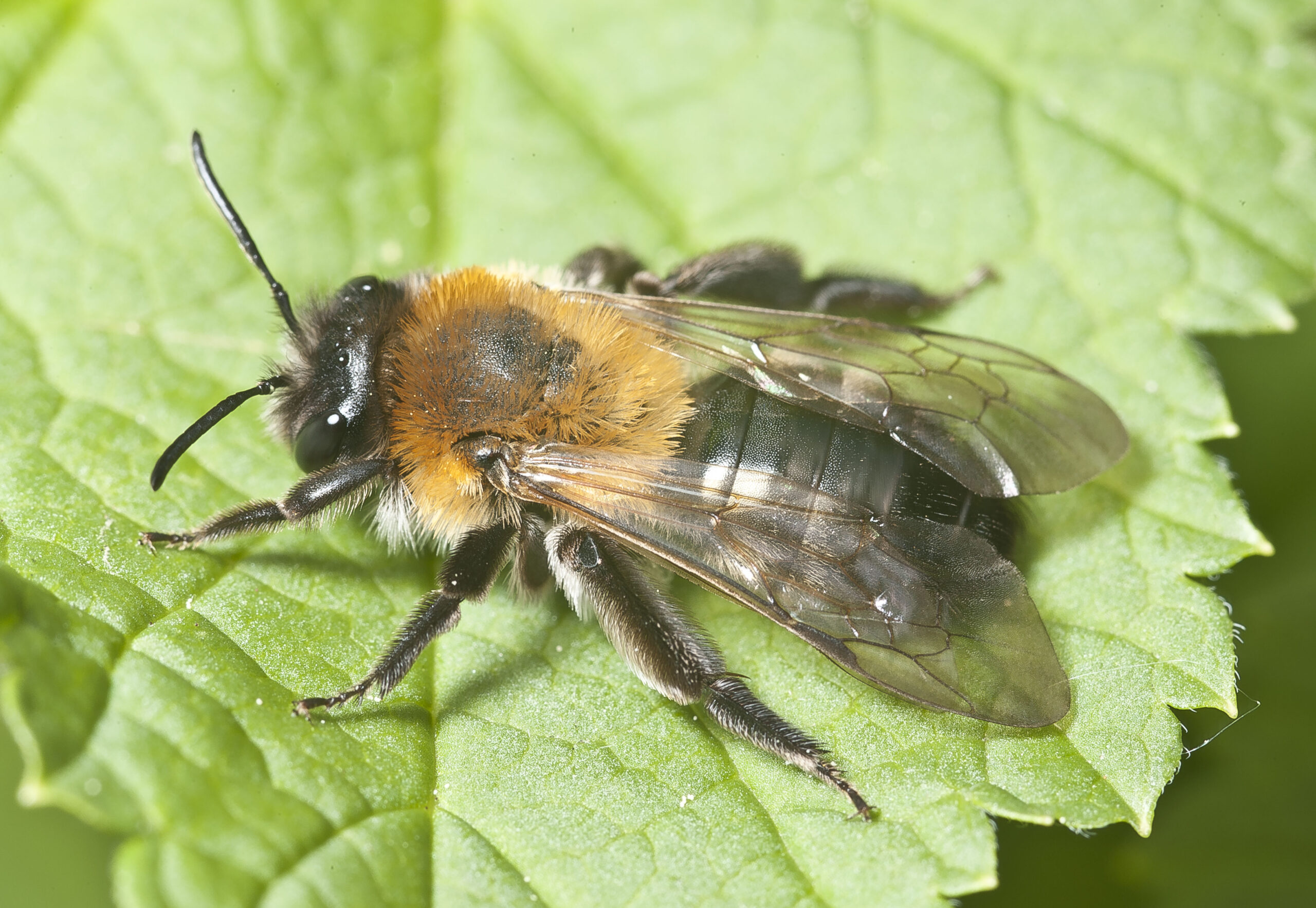 Andrena nitida, the grey-patched mining bee. Pjt56, CC BY-SA 4.0, via Wikimedia Commons.
UK Bee Species
Grey-patched Mining Bee (Andrena nitida)
Andrena nitida (Müller, 1776) · family Andrenidae
The grey-patched mining bee is a large, handsome spring bee: a bright foxy-brown thorax above a polished black abdomen, with neat white patches along the sides that give it its name. Common in lawns and grassland across southern Britain, it is a gentle, generalist pollinator of spring blossom. See where it sits among Britain's bees on the UK Native Bee Species Map, or among the world's bees in the World Bee Atlas.
Quick Facts
| Kingdom | Animalia |
| Phylum | Arthropoda |
| Class | Insecta |
| Order | Hymenoptera |
| Family | Andrenidae |
| Genus | Andrena |
| Species | Andrena nitida |
Foxy thorax, polished abdomen, grey patches
The grey-patched mining bee is a large Andrena, with females a little bigger than a honeybee at up to about 12.5 mm.[3] Fresh females have a dense, bright foxy-brown pile on top of the thorax that contrasts sharply with a shiny black abdomen.[1] The English name comes from neat patches of white hairs along the sides of the first three abdominal segments, which catch the light as soft grey blocks.[2] The face may be black-haired or largely white-haired. Males are smaller and slimmer, with a bright orange thorax, a shiny black abdomen with sparse white bands, and a mostly white-haired face.[2]
Against the polished black abdomen, the pale side-patches read as grey blocks, and they separate this bee from look-alikes such as Andrena thoracica, which has a darker thorax and entirely black-haired legs and abdomen.[2]
Where it lives and what it visits
This is one of the commoner mining bees of southern Britain, frequent through the south and Midlands and thinning out towards Yorkshire, its most northerly county.[1][4] It flies from late March to mid-July, peaking in spring, in open grassland, gardens, lawns and pasture.[3] Unusually for a mining bee it shows no strong preference for bare ground, nesting among short to medium turf, and its nests are always well-dispersed rather than packed into aggregations.[1] It is a generalist forager, found high up on blackthorn blossom and low down on dandelions alike.[1]
Lifecycle
Like all mining bees the grey-patched mining bee is solitary: after mating, each female digs her own burrow in turf, lines a series of cells, and stocks each with a pollen and nectar store for a single larva.[5] The young develop underground and emerge the following spring. Because the bees nest dispersed through grassland rather than in dense banks, a garden lawn may host several without any obvious colony, the bees coming and going quietly among the grass.
This bee has a tangled naming history. It has long been confused with Andrena pubescens, and there has been considerable debate over which name is correct for this distinctive spring species; older records under either name should be read with care. There is also doubt over the validity of some Irish and Scottish records at the edge of its range.[1]
Why it matters
The grey-patched mining bee is a common, effective pollinator of spring blossom and a striking bee to find in an ordinary lawn. Because it nests quietly through turf rather than in obvious banks, it is easy to overlook and easy to lose to tidy mowing and habitat change. Letting lawns and grassland flower, and tolerating a little spring blossom and dandelion, gives this handsome mining bee the space it needs.

Raw Acacia Honey
Our flagship raw Acacia honey: pale, delicate and slow to crystallise. Six generations of family beekeeping heritage in every 280g jar. £10.99.
Shop Acacia Honey
British Wildflower Honey
Raw honey from Midlands meadows and hedgerows, the blackthorn and dandelion a grey-patched mining bee works in spring. Our British honey supplier holds SALSA Certification. 280g. £10.99.
Shop Wildflower Honey
Subscribe & Save 20%
Choose any single honey and save 20% on every delivery, with free UK delivery on every subscription order.
Start a SubscriptionFrequently asked questions
How do I identify a grey-patched mining bee?
Why is it called grey-patched?
When is it active?
Where does it nest?
Is it found across the UK?
Does a cuckoo bee use it?
Do grey-patched mining bees sting?
Does the grey-patched mining bee make honey?
Related species
Buffish Mining Bee
Andrena nigroaeneaRead more → Mining beeTawny Mining Bee
Andrena fulvaRead more → Mining beeAshy Mining Bee
Andrena cinerariaRead more →Sources & references
- BWARS (Bees, Wasps & Ants Recording Society). Species account: Andrena nitida, identification, dispersed nesting, distribution, the nitida/pubescens naming history and possible cuckoo Nomada goodeniana. bwars.com.
- Falk, S. Field Guide to the Bees of Great Britain and Ireland, Bloomsbury, notes for Andrena nitida (female and male characters, grey side-patches, separation from A. thoracica). Steven Falk Flickr collection.
- Nature accounts after Falk: size (8.5 to 12.5 mm), flight period and nesting in turf, lawns and pasture (Pete Hillman / Nature Journeys species profile).
- NatureSpot. Andrena nitida (grey-patched mining bee): habitat, flight period and distribution to its northern limit. naturespot.org.
- Crowley, L.M. & Badham, X.R. et al. (2025). The genome sequence of the Grey-patched Mining Bee, Andrena nitida (Müller, 1776). Wellcome Open Research 10:573 (taxonomy and biology).

Dragos Nistor
Founder, HoneyBee & Co. · Guest Lecturer, University of Greenwich
HoneyBee & Co. draws on six generations of family beekeeping heritage, with honey from the Nistor family apiaries and from carefully chosen British producers. Our British honey supplier holds SALSA Certification, and we offer a 15% NHS Discount. Every jar is raw, unfiltered and traceable to the hive.