

 English (UK)
  Italiano
  Français
  简体中文
简体中文  한국어
한국어 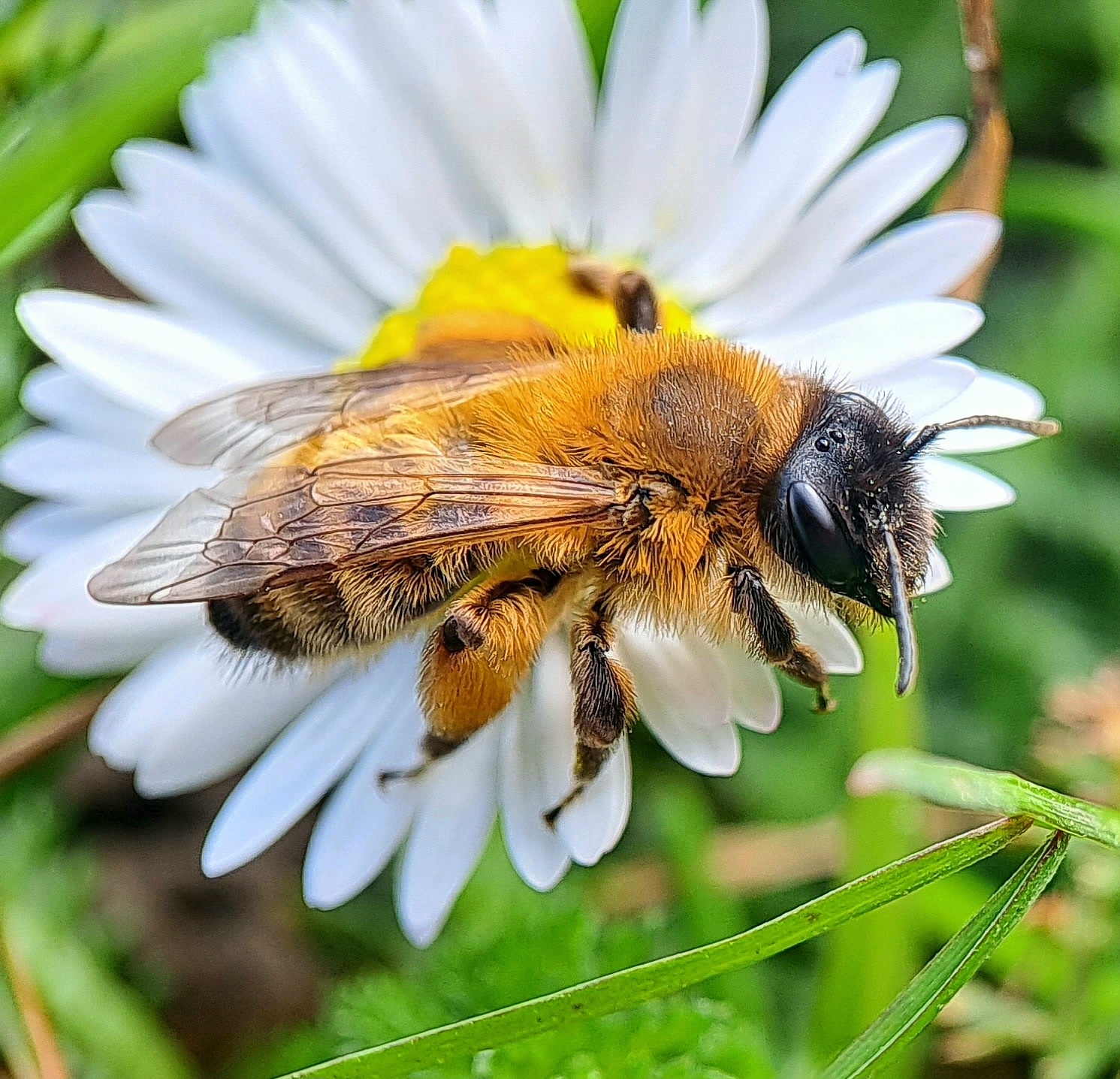 Andrena nigroaenea, the buffish mining bee. Jessica Alvey, CC0 1.0, via Wikimedia Commons.
UK Bee Species
Buffish Mining Bee (Andrena nigroaenea)
Andrena nigroaenea (Kirby, 1802) · family Andrenidae
The buffish mining bee is a large, early spring mining bee, one of the first to appear and an important pollinator of willows and fruit blossom. Plain and brown where many of its relatives are boldly marked, it is best known for the company it keeps: it is the host of two of our commonest cuckoo bees, and forms some of the biggest nesting aggregations of any British bee. See where it fits on the UK Native Bee Species Map, or among the world's bees in the World Bee Atlas.
Quick Facts
| Kingdom | Animalia |
| Phylum | Arthropoda |
| Class | Insecta |
| Order | Hymenoptera |
| Family | Andrenidae |
| Genus | Andrena |
| Species | Andrena nigroaenea |
A big, plain, early bee
The buffish mining bee is one of the larger British Andrena, around 10 to 15 mm long, with females bigger than males.[5] It is comparatively plain: a dark brown abdomen, dense brown hairs on the thorax, and buff or orange hairs on the hind legs and sides of the thorax that help carry pollen.[5] It is among the earliest mining bees on the wing, with males flying from March and females from April, and since the mid-1990s a partial second generation has been recorded in late summer.[5] Its plainness means it is most reliably told from relatives by a close view, and often by the cuckoo bees that follow it.[2]
Although each female digs her own nest, the buffish mining bee often nests in large aggregations. At the Spetchells in Prudhoe, Northumberland, a single colony has been estimated at more than 100,000 bees sharing one chalky bank.[3]
The host of two cuckoo bees
The buffish mining bee is best known as a host. It is parasitised by two of Britain's commonest and largest nomad bees, Gooden's nomad bee and Marsham's nomad bee, both bright black-and-yellow cuckoos that lay their eggs in the host's burrows.[1][3] Learning to spot a patrolling nomad bee is one of the best ways to find a buffish mining bee colony, since the cuckoo flies low over the same bare, sunny ground in search of nests.[4]
Where it lives and what it visits
The buffish mining bee is widespread and common across much of Britain, nesting in bare ground and short turf, both singly and in large aggregations, often alongside other mining bees.[3] It is a broad generalist, collecting pollen and nectar from blossoming spring shrubs and trees such as willows and fruit trees, and from herbaceous flowers including dandelions and buttercups.[3] Its early emergence makes it a valuable pollinator at a time of year when few other bees are flying.
Sources disagree on how social its nesting is. The national recording society notes records of single nesting, while the standard field guide and many field observers report it nesting in dense aggregations, sometimes vast ones. The likeliest reading is that it does both, nesting alone where ground is scarce and clustering wherever conditions are ideal.[2][4]
Why it matters
The buffish mining bee shows how an unshowy, common species can be ecologically central. It is an abundant early pollinator of orchards and hedgerows, and its great nesting banks support a community of cuckoo bees and other associates. Protecting open, sunny, sparsely vegetated ground, and the willows and spring blossom it depends on, keeps this keystone of the spring bee fauna, and everything that follows it, in place.

Raw Acacia Honey
Our flagship raw Acacia honey: pale, delicate and slow to crystallise. Six generations of family beekeeping heritage in every 280g jar. £10.99.
Shop Acacia Honey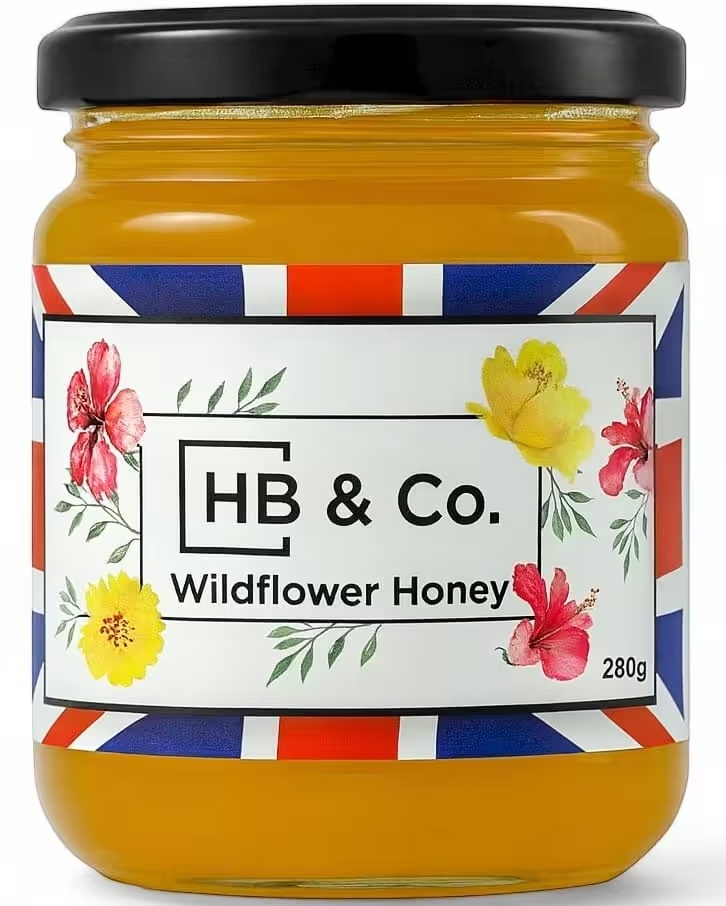
British Wildflower Honey
Raw honey from Midlands meadows and hedgerows, the willow and spring blossom a buffish mining bee forages. Our British honey supplier holds SALSA Certification. 280g. £10.99.
Shop Wildflower Honey
Subscribe & Save 20%
Choose any single honey and save 20% on every delivery, with free UK delivery on every subscription order.
Start a SubscriptionFrequently asked questions
How do I identify a buffish mining bee?
What is a mining bee?
When is the buffish mining bee active?
How big can its nesting aggregations get?
Which cuckoo bees use it as a host?
Is the buffish mining bee endangered?
Do buffish mining bees sting?
Does the buffish mining bee make honey?
Related species
Grey-patched Mining Bee
Andrena nitidaRead more → Mining beeYellow-legged Mining Bee
Andrena flavipesRead more → Mining beeAshy Mining Bee
Andrena cinerariaRead more →Sources & references
- BWARS (Bees, Wasps & Ants Recording Society). Species account: Andrena nigroaenea, with Nomada goodeniana as a cleptoparasite. bwars.com.
- Falk, S. Field Guide to the Bees of Great Britain and Ireland, Bloomsbury, notes for Andrena nigroaenea (size, plain coloration, aggregation nesting). Steven Falk Flickr collection.
- Buglife Bug Directory. Buffish mining bee (Andrena nigroaenea): diet, nesting, hosts Nomada goodeniana and N. marshamella, the Spetchells aggregation and Northern Ireland decline. buglife.org.uk.
- Buzz About Bees. Buffish mining bee: nesting habit and finding the host via its nomad cuckoo bees. buzzaboutbees.net.
- Wood, T.J. et al. (2025). Buffish Mining Bee Andrena nigroaenea (Kirby, 1802). IUCN Red List of Threatened Species (size, phenology, Least Concern assessment).

Dragos Nistor
Founder, HoneyBee & Co. · Guest Lecturer, University of Greenwich
HoneyBee & Co. draws on six generations of family beekeeping heritage, with honey from the Nistor family apiaries and from carefully chosen British producers. Our British honey supplier holds SALSA Certification, and we offer a 15% NHS Discount. Every jar is raw, unfiltered and traceable to the hive.