

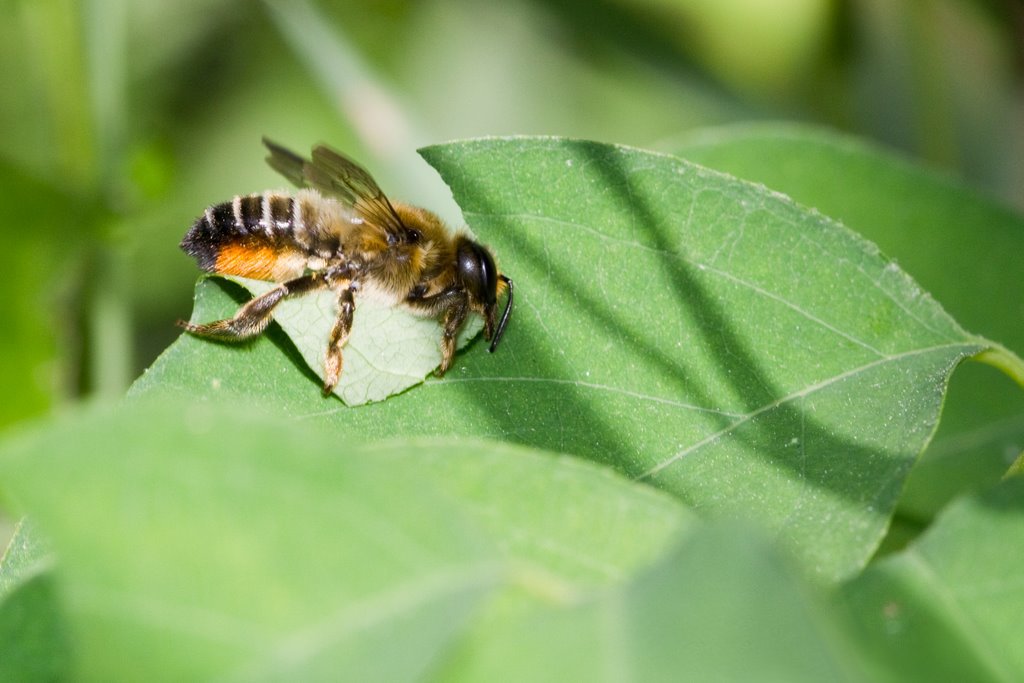
Bernhard Plank - SiLencer, CC BY-SA 3.0, via Wikimedia Commons
Patchwork Leafcutter Bee
Megachile centuncularis
Linnaeus, 1758 • Megachilidae • Megachilinae
On a summer afternoon, a rose leaf with a neat oval or circular hole cut from its edge is the calling card of the patchwork leafcutter bee. Megachile centuncularis Linnaeus, 1758 is Britain's most common leafcutter bee: a dark, compact bee with bright orange hairs on the underside of the abdomen, which the female uses to carry pollen rather than on her hind legs like most other bees. She cuts discs of leaf with her mandibles, carries them to a cavity in dead wood or a bee hotel, and rolls them into individual brood cells, one leaf-lined capsule per egg. It is a summer bee, flying from June to August, and one of the most productive users of bee hotels in any British garden. Explore its range on the UK Native Bee Species Map or read about leafcutter bees worldwide in the World Bee Atlas.
Quick Facts
Taxonomy and Classification
The patchwork leafcutter bee was described by Carl Linnaeus in 1758. It belongs to the family Megachilidae, the mason, leafcutter and carder bees, and within the family to the subfamily Megachilinae and the genus Megachile, the largest genus in the family with over 1,500 described species worldwide.[1] The species name centuncularis derives from the Latin centunculus, meaning "a patchwork of small pieces," a reference to the leaf-disc nest cells that look like tiny rolled quilts.
| Kingdom | Animalia |
| Phylum | Arthropoda |
| Class | Insecta |
| Order | Hymenoptera |
| Family | Megachilidae |
| Subfamily | Megachilinae |
| Tribe | Megachilini |
| Genus | Megachile Latreille, 1802 |
| Species | Megachile centuncularis Linnaeus, 1758 |
Identification
The patchwork leafcutter bee is a compact, rather dark bee, broadly dark brown or black above with the abdominal segments fringed with pale buff hair bands. The diagnostic feature is the underside of the abdomen: females carry a dense brush of bright orange hairs, the ventral scopa, which extends from the base of the abdomen and remains orange all the way to the tip, distinguishing it from closely related leafcutter species whose scopa darkens or becomes black-tipped.[2] In dorsal view, the orange scopa hairs form a bright halo around the edge of the abdomen. Females are 10 to 12 mm; males are smaller at 8 to 10 mm and have unmodified front legs.
A pollen-laden female with a bright orange belly, cutting a neat disc from a rose leaf in summer, is one of the most distinctive sights in the garden bee-hotel world. The clean, circular or oval cuts she leaves are an identification feature in themselves.
The Leaf-Cutting Method
The female's mandibles are sharp enough to cut through living leaf tissue cleanly. She selects a leaf, cuts a roughly oval or circular disc with a series of rapid bites working around a curve, then rolls the disc into a partial tube and flies it back to the nest site in a single trip.[1] Rose, bramble, wisteria, rhododendron and birch are among the most commonly used leaf sources in British gardens, though she is catholic in her choice and uses dozens of plant species. The cells are not woven but rolled: each is a tight cylinder of leaf material sealed at one end with a disc cap.
The bee hotel's most productive tenant
The patchwork leafcutter bee is the most frequently recorded bee at British garden bee hotels of all the leafcutter species. It readily takes tubes of 6 to 9 mm diameter and fills them quickly, often completing a tube in two or three days during warm weather. A well-placed bee hotel can attract several females nesting simultaneously within a few metres of each other.[2]
Life Cycle and Foraging
The patchwork leafcutter bee is univoltine, flying from June to August with peak activity in July. Females emerge, mate and begin nesting immediately. Each cell is provisioned with a mixture of pollen and nectar: the female makes many foraging trips to gather pollen on her ventral scopa, packing a dense loaf into each cell before laying an egg and sealing it with a leaf disc cap.[3] The larva develops, pupates and overwinters inside the sealed cell, emerging the following summer.
Megachile centuncularis is polylectic, visiting a wide range of flowering plants. It shows a preference for composites such as thistles, knapweeds, fleabane and cat's-ear, and also visits legumes including bird's-foot trefoils and vetches, as well as bramble, raspberry, geraniums, phacelia and garden flowers. The June-to-August flight season means it is active when most spring solitary bees have finished and the summer composites are at their best.[2]
Which leaves does it prefer?
Most British sources, including BWARS and Falk (2015), note rose as the most commonly used leaf source in gardens, but a DNA barcoding study of leaf cell contents from introduced populations in North America found M. centuncularis using 23 plant species with no strong preference for native versus non-native plants, and a significant preference for woody plants over perennials.[4] In British gardens, rose, bramble and wisteria are the most frequently reported, but the bee is genuinely catholic in its choice and the "rose bee" association is partly a function of which plants gardeners notice holes in.
Summer Composites and Summer Honey
The patchwork leafcutter bee peaks in July and August, the same weeks honeybee colonies are working at full strength across British meadows and orchards. It makes no honey itself. But our British Soft Set Honey comes from the same season: raw Midlands wildflower honey gently stirred to a smooth, spreadable texture, gathered while the composites the leafcutter forages are in full bloom.

Raw British wildflower honey gently stirred to a smooth, spreadable soft set. Harvested in the same summer season the leafcutter bee is active. SALSA-certified British supplier. 280g.

Three honeys matched to different teas. A thoughtful gift for anyone who takes their tea seriously.
Shop Tea Lovers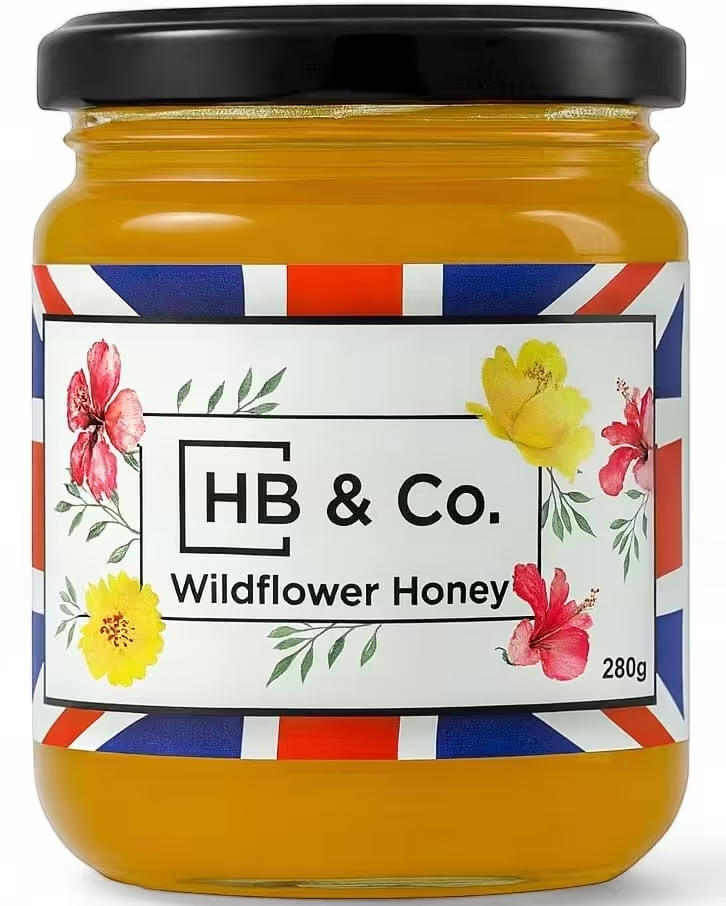
Raw single-origin honey every month. Soft Set, Wildflower, Heather and more. From £8.79/month.
Start SubscriptionFrequently Asked Questions
Why are there neat holes cut in my rose leaves?
Those are the work of a leafcutter bee, most likely the patchwork leafcutter bee (Megachile centuncularis). The female uses her sharp mandibles to cut neat oval or circular discs from rose, bramble and other smooth-leaved plants, then rolls the discs into individual brood cells in a cavity nest. The holes do no lasting harm to the plant. Leafcutter bees are gentle, do not sting to defend their leaf patches, and are valuable summer pollinators.
How do I identify a patchwork leafcutter bee?
Look for a compact dark bee around 10 to 12 mm with buff hair fringes on the abdominal segments and, in females, a vivid orange brush of hairs on the underside of the abdomen. This orange belly scopa is visible when the bee is in flight or visiting flowers, and is the most reliable field character. In a bee hotel, the distinctive rolled-leaf cell plugs at the tube entrance confirm the species.
When does the patchwork leafcutter bee fly?
June to August, peaking in July. It is a summer bee, active after most spring solitary bees have finished. It is one of the later-flying solitary bee species you are likely to see regularly in a British garden.
How can I attract patchwork leafcutter bees?
Provide a bee hotel with tubes of 6 to 9 mm diameter in a warm, sunny, sheltered position. Plant composites such as knapweed, thistles and fleabane for foraging. Having rose, bramble or wisteria nearby gives the female leaf material for nesting, though she will use many other plant species. The bee hotel should be positioned close to both the leaf source and the foraging flowers.
Do leafcutter bees sting?
Females have a sting but are extremely unlikely to use it. They do not defend their leaf-cutting sites or the leaf discs they carry, and they are not aggressive around the nest. Males cannot sting. They are safe to observe closely and present no risk to children or pets.
Is the patchwork leafcutter bee the same as the red mason bee?
No. Both are solitary cavity-nesting bees in the family Megachilidae, but they look different, fly at different times and use different nesting materials. The red mason bee (Osmia bicornis) is gingery, flies in spring (April to June), and builds mud cell walls. The patchwork leafcutter bee is dark with an orange belly, flies in summer (June to August), and uses rolled leaf discs. Both use bee hotels. Read the Red Mason Bee profile for a full comparison.
Does the patchwork leafcutter bee make honey?
No. It is a solitary bee: each female provisions only her own brood cells with pollen and nectar for her offspring. There is no colony, no surplus and nothing to harvest. All commercial honey comes from managed honeybee (Apis mellifera) colonies.
How common is it in the UK?
Common and widespread across lowland England, and present in Wales. Records extend to Scotland, though it becomes scarcer further north.[5] It is the most frequently encountered leafcutter bee at garden bee hotels in Britain. See the UK Native Bee Species Map for its regional distribution.
Sources and References
- Bees, Wasps and Ants Recording Society (BWARS). Megachile centuncularis species account: identification, nesting, foraging, distribution. bwars.com
- BWARS / Falk, S. J. (2015). Field Guide to the Bees of Great Britain and Ireland. British Wildlife Publishing. Orange scopa field character, bee hotel use and composite preference. Summarised via Exotic Bee ID. idtools.org
- NatureSpot. Patchwork Leafcutter Bee (Megachile centuncularis): life cycle, cell construction, flight season. naturespot.org
- Turo, K. J. & Gardiner, M. M. (2019). DNA barcoding of leaf preference in introduced Megachile centuncularis: 23 plant species, preference for woody plants. PeerJ. ncbi.nlm.nih.gov
- Powney, G. D. et al. (2019). Widespread losses of pollinating insects in Britain. Nature Communications 10:1018. doi.org