

 English (UK)
  Italiano
  Français
  简体中文
简体中文  한국어
한국어 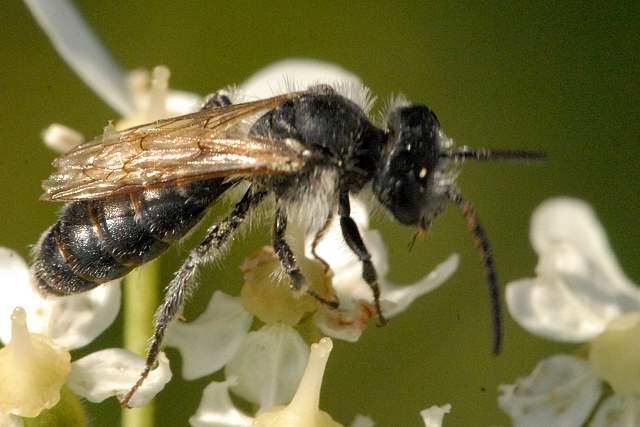
UK Bee Species
Banded Furrow Bee (Lasioglossum zonulum)
Lasioglossum zonulum Smith, 1848 · subgenus Lasioglossum · family Halictidae
The banded furrow bee is one of Britain's larger furrow bees, a robust, dark halictid with pale hair bands along the abdomen and, in the male, a distinctly “bull-headed” square profile. Widespread but local across southern Britain, it favours composite flowers and thrives on brownfield and dry grassland.
Quick facts
| Kingdom | Animalia |
| Phylum | Arthropoda |
| Class | Insecta |
| Order | Hymenoptera |
| Family | Halictidae |
| Genus | Lasioglossum |
| Subgenus | Lasioglossum |
| Species | Lasioglossum zonulum |
A big, bull-headed furrow bee
Furrow bees of the genus Lasioglossum take their English name from a fine groove, or furrow, at the tip of the female's abdomen. Most are small and dark, but the banded furrow bee is one of the larger and more robustly built British species.[2] It has pale hair bands at the sides of the abdominal segments, a shiny and rather sparsely punctured first segment, a warm brown pile on top of the thorax when fresh, and completely black legs.[1] Compare it against the other British bees on the UK Native Bee Species Map.
Males earn the alternative name bull-headed furrow bee: their heads are noticeably square in top view and their shoulders well developed, giving a stocky, front-heavy look.[2]
Telling it from the white-zoned furrow bee
The banded furrow bee is easily confused with the very similar white-zoned furrow bee (L. leucozonium). Females of the banded furrow bee have a much paler, yellow-brown wing stigma, a shinier and less densely punctured first segment, a brighter brown thorax pile, and a more square head.[1]
Most furrow bees are small and easily overlooked. This one is big, square-shouldered and unusually easy to notice.
Where it lives and what it visits
The banded furrow bee is largely restricted to southern England and south Wales, where it is widespread but local.[2][5] It shows a preference for woodland rides and is sometimes coastal, and is not frequent on chalky soils.[2]
It is polylectic, visiting a range of flower families rather than specialising, though composites of the daisy family such as common fleabane, creeping thistle and hawkbits are among its recorded flowers.[1][2]
Nesting and the blood bee
Like other furrow bees, the banded furrow bee is a ground-nester, the female digging her own burrow and provisioning a series of cells with pollen and nectar.[3] Its nests are targeted by a cleptoparasitic blood bee, the scarce Sphecodes scabricollis, a red-and-black cuckoo that lays in the furrow bee's cells so that its own grub consumes the stored food.[2]
Furrow bees are among the hardest British bees to name from photographs. Reliable records of the banded furrow bee usually need a specimen and a microscope to check wing stigma colour, the punctation of the first abdominal segment and head shape, using a standard key such as Falk (2015).[4]
Why it matters
As a larger, generalist furrow bee that works composite flowers through the summer, the banded furrow bee is part of the steady background of pollination on grassland and brownfield. Its dependence on flower-rich open ground, and its own dedicated cuckoo, make it a small illustration of how a single common bee anchors a wider web of species. Leaving thistles, fleabane and scabious to flower, and keeping some warm, open ground unmown, supports it directly.
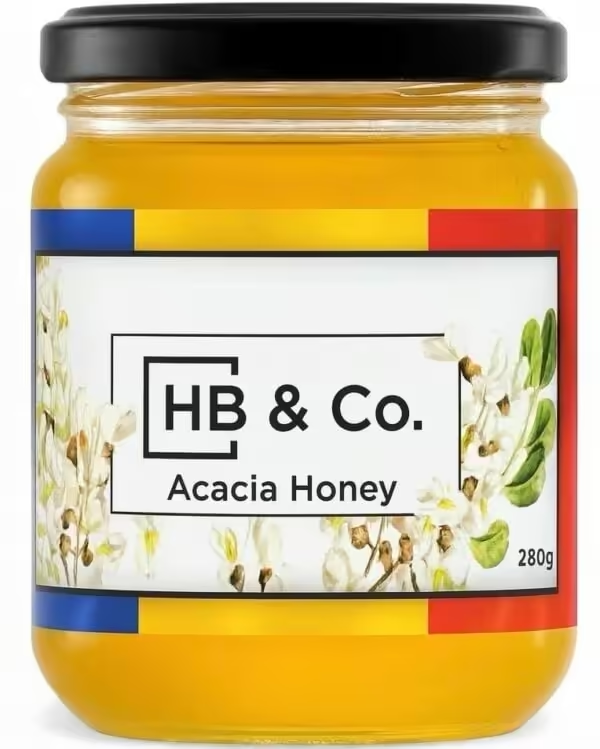
Raw Acacia Honey
Our flagship raw Acacia honey: pale, delicate and slow to crystallise. Six generations of family beekeeping heritage in every 280g jar. £10.99.
Shop Acacia Honey
Sunflower Honey
Golden, warm and naturally set, our raw Sunflower honey is the cook's honey. A single 280g jar, £10.99.
Shop Sunflower HoneyBritish Soft Set Honey
Creamy, buttery and spreadable British Soft Set honey, unpasteurised and minimally strained with no heat applied. Our British honey supplier holds SALSA Certification. 280g. £10.99.
Shop Soft Set HoneyFrequently asked questions
How do I identify a banded furrow bee?
What is a furrow bee?
Why is it also called the bull-headed furrow bee?
Where does it nest?
What flowers does it visit?
What is Sphecodes scabricollis?
Do banded furrow bees sting?
Does the banded furrow bee make honey?
Related species
Sources & references
- Falk, S. Field Guide to the Bees of Great Britain and Ireland, Bloomsbury, and the Steven Falk Flickr collection: Lasioglossum zonulum (large robust build, pale wing stigma, black legs, bull-headed male, separation from L. leucozonium).
- BWARS (Bees, Wasps & Ants Recording Society). Species account: Lasioglossum zonulum (Smith, F., 1848): distribution, habitat, polylectic foraging and the cleptoparasite Sphecodes scabricollis. bwars.com.
- Falk, S. (2015) and BWARS genus notes: Lasioglossum biology, solitary ground nesting and cell provisioning.
- NatureSpot. White-zoned and banded furrow bees (Lasioglossum leucozonium / zonulum): identification difficulty and the need for specimens and a standard key. naturespot.org.
- NBN Atlas / GBIF Secretariat. Lasioglossum zonulum (Smith, 1848): taxonomy and UK distribution. nbnatlas.org; gbif.org.

Dragos Nistor
Founder, HoneyBee & Co. · Guest Lecturer, University of Greenwich
HoneyBee & Co. draws on six generations of family beekeeping heritage, with honey from the Nistor family apiaries and from carefully chosen British producers. Our British honey supplier holds SALSA Certification, and we offer a 15% NHS Discount. Every jar is raw, unfiltered and traceable to the hive.