

 English (UK)
  Italiano
  Français
  简体中文
简体中文  한국어
한국어 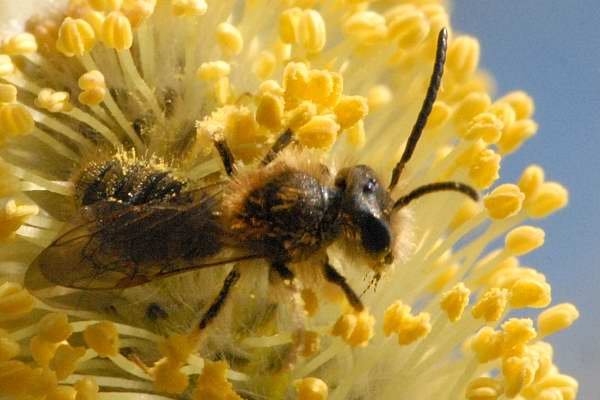
UK Bee Species
Common Mini-mining Bee (Andrena minutula)
Andrena minutula Kirby, 1802 · subgenus Micrandrena · family Andrenidae
The common mini-mining bee is Britain's most frequently encountered of the tiny “mini-miners,” a group of small dark mining bees that are easy to overlook. It is double-brooded, flying from early spring through to autumn, and its very ordinariness makes it a quiet, dependable pollinator of gardens and grassland.
Quick facts
| Kingdom | Animalia |
| Phylum | Arthropoda |
| Class | Insecta |
| Order | Hymenoptera |
| Family | Andrenidae |
| Genus | Andrena |
| Subgenus | Micrandrena |
| Species | Andrena minutula |
The yardstick mini-miner
Mining bees of the genus Andrena are solitary, ground-nesting bees, and the subgenus Micrandrena, the mini-miners, are its smallest members, tiny dark bees that are among the hardest of all British bees to identify.[3] The common mini-mining bee is the commonest of them and serves as the yardstick against which the others are measured.[1] Find it among Britain's bees on the UK Native Bee Species Map.
The female has a dull thorax with fairly close, obvious punctures, and abdominal segments that lack punctures and carry only narrow white hair-fringes at the sides. Even so, separating it from close relatives such as A. semilaevis and A. minutuloides usually needs a microscope.[1]
Two kinds of male
The common mini-mining bee shows brood dimorphism: spring males typically have a black-haired face and a duller, faintly punctured thorax, while summer males have pale-haired faces and a shinier, more strongly punctured body.[1] The difference once misled naturalists into treating the two broods as separate species.[2]
So small it is usually overlooked, so common it is everywhere: the mini-miner is the workhorse you never notice.
Two broods, spring to autumn
Unlike most British mining bees, which fly for only a few weeks, the common mini-mining bee is bivoltine, raising two full generations a year: a spring brood on the wing from mid-March to early June and a summer brood from late June or early July to the end of September.[2] It is the earliest of the mini-miners to appear and the one most likely to be found on early spring blossom.[3]
It is polylectic, visiting a great variety of flowers across both broods, but is especially abundant on dandelion, coltsfoot and lesser celandine in spring.[1] It is widespread from the south coast of England north to southern Scotland.[2][5]
Nesting and its cuckoo
Despite the bee's abundance, its nests are surprisingly seldom found. It is thought to nest solitarily, each female digging her own burrow in the ground.[2][4] Its cells are targeted by a tiny cuckoo, the little nomad bee (Nomada flavoguttata), which lays in the mini-miner's nests.[2]
The two broods puzzled early naturalists. After reviewing the British mini-miners, Perkins (1914) treated the spring generation as a distinct species, Andrena parvula, and the summer one as A. minutula, based on very subtle differences in surface texture. The name parvula was later shown to be the same species and demoted to a synonym.[2]
Why it matters
The common mini-mining bee's value lies precisely in its ordinariness. Small, abundant and active across two seasons, it spreads pollination across a huge range of wild and garden flowers from early spring to autumn, plugging gaps that showier, single-brooded bees leave. Growing dandelions, celandines and other simple open flowers, and tolerating a little bare, sunny ground for nesting, quietly supports one of Britain's busiest bees.

Raw Acacia Honey
Our flagship raw Acacia honey: pale, delicate and slow to crystallise. Six generations of family beekeeping heritage in every 280g jar. £10.99.
Shop Acacia Honey
Sunflower Honey
Golden, warm and naturally set, our raw Sunflower honey is the cook's honey. A single 280g jar, £10.99.
Shop Sunflower HoneySubscribe & Save 20%
Choose any single honey and save 20% on every delivery, with free UK delivery on every subscription order.
Start a SubscriptionFrequently asked questions
How do I identify a common mini-mining bee?
What is a mining bee?
What is a mini-miner?
When is the common mini-mining bee active?
What flowers does it visit?
Why do the spring and summer bees look different?
Do common mini-mining bees sting?
Does the common mini-mining bee make honey?
Related species
Sources & references
- Falk, S. Field Guide to the Bees of Great Britain and Ireland, Bloomsbury, and the Steven Falk Flickr collection: Andrena minutula (commonest mini-miner, female and brood-dimorphic male characters, bivoltine flight, spring forage).
- BWARS (Bees, Wasps & Ants Recording Society). Species account: Andrena minutula (Kirby, 1802): seasonal dimorphism, the parvula history, bivoltine flight, distribution, solitary nesting and the cuckoo Nomada flavoguttata. bwars.com.
- Steven Falk, Micrandrena collection notes, and NatureSpot family account for Andrenidae: mini-miner identification difficulty and biology. naturespot.org.
- Falk, S. (2015): Andrena genus biology, solitary ground nesting and generalist foraging.
- NBN Atlas / GBIF Secretariat. Andrena minutula (Kirby, 1802): taxonomy and UK distribution. nbnatlas.org; gbif.org.

Dragos Nistor
Founder, HoneyBee & Co. · Guest Lecturer, University of Greenwich
HoneyBee & Co. draws on six generations of family beekeeping heritage, with honey from the Nistor family apiaries and from carefully chosen British producers. Our British honey supplier holds SALSA Certification, and we offer a 15% NHS Discount. Every jar is raw, unfiltered and traceable to the hive.