

 English (UK)
  Italiano
  Français
  简体中文
简体中文  한국어
한국어 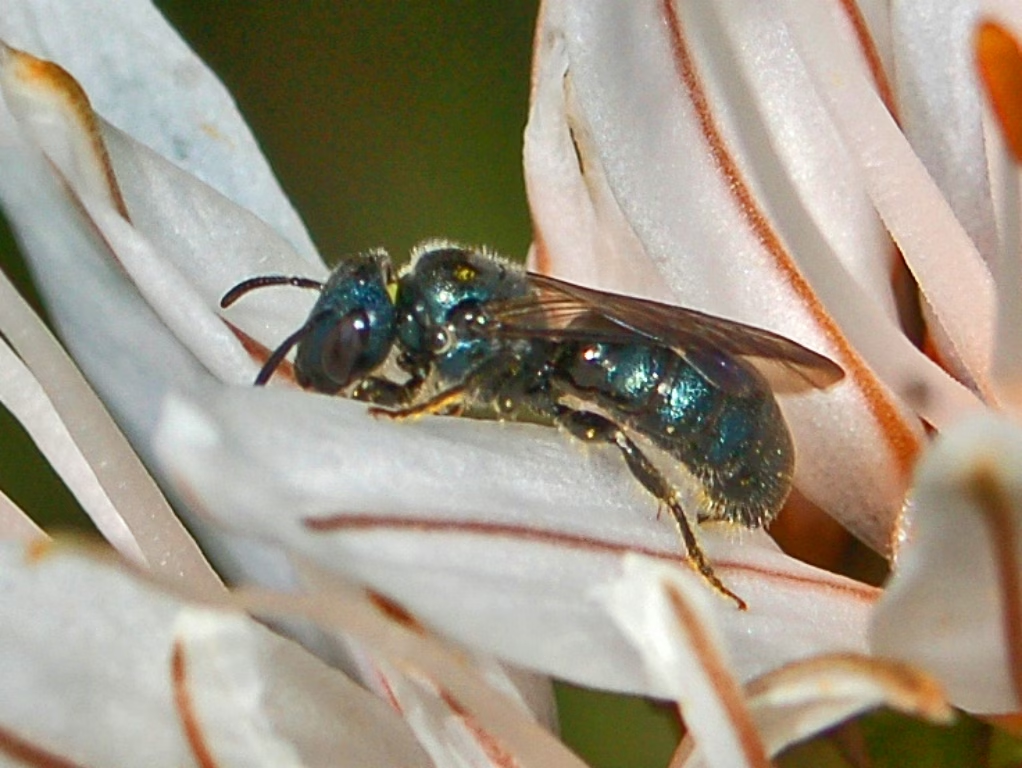
UK Bee Species
Blue Carpenter Bee (Ceratina cyanea)
Ceratina cyanea (Kirby, 1802) · subfamily Xylocopinae · family Apidae
The blue carpenter bee is one of the most distinctive and least bee-like of all our native bees: a tiny, shining, metallic blue-black insect, almost free of hair, that most people take for a small beetle or wasp. It is Britain's only small carpenter bee, named for the way the female hollows out her nest inside dead bramble stems. Once thought a great rarity, it is a southern speciality that rewards a close look on warm, scrubby ground. See where it sits among Britain's bees on the UK Native Bee Species Map, or among the world's bees in the World Bee Atlas.
Quick Facts
| Kingdom | Animalia |
| Phylum | Arthropoda |
| Class | Insecta |
| Order | Hymenoptera |
| Family | Apidae |
| Subfamily | Xylocopinae |
| Genus | Ceratina |
| Species | Ceratina cyanea |
A tiny metallic bee unlike any other
At only 5 to 8 mm long, the blue carpenter bee is small, slim and shining, its blue-black body carrying only sparse hairs and catching the light with a faint metallic sheen.[1][2] It has none of the furriness people expect of a bee, which is why it is so often passed over as a beetle or a small wasp. In Britain it is effectively unmistakable: no other native bee is this glossy, hairless and blue, so once you have seen one the identification looks after itself.[2]
Not the big black carpenter bee
The name causes confusion. The large, dark, violet-winged carpenter bees that visitors meet in southern Europe and warmer countries are a different genus, Xylocopa, and can be 25 mm or more. The blue carpenter bee is a small carpenter bee, genus Ceratina, only distantly related to those giants, and it is the single member of that group found in Britain.[1][4][5] Both kinds earn the name carpenter from the same habit: working their nests into wood or stems rather than digging in the ground.
A carpenter of bramble stems
The female is the carpenter. Using strong jaws, she bores into a dead, dry, broken stem where the soft pith is exposed and hollows out a narrow burrow, then divides it into a row of cells separated by partitions of chewed pith.[3] Each cell is stocked with a ball of pollen and nectar for a single grub. By far the favourite stem is bramble, with a few nests found in rose, and most are in detached or broken stems lying on or close to open ground.[3] She works alone, provisioning and guarding the nest herself.[5]
Dead, broken bramble stems are this bee's workshop and nursery. Where tidy management clears them away, the blue carpenter bee loses its nest sites.[3]
A bee that can live a year
Most British solitary bees live as adults for only a few weeks. The blue carpenter bee is different. It has a single generation a year, on the wing chiefly from May to late August, yet adults can be found in every month, because both sexes spend the winter as fully grown adults sheltering inside old stems.[1] Females are notably long-lived: many survive about a year, and there is evidence that some live for around eighteen months.[3] That long adult life, unusual among our bees, is part of what makes a chance winter sighting of a glittering blue bee possible at all.
Where and when you will see it
The blue carpenter bee was long thought to be a great rarity in Britain, until it was found in abundance on a Hampshire downland in 1972; it then proved to be more widespread and locally common across south-east England, especially in the Weald.[1] It favours warm, sheltered southern sites: south-facing chalk escarpments, heathland, old sand quarries and sunny woodland rides, anywhere with bramble and dead pithy stems.[1] It is polylectic, taking pollen and nectar from a range of flowers including bird's-foot-trefoil, buttercups, cinquefoils and yellow daisies.[3] Formerly listed as Rare, it is now best regarded as a scarce species of the south, still very local further north.[1][6]
Treated as a great rarity until 1972, the blue carpenter bee is now known to be locally common in parts of south-east England, though still scarce overall.[1]
Named by William Kirby in 1802
The blue carpenter bee was first described in 1802 by the Suffolk clergyman and naturalist William Kirby, in his Monographia Apum Angliae, the founding study of Britain's bees.[7] Its scientific name is neatly descriptive: Ceratina comes from the Greek for "horned", and cyanea from kyanos, "dark blue", together capturing the small, deep metallic-blue insect Kirby had before him.[5] It is the only British member of the small carpenter bees, the genus Ceratina, miniature relatives of the large carpenter bees (Xylocopa) that share their habit of tunnelling into wood and pith to nest.[1]
From great rarity to south-east regular
For most of its recorded history in Britain this was thought a great rarity, known from only a scatter of records.[3] That changed in 1972, when it was found in abundance at a downland site in east Hampshire; once naturalists knew where and how to look, it proved to be widely distributed and locally common across south-east England, especially in the Weald.[3] It was still listed as Rare in the national reviews of 1987 and 1991, but is now better regarded as scarce, and is fairly frequent in warm parts of Sussex, Kent, the Thames Gateway and the Suffolk Sandlings.[1]
Long dismissed as a great British rarity, the blue carpenter bee was found in abundance on east Hampshire downland in 1972, and turned out to be widespread across the south-east.[3]
How to tell it apart
For all its former rarity, the blue carpenter bee is one of the easier British bees to name: a small, shining, almost hairless bee of deep metallic blue is difficult to confuse with anything else here.[2] The narrow, elongate abdomen ends in a fine lengthwise keel in both sexes, males carry a small pale mark on the lower face, and the flight is slow and low over the flowers.[1] The only real lookalikes, the metallic Lasioglossum furrow bees, are greener, a different shape, and carry obvious pollen brushes on the hind legs that this bee lacks.[2]
Why the blue carpenter bee matters
This little bee is a reminder that wildlife often needs the parts of the landscape we are tempted to tidy away. Its whole nesting life depends on dead, broken bramble and other pithy stems left standing or lying in warm, sunny places.[1] Cutting and clearing every bramble and dead stem removes its nurseries at a stroke, and the same goes for a long list of other stem-nesting insects. Leaving rough, scrubby margins, sunny bramble patches and standing dead stems is one of the simplest ways to help the blue carpenter bee hold and expand its southern range.
This tiny bee works wild brambles and meadow flowers; our honeybees turn the same kind of forage into raw honey. Explore the range in the HoneyBee & Co. shop.
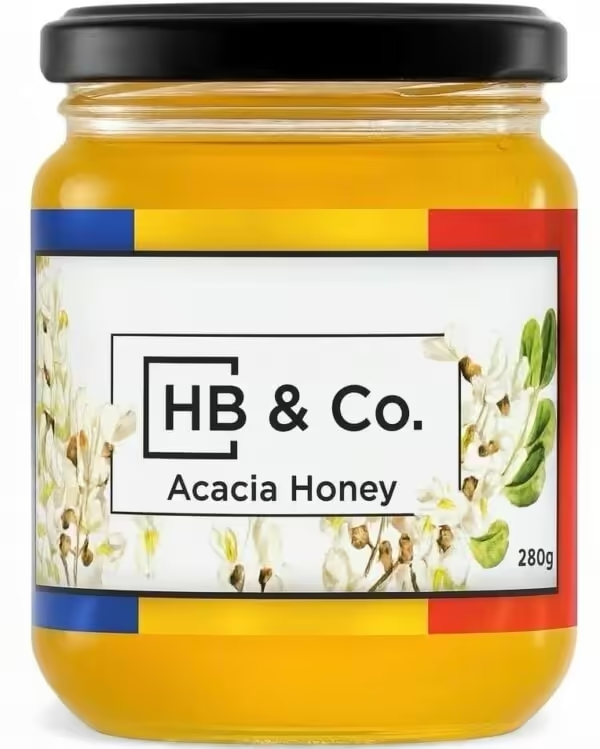
Raw Acacia Honey
Our flagship raw Acacia honey: pale, delicate and slow to crystallise. Drawn from the Nistor family's Transylvanian apiaries, with six generations of beekeeping heritage in every 280g jar. £10.99.
Shop Acacia Honey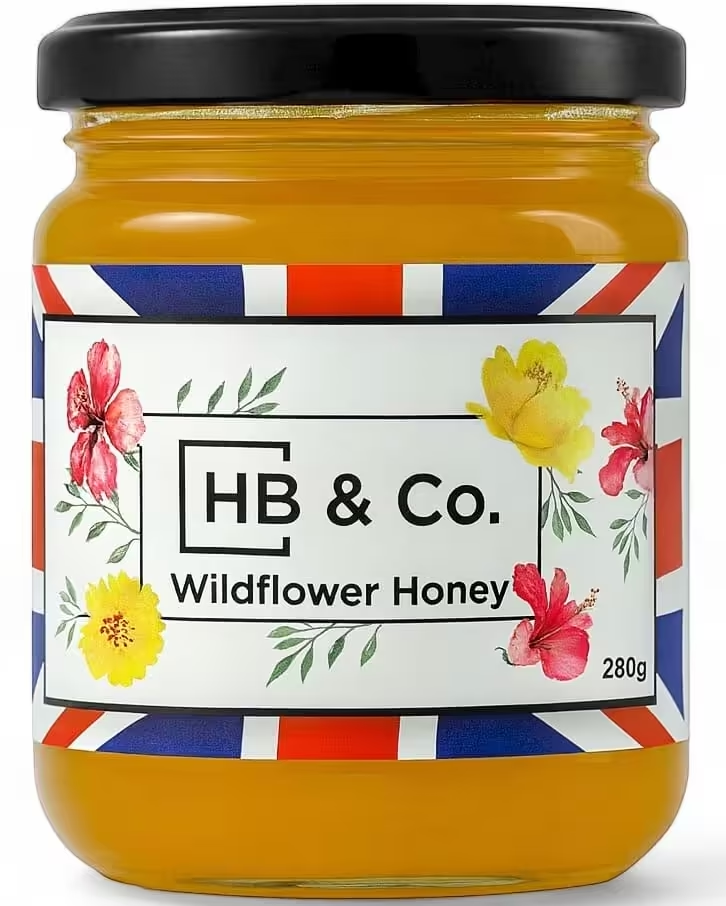
British Wildflower Honey
Raw honey from Midlands meadows and hedgerows, the bramble and trefoil this little bee also forages. Our British honey supplier holds SALSA Certification. 280g. £10.99.
Shop Wildflower
Subscribe & Save 20%
Choose any single honey and save 20% on every delivery, with free UK delivery on every subscription order.
Start a SubscriptionFrequently asked questions
What is the blue carpenter bee?
Is it the same as the big black carpenter bee?
How do I identify Ceratina cyanea?
Where does the blue carpenter bee live?
When is the blue carpenter bee active?
Do blue carpenter bees sting?
Where do blue carpenter bees nest?
Does the blue carpenter bee make honey?
Related species
Red Mason Bee
Osmia bicornisRead more → Cavity nesterPatchwork Leafcutter Bee
Megachile centuncularisRead more → Solitary beeWool Carder Bee
Anthidium manicatumRead more →Sources & references
- BWARS (Bees, Wasps & Ants Recording Society). Species account: Ceratina cyanea (Britain's only small carpenter bee, nesting in pithy bramble stems, status from rarity to scarce, south-east England, flight May to August with adults found all year). bwars.com.
- Falk, S. Field Guide to the Bees of Great Britain and Ireland, Bloomsbury, and the Steven Falk Flickr collection: Ceratina cyanea (small size, shining near-hairless metallic blue-black body, identification).
- Else, G.R. (1995). The distribution and habits of the small carpenter bee Ceratina cyanea in Britain (Hymenoptera, Apidae): nesting in bramble and rose stems, cell partitions, forage pollen and adult longevity. bwars.com.
- Else, G.R. & Edwards, M. (2018). Handbook of the Bees of the British Isles. Ray Society (taxonomy and placement in the Xylocopinae).
- Buzz About Bees. Ceratina, the small carpenter bees: nesting in pithy stems, provisioning and guarding, and the difference from the large carpenter bees. buzzaboutbees.net.
- Nieto, A. et al. (2014). European Red List of Bees. IUCN / Publications Office of the European Union (conservation status context).
- Kirby, W. (1802). Monographia Apum Angliae. Ipswich (the original description of Ceratina cyanea and a foundation of British bee taxonomy).

Dragos Nistor
Founder, HoneyBee & Co. · Guest Lecturer, University of Greenwich
HoneyBee & Co. draws on six generations of family beekeeping heritage, with honey from the Nistor family apiaries and from carefully chosen British producers. Our British honey supplier holds SALSA Certification, and we offer a 15% NHS Discount. Every jar is raw, unfiltered and traceable to the hive.