

 English (UK)
  Italiano
  Français
  简体中文
简体中文  한국어
한국어 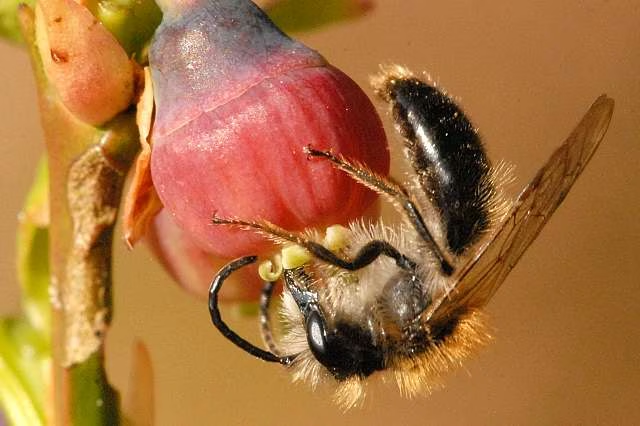
UK Bee Species
Bilberry Mining Bee (Andrena lapponica)
Andrena lapponica (Zetterstedt, 1838) · family Andrenidae
The bilberry mining bee is an upland, ground-nesting solitary bee tied to the moors, heaths and open woods where bilberry grows. Where many of Britain's mining bees belong to lowland gardens and verges, this one is a creature of the hills, emerging in spring to work the nodding pink flowers of bilberry on the moorland edge. Its scientific name, lapponica, means of Lapland and points to its cool, northern character. See where it sits among Britain's bees on the UK Native Bee Species Map, or among the world's bees in the World Bee Atlas.
Quick Facts
| Kingdom | Animalia |
| Phylum | Arthropoda |
| Class | Insecta |
| Order | Hymenoptera |
| Family | Andrenidae |
| Genus | Andrena |
| Species | Andrena lapponica |
How to identify a bilberry mining bee
The bilberry mining bee is a medium Andrena, roughly 10 to 12 mm long. The female has a black-haired face, a warm reddish-brown pile of hair over the top of the thorax, and a blackish, distinctly shining abdomen fringed with long pale hairs, most obvious on the first segment.[2] It closely resembles the heath-loving Andrena varians, but the pale hairs on the first abdominal segment are less dense, the abdomen is shinier and the overall build is a little broader.[2] Males belong to a group with long jaws bearing a small triangular projection near the base, and they always have dark hind feet, which helps separate them from close relatives.[2]
A bee of the uplands
More than its markings, it is location that identifies this bee. The bilberry mining bee is a specialist of upland and northern country: moorland, upland heath, open birch and pine woods, and the bilberry-clad edges of bogs.[1][5] A medium, foxy-thoraxed mining bee working bilberry flowers on a Welsh, Pennine or Highland hillside in spring is very likely this species, simply because few other mining bees share that ground at that time.
A bee that follows the bilberry
As its name suggests, the bilberry mining bee is closely linked to bilberry (Vaccinium myrtillus) and its relative cowberry, whose pink, bell-shaped flowers it works busily in spring.[1] It is not strictly tied to them, and also visits willow, blackthorn, gorse, dog-violet, thyme and other moorland and woodland-edge flowers, but bilberry is its signature plant.[1] Adults fly from April to July, peaking as the bilberry comes into bloom, in a single generation each year.[2] Like all mining bees it is solitary: each female digs and stocks her own burrow in well-drained ground among the heath, with no queen and no workers.
Its cuckoo: the bilberry nomad bee
Like other mining bees, the bilberry mining bee has its own dedicated cuckoo. Its nests are parasitised by the bilberry nomad bee (Nomada glabella), a wasp-like cuckoo bee that was for a long time treated as a form of Panzer's nomad bee (Nomada panzeri).[1][3] Recent work combining DNA barcoding and close study of structure confirmed the bilberry nomad as a distinct species, widespread and long established in bilberry-rich districts of Britain and often flying alongside true Panzer's nomad bee.[3] The female cuckoo enters the mining bee's burrow and lays in a provisioned cell, where her grub destroys the host egg and eats the stored food. You can meet another British cuckoo bee in our guide to the painted nomad bee.
The bilberry mining bee's cuckoo, the bilberry nomad bee, was confirmed as a species in its own right only recently, through DNA and morphology, having long passed as a form of Panzer's nomad bee.[3]
Where and when you will see it
The bilberry mining bee follows its food plant, so it is most frequent in the bilberry-rich uplands of northern and western Britain, from Wales and the Pennines to the Scottish Highlands, with more scattered records on southern heaths where bilberry persists.[4][5] It is best looked for on warm spring days from April onwards, low over open heath and around flowering bilberry, where the female works the bells and the smaller, plainer male patrols for mates.[2] It is a local species overall, tied to its habitat, but can be frequent where bilberry covers the ground, and across its wide northern range in Europe it is not considered threatened.[6]
One generation a year, on the wing from April to July and peaking with the spring bilberry bloom on upland heaths and moors.[2]
Why the bilberry mining bee matters
Bilberry is a keystone plant of British moorland, feeding birds, mammals and people, and the bilberry mining bee is one of its most faithful spring pollinators.[1] A healthy population is a sign of unbroken, flowering upland heath, the same habitat that supports red grouse, mountain plants and a wider community of specialist insects. Because it depends on extensive bilberry and open, well-drained ground to nest in, conserving and restoring upland heath, and resisting its loss to overgrazing, drainage and afforestation, is the surest way to keep this hill bee and its dedicated cuckoo in the landscape.
The same moors and heaths give us one of Britain's great honeys. Explore our single-origin raw honeys in the HoneyBee & Co. shop.

Raw British Heather Honey
From the same upland heaths and moors where the bilberry mining bee flies, only later in the year: rich, amber and aromatic, from a single annual heather harvest. Our British honey supplier holds SALSA Certification. 280g. £12.99.
Shop Heather Honey
Raw Acacia Honey
Our flagship raw Acacia honey: pale, delicate and slow to crystallise. Drawn from the Nistor family's Transylvanian apiaries. 280g. £10.99.
Shop Acacia
Subscribe & Save 20%
Choose any single honey and save 20% on every delivery, with free UK delivery on every subscription order.
Start a SubscriptionFrequently asked questions
What is a bilberry mining bee?
Why is it called the bilberry mining bee?
How do I identify Andrena lapponica?
When are bilberry mining bees active?
Where do bilberry mining bees live?
Do bilberry mining bees sting?
What is the bilberry nomad bee?
Does the bilberry mining bee make honey?
Related species
Heather Mining Bee
Andrena fuscipesRead more → Mining beeTawny Mining Bee
Andrena fulvaRead more → Spring minerClark's Mining Bee
Andrena clarkellaRead more →Sources & references
- BWARS (Bees, Wasps & Ants Recording Society). Species account: Andrena lapponica (forage including bilberry and cowberry, upland habitat, cuckoo association). bwars.com.
- Falk, S. Field Guide to the Bees of Great Britain and Ireland, Bloomsbury, and the Steven Falk Flickr collection: Andrena lapponica (female and male identification, resemblance to A. varians, flight April to July peaking with bilberry).
- Falk, S.J. et al. (2022). DNA and morphological characterisation of the cuckoo of the Bilberry Mining Bee, Nomada glabella sensu Stoeckhert, in Britain, and its separation from Nomada panzeri.
- Else, G.R. & Edwards, M. (2018). Handbook of the Bees of the British Isles. Ray Society (taxonomy, distribution and upland ecology).
- National Trust for Scotland. Bees and Ben Lawers: upland and Highland records of the bilberry mining bee and the bilberry nomad bee. nts.org.uk.
- Nieto, A. et al. (2014). European Red List of Bees. IUCN / Publications Office of the European Union (conservation status context).

Dragos Nistor
Founder, HoneyBee & Co. · Guest Lecturer, University of Greenwich
HoneyBee & Co. draws on six generations of family beekeeping heritage, with honey from the Nistor family apiaries and from carefully chosen British producers. Our British honey supplier holds SALSA Certification, and we offer a 15% NHS Discount. Every jar is raw, unfiltered and traceable to the hive.