

 English (UK)
  Italiano
  Français
  简体中文
简体中文  한국어
한국어 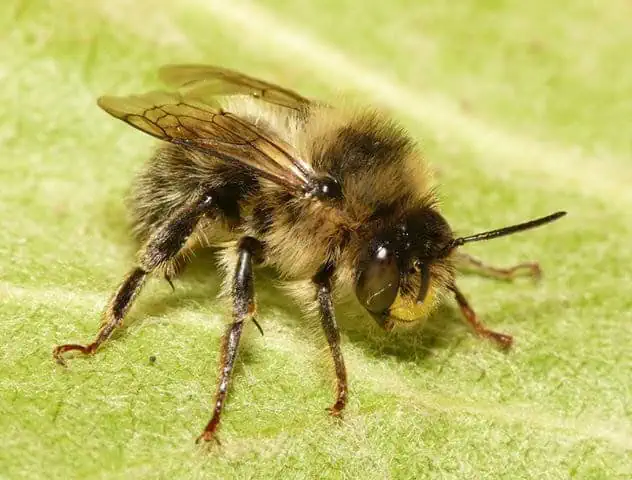
Anthophora furcata, the fork-tailed flower bee. Dick Belgers, CC BY 1.0, via Wikimedia Commons.
UK Bee Species
Fork-tailed Flower Bee (Anthophora furcata)
Anthophora furcata (Panzer, 1798) · family Apidae
Most people who meet this bee think they have seen a small ginger bumblebee. They have not. It is a flower bee, it flies in fast darting bursts with a high shrill buzz, and it does something no other British flower bee does: it chews its nest out of rotten wood instead of digging it in the ground.[1] It also carries a tongue nearly as long as its own body, which decides almost everything about where it feeds.[3] See where it fits among Britain's bees on the UK Native Bee Species Map, or among the world's bees in the World Bee Atlas.
Quick facts
| Rank | Classification |
|---|---|
| Kingdom | Animalia |
| Phylum | Arthropoda |
| Class | Insecta |
| Order | Hymenoptera |
| Family | Apidae |
| Genus | Anthophora |
| Species | Anthophora furcata |
The flower bee that gave up digging
Flower bees are ground bees. Most British species tunnel into soil, cliffs, banks and soft mortar, sometimes in noisy aggregations of hundreds. This one does not. It excavates its burrows in rotten wood, in dead trees, fence posts and driftwood on the coast, and a nest generally runs as two or more parallel tunnels. The cells are oval widenings of the burrow, each lined with compacted wood dust.[1]
There is a second oddity that fits the first. This is the only British Anthophora with three teeth on the mandible rather than two, with an inner and an outer subapical tooth.[1][2]
Known, and inferred
Known: it nests in rotten wood, alone among British flower bees. It has a third mandibular tooth, alone among British flower bees. Both facts are in the standard accounts.
Inferred: that the jaw exists because of the wood. It is an obvious reading and very likely right, since chewing timber asks more of a mandible than shifting soil does, but we have not found a study that tests it. Treat the connection as a good hypothesis rather than a fact, which is more than most pages will tell you.
How to tell it from a bumblebee
The confusion is almost always with the common carder bee, which is a similar size and a similar gingery brown.[4] Three things separate them, and none needs a hand lens.
The flight
Flower bees move in fast darting bursts, hover, then vanish. Carder bumblebees trundle. Once you have watched both, the difference is unmistakable at ten paces, and the sound helps too: flower bees carry a high shrill buzz where bumblebees hum lower.[4]
The face
Males have a bright yellow face with very little hair on it.[3] No British bumblebee looks like that. If you see the yellow mask, you have a male flower bee.
The tail
Females are brown all over with a small orange-red tip to the abdomen, and dense brown hair on the hind legs.[3][4] The name comes from the males, whose abdomen tip carries two projections. Two other flower bees have that character but far less developed.[2]
A note on records. Solitary bees can rarely be named from a field photograph, and verification for this group normally asks for face, side, top and wing views, the sex, and which key characters were matched.[3] The flight and the yellow face will tell you it is a flower bee. Species-level certainty asks for more.
The tongue decides the menu
An extended tongue around 12mm long, on a bee of 10 to 14mm, is a specialised instrument.[3][5] It buys access to flowers where the nectar sits at the bottom of a deep tube, which most short-tongued bees cannot reach, and the plants that offer it are largely one family: the dead-nettles.
Pollen comes chiefly from hedge woundwort, black horehound, wood sage and their relatives, along with garden sages and lamb's ear.[2][5] Those are high-reward flowers, and this bee needs them, because a fast darting flight is expensive to run.[5]
Which gives the only garden advice that matters for this species, and it comes in two parts that must both be true. Plant woundworts, wood sage or black horehound, in a patch rather than as single specimens.[5] And leave a pile of old soft logs somewhere out of the way. Flowers without dead wood, or dead wood without those flowers, and it has no reason to stay. Our guide to attracting bees to your garden and the one on which flowers bees actually use cover the wider version of this.
Where it lives
It is the most widespread British flower bee, recorded north to the Moray Firth in Scotland, and effectively ubiquitous in lowland Britain: gardens, woodland, grassland, moors, heaths and fens.[1][2] There are no records from Ireland or the Channel Islands.[1] Beyond Britain it is a Eurasian bee whose range reaches Kashmir.[1]
It is not scarce or threatened, but it is inconspicuous and quick, and it is widely thought to be under-recorded simply because people see a small brown bumblebee and stop looking.[4]
Its own cuckoos are sharp-tail bees, Coelioxys rufescens and C. quadridentata.[2] The same genus appears on our brown-footed leafcutter bee page, attacking a different host in a different family, which is a good illustration of how these cuckoos work across the bee world rather than within one branch of it.
British Wildflower Honey
Raw honey from mixed summer flowers, the hedge banks and rough margins where woundworts grow. Our British honey supplier holds SALSA Certification. 280g.
Shop Wildflower
Raw Heather Honey
Dark and bold, from the late summer moors where this bee is also recorded. 280g.
Shop Heather
Raw Acacia Honey
Pale, delicate and slow to crystallise. Free UK delivery on orders of 3 or more jars, on any order type. 280g.
Shop AcaciaBrowse all six raw honeys in the shop, or start at the HoneyBee & Co. homepage.
Frequently asked questions
Is this a bumblebee?
No, though it is regularly mistaken for one, usually the common carder bee. Flower bees fly in fast darting bursts with a high shrill buzz and hover between flowers, where bumblebees move more steadily with a lower hum. Males also have a bright yellow face, which no British bumblebee has.
Why is it called fork-tailed?
For the male, whose abdomen tip carries two small projections. Two other British flower bees show the same feature but much less strongly. Females instead have a small orange-red tip to the abdomen and no yellow on the face.
Where does it nest?
In rotten wood. It is the only British flower bee that does, chewing burrows into dead timber, fence posts and coastal driftwood rather than digging into soil or banks. A nest is usually two or more parallel tunnels, with oval cells lined with compacted wood dust.
What flowers should I plant for it?
Members of the dead-nettle family with deep flowers: hedge woundwort, black horehound, wood sage, garden sages and lamb's ear. Plant them in a patch rather than singly. Flowers alone are not enough, though. Without soft dead wood nearby for nesting, there is nothing to keep it.
How long is its tongue?
Around 12mm when extended, on a bee of 10 to 14mm, so close to its own body length. That reach gives it access to nectar sitting deep in tubular flowers, which is why it specialises in the dead-nettle family rather than open flowers such as daisies.
Does it sting?
Females can, but only if handled. It is a solitary bee with no colony to defend, and it is far more interested in woundwort than in you. Males have no sting at all.
Does it make honey?
No. Each female provisions her own cells for her own larvae, with nothing stored and no surplus. Only honeybees produce honey in quantity. Compare the bee families in the World Bee Atlas.
Is it found in Ireland?
No. There are no records from Ireland or the Channel Islands. In Britain it is the most widespread of our flower bees, reaching as far north as the Moray Firth, and it is thought to be under-recorded because it is quick, inconspicuous and easily written off as a small bumblebee.
Related species
Sources and references
- BWARS (Bees, Wasps and Ants Recording Society). Species account: Anthophora furcata (Panzer, 1798). Nesting in rotten wood, parallel burrows and wood-dust-lined cells, tridentate mandible, distribution including the absence of Irish and Channel Island records, Eurasian range, habitats, univoltine flight period and status. bwars.com
- Falk, S. Species account for Anthophora furcata, accompanying the Field Guide to the Bees of Great Britain and Ireland. Male yellow face and paired abdominal projections, female orange-tipped abdomen, the three apical mandibular teeth, range to the Moray Firth, pollen sources among the lamiates, and the Coelioxys cuckoos. Steven Falk collection
- NatureSpot. Species page for the fork-tailed flower bee: size, tridentate mandible, tongue length relative to the body, brown eyes, sexual differences, flight period, and the recording standard for solitary bees. naturespot.org
- Natural History Society of Northumbria. Species profile: separation from the common carder bee by flight behaviour and sound, the yellow male face, dense hind-leg hair, dead-wood nesting and the likelihood of under-recording. nhsn.org.uk
- Field observations of nesting and foraging in a wildlife garden, including tongue length of about 12mm, use of hedge woundwort, black horehound and wood sage, the high nectar reward these flowers offer, and planting in quantity rather than singly. My Biodiversity Garden
Dragos NistorFounder, HoneyBee & Co. · Guest Lecturer, University of GreenwichHoneyBee & Co. draws on six generations of family beekeeping heritage, with honey from the Nistor family apiaries in Transylvania and from carefully chosen British producers. Our British honey supplier holds SALSA Certification, and we offer a 15% NHS Discount. Every jar is raw, unfiltered and traceable to the hive.
Published 16 September 2026. Questions are answered on our FAQ page.