
Raw · Yorkshire Moorlands · Premium Tier
Miel de bruyère britannique
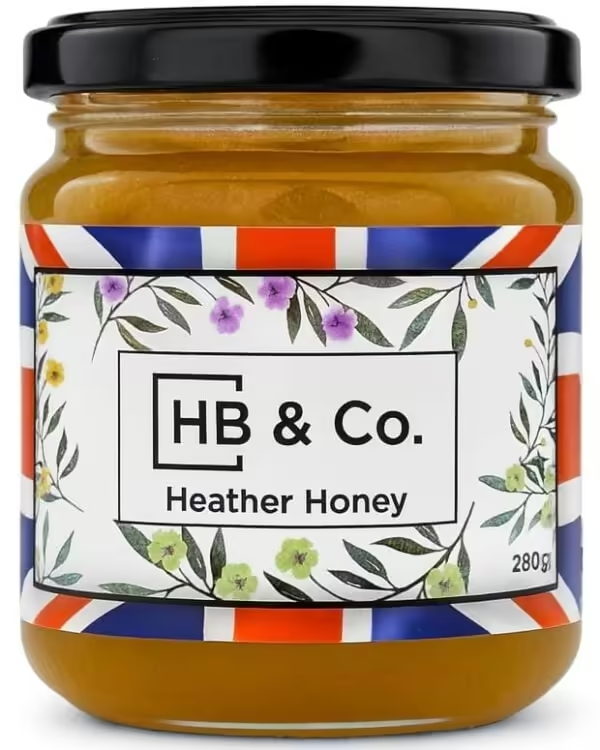
Raw, unpasteurised Heather Honey from the Yorkshire Moorlands. Harvested once a year during the brief late-summer bloom of ling heather (Calluna vulgaris). Rich, earthy, deeply floral, with a thixotropic texture found in no other British honey.
Notes de dégustation
Un miel pas comme les autres en Grande-Bretagne
Le miel de bruyère est le miel le plus complexe et le plus caractéristique produit dans les îles britanniques. Il n'y a pas deux pots identiques. La saveur varie en fonction de la saison, de l'altitude et de la date exacte de la récolte. Ce qui ne change jamais, c'est sa profondeur inimitable.
Saveur
Riche, terreux et intensément floral avec des nuances chaudes et fumées et une finale amère persistante.
Arôme
Bruyère sauvage, bois chaud, résine et légère note de caramel.
Douceur
Moins sucré que la plupart des miels. Audacieux, savoureux, raffiné.
Finition
Long et complexe. Cacao, résine et écho floral net.
Qu'est-ce que le thixotropisme ?
La texture de la gelée est une marque d'authenticité
Heather honey is one of only a handful of honeys in the world with a thixotropic structure. It behaves like a soft gel in the jar, then becomes fluid when stirred or warmed. This property is caused by proteins in the nectar of ling heather (Calluna vulgaris) and cannot be replicated or faked. If your heather honey pours freely like water, it has been over-processed. Ours does not. For deeper detail, read our guide complet des plantes de bruyère.

The Species Behind the Jar
What Makes This Real Heather Honey
Heather honey is not a marketing label. It is a specific monofloral honey produced from the nectar of one plant: ling heather (Calluna vulgaris). Understanding this species explains why real British heather honey behaves, tastes, and costs differently from anything else on the shelf.
The plant
Ling heather is the dominant heather species of the British and Irish uplands, covering the North York Moors, the Scottish Highlands, Dartmoor, and the Peak District. It thrives on acidic peat soils between 200 and 450 metres above sea level, where poor ground and harsh weather stress the plant and concentrate its nectar. The flowers appear in dense purple carpets from late July to early September.
The thixotropic signature
Only honey produced from Calluna vulgaris nectar shows true thixotropic behaviour. This is caused by a protein fraction unique to ling nectar. Bell heather (Erica cinerea), a close relative, does not produce the same effect. Any "heather honey" that pours like syrup is either blended, over-filtered, or mislabelled.
Why it matters for what you buy
The short bloom window and the difficulty of extracting thixotropic honey from the comb mean real heather honey is always limited in supply. When you see heather honey sold cheaply at scale, it is almost always a blend. Ours is genuine single-origin Calluna vulgaris, harvested from the Yorkshire Moorlands and never blended.
Curious how heather compares to wildflower on flavour? Read our wildflower vs heather taste guide →
Origine et terroir
The Yorkshire Moorlands. Where Britain's Finest Heather Grows.
Our Heather Honey comes from a single landscape: the North York Moors, one of the largest expanses of upland heather moorland in the United Kingdom, covering more than 550 square miles of open, windswept terrain. The heather that blankets these moors in late summer is ling heather, the species responsible for the world's most prized heather honey.
The moors sit between 200 and 450 metres above sea level. Acidic peat soils, high rainfall, and short summers create conditions that stress the heather plants and concentrate their nectar. This intensity translates directly into the flavour of the honey: bolder, richer, and more complex than heather honey produced at lower altitudes.
The bloom lasts only four to six weeks each year, typically from late July through to early September. Our beekeeper times the harvest precisely, waiting until the combs are capped and the moisture content is right. This is not factory production. It is a craft that depends entirely on reading the land. Read more about our British honey range and the Yorkshire story.
554
sq miles of moorland
4-6
week bloom window
1×
harvest per year
SALSA
British supplier certified
Acheter plus, économiser plus
Stock Up Before Supply Runs Out
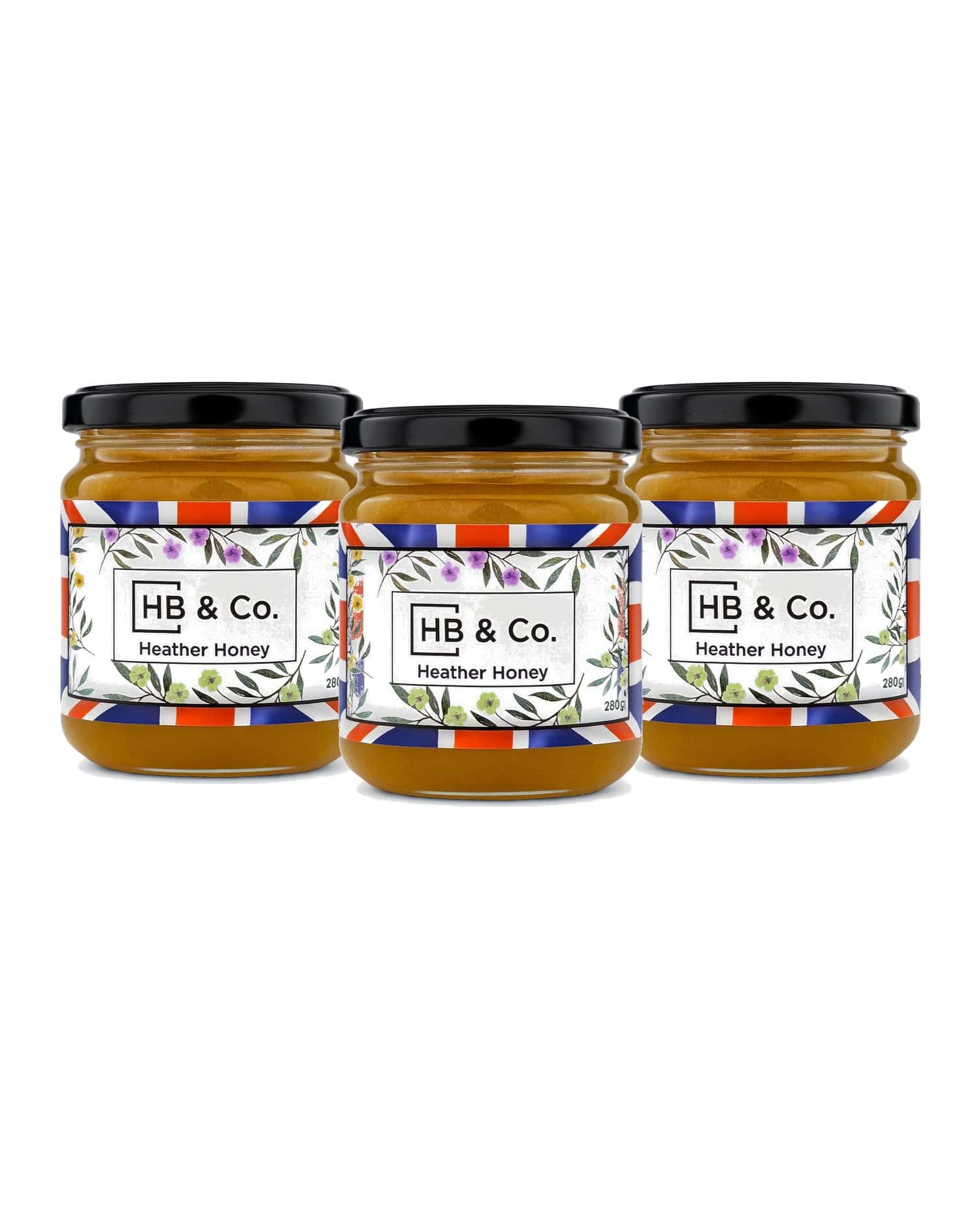
Heather honey sells out every year. A single harvest window means limited stock until the next bloom. Save 5% and get free UK delivery on every multi-jar bundle.
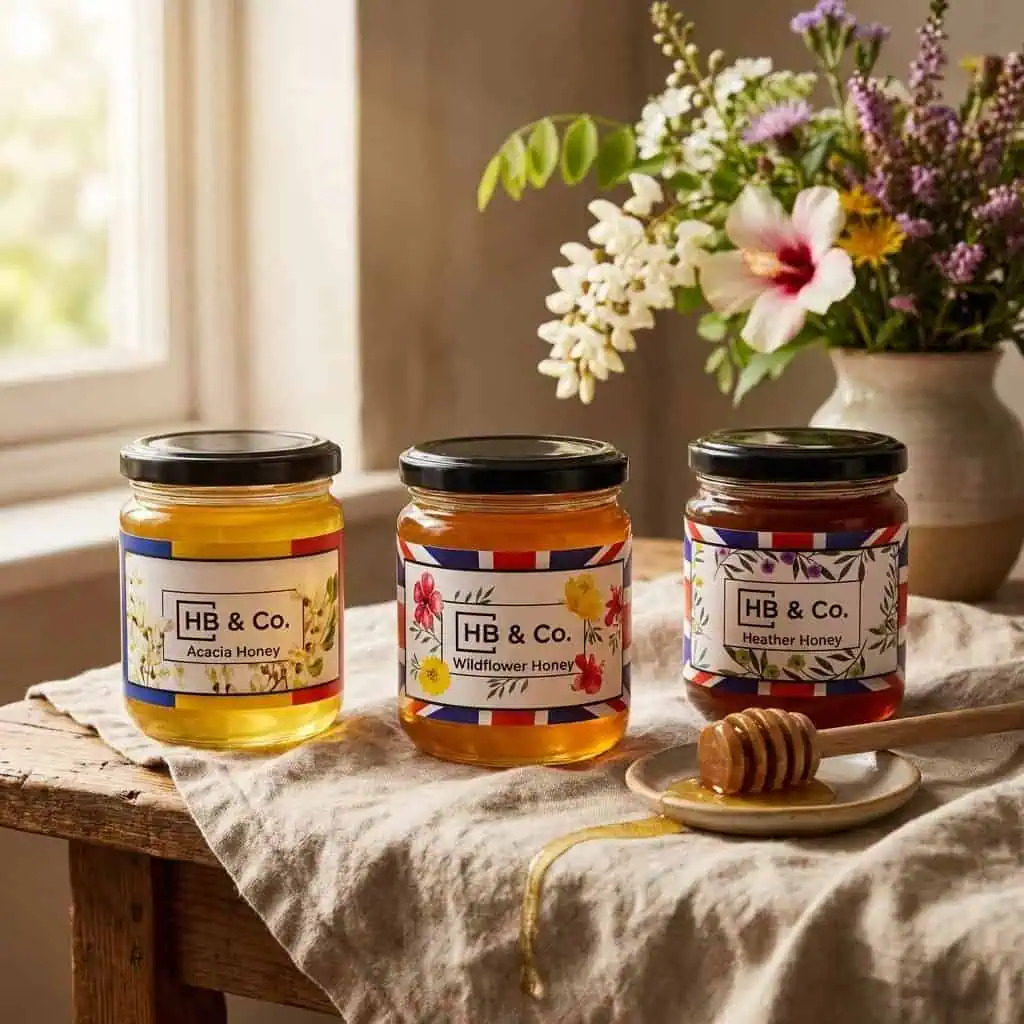
Vous cherchez quelque chose de différent ? Parcourir les 20 coffrets cadeaux miel →
Rareté et valeur
Pourquoi Heather Honey reçoit-elle une prime ?
Le miel de bruyère est le miel le plus cher produit en Grande-Bretagne. Ce n'est pas une question de marketing. C'est une conséquence directe de la façon dont il est fabriqué, de son origine et de ce qu'il faut pour l'amener à votre table.
Une fenêtre de récolte par an
Ling heather blooms for just four to six weeks in late summer. Miss the window and there is no second attempt until the following year. Every jar we sell is the result of a single seasonal harvest. If the weather is poor, the yield is low. There are no shortcuts and no substitutes.
L'extraction est particulièrement difficile
La structure thixotropique qui fait la spécificité du miel de bruyère en fait également l'un des miels les plus difficiles à extraire. L'essorage centrifuge standard ne fonctionne pas. Le miel s'accroche au rayon. Il doit être pressé ou agité avec précaution avant d'être libéré. Cette opération est plus lente et demande plus de travail que pour n'importe quelle autre variété de miel britannique.
Une production limitée et véritablement artisanale
Our Yorkshire Moorlands Heather Honey is produced by an independent beekeeper in small batches each season. Yield varies year to year depending on bloom timing, rainfall, and colony health. When it sells out, it is gone until the next harvest. We do not blend, dilute, or substitute.
Propriétés naturelles
The Natural Properties of Raw Heather Honey
Le miel de bruyère brut conserve toute sa composition naturelle car il n'est jamais chauffé au-delà de la température de la ruche. Les propriétés ci-dessous ne sont présentes que dans le miel brut, non transformé. La pasteurisation les détruit.
Enzymes et antioxydants
Raw heather honey contains naturally occurring enzymes including glucose oxidase and diastase, preserved intact through cold extraction. Darker honey varieties including heather have been shown in published research to have higher antioxidant activity than lighter varieties. Source: NCBI ↗
Natural Antimicrobial Activity
The enzyme glucose oxidase in raw honey produces hydrogen peroxide on contact with moisture. Heather honey is also a source of bee defensin-1, an antimicrobial peptide. Research has noted heather honey demonstrating antibacterial activity comparable to other premium varieties. Source: NCBI ↗
Source d'énergie naturelle
Le miel fournit de l'énergie naturelle grâce au fructose et au glucose. Contrairement au sucre raffiné, le miel brut contient également des oligo-éléments et des vitamines B. Le NHS reconnaît le miel comme un aliment naturel dont le profil nutritionnel est différent de celui du sucre raffiné. Source : NHS
Propriétés prébiotiques
Raw honey contains oligosaccharides that may benefit the gut microbiome. Published research has found raw honey demonstrating prebiotic-like activity, encouraging the growth of beneficial bifidobacteria and lactobacilli. Source: NCBI ↗
Heather vs Manuka
The Comparison Worth Knowing
Manuka honey is globally famous for its antimicrobial strength. Less widely known is that British heather honey shares similar mechanisms through hydrogen peroxide activity and bee defensin-1. Published research has noted heather honey demonstrating Total Activity scores comparable to mid-grade Manuka. The fundamental difference is marketing reach, not quality. Heather honey must be raw to retain these properties — heat destroys them entirely. Source: NCBI ↗
Les informations ci-dessus sont données à des fins éducatives uniquement et ne constituent pas un avis médical. Le miel brut n'est pas recommandé pour les enfants de moins de 12 mois. Si vous souffrez d'une maladie ou si vous êtes enceinte, consultez votre médecin traitant avant de modifier votre régime alimentaire.
Comment l'utiliser
Six façons d'apprécier le miel de bruyère du Yorkshire
Le caractère audacieux et complexe du miel de bruyère signifie qu'il donne les meilleurs résultats lorsqu'il peut être dégusté correctement. Il ne s'agit pas d'un édulcorant de fond. C'est une saveur à part entière.
Fromages britanniques forts
Le miel de bruyère est un compagnon classique du plateau de fromage. Son amertume terreuse tranche avec la richesse du cheddar vieilli, du Stilton et du Lancashire à pâte dure. Versez-en un filet directement sur le fromage ou servez-le à côté dans un petit ramequin.
Best with: cheddar, Stilton, LancashirePorridge et avoine
Une cuillerée versée dans du porridge chaud est l'utilisation britannique la plus traditionnelle du miel de bruyère. La chaleur assouplit sa texture thixotropique et libère tout son arôme. Les notes de bruyère, de bois et de fleurs sont toutes amplifiées par la chaleur.
Most popular everyday useThé et boissons chaudes
Dissolve a small amount in lightly cooled tea. Add it when the drink is around 40°C or below to preserve the enzymes. Heather honey has enough character to stand alongside strong black teas, Earl Grey, or herbal blends.
Tip: wait for the brew to coolGlaçage des viandes rôties
Son caractère audacieux et légèrement amer en fait un glaçage exceptionnel pour les rôtis d'agneau, de canard ou de chevreuil. Mélangez-la à de la moutarde en grain et à un peu de thym pour obtenir une sauce inspirée de la lande. Les sucres caramélisent magnifiquement à la température de cuisson.
Pairs with: game, lamb, duckPâtisserie et desserts
Remplace le sirop d'or dans les flapjacks, le parkin et les sablés. Sa profondeur de goût transforme les pâtisseries simples. Il convient particulièrement bien aux recettes contenant de l'avoine, du gingembre ou du chocolat noir.
Ideal: parkin, flapjack, gingerbreadDirectement du bocal
Prenez une petite cuillère, laissez-la reposer sur votre langue et laissez-la fondre lentement. Remarquez que la douceur initiale cède la place à une profondeur florale, puis au bois et à la résine, et enfin à la longue finale légèrement amère. C'est le goût de la lande de bruyère.
The purist's choiceGuide des textures
Comment traiter votre miel de bruyère
Le miel de bruyère se comporte différemment de tous les autres miels que l'on trouve sur les étagères. Comprendre sa texture vous permettra d'en tirer le meilleur parti.
Vérifiez la température de votre bocal
If stored in a cool kitchen or near a window in winter, the honey will be firmer. Moving it somewhere warmer will soften it over a few hours without any intervention.
Remuer doucement à l'aide d'une cuillère
Le miel de bruyère est thixotrope. En le remuant, on casse sa structure gélifiée et il devient nettement plus fluide en l'espace de quelques secondes. Aucune chaleur n'est nécessaire. Il se déguste à la cuillère, directement du pot, sur des toasts, dans du porridge ou dans du thé.
Bain d'eau chaude si nécessaire
Place the closed jar in a bowl of warm water, no hotter than 40°C. Leave for 15 to 20 minutes, stirring gently once or twice. The honey will loosen to a runnier consistency.
It will firm up again — that is fine
Une fois refroidi, le miel de bruyère retrouve son état de gel. Il s'agit d'un comportement naturel permanent, qui ne pose pas de problème. Répétez le bain d'eau chaude chaque fois que vous souhaitez obtenir une coulée plus fluide.
Never microwave — uneven heat destroys enzymes and can cause hot spots that burn the honey.
Never use boiling water — any temperature above 40°C begins to damage the active compounds.
Never refrigerate — cold makes honey firmer and can trigger unwanted crystallisation.
La science à l'œuvre
Pourquoi seule Heather Honey fait cela
Le comportement thixotropique du miel de bruyère est dû à des protéines appelées colloïdes, en particulier la fraction protéique propre au nectar du Calluna vulgaris (ling heather). These proteins form a weak gel network within the honey that breaks down under mechanical stress and reforms when left to rest.
Aucun autre miel britannique courant ne possède cette propriété. C'est ce qui rend le miel de bruyère impossible à extraire à l'aide des méthodes d'essorage centrifuge standard, et c'est pourquoi le véritable miel de bruyère présente toujours une certaine résistance dans le pot.
Un test d'authenticité utile : Plongez une cuillère dans le pot et soulevez-le lentement. Le véritable miel de bruyère thixotrope s'étire légèrement et conserve sa forme avant de tomber, au lieu de s'écouler librement.
Founder & Provenance
Curated by a Six-Generation Beekeeper

Dragos Nistor, Fondateur
Six-Generation Beekeeper · Guest Lecturer, University of Greenwich · LinkedIn Top Voice 2024
"Heather honey is not from my family's apiaries. My family has kept bees in Transylvania for six generations, which taught me what to look for in any honey, anywhere in the world. When I wanted to bring a British heather into the range, I sought out a Yorkshire beekeeper who meets our standards: genuine thixotropic texture, single-origin harvest, and no blending. Ever. I would not put our name on anything else."
Featured in Vogue's Summer Hot List across three consecutive editions in summer 2024. Our British honey supplier holds SALSA certification. NHS 15% Discount available for all NHS staff. GS1-barcoded for full traceability on every jar.
Provenance et confiance
Traçabilité totale de la lande à votre porte
Chaque pot de miel de bruyère HoneyBee & Co. provient d'un seul apiculteur de la région des Yorkshire Moorlands. Nous connaissons le paysage, le calendrier saisonnier et le processus d'extraction. Il n'y a pas de chaîne d'approvisionnement anonyme entre la ruche et votre pot.
Notre fournisseur de miel britannique détient la certification SALSA, la norme de sécurité alimentaire conçue spécifiquement pour les petits producteurs alimentaires britanniques, supervisée par l'Institute of Food Science and Technology et reconnue par l'ensemble de l'industrie alimentaire britannique comme la référence en matière de qualité des fournisseurs de petits lots.
We work with the same beekeeping partner season after season. We do not switch sources to hit a price point. Continuity of supply means continuity of quality. Read more in our British Honey story.
Questions fréquemment posées
Tout ce que vous devez savoir sur le miel de bruyère
Qu'est-ce qui différencie le miel de bruyère des autres miels britanniques ?+
Le miel de bruyère est le seul miel britannique commun à avoir une texture thixotropique. Il se comporte comme un gel mou dans le pot et devient fluide lorsqu'on le remue. Ce phénomène est dû à des protéines propres à la bruyère (Calluna vulgaris) nectar. Darker in colour, more complex in taste, and rarer in supply, heather is widely regarded as the most premium honey produced in the British Isles.
Pourquoi mon miel de bruyère est-il si épais ? Est-ce normal ?+
Completely normal, and it is what you want. To loosen it, stir gently with a spoon and it will become more fluid. Alternatively, place the jar in a bowl of warm water no hotter than 40°C for 15 to 20 minutes. If your heather honey pours freely without any resistance, it may have been over-processed or diluted.
Votre miel de bruyère est-il véritablement cru et non pasteurisé ?+
Yes. Our Yorkshire Moorlands Heather Honey is cold-extracted and never heated above natural hive temperature. It is not pasteurised, not ultra-filtered, and not blended. Our British supplier holds SALSA certification, which independently verifies these practices. Every jar retains its natural enzymes, pollen, antioxidants, and active proteins intact.
Is this real heather honey or a blend?+
Real, monofloral, and single-origin. Harvested exclusively during the late-summer ling heather bloom on the Yorkshire Moorlands. We never blend it with cheaper multifloral honeys. A simple authenticity test: dip a spoon into the jar and lift slowly. Genuine thixotropic heather honey stretches and holds its shape. A blend pours like syrup.
Quelle est la différence entre le miel de bruyère et le miel de Manuka ?+
Both heather and Manuka honey have antimicrobial properties. Manuka's comes from methylglyoxal. Heather's comes from hydrogen peroxide activity and bee defensin-1. Research has noted heather honey demonstrating Total Activity scores comparable to mid-grade Manuka. Heather honey must be raw to retain these properties — heat destroys them.
Quand le miel de bruyère est-il récolté et pourquoi est-il parfois en rupture de stock ?+
Ling heather blooms for approximately four to six weeks each year, typically late July through early September on the Yorkshire Moors. Yield varies with weather and colony health. When our stock is exhausted, we do not substitute from other sources. We wait for the next harvest.
How long will a 280g jar of heather honey last me?+
Because heather is bold in flavour, most households use it more sparingly than milder honeys. A 280g jar typically lasts two to three months with regular use. For heavier users, our 3-jar stock-up is better value and hedges against seasonal stock gaps.
Is this the same honey as in your bundles and subscription?+
Yes. Identical honey, identical jar, identical harvest. A single jar is £12.99. A 3-jar stock-up bundle saves 5%. An ongoing abonnement saves 20% on every delivery, with priority access during years of limited yield.
Quelle est la meilleure façon de conserver le miel de bruyère ?+
Store at room temperature, away from direct sunlight and heat sources. Do not refrigerate. Keep the lid firmly closed. Heather honey has a naturally higher moisture level than most varieties, so lid hygiene matters more here than with drier honeys like acacia.
Can I cook or bake with heather honey?+
Yes. It excels in parkin, flapjacks, oatcakes, gingerbread, and as a glaze for roast lamb, duck, or venison. Note that cooking destroys the enzymes and antimicrobial properties. If using heather honey for its health properties, consume it raw — stirred into warm tea, drizzled over yoghurt, or eaten straight from the jar.