

 English (UK)
  Italiano
  Français
  简体中文
简体中文  한국어
한국어 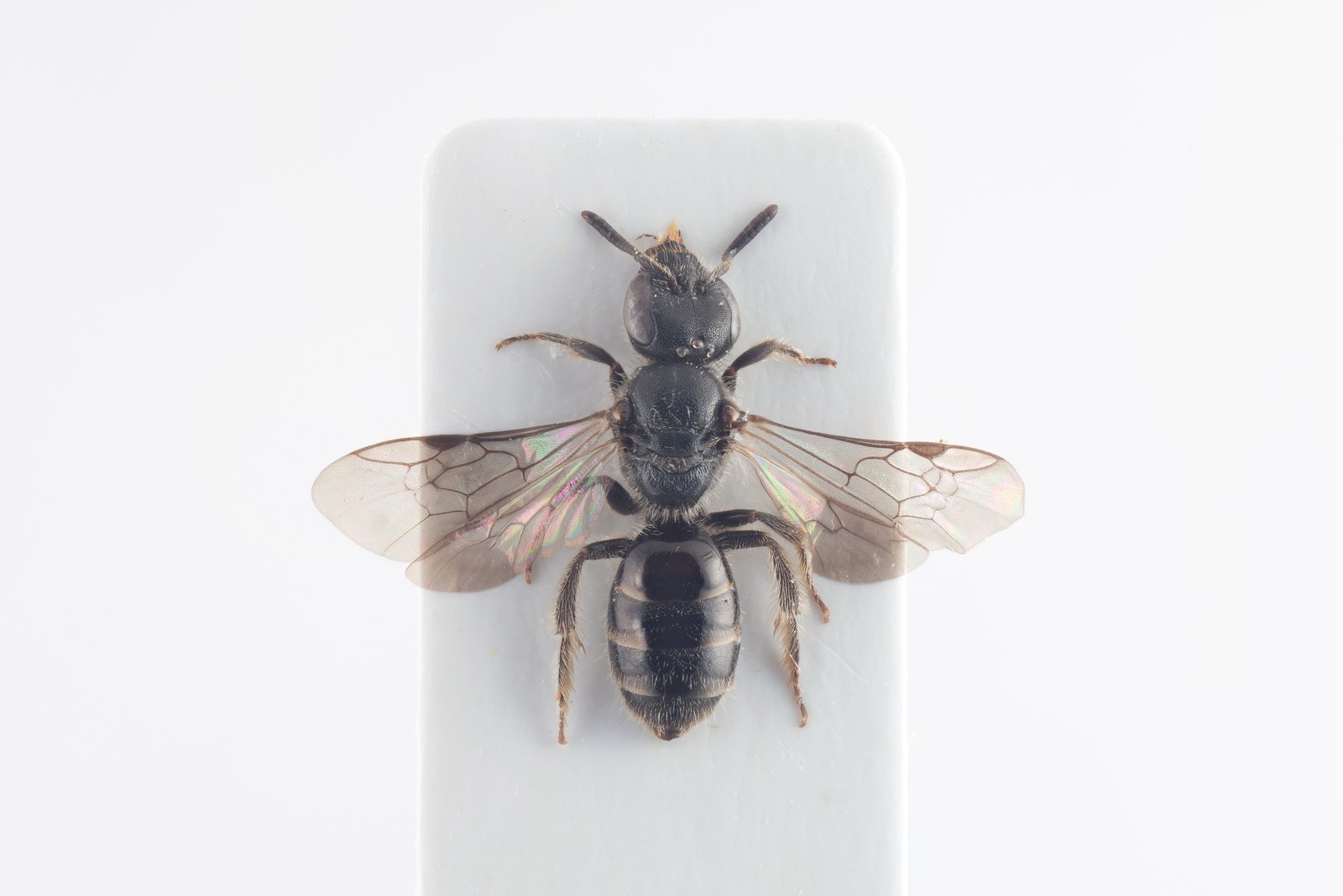
Half-shining furrow bee, Lasioglossum semilucens, a set specimen. A minute, dark, non-metallic furrow bee, rarely seen and easily overlooked in the field. Photograph by Arnstein Staverløkk, CC BY 3.0, via Wikimedia Commons.
UK Bee Species
Half-shining Furrow Bee Lasioglossum semilucens
Alfken, 1914 · subgenus Evylaeus · subfamily Halictinae · family Halictidae
Also called the small shiny furrow bee. The name semilucens means "half-shining", after its part-polished look.
Some bees are rare because they are fussy. The half-shining furrow bee may be rare partly because it is so small that almost nobody notices it: one of Britain's least-seen furrow bees, a minute dark insect of sandy woodland clearings in the south, probably overlooked at times simply for its size.[1] Much of its life is still a blank on the map.
A minute bee with a half-polished shine
This is a genuinely tiny bee, one of the smallest of a genus that is already full of small, hard-to-separate species. It is not one of the metallic furrow bees; it is dark, and its name is a clue to the single most useful feature. Semilucens, "half-shining", points to its surface: the abdomen is shiny and barely pitted, and the top of the propodeum, the panel behind the thorax, is broadly smooth and shining around its hind margin.[3] In the field it is most likely to be confused with the least furrow bee, and the two are separated on fine detail:
Females: tergites shiny and barely punctate; the join between the first and second segments lacks a distinct cross-groove. Males: legs more extensively pale. Propodeum smooth and shining at the hind margin.[3]
The usual confusion species. Shows a distinct transverse depression at the junction of the first two abdominal segments, and males have darker legs. Separation is a hand-lens job on set specimens.[3]
In practice, a certain identification of either bee needs a specimen and a microscope. This is not a species to name from a photograph.
Where it lives, and how little we see it
The half-shining furrow bee is a bee of warm, open, sandy ground: mainly open woodland with sunny clearings, on sandy and gravelly soils.[1] A female has been found nesting in a low sandy bank, and on present evidence it is thought to be a solitary species, each female working alone rather than forming the small helper colonies that some of its relatives do.[1] British records are few and thinly scattered across the south-east, and there is no sign that it is spreading.[2] Like other members of its genus, its nests are open to cuckoos: cleptoparasitic Sphecodes blood bees, and the tiny nomad bee Nomada sheppardana, which target furrow bees of this kind.[4] To see how thinly it sits among Britain's better-known bees, visit the UK Native Bee Species Map, or place its family in the World Bee Atlas.
What we still do not know
- Whether it is truly as rare as it looks, or simply under-recorded because it is so small and easily passed over.[1]
- When exactly the males first appear. Females fly from April to early September, but the start of the male season is genuinely uncertain for lack of records.[1]
- Almost everything about its nesting and social life beyond a single observation of a female in a sandy bank.[1]
That honesty matters. For a bee this obscure, the useful thing an encyclopedia can do is mark clearly where the knowledge runs out, rather than paper over the gaps.
Quick facts
| Kingdom | Animalia |
|---|---|
| Phylum | Arthropoda |
| Class | Insecta |
| Order | Hymenoptera |
| Family | Halictidae |
| Subfamily | Halictinae |
| Genus | Lasioglossum |
| Subgenus | Evylaeus |
| Species | Lasioglossum semilucens |
Rare bees, wild ground, and raw British honey
Little-known bees like this one depend on warm, undisturbed, flower-rich ground. Our honeybees work the wild and moorland flowers of Britain into raw honey.

Raw British Heather Honey
Thick, aromatic and jelly-like, from a single annual harvest on British heather moorland. Our British honey supplier holds SALSA Certification. 280g, £12.99.
Shop Heather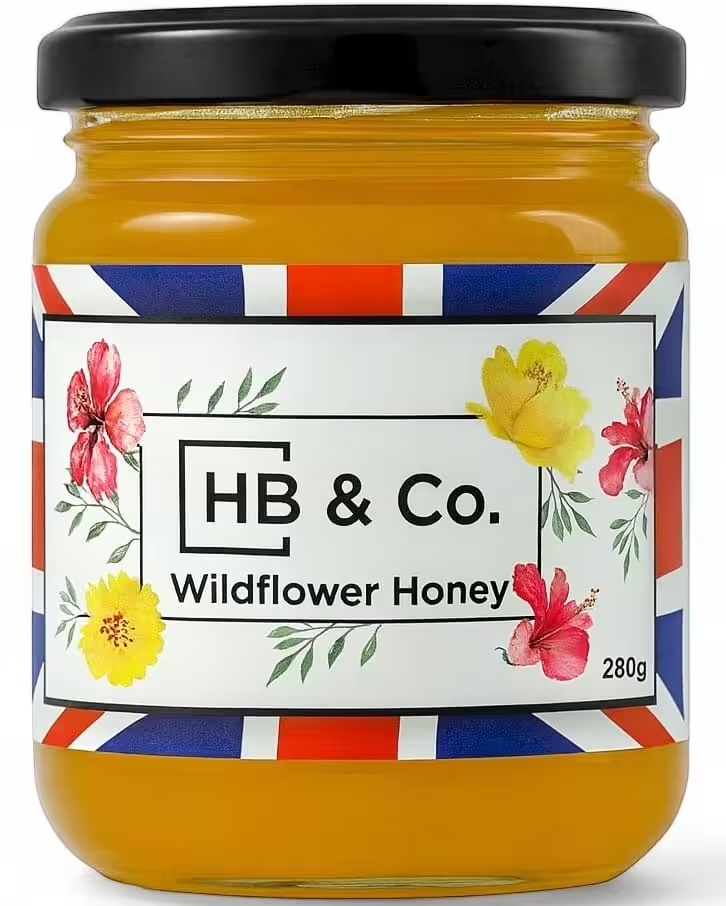
Subscribe and save 20%
Pick any single honey, from delicate wildflower upward, and save 20% on every delivery, with free UK delivery on every subscription order.
Start a SubscriptionFrequently asked questions
Is the half-shining furrow bee the same as the small shiny furrow bee?
Yes. Lasioglossum semilucens is called the small shiny furrow bee in Steven Falk's field guide, and half-shining furrow bee is a direct translation of the Latin semilucens. Both names mean the same species.
Why is it so rarely seen?
Partly genuine rarity and partly its size. It is one of our smallest bees, it lives sparingly in the south-east, and it is so easy to overlook that experts think it may have been under-recorded for that reason alone.
How do you tell it from the least furrow bee?
On fine detail, under a lens. In the half-shining furrow bee the female's abdomen is shiny and barely pitted and lacks a groove between the first two segments, and the males have paler legs. It is not a species that can be named safely from a field photograph.
Where in Britain does it live?
In southern England, most records coming from the south-east and reaching north to Oxfordshire. It favours open woodland with sunny clearings on sandy and gravelly soils.
When is it active?
Females fly from April to early September. The start of the male flight season is genuinely uncertain because so few have been recorded.
Is it social or solitary?
On present evidence it is thought to be solitary, with each female making and provisioning her own nest. A female has been found nesting in a low sandy bank.
Am I likely to find one in my garden?
Very unlikely. This is a scarce bee of sandy woodland clearings in the south-east, not a garden regular. A tiny dark furrow bee in an ordinary garden is far more likely to be one of the common species, such as the green or common furrow bee.
Does it make honey?
No. Like all furrow bees it stores only enough pollen and nectar for its own young. Only the honeybee makes honey in any quantity. Compare the bee families in the World Bee Atlas.
Related species
Sources and references
- BWARS (Bees, Wasps & Ants Recording Society). Species account: Lasioglossum semilucens (Alfken, 1914): minute size, likely under-recording, southern British range, sandy open-woodland habitat, female flight April to early September, uncertain male season, and a solitary nest in a sandy bank. bwars.com.
- Falk, S. (1991). A review of the scarce and threatened bees, wasps and ants of Great Britain. Nature Conservancy Council: Rare (RDB3) status, and no indication of range increase.
- Falk, S. Field Guide to the Bees of Great Britain and Ireland, Bloomsbury, and the Steven Falk Flickr collection: separation from L. minutissimum by tergite punctation, the tergite 1 to 2 junction, male leg colour, and the smooth shining propodeum margin.
- Else, G.R. & Edwards, M. (2018). Handbook of the Bees of the British Isles. Ray Society, and the Steven Falk genus account: the Halictidae, and cleptoparasites of British Lasioglossum including Sphecodes blood bees and Nomada sheppardana.
- Else, G.R., Bolton, B. & Broad, G.R. (2016). Checklist of British and Irish Hymenoptera: Aculeata. Biodiversity Data Journal 4: e8050: current name and placement, Lasioglossum semilucens (Alfken, 1914), subgenus Evylaeus.
- Alfken, J.D. (1914), original description (as Halictus semilucens); taxonomy confirmed via GBIF and the British and Irish checklist.
HoneyBee & Co. draws on six generations of family beekeeping heritage, with honey from the Nistor family apiaries and from carefully chosen British producers. Our British honey supplier holds SALSA Certification, and we offer a 15% NHS Discount. Every jar is raw, unfiltered and traceable to the hive.