

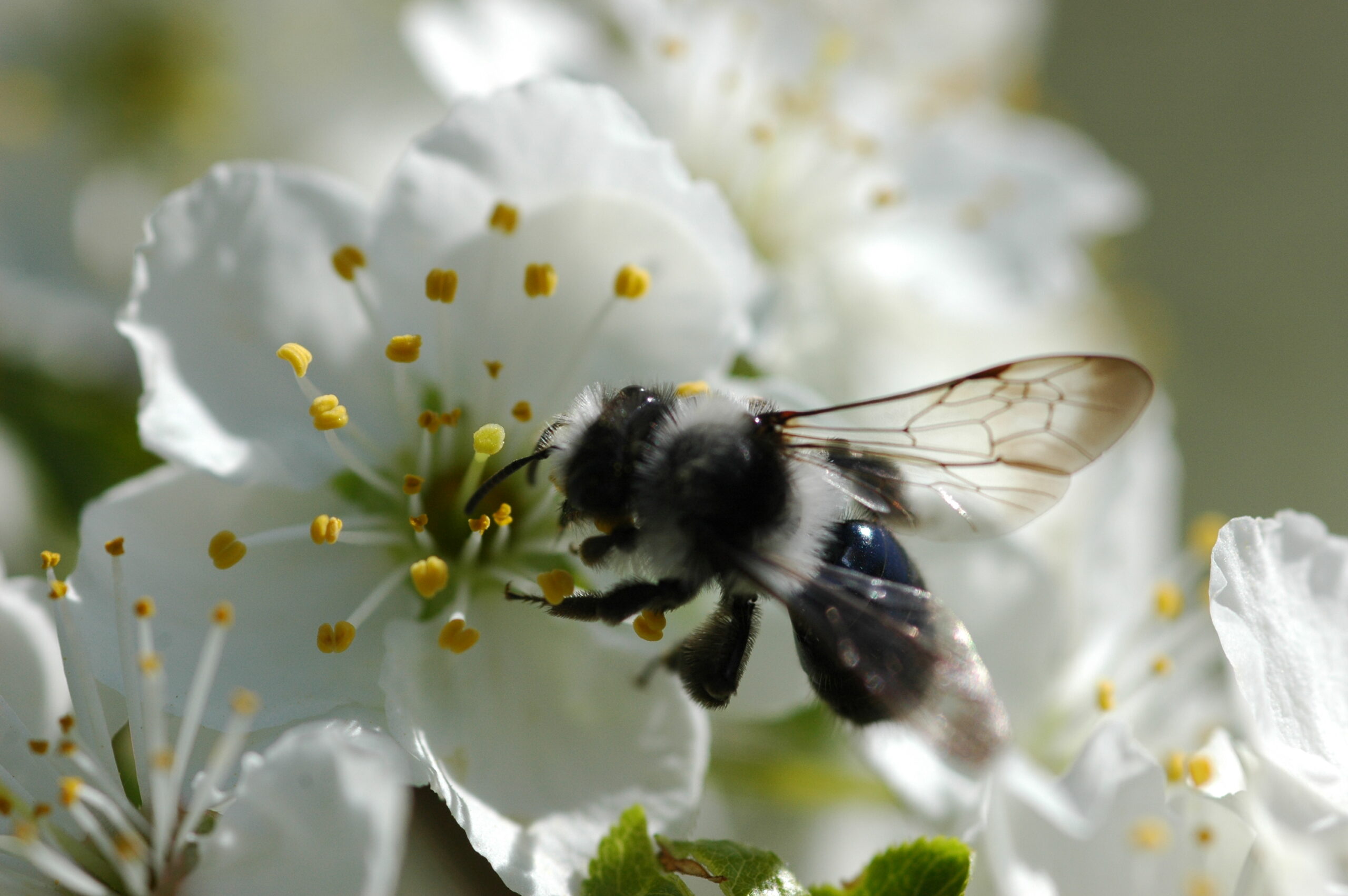
Ashy Mining Bee
Andrena cineraria
Linnaeus, 1758 • Andrenidae • Melandrena
The ashy mining bee is one of the most striking and most easily identified solitary bees in Britain. The female is jet black with two broad bands of ash-grey hair across the thorax, giving her a bold monochrome appearance unlike any other common spring bee. She is a ground-nester, excavating a burrow in lawns, paths and south-facing banks from late March, and she arrives at exactly the same time as the first spring blossom. Common and apparently increasing across England and Wales, Andrena cineraria Linnaeus, 1758 is a bee that rewards attention: once you know it, you will spot it every spring. See where it lives alongside Britain's other wild bees on the UK Native Bee Species Map, or read about its close relatives in the World Bee Atlas.
Quick Facts
Taxonomy and Classification
The ashy mining bee was described by Carl Linnaeus in 1758 in the tenth edition of Systema Naturae. It belongs to the family Andrenidae and the large genus Andrena, sitting within the subgenus Melandrena, a grouping of mostly black species with grey or white hair bands.[1] The species name cineraria comes from the Latin cinis, meaning ash or ashes, a direct reference to the ash-grey thorax bands that define the female. It is one of two very similar black-and-grey Andrena in Britain; the other, the much rarer grey-backed mining bee (Andrena vaga), has grey covering the entire thorax and is a recent colonist confined to a few south-eastern sites.
| Kingdom | Animalia |
| Phylum | Arthropoda |
| Class | Insecta |
| Order | Hymenoptera |
| Family | Andrenidae |
| Subfamily | Andreninae |
| Genus | Andrena Fabricius, 1775 |
| Subgenus | Melandrena Perez, 1890 |
| Species | Andrena cineraria Linnaeus, 1758 |
Identification
The female ashy mining bee is one of the most instantly recognisable solitary bees in Britain. She is black, with a bluish-black shiny abdomen, and her thorax carries two broad, clearly defined bands of ash-grey hair: one across the front of the thorax (the pronotum and mesoscutum) and one across the rear (the propodeum). The contrast between the grey bands and the black body is sharp and striking. She is roughly honeybee-sized at 13 to 15 mm, with noticeably thicker hind legs than the male, used for carrying pollen.[1]
The male is smaller at 10 to 12 mm, entirely black, with the entire top of the thorax covered in grey hair (rather than two distinct bands), white hairs forming a conspicuous tuft on the lower face, and white hairs on the sides of the abdomen and the base of the abdominal segments.[2] Males emerge a week or two before females in late March and are often seen patrolling potential nesting areas. The genus Andrena is identified by the broad velvety facial foveae (strips of dense hair between the compound eyes and the antennal bases), which are absent in other bee genera.
Nesting: Burrows, Aggregations and a Closed Door
The ashy mining bee nests in the ground, favouring bare or sparsely vegetated soil: lawns, footpaths, south-facing clay banks, sheep-grazed slopes, brownfield sites and coastal grassland.[1] Each female excavates her own vertical burrow, typically 10 to 20 cm deep, with two or three brood cells branching off the main shaft. She provisions each cell with a pollen-and-nectar loaf, lays a single egg, seals the cell, and the larva develops entirely without further care. Adults overwinter inside the natal cells and emerge the following spring.[3]
Aggregations can be dense: nest densities of up to 11 nests per square metre have been recorded at prime sites. Where conditions are right, hundreds or thousands of females may choose the same slope or path edge, creating highly visible concentrations that attract attention in April. Despite the appearance of a colony, each female is entirely independent and shares nothing with her neighbours.
A bee that closes its own door
The ashy mining bee has the unusual habit of actively sealing the entrance to its burrow: at the end of each foraging trip, during rain, and when disturbed, the female packs the entrance with soil, leaving no visible opening. Between foraging trips the entrance is left open. This behaviour protects the brood cells from parasites and flooding and is one of the features that makes the species straightforward to observe, since females can be watched entering and exiting the burrow with fresh plugs of soil.[1]
Life Cycle and Foraging
The ashy mining bee is univoltine with one generation per year. Males emerge from late March, females from early April, and both sexes are active through to mid-June, peaking in April and May.[1] After mating the male dies; the female builds and provisions nests through spring. Flight season timing matches closely with the flowering of spring blossom, and the species is an important early-season pollinator of fruit trees as well as wildflowers.
Andrena cineraria is polylectic, collecting pollen from a broad range of spring-flowering plants. Recorded foraging plants include willows, blackthorn, wild cherry, plum, pear, apple, dandelion, buttercup, cow parsley, gorse, hawthorn, hogweed, thrift, daisies, bramble and various brassicas.[1] The species has also been observed in recent years foraging on ivy flowers in September and October, possibly an extension of activity associated with warming autumns, though this behaviour is not yet well documented.
Distribution and Status
The ashy mining bee is widespread and common across lowland England and Wales, with records extending into southern Scotland. BWARS notes that it appears to be increasing in both range and abundance, particularly in southern England, where it has been recorded in new areas since the late twentieth century.[1] It also occurs in Ireland and the Channel Islands. Across Europe its range extends from Fennoscandia south to Iberia and east through central Asia to northern China and Mongolia, making it one of the most widely distributed members of the genus.[5]
The species is not subject to any conservation concern and is listed as Least Concern. It is one of a small number of British solitary bees showing positive trends, possibly benefiting from the expansion of gardens, brownfield land and informal green spaces which offer both foraging plants and suitable nesting substrate. See its full regional distribution across Britain's 17 recording zones on the UK Native Bee Species Map.
Natural Enemies: Lathbury's Nomad Bee
The primary cleptoparasite of the ashy mining bee is Lathbury's nomad bee (Nomada lathburiana), a wasp-like bee that enters unguarded burrows while the host is foraging and lays eggs in the provisioned brood cells. The nomad larva destroys the host egg and consumes the pollen loaf.[1] The species is also parasitised by Gooden's nomad bee (Nomada goodeniana) at some sites. Nomad bees are an entirely natural feature of the ecosystem and their presence is a direct indicator of a thriving host population: where you find large ashy mining bee aggregations, the nomad bees will not be far away.
Is the ashy mining bee genuinely increasing, or just better recorded?
BWARS notes the species as apparently increasing in range and abundance, at least in southern England. However, this assessment is partly based on improved recording effort since the late twentieth century, driven by growth in citizen science schemes like iRecord and BWARS mapping projects. Whether the trend reflects a genuine population increase, a range expansion in response to climate change and habitat change, or improved detection, is not fully resolved. Current data are consistent with a genuine increase but cannot definitively separate the two causes.[4]
April Bees, April Honey
The ashy mining bee and the acacia tree share a season. The bee is at its peak in April and May; the black locust (Robinia pseudoacacia) flowers in the Transylvanian forests in late May and early June, at exactly the moment our honeybee colonies are at full spring strength and foraging hard. The ashy mining bee does not produce honey. But the parallel is worth noting: both are precision spring foragers, tuned to a narrow window of blossom, gathering what they need from that brief abundance.
Our Acacia Honey is harvested from those same Transylvanian forests, where the Nistor family has kept bees for six generations. It is pale, mild and slow to crystallise, with a high fructose content that keeps it runny far longer than most honeys. It is the honey from the spring harvest, the one that rewards patience and a single-origin approach. 280g, raw and cold-extracted.

Frequently Asked Questions
How do I identify an ashy mining bee?
The female is black with two broad bands of ash-grey hair across the thorax, a shiny bluish-black abdomen, and noticeably thick hind legs. She is roughly honeybee-sized (13–15 mm). No other common British bee has this exact combination in spring. Males are smaller, with grey covering the entire thorax, a white facial tuft, and white hairs on the abdomen sides. Both sexes are on the wing from late March to mid-June.
Where do ashy mining bees nest?
In the ground, typically in bare or sparsely vegetated soil: lawns, footpaths, south-facing clay or sandy banks, sheep-grazed slopes, brownfield sites and coastal grassland. They often nest in loose aggregations where conditions are right, with hundreds of females choosing the same patch. Burrows are 10 to 20 cm deep with two or three brood cells each.
Do ashy mining bees sting?
They are gentle and pose no real risk. Females have a sting but are very reluctant to use it; males cannot sting at all. Large aggregations can be watched at close range without any danger. The BWARS information sheet notes that the sting of solitary mining bees is generally too short to penetrate human skin in normal circumstances.
Why does the ashy mining bee close the entrance to its burrow?
The female actively plugs the burrow entrance with soil when she is not actively foraging: at the end of each trip, during rain, and when disturbed. This protects the developing larvae from parasites, flooding and disturbance. It also makes the nest entrance hard to spot between visits, which is a natural defence against cleptoparasites like the nomad bees that patrol nest aggregations looking for unguarded burrows.
Is the ashy mining bee the same as the tawny mining bee?
No. Both are spring solitary mining bees in the genus Andrena, but they look very different. The ashy mining bee is black with grey bands; the tawny mining bee (Andrena fulva) is covered in dense fox-red or orange hair. They often nest in the same habitats in April and May. Read the Tawny Mining Bee profile for a full comparison.
What flowers do ashy mining bees visit?
A wide range of spring-flowering plants. Key sources include willows, blackthorn, wild cherry, apple, pear, dandelion, buttercup, cow parsley, gorse, hawthorn, thrift and bramble. The flight season is timed to overlap with spring fruit blossom, making the ashy mining bee a useful orchard pollinator alongside managed honeybee colonies.
Is the ashy mining bee common in the UK?
Yes. It is widespread across lowland England and Wales, found wherever suitable nesting soil and spring blossom occur together. BWARS considers it apparently increasing in both range and abundance since the late twentieth century, with records extending into southern Scotland. It is also present in Ireland and the Channel Islands. Nationally it is not of conservation concern.
Does the ashy mining bee make honey?
No. Ashy mining bees are solitary: each female collects pollen and nectar solely to provision her own brood cells. There is no colony, no surplus and nothing to harvest. All harvestable honey comes from managed honeybee (Apis mellifera) colonies.
Sources and References
- Bees, Wasps and Ants Recording Society (BWARS). Andrena cineraria species account: identification, nest biology, foraging plants, distribution, cleptoparasites. bwars.com
- BWARS Information Sheet: Ashy Mining-bee (Andrena cineraria). Identification, biology and conservation notes. bwars.com
- Buzzaboutbees.net. Ashy Mining Bee: nesting depth, burrow structure, cell count. buzzaboutbees.net
- Powney, G. D. et al. (2019). Widespread losses of pollinating insects in Britain. Nature Communications 10:1018. doi.org
- GBIF. Andrena cineraria Linnaeus, 1758: Palearctic distribution records. gbif.org