

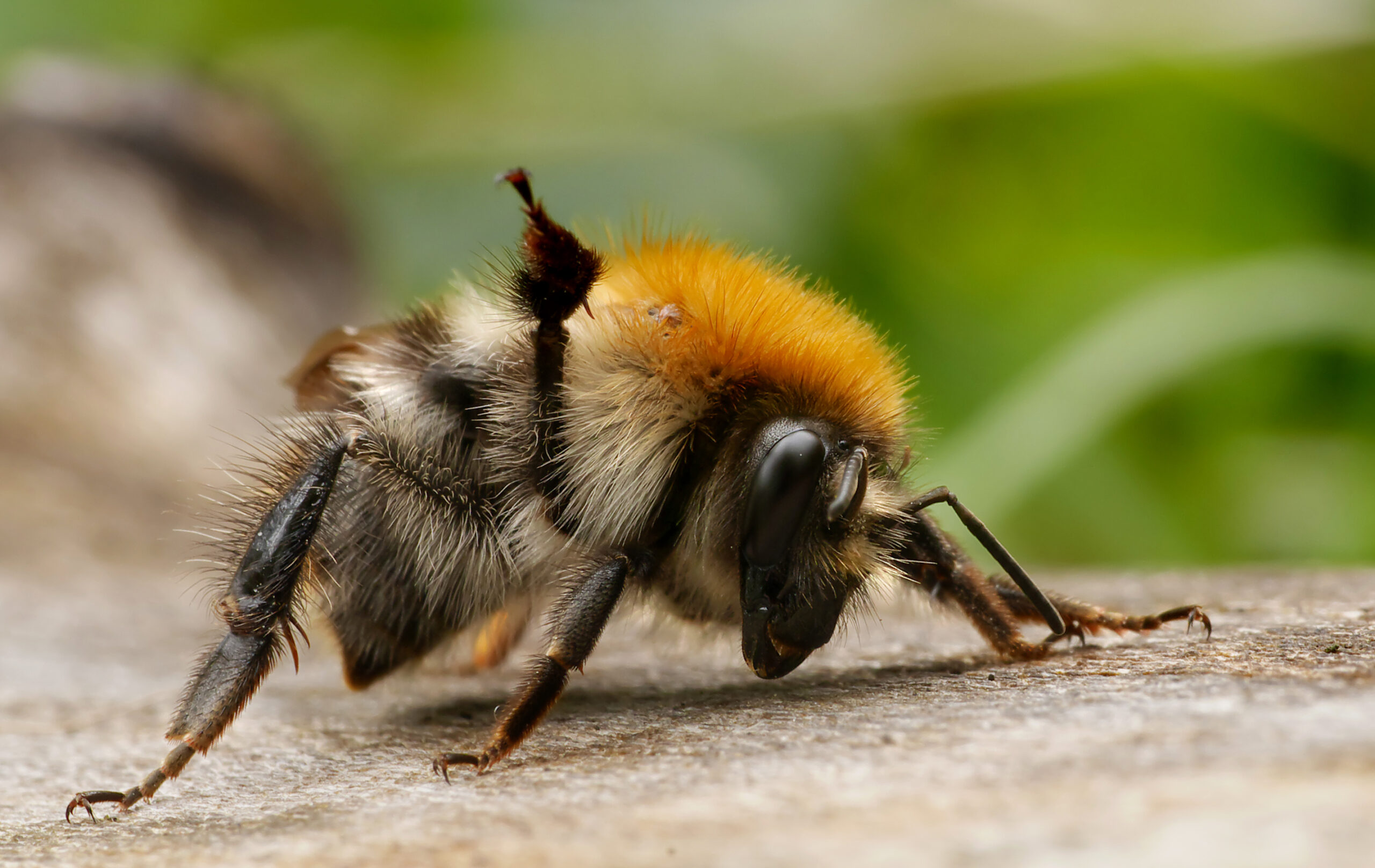
Frank Vassen from Brussels, Belgium, CC BY 2.0, via Wikimedia Commons
Common Carder Bee
Bombus pascuorum
Scopoli, 1763 • Apidae • Bombini • Thoracobombus
Bombus pascuorum Scopoli, 1763, the common carder bee, is the ginger bumblebee in the garden from March to October: the one that is still foraging on the ivy and the knapweed long after most other species have finished for the year. It is Britain's only common and widespread all-brown bumblebee, with one of the longest flight seasons of any British bee, and the distinctive habit that gives it its name: gathering, or carding, moss and dry grass to thatch the surface of its above-ground nest. It is widespread across England, Wales, Scotland and Ireland, present in almost every habitat from inner-city gardens to upland grassland, and a key pollinator of long-tubed flowers that shorter-tongued bees cannot easily reach. See where it lives on the UK Native Bee Species Map, or explore its close relatives in the World Bee Atlas.
Quick Facts
Taxonomy and Classification
The common carder bee was described by Giovanni Antonio Scopoli in 1763. It belongs to the family Apidae, tribe Bombini, and sits within the subgenus Thoracobombus, a grouping of predominantly brown or tawny bumblebees sometimes called the carder bees.[1] There are four all-brown bumblebee species recorded in Britain: the common carder bee, the moss carder bee (Bombus muscorum), the brown-banded carder bee (Bombus humilis), and the shrill carder bee (Bombus sylvarum). The latter three are all scarce or declining; B. pascuorum is the only one that is common and widespread, and in parts of northern Britain it appears to be expanding into territory formerly held by B. muscorum.[2]
| Kingdom | Animalia |
| Phylum | Arthropoda |
| Class | Insecta |
| Order | Hymenoptera |
| Family | Apidae |
| Tribe | Bombini |
| Genus | Bombus Latreille, 1802 |
| Subgenus | Thoracobombus Dalla Torre, 1880 |
| Species | Bombus pascuorum Scopoli, 1763 |
Identification
The common carder bee is the only common, widespread all-brown bumblebee in Britain, making it relatively straightforward to place in the field, though pinning down individual specimens to species within the all-brown carder group can be difficult. The key identification feature that separates B. pascuorum from the rarer carder bees is the presence of at least some black hairs scattered among the ginger on the abdomen.[3] The thorax is a warm ginger-orange in fresh spring bees and fades through the season to a pale buff or straw colour by late summer.
Queens are 16 to 18 mm, distinctly smaller than the queens of many other British bumblebees. Workers range from 10 to 15 mm and can be very small early in the season. Males are 13 to 14 mm with a longer face than other bumblebees, yellow facial hair and some black hairs.[4] All castes share the all-brown body without the yellow bands seen in Bombus terrestris or the red tail of Bombus lapidarius. The face is distinctly longer than wide, a useful feature if examining a stationary bee closely. It is a long-tongued species, with a tongue that exceeds the sheath, allowing it to reach the nectar of deep tubular flowers that short-tongued bees must bypass.
What "Carder" Means: The Nest-Building Behaviour
The name carder comes from the textile trade. Carding is the process of combing raw fibres into alignment before spinning, and the common carder bee does something visually similar: females gather moss, dry grass and plant fibres, pulling and teasing them into a loose mat that forms the outer covering of the nest.[1] The result is an above-ground nest tucked into a grass tussock, under a hedgerow or in a pile of plant litter, camouflaged and insulated by this hand-made thatch.
Nests are most often built at or just below ground level in long tussocky grassland, under hedges, or occasionally in nest boxes, wall cavities and old bird nests. A successful nest reaches its peak population of 60 to 150 workers in August, making it smaller than the colonies of Bombus terrestris or B. lapidarius. The average colony lifespan after founding is around 25 weeks, one of the longest of any British bumblebee, consistent with the species' exceptionally extended flight season.[4]
Nest density in UK farmland
Research in UK agricultural landscapes estimates the common carder bee nests at around 68 nests per km2, with a maximum foraging range of approximately 450 m from the nest entrance.[3] This makes it one of the more densely distributed bumblebee species and a significant contributor to pollination in farmed and semi-farmed habitats.
The Longest Season: March to October
The common carder bee has an exceptionally long flight period, and is possibly bivoltine, producing two generations in a year in favourable conditions in southern Britain.[3] Hibernating queens begin emerging as early as March, well before most other bumblebee species. Workers appear from April and continue foraging into October, sometimes November during mild autumns. New queens and males emerge from July onwards. In northern Scotland the whole season can be shifted by up to two months later than in the south.
This extended presence is ecologically valuable. The common carder bee bridges early spring and late autumn, providing pollination services in windows that many other species miss. In late summer and early autumn it is frequently the dominant bee on devil's-bit scabious, thistles, knapweeds, ivy, lavender and late-flowering garden plants, continuing to forage in weather and temperatures that would ground most other bees.
Foraging: The Long-Tongue Advantage
Bombus pascuorum is broadly polylectic, visiting a very wide range of flowering plants, but its long tongue gives it access to deep-corolla flowers that shorter-tongued bees cannot easily reach. It shows a preference for pollen from the legume family (Fabaceae), dead-nettles and related plants (Lamiaceae), foxgloves and their relatives (Scrophulariaceae), and red-flowered composites (Asteraceae).[3]
Regularly visited species include red clover, white clover, bird's-foot trefoil, vetch, comfrey, lavender, bugle, rosemary, woundworts, foxglove, bramble, raspberry, knapweed, devil's-bit scabious, thistles, Himalayan balsam, and buddleia. In spring, queens feed on sallow, blackthorn, bluebell, dead-nettles and ground ivy. The long tongue means the common carder bee is one of the few species able to pollinate red clover effectively, a commercially important forage crop.[1]
The Field Cuckoo Bee and Other Parasites
The main social parasite of the common carder bee is the field cuckoo bumblebee (Bombus campestris), a wasp-patterned bee that invades established carder bee colonies, kills or subdues the host queen, and uses the existing worker force to raise its own reproductive offspring.[1] Females of B. campestris are commonly observed near carder bee nests in early summer.
Beyond the cuckoo bee, the common carder bee is also targeted by the conopid fly Sicus ferrugineus, which intercepts foraging workers in flight and lays an egg inside the bee's abdomen. The developing fly larva feeds on the bee's internal organs before emerging. The nematode Sphaerularia bombi parasitises hibernating queens, preventing them from nesting in spring.[5] These parasites are a natural feature of the ecology, and their presence indicates a healthy population of host bees.
A Bee for Every Month, A Honey for Every Season
The common carder bee is in the garden from the first warm days of March to the last mild days of October. It makes no honey: like all bumblebees, the colony produces only enough nectar stores to last a few days, with nothing to harvest. What it produces instead is pollination, month after month, on the flowers that feed both wild plants and managed crops.
Our honey works on a similar principle of continuity. A HoneyBee & Co. subscription delivers raw single-origin honey to your door every month, rotating through our range across the seasons: spring Acacia from Transylvania's linden forests, summer Wildflower from the British Midlands, autumn Heather from the Yorkshire Moors. The same way the common carder bee is present across the whole season, a subscription keeps quality honey on the table across the whole year. Save 20% on every delivery, free UK delivery included, pause or cancel any time.
Source Conflicts and Open Questions
Is the common carder bee univoltine or bivoltine?
Most sources describe B. pascuorum as univoltine, producing one colony cycle per year. However the 2023 genome paper notes it is "possibly bivoltine in the UK," citing the extended flight season and the observation that in warm southern sites queens can found a second nest after the first colony has ended.[3] BWARS notes workers present in September and October in some cases. The question is unresolved: bivoltinism may occur in favourable conditions in southern Britain but is not the norm across the whole range.
Is it replacing Bombus muscorum in northern Britain?
Several sources including BWARS and the NBN Atlas note that B. pascuorum appears to be spreading northward and is now found in areas, including Orkney, where it was previously absent or rare, while B. muscorum has declined sharply.[2] Whether this is active competitive displacement or parallel responses to the same environmental changes (habitat loss, climate shift) is not established. The two species have overlapping niches and habitat preferences, but direct competition has not been demonstrated experimentally.
Frequently Asked Questions
How do I identify a common carder bee?
Look for an all-ginger or all-brown bumblebee with no yellow bands and no red tail. The key feature separating it from the rare carder bees is at least a few black hairs scattered on the abdomen. Fresh spring bees have a rich warm ginger thorax; this fades to straw or buff by late summer. Queens are noticeably small for a bumblebee. The face is longer than wide, and the tongue is long. If in doubt, context helps: it is the commonest all-brown bumblebee in almost every British habitat.
When does the common carder bee fly?
Queens emerge from hibernation as early as March, workers appear from April, and the colony continues until late September or October. In mild autumns workers can still be found in November. This gives it one of the longest active seasons of any British bumblebee, bridging early spring and late autumn. New queens and males emerge from July onwards to mate before winter.
Why is it called the carder bee?
Carding is a textile process of combing raw fibres into alignment before spinning. Common carder bee females gather moss, dry grass and plant fibres and tease them into a loose mat that forms the waterproof thatch covering the nest. The name describes the behaviour: these bees literally card their nesting material, just as a wool-carder cards fleece.
Where does the common carder bee nest?
Above ground, typically in long tussocky grassland, under hedgerows, in piles of plant litter, at the base of shrubs, or occasionally in wall cavities, nest boxes and old bird nests. The nest is made of moss and dry grass formed into a domed thatch. It is much harder to spot than a bumblebee nest in a mouse hole because it blends into the vegetation around it.
Is the common carder bee in decline?
It is currently the most stable and widespread of the four all-brown British carder bees, and it appears to be expanding northward into Scotland. It may be less frequent than it once was in some intensively farmed areas, where the loss of tussocky grassland and late-cutting hay meadows has reduced nesting habitat,[6] but it is not listed as a species of conservation concern. The other carder bees (B. muscorum, B. humilis, B. sylvarum) are all scarce or declining and of genuine concern.
What flowers do common carder bees visit?
A very wide range, with a preference for deep-tubed flowers its long tongue can reach: red clover, vetches, foxgloves, comfrey, lavender, woundworts, dead-nettles, knapweed, devil's-bit scabious, thistles, bramble, raspberry, bugle and buddleia. In spring queens favour sallow, blackthorn, bluebell and ground ivy. It is one of very few British bees that can pollinate red clover effectively, as its long tongue can reach the nectar at the base of the tube.
Does the common carder bee make honey?
No. Like all bumblebees, the common carder bee stores only enough nectar in the nest to last a few days. There is no surplus, no honeycomb, and nothing to harvest. The colony dies out each autumn. All commercial honey comes from managed honeybee (Apis mellifera) colonies, which store large reserves through summer to feed the colony over winter.
How can I help common carder bees in my garden?
Leave a patch of long tussocky grass or a pile of dry plant material as potential nest habitat. Plant long-tubed flowers the carder bee can exploit with its long tongue: comfrey, lavender, red clover, foxgloves and woundworts are ideal. Avoid cutting grass or clearing hedgerow bases in May and June when queens are establishing nests. Late-season flowers like knapweed, devil's-bit scabious and ivy are particularly valuable as the carder bee is one of the last bees still foraging in autumn. See more on why pollinators matter.
Sources and References
- Bees, Wasps and Ants Recording Society (BWARS). Bombus pascuorum species account: identification, nesting, foraging, cleptoparasites. bwars.com
- Bumblebee Conservation Trust. Bombus pascuorum species profile: distribution, habitat, relationship to B. muscorum. bumblebeeconservation.org
- Crowley, L. M. et al. (2023). The genome sequence of the Common Carder Bee, Bombus pascuorum (Scopoli, 1763). Wellcome Open Research 8:362. ncbi.nlm.nih.gov
- Bumblebee.org. Bombus pascuorum: sizes, nest biology, foraging, possible bivoltinism. bumblebee.org
- Schmid-Hempel, P. (1998). Parasites in Social Insects. Princeton University Press. Conopid fly and nematode parasitism of bumblebees including B. pascuorum.
- Powney, G. D. et al. (2019). Widespread losses of pollinating insects in Britain. Nature Communications 10:1018. doi.org