

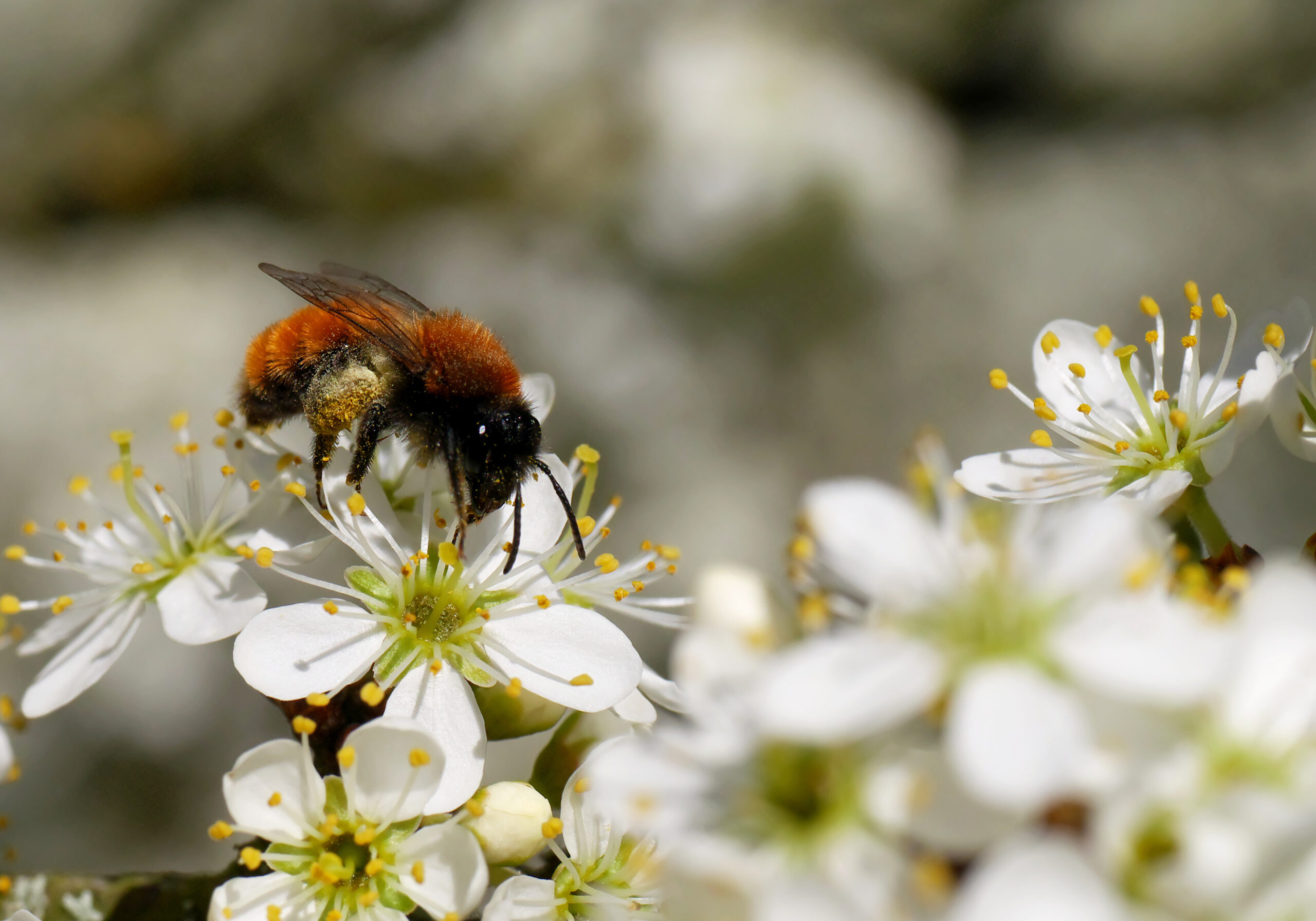
Frank Vassen from Brussels, Belgium, CC BY 2.0, via Wikimedia Commons
Tawny Mining Bee
Andrena fulva
Müller, 1766 • Andrenidae • Andreninae
Every April, a flash of fox-red appears in British gardens. Andrena fulva Müller, 1766, the tawny mining bee, is one of the most instantly recognisable solitary bees in Britain: the female is clothed in dense, bright reddish-orange hair from head to tail, making her look almost flame-coloured in good light. She excavates a vertical burrow in lawn turf, leaving a characteristic volcano-shaped mound of fresh soil, provisions each cell with pollen and nectar, lays a single egg, and seals it. She does this alone, with no colony and no queen, just one bee making the most of a short spring window. Explore where she lives alongside Britain's other wild bees on the UK Native Bee Species Map, or read about solitary bees from around the world in the World Bee Atlas.
Quick Facts
Taxonomy and Classification
The tawny mining bee was described by Otto Friedrich Müller in 1766. It belongs to the family Andrenidae, the mining bees, which with around 1,500 described species globally is one of the largest bee families. Within Andrenidae it sits in the subfamily Andreninae and the large genus Andrena, which contains more species than any other bee genus in Europe.[1] Andrena fulva is one of a small group of red or reddish Andrena species sometimes grouped informally as the "red androenas," but it is by far the most distinctive and most readily identified of these in Britain.
The genus Andrena can be identified by the broad velvety facial foveae, strips of dense pale hair between the compound eyes and the antennal bases, which are absent in other British bee genera. Within the genus, A. fulva females are almost unmistakable. The authority citation uses Müller 1766 rather than the often-seen Schrank 1781; the earlier date has priority under the rules of zoological nomenclature.[1]
| Kingdom | Animalia |
| Phylum | Arthropoda |
| Class | Insecta |
| Order | Hymenoptera |
| Family | Andrenidae |
| Subfamily | Andreninae |
| Genus | Andrena Fabricius, 1775 |
| Species | Andrena fulva Müller, 1766 |
Identification
The female tawny mining bee is one of the easiest solitary bees in Britain to identify in the field. She is covered on the dorsal surface of her thorax and abdomen with long, dense, bright reddish-orange hair, often described as fox-red, contrasting sharply with the black hair on her head, legs and underside. Females measure 10 to 12 mm, roughly honeybee-sized, and carry pollen in a scopa of stiff hairs on their hind femora.[1] The colouring is vivid in fresh spring specimens and can appear almost flame-coloured in direct sunlight.
Males are less striking: 8 to 10 mm, with sparser reddish-brown hair on the body, a white "moustache" of long pale hairs on the lower clypeus, and a distinctive large tooth at the base of each mandible.[2] Males emerge a week or two before females and can be seen patrolling potential nesting areas and flower patches. The most similar species likely to cause confusion is the red mason bee (Osmia bicornis), which is also gingery, but can be distinguished by its two facial horns (females), its ventral abdominal pollen scopa, and its habit of nesting in cavities rather than the ground.
Nesting: The Lawn Volcano
The tawny mining bee is a ground-nester. Each female excavates a vertical shaft in the soil, typically 200 to 300 mm deep, with several brood cells branching off the main tunnel.[3] A single female usually builds two or three separate nests in a season, each containing four or five cells. She provisions each cell with a ball of pollen and nectar, lays a single egg, seals the cell, and moves on. The nest entrance is surrounded by a characteristic mound of freshly excavated soil, often shaped like a miniature volcano, which makes aggregations easy to spot in lawns and flower beds.
Nesting typically happens in short-turf lawns, garden paths, bare or sparsely vegetated banks, and south-facing slopes where the soil warms up quickly in spring. Females can nest singly or in loose aggregations: in some gardens, dozens or even a few hundred individuals will choose the same patch of suitable ground, creating a cluster of soil mounds that can alarm gardeners who are unfamiliar with them.[3] This is not a colony in any social sense. Each female is completely independent, and the aggregation is simply the result of many individuals finding the same favourable conditions attractive at the same time.
Tawny mining bees in your lawn: what to do
Nothing. The bees will be active for around six to eight weeks from April to June, do no meaningful harm to turf, and provide real pollination value to nearby spring blossom. The soil mounds can be brushed flat if needed without harming the bees. Females are gentle and do not sting unless directly handled. Males cannot sting at all. Once the season ends the ground returns to normal.
Life Cycle and Behaviour
The tawny mining bee is univoltine: one generation a year. Males emerge from overwintering in early April, a week or two before the females, and can be seen flying low over potential nesting areas or gathering on spring flowers. After mating, females begin nesting immediately. The male's role ends with mating and he dies shortly afterwards.[3]
The larva in each sealed brood cell hatches within a few days, feeds on its pollen-and-nectar loaf, grows quickly, and pupates within a few weeks. The fully formed adult overwinters in the sealed cell and does not emerge until the following spring. The flight season runs from early April to mid-June, peaking in April and May, timed to coincide with the flowering of blackthorn, hawthorn, fruit trees, willows, and a wide range of spring garden plants.[1]
Foraging
Andrena fulva is polylectic: it forages across a wide range of flowering plants rather than specialising on a single genus or family. Key sources include blackthorn, plum, cherry, apple, cherry laurel, willows, currants, hawthorns, dandelions, and many garden flowering herbs and shrubs.[1] This generalism makes it a useful pollinator of spring fruit crops as well as wildflowers.
Natural Enemies: The Nomad Bee and the Bee-fly
The tawny mining bee has two well-documented cleptoparasites that target its nest cells. The first is Panzer's nomad bee (Nomada panzeri), a wasp-like bee without a pollen scopa of its own. The female nomad bee enters unguarded tawny mining bee burrows while the host is away foraging, lays her own eggs in the sealed or near-sealed cells, and departs. When the nomad's egg hatches, the larva destroys the host egg and consumes the pollen loaf.[4] At a site in South Wales, N. panzeri accounted for 18% cleptoparasitism of A. fulva nests. The second nomad bee cleptoparasite is Nomada signata.[1]
The large bee-fly (Bombylius major), a hoverfly-like insect with a long straight proboscis and hovering flight, is a further parasite. Females flick their eggs towards the nest entrance in flight. If the larva reaches a bee cell, it consumes the provisions and eventually the bee larva.[4] Bee-flies are commonly seen hovering near tawny mining bee aggregations in April and are themselves a sign of a healthy and abundant bee population.
Which sex is larger: female or male?
Some sources including Wikipedia list females as 8–10 mm and males as 10–12 mm, implying males are larger. This is an error: in Andrena fulva, as in nearly all bees, females are the larger sex. BWARS, the authoritative source, states females are larger than males, and the 2023 genome paper (Crowley et al.) gives female wing length as 10 mm vs male wing length of 8 mm, confirming females are larger.[2] The Wikipedia size figures appear to have the sexes transposed. The figures used in this article (females 10–12 mm body length, males 8–10 mm) follow BWARS.
Distribution and Status
The tawny mining bee is widespread and common throughout lowland England and Wales, found wherever spring blossom and suitable nesting ground occur together, which in practice means most gardens, parks, allotments, orchards, hedgerow edges and woodland rides in the southern two-thirds of Britain.[1] It has been recorded in Scotland for the first time in recent years and appears to be extending its range northwards, consistent with a general trend of southerly species tracking warming spring temperatures.[5] In Ireland it is known from only two sites in Kilkenny, making it very scarce there. The species is listed as Least Concern and is not subject to any conservation concern.
Across Europe it ranges from Britain east through central Europe to the Balkans and north to southern Scandinavia.[6] It is one of the most abundant spring solitary bees in western Europe and, because its bright colouring makes it unusually recognisable to non-specialists, it is among the most-reported species to citizen science recording schemes. See the UK Native Bee Species Map for its regional distribution across Britain's 17 recording zones.
Spring Bees and Spring Honey
The tawny mining bee's season is April and May, the same weeks that hawthorn, apple and cherry blossom open across Britain and our partner's honeybee colonies leave winter cluster and start their first foraging flights of the year. Andrena fulva makes no honey. Each female provisions only her own nest cells, with nothing left to store. But as a spring generalist forager working the same orchards and wildflower patches as the honeybee, she is part of the same landscape story.
That landscape, and the honeys it produces, varies across Britain's seasons. If you want to taste across the range, the Discovery Trio brings together our three most characterful honeys: raw Acacia from Transylvania's linden-rich forests, British Wildflower from the Midlands, and bold Yorkshire Heather. Three origins, three seasons, one box. A good place to start if you are new to single-origin honey, or want to understand how much the flavour differs between variety and region.

Source Conflicts and Open Questions
Is the tawny mining bee expanding northwards in the UK?
BWARS notes recent first records for Scotland, and the species' range in northern England appears to have thickened over the past two decades. This is consistent with phenological data showing earlier spring emergence in solitary bees tracked by the UK Pollinator Monitoring Scheme.[5] However, some of the apparent expansion may reflect increased recording effort rather than a genuine range shift. The question is unresolved, though a northward trend is considered likely by most authors.
Frequently Asked Questions
How do I identify a tawny mining bee?
The female is one of Britain's most distinctive bees: fox-red or bright reddish-orange hair covering the top of her thorax and abdomen, contrasting with black hair on the head, legs and underside. She is roughly honeybee-sized (10–12 mm). If you see an orange-red bee excavating a soil mound in a garden lawn in April or May, it is almost certainly a tawny mining bee. Males are smaller and duller brown, with a white clypeal moustache.
Why does my lawn have small soil mounds with bees flying around them?
Those are tawny mining bee nest entrances. Each mound marks a burrow dug by a single female bee. Aggregations can number dozens or hundreds of bees in a favoured patch of lawn. They are harmless: the bees are gentle, the tunnels cause no lasting damage to turf, and the season lasts only six to eight weeks. The bees are valuable spring pollinators and are best left alone to complete their nesting cycle.
Do tawny mining bees sting?
Rarely and only under direct provocation. Females have a sting but are very disinclined to use it; they are not colony defenders and have no nest to protect in the social sense. Males cannot sting at all. Children and pets can walk through a nesting aggregation without danger, though deliberately handling or trapping a female should be avoided.
When do tawny mining bees fly?
From early April to mid-June, with peak activity in April and May. Males emerge a week or two before females. This single annual flight season is timed to match the flowering of blackthorn, hawthorn, fruit trees and spring garden plants. By midsummer all adults have died and only dormant larvae remain underground, waiting to emerge the following spring.
What is the bee-fly I keep seeing near the mining bee nests?
The large bee-fly (Bombylius major) is a common sight hovering around tawny mining bee aggregations in April. It looks like a small hoverfly with a long straight proboscis and furry golden-brown body. It is a parasite: females flick their eggs towards the bee nest entrances, and the larvae, if they reach the brood cells, feed on the bee's pollen stores. Despite this, the bee-fly's presence is a reliable indicator of a thriving tawny mining bee population.
Is the tawny mining bee the same as the red mason bee?
No. They are different species that look superficially similar. Both are gingery, but the tawny mining bee (Andrena fulva) nests in the ground and carries pollen on her hind legs, while the red mason bee (Osmia bicornis) nests in cavities, carries pollen on her belly, and has two distinctive horns on her face. Both are spring species and both are common garden bees. Read the Red Mason Bee profile for a full comparison.
What flowers do tawny mining bees visit?
They are polylectic generalists, visiting a wide range of spring-flowering plants. Favoured sources include blackthorn, plum, cherry, apple, hawthorn, willows, currants, cherry laurel, dandelions and many garden flowering shrubs. The peak foraging period in April and May coincides with fruit tree blossom, making this bee a useful orchard pollinator.
Do tawny mining bees make honey?
No. Tawny mining bees are solitary: each female collects pollen and nectar purely to provision her own brood cells, with nothing left over to store. There is no colony, no surplus, and nothing to harvest. All harvestable honey comes from managed honeybee (Apis mellifera) colonies.
Sources and References
- Bees, Wasps and Ants Recording Society (BWARS). Andrena fulva species account: identification, distribution, nesting biology, cleptoparasites, foraging plants. bwars.com
- Crowley, L. M. et al. (2023). The genome sequence of the Tawny Mining Bee, Andrena fulva (Müller, 1766). Wellcome Open Research 8:296. doi.org
- NatureSpot. Tawny Mining Bee (Andrena fulva): nest structure, cell count, aggregation behaviour. naturespot.org
- Spooner, G. M. (1931); Perkins, R. C. L. (1919). Cleptoparasitism of Andrena fulva by Nomada panzeri and Bombylius major. Summarised in BWARS species account and: Baldock, D. W. (2008). Bees of Surrey. Surrey Wildlife Trust. bwars.com
- Powney, G. D. et al. (2019). Widespread losses of pollinating insects in Britain. Nature Communications 10:1018. doi.org
- GBIF. Andrena fulva occurrence records: European distribution from Britain to the Balkans. gbif.org