

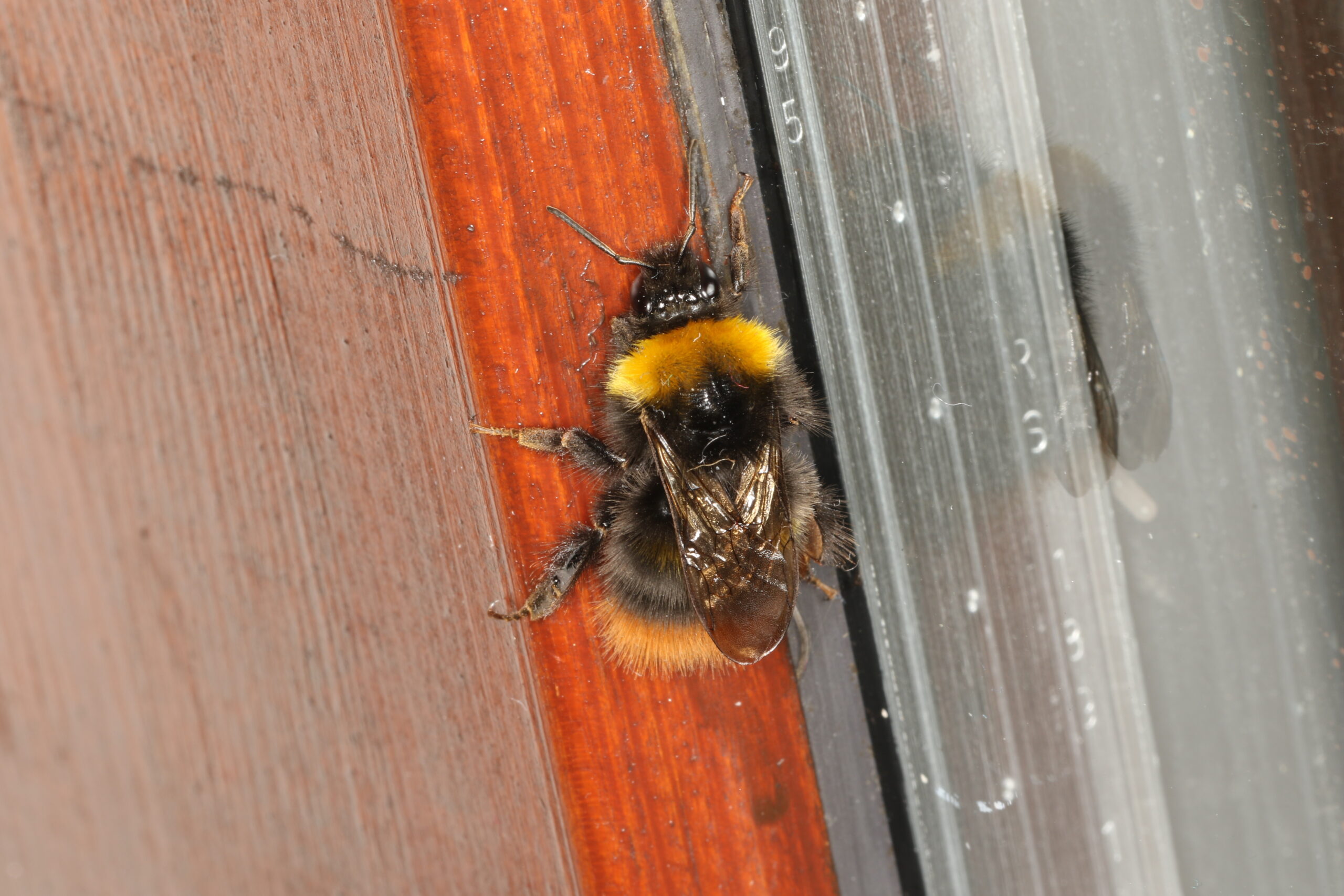
Donald Hobern from Copenhagen, Denmark, CC BY 2.0, via Wikimedia Commons
Early Bumblebee
Bombus pratorum
Linnaeus, 1761 • Apidae • Pyrobombus
The early bumblebee earns its name every year. Bombus pratorum Linnaeus, 1761 is the first bumblebee to complete its entire colony cycle, with queens sometimes emerging in February and the colony finished by July, leaving the rest of summer to other species. It is small, fast and lively, with a bright yellow collar, a yellow band across the abdomen, and a distinctive orange-red tail. Found in gardens, hedgerows and woodland edges across Britain, it is a familiar sight on spring blossom and the first bee many people notice in the year. Explore its distribution on the UK Native Bee Species Map, or discover bumblebees from around the world in the World Bee Atlas.
Quick Facts
Taxonomy and Classification
The early bumblebee was described by Carl Linnaeus in 1761. It belongs to the subgenus Pyrobombus, a grouping of small to medium-sized bumblebees found across the northern hemisphere. Within Britain, Pyrobombus includes the tree bumblebee (Bombus hypnorum) and the heath bumblebee (Bombus jonellus) as well as B. pratorum.[1] The species name pratorum is Latin for "of meadows," a reference to one of its preferred habitats.
| Kingdom | Animalia |
| Phylum | Arthropoda |
| Class | Insecta |
| Order | Hymenoptera |
| Family | Apidae |
| Tribe | Bombini |
| Genus | Bombus Latreille, 1802 |
| Subgenus | Pyrobombus Dalla Torre, 1880 |
| Species | Bombus pratorum Linnaeus, 1761 |
Identification
The early bumblebee is one of Britain's smaller bumblebees, noticeably more compact and faster-moving than the larger species. All three castes share the same basic pattern: a bright yellow collar at the front of the thorax, a yellow band across the second abdominal segment, and an orange-red tail.[2] Queens are 15 to 17 mm; workers range from 10 to 14 mm and are often considerably smaller than early-season workers of other species; males are 11 to 13 mm with broader yellow collars and noticeably yellow facial hair.
Workers can be quite variable: the yellow abdominal band is frequently reduced, faint or absent in workers, though the yellow collar and orange-red tail remain consistent. The combination of a small orange tail with a yellow collar is the quickest field character, shared in Britain only with the male red-tailed bumblebee (Bombus lapidarius), which is larger, lacks the abdominal band and has no yellow collar of similar width.[2] The early bumblebee tends to look fluffy and round-bodied compared with some other species.
Britain's Fastest Colony Cycle
The defining feature of Bombus pratorum is the speed of its colony cycle. With an average lifespan of around 14 weeks from founding to dispersal, it has the shortest colony cycle of any British bumblebee.[3] Queens emerge from hibernation as early as February in mild springs, though March is more typical. Workers appear from April, and new queens and males are produced from May onwards, often flying in June. By July, most colonies in southern Britain have concluded and the new queens have dispersed to find hibernation sites.
This rapid cycle allows the early bumblebee to complete its season before most other bumblebees have reached peak worker numbers. It is one of the few British bumblebees that can produce two complete colony cycles in a warm year in the south, with a second generation of queens founding new colonies in late spring after the first has ended.[3] Workers of the second generation can be found foraging into September, meaning the species is present from February to September in total, despite each individual colony lasting only 14 weeks.
14 weeks: the shortest colony cycle
At around 14 weeks from queen emergence to colony dissolution, Bombus pratorum completes its colony faster than any other British bumblebee. The buff-tailed bumblebee (Bombus terrestris) colony can last 6 months or more. The common carder bee (Bombus pascuorum) averages 25 weeks. The early bumblebee's brevity is a strategy, not a limitation.
Nesting: Bird Boxes, Tussocks and Unusual Places
The early bumblebee nests above ground in a wide variety of locations. Old bird nests in nest boxes and tree cavities are a strong preference, particularly uncleared tit boxes from the previous year.[3] It also nests in tussocky grass, under hedgerows, in piles of plant debris, and, with a reputation shared with the garden bumblebee, in unusual man-made sites: jacket pockets, fuse boxes, rolled rugs and wall cavities have all been recorded. Colony size is small, reaching a maximum of around 100 workers, considerably fewer than many other bumblebee species.
Queens use aggressive behaviour rather than pheromones to maintain dominance over workers in the colony, an unusual feature among British bumblebees. The colony produces male and new queen offspring from May, and once these have dispersed and mated, the colony declines rapidly.
Foraging: Short Tongue, Big Range
The early bumblebee has a short tongue relative to species like the garden bumblebee or common carder bee, which restricts its access to deep-tubed flowers. It makes up for this by foraging on a wide range of open and shallower flowers, and by nectar robbing: biting a hole at the base of a deep corolla to access the nectar without entering through the flower's legitimate entrance, thereby delivering no pollination benefit to that flower.[1]
Recorded foraging plants include sallows, blackthorn, cherry plum, apple blossom, dead-nettles, ground ivy, dandelions, garden heathers, bramble, raspberry, currants, cotoneaster, lavender, sage, alliums, comfrey (often via nectar robbing), scabious and thistles.[2] Queens in early spring feed heavily on sallow and blackthorn, making them a useful pollinator of early-season shrubs before most other species are active. The species shows a strong positive correlation with the presence of gardens and allotments in the landscape.[4][5]
The Forest Cuckoo Bee
The early bumblebee is the primary host of the forest cuckoo bumblebee (Bombus sylvestris), one of six cuckoo bumblebees recorded in Britain. Female forest cuckoos invade established early bumblebee colonies in spring, suppress or kill the host queen, and use the existing workers to raise their own reproductive offspring. The forest cuckoo is itself relatively common, reflecting the abundance of its host.[1]
Is the early bumblebee genuinely bivoltine?
Multiple sources including bumblebee.org note that two or even three colony cycles per year have been recorded in southern Britain, and that in the north there is reliably only one generation per year.[3] BWARS treats it as a species with a short univoltine cycle that occasionally produces a second generation in favourable conditions, rather than a genuinely bivoltine species in the way some insects are defined. The evidence for consistent bivoltinism is strong in the south but variable year to year, and the boundary is not well defined.
Spring Bees and Spring Honey
The early bumblebee and the spring honey harvest share a moment. Our British Wildflower Honey comes from the same mixed blossom landscape that early bumblebee queens patrol from February: hawthorn, blackthorn, apple, dandelion and clover in an unbroken sequence from late winter to early summer. The early bumblebee makes no honey of its own. But it works the same flowers, on the same timeline, that the honeybee colony is ramping up to exploit at full strength.
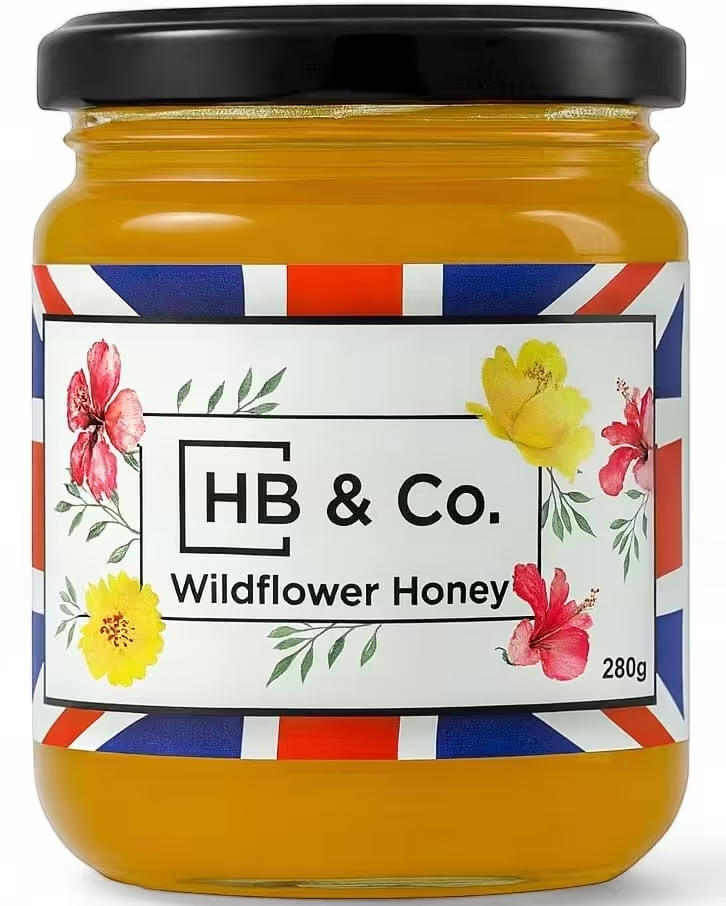
Raw, cold-extracted wildflower honey from the same mixed British blossom that early bumblebee queens forage from February. Harvested by our SALSA-certified British supplier. 280g.

Acacia, Wildflower and Heather in one gift box. Three of our most distinct raw honeys, 280g each.
Shop Discovery Trio
Raw single-origin honey delivered every month. Your variety, your schedule. From £8.79/month.
Start SubscriptionSource Conflicts and Open Questions
Why does it finish so early?
The early bumblebee's abbreviated colony cycle is well documented but not fully explained. Leading hypotheses include avoidance of peak competition with larger, later bumblebee species; earlier availability of its preferred food plants; and a life-history trade-off that favours rapid reproduction over colony size. The short cycle may also be an ancestral trait of the subgenus Pyrobombus retained from a more northerly or montane original distribution. None of these hypotheses has been definitively confirmed.[4]
Frequently Asked Questions
How do I identify an early bumblebee?
Look for a small, round, fast-moving bumblebee with a bright yellow collar at the front of the thorax, a yellow band on the second abdominal segment (sometimes faint or absent in workers), and an orange-red tail. Queens are 15 to 17 mm; workers are often noticeably smaller. The combination of yellow collar and orange-red tail is the key field mark. Males have broader yellow collars and yellow facial hair.
When does the early bumblebee fly?
Queens emerge from hibernation as early as February, though March is more typical. Workers appear from April, and the colony produces new queens and males from May. The founding queen's colony is typically complete by July, but workers of second-generation colonies can be seen into September. In the north of Britain, just one generation is produced and the season ends earlier.
Why is it called the early bumblebee?
Because it is the first bumblebee to complete its entire colony cycle each year. Queens are among the earliest bumblebees to emerge from hibernation, sometimes in February, and the colony finishes before most other British bumblebee species have reached full worker strength. The name refers to this early colony timing, not just early adult emergence.
Where does the early bumblebee nest?
Above ground, in a wide range of locations. It has a particular fondness for old bird nests in nest boxes, especially tit boxes not cleaned out from the previous year. It also nests in tussocky grass, under hedgerows, in plant litter, and occasionally in unusual man-made sites. Colony size is small, up to about 100 workers, and the nest lasts around 14 weeks before dispersing.
Is the early bumblebee declining?
No. It is one of the more stable and widespread British bumblebee species. Studies show a positive correlation between early bumblebee abundance and garden and allotment cover in the landscape, suggesting it benefits from urban and suburban habitats. It is listed as Least Concern and is not subject to conservation concern. See the UK Native Bee Species Map for its regional distribution.
What flowers do early bumblebees visit?
A wide range. Queens in early spring favour sallows, blackthorn, cherry plum, apple blossom, dead-nettles and ground ivy. Workers visit bramble, raspberry, currants, cotoneaster, lavender, sage, alliums, scabious and thistles. The short tongue means it cannot easily access deep tubular flowers, and it sometimes nectar robs comfrey and other deep-tubed plants by biting a hole at the base of the corolla.
Does the early bumblebee make honey?
No. Like all bumblebees, it stores only enough nectar in the nest to last a few days. There is no surplus and nothing to harvest. All commercial honey comes from managed honeybee (Apis mellifera) colonies.
How can I help early bumblebees?
Leave old bird boxes in place over winter rather than cleaning them out in autumn: an uncleared tit box is ideal early bumblebee nesting habitat. Plant early-flowering species such as sallows, blackthorn, dead-nettles and apple. Leave a patch of tussocky grass or plant litter as an alternative nesting site. See the Your Plate Without Bees tool for more on why pollinators matter.
Sources and References
- Bees, Wasps and Ants Recording Society (BWARS). Bombus pratorum species account: identification, nesting, foraging, cleptoparasites. bwars.com
- Bumblebee Conservation Trust. Bombus pratorum species profile: identification, distribution and habitat. bumblebeeconservation.org
- Bumblebee.org. Bombus pratorum: colony cycle, sizes, nest biology, possible bivoltinism. bumblebee.org
- Crowley, L. M. et al. (2023). The genome sequence of the Early Bumblebee, Bombus pratorum (Linnaeus, 1761). Wellcome Open Research 8:379. ncbi.nlm.nih.gov
- Powney, G. D. et al. (2019). Widespread losses of pollinating insects in Britain. Nature Communications 10:1018. doi.org