
 Italiano
 English (UK)
 Français
 简体中文
 한국어

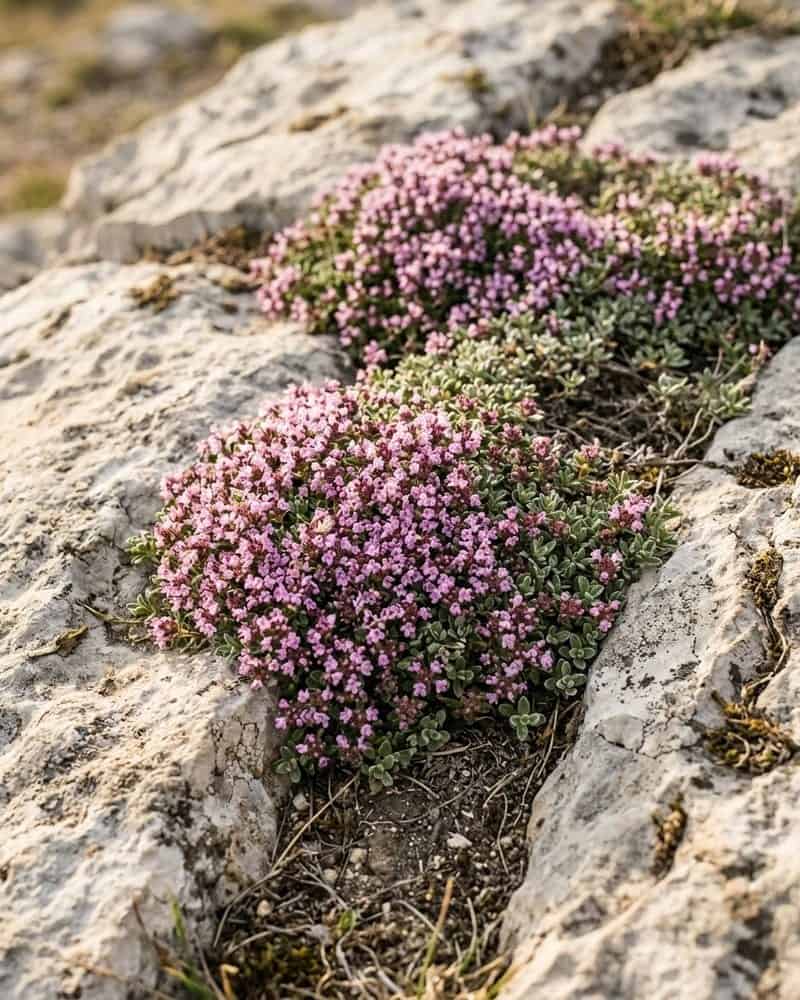
Wild thyme on a dry hillside: the plant behind one of the Mediterranean’s best-known single-flower honeys.
Honey varieties
Thyme Honey: What It Tastes Like, Where It Comes From and How to Buy a Real One
Thyme honey is a single-flower honey made mainly from the nectar of wild thyme, best known from Greece and other dry Mediterranean hillsides. It is medium to dark amber, strongly aromatic with herbal, woody and resinous notes, and it crystallises at a moderate pace. A genuine one often shows surprisingly little thyme pollen, so the label and the taste matter as much as any lab figure.
- Main plant
- Wild thymes, chiefly Thymus capitatus (now often listed as Thymbra capitata) and other Thymus species
- Producing countries
- Greece, Albania, Italy, Croatia, Spain, France
- Colore
- Medium to dark; mean 53.1 mm on the Pfund scale
- Aroma and taste
- Medium to strong; woody, herbal, slightly resinous, with fresh and fruity notes
- Cristallizzazione
- Moderato
- Typical thyme pollen
- About 36% on average; often well under half
Sources: Persano Oddo and Piro (2004), descriptive sheets; Persano Oddo et al. (2004), botanical species list. Both Apidologie. Links in the sections below.
What thyme honey tastes like
The first spoonful of a good thyme honey does not taste like the herb in your spice rack. It is sweeter and rounder than that, with the thyme arriving as a warm, resinous note in the finish. In the European reference descriptions it carries a medium-to-strong aroma described as woody and “chemical” (in tasting language that means sharp, volatile notes, not anything artificial), with fresh and floral-fruity layers underneath.
Warm herb, resin, a hint of wax. Stronger when the pollen share is high.
Full sweetness, a faint saltiness in some island honeys, and a long finish.
Runny when fresh, setting gradually to a fine-grained cream over months.
A 2021 sensory study of Greek island thyme honeys in the journal Applied Sciences grouped samples by how much thyme pollen they contained. The group with the most thyme pollen, over 60%, was the lightest in colour, had the most intense floral odour and the strongest salty note, and showed wood, wax and resin aromas (Sensory Profile of Greek Islands Thyme Honey, Applied Sciences, 2021). In other words, “more thyme” does not simply mean “darker and stronger”.
Where thyme honey comes from
Thyme grows as low, woody cushions on poor, stony, sun-baked ground, exactly the kind of land that suits little else. The European list of plants that give single-flower honeys records thyme honeys from Greece, Albania, Italy, Croatia, Spain and France (Persano Oddo et al., Botanical species giving unifloral honey in Europe, Apidologie, 2004).
Greece is the name most UK shoppers know, and the Greek islands have their own research record. A scientific note on thyme honey from the island of Kythira found thyme pollen averaging 42% of the pollen spectrum, ranging from 18% to 80%, and an average moisture of 15.7% (Tsigouri and Passaloglou-Katrali, Apidologie, 2000).
For how Greek honeys compare with British ones as a whole, we have a separate piece on Greek honey vs British honey; this page stays on thyme itself.
The pollen puzzle: why “thyme” honey is not mostly thyme pollen
This is the part most buying guides skip, and it trips up honest buyers. Many plants put fewer pollen grains into their nectar than you would expect, so a honey made mainly from them shows a low share of their pollen under the microscope. In the Persano Oddo and Piro descriptive sheets, Italian thyme honeys averaged 26.6% thyme pollen and Greek ones 40.2%, with an overall mean of 36% (Main European unifloral honeys: descriptive sheets, Apidologie, 2004).
So a lab report showing 30% thyme pollen is not a red flag on its own. Equally, a high figure is not a guarantee. Labs judge thyme honey on pollen together with colour, conductivity, sugar profile and a trained tasting panel. Our wider explainer on what the evidence says about spotting fake honey covers why single tests mislead, and how flower nectar becomes distinctive honey covers the nectar side.
We would go further: if a seller leads with a pollen percentage and nothing else, ask what the other tests said. A defensible thyme claim rests on several kinds of evidence agreeing.
How to buy a real thyme honey in the UK
UK law gives you two useful handholds. Under the Regolamento del 2015 sul miele (Inghilterra), the label must name the country where the honey was harvested, and a floral name such as “thyme” is only allowed if the honey “comes wholly or mainly from the indicated source” and has that source’s taste, chemistry and microscopic traits.
- A named country, not a blend line. “Product of Greece” tells you something; “blend of EU and non-EU honeys” tells you almost nothing about thyme.
- Colour in the right range. Medium to dark amber. A very pale, watery honey sold as thyme deserves a second look.
- A real aroma. Open the jar: you should smell warm herb and resin before you taste anything.
- Slow, even setting. Thyme honey crystallises at a moderate rate. Fine crystals after some months are normal, and our piece on perché il miele grezzo si solidifica spiega i meccanismi chimici.
- A producer you can trace. A named beekeeper, cooperative or region beats a generic import brand.
Using thyme honey in the kitchen
Its strength is an asset with salty, tangy and fatty foods, and a liability in delicate bakes. These are the pairings that work, and the gentler swap if you are using one of our jars instead.
| Utilizzo | Why thyme works | Gentler swap from our range |
|---|---|---|
| Greek yoghurt and walnuts | The resinous finish cuts the tang | Acacia, for a clean sweetness that lets the yoghurt lead |
| Feta, halloumi or a cheese board | Salt meets herb | Acacia or heather; see best honey for a grazing board |
| Roast lamb or root vegetables | Echoes thyme already in the pan | Wildflower, brushed on in the last minutes |
| Figs and soft fruit | Adds depth to ripe sweetness | Acacia, which does not mask the fruit |
| Tea | Bold, best in herbal infusions | Linden, the classic tea honey in our range |
Two practical notes. First, use less than you would of a mild honey: half a teaspoon of thyme honey carries as much flavour as a full teaspoon of something gentle. Second, add it late when cooking. Honey is rich in fructose, and food scientists at the University of Guelph list fructose as the sugar that starts to caramelise at the lowest temperature, around 110°C, against about 170°C for table sugar (Rogers Lab, University of Guelph). A thyme honey glaze brushed on at the start of a long roast simply burns, and the aroma you paid for goes with it. If tea is your use, our miele di tiglio is the gentler, more fragrant choice.
For more pairings, our honey with wine and cheese guide e honey for yoghurt and pancakes go further.
Why we don’t sell thyme honey, and what we pour instead
We keep our range to honeys our family and our British supplier actually know: Transylvanian acacia, linden and sunflower, and British wildflower, heather and soft set. Thyme is a Mediterranean hillside honey, and we would rather send you to a good Greek producer than put our name on a jar we cannot vouch for from hive to shelf.
When customers tell us they love thyme honey on yoghurt, figs and cheese, the jar we suggest is acacia. It is the opposite in character, which is the point: very light, mild and floral, and slow to crystallise, so it keeps pouring well for longer than most honeys. Where thyme adds its own voice, acacia lets the food speak.
Thyme honey
Medium to dark. Strong, herbal, resinous. Moderate set. Imported; not in our range.
Our acacia honey
Very light. Mild, floral, clean. Slow to crystallise. Transylvanian, 280g, unblended.
If you want strength rather than gentleness, our Miele di erica britannico is the closest match for intensity, and acacia vs heather sets the two side by side. Free UK delivery on 3 or more jars on any order type.
Thyme honey FAQ
Is thyme honey the same as Greek honey?
No. Greece produces many honeys, including pine, fir and heather types. Thyme honey is the best known, but “Greek honey” on a label does not mean thyme.
Is there British thyme honey?
Wild thyme grows in parts of Britain, but we are not aware of it giving a recognised single-flower honey here, and the European reference lists record thyme honeys from Mediterranean countries. Treat a “British thyme honey” claim with curiosity and ask the producer how it was verified.
Why has my thyme honey gone cloudy?
It is crystallising, which is natural and harmless. Thyme honey sets at a moderate pace. Warm the jar gently in a bowl of warm water to loosen it; our softening guide shows how without overheating.
Does thyme honey keep well?
Like other honeys stored sealed at room temperature, it keeps very well and remains safe to eat well beyond its best-before date. Expect colour to deepen and texture to change over time.
Can children have thyme honey?
Not babies. The NHS advises: “Do not give your child honey until they’re over 1 year old.” From then on it is a food like any other honey.