

 English (UK)
  Italiano
  Français
  简体中文
简体中文  한국어
한국어 
We do not yet have a freely licensed photograph of the silver-sided nomad bee. The placeholder above stands in for now. If you can help, please see the request below.
UK Bee Species
Silver-sided Nomad Bee Nomada argentata
Herrich-Schäffer, 1839 · subfamily Nomadinae · family Apidae
Also called the silvery nomad bee. The name argentata means "silvery", after the silver hairs along its sides.
Most cuckoo bees you can at least name from a good photograph. The silver-sided nomad bee is not one of them: it is genuinely a microscope job, separated from its near-relatives on the fine detail of its mandibles, antennae and hind legs.[3] It is also one of Britain's rarest and most sharply declined bees, and its fortunes are bound to a single, equally particular host.[1]
Can you help? We need a photograph
We would love to show the silver-sided nomad bee properly. If you hold an image of Nomada argentata under a Creative Commons or public-domain licence, and are happy for us to feature it with full credit, please get in touch.
One cuckoo, one host, one flower
The silver-sided nomad bee is a specialist's specialist. It is a cuckoo of just one mining bee, the small scabious mining bee (Andrena marginata), laying its eggs in that bee's burrows.[2] That host, in turn, depends on scabious: devil's-bit scabious and small scabious, on the kind of unimproved chalk grassland and heath that is now scarce itself. Three links, and every one of them has to hold.[1]
The nomad is scarcer than its host, and the host is scarcer than its flower. Lose any link and the chain breaks.
How a nomad bee lives
Nomad bees are the wasp-like cuckoos of the mining bees. A female builds no nest and gathers no pollen. She flies low over a host's nesting ground, slips into an open burrow, and lays her egg in a cell the host has stocked.[4] When the nomad grub hatches it destroys the host's egg or young larva and eats the pollen store laid up for it. It is why nomads are almost hairless and brightly patterned rather than furry: with no pollen to carry, they have no need of the brushes and coats that working bees rely on. What the silver-sided nomad bee does need, absolutely, is for its one host to be nesting nearby.[1]
Where and when to look
This is a bee of high summer, univoltine and on the wing from about mid-July to mid-September, timed to the late-season flight of its host.[1] Look, if anywhere, on scabious-rich unimproved grassland, chalk downland, dunes and heaths in southern and eastern England, with modern strongholds in the East Anglian Brecks and on Salisbury Plain.[1] Even there it is elusive: it turns up at only a fraction of the sites where its host still flies, and it has declined markedly. Set its family among the world's cuckoo bees in the World Bee Atlas, or see the wider British picture on the UK Native Bee Species Map.
How to help
This bee cannot be helped directly, only through its host and its host's flowers. Protecting and restoring unimproved, scabious-rich chalk grassland and heath, and grazing or cutting it in ways that let devil's-bit and small scabious flourish, is what keeps the small scabious mining bee going, and with it any hope for its silver-sided cuckoo.
Quick facts
| Kingdom | Animalia |
|---|---|
| Phylum | Arthropoda |
| Class | Insecta |
| Order | Hymenoptera |
| Family | Apidae |
| Subfamily | Nomadinae |
| Genus | Nomada |
| Species | Nomada argentata |
The name: silver at the edges
"Nomad" fits a bee that keeps no home of its own and wanders in search of other bees' nests. Argentata is Latin for "silvery", after the neat patches of silver hair along the sides of the body that, in a group of red-and-black look-alikes, are one of the more noticeable field marks.[6] Field guides usually call it the silver-sided nomad bee for exactly that reason; silvery nomad bee is the same species under a slightly shorter name.
Flower-rich grassland feeds far more than one bee
The same unimproved meadows and downs that a rare cuckoo needs are what fill a jar of wildflower honey. Looking after one helps the other.
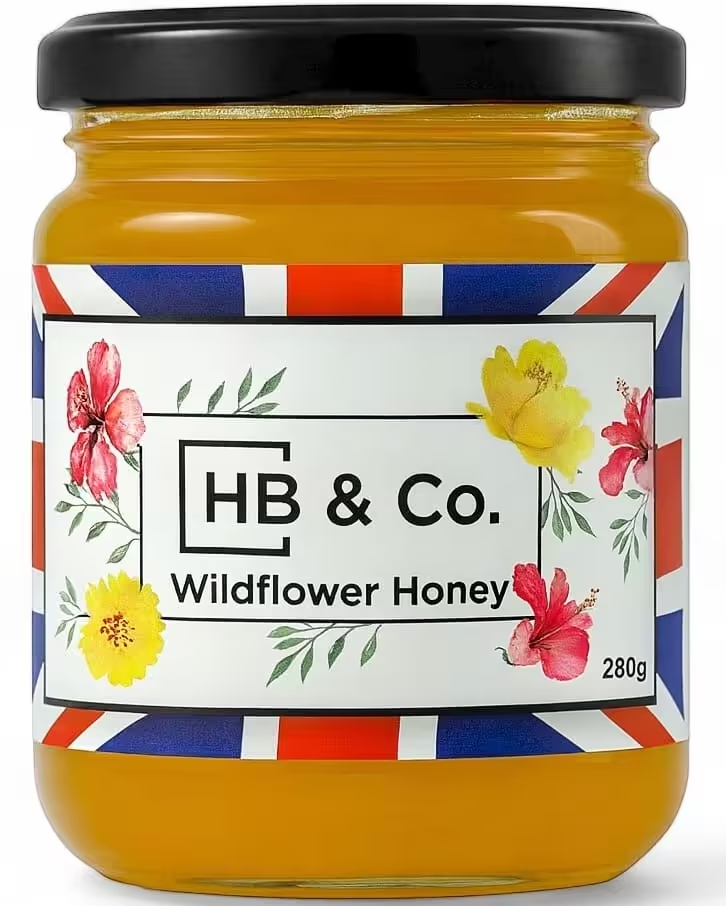
Raw British Wildflower Honey
Set by the meadow and hedgerow flowers of the British countryside, raw, unfiltered and full of character. Our British honey supplier holds SALSA Certification. 280g, £10.99.
Shop Wildflower HoneyPrefer a regular jar? Subscribe to any single honey and save 20%, with free UK delivery on every subscription order.
Start a SubscriptionFrequently asked questions
Is the silver-sided nomad bee the same as the silvery nomad bee?
Yes. Nomada argentata is usually called the silver-sided nomad bee in field guides, after the silvery hairs along its sides. Silvery nomad bee is a shorter name for the same species.
Is it rare?
Yes, one of Britain's rarer bees. It is confined to southern and eastern England, has declined markedly, and holds on mainly in the East Anglian Brecks and on Salisbury Plain.
What does it parasitise?
A single host: the small scabious mining bee, Andrena marginata. The silver-sided nomad lays its eggs in that bee's nests, and its grubs eat the host's pollen store.
Why is it tied to scabious?
Not directly. Its host depends on scabious, devil's-bit and small scabious, so the nomad is only found where those flowers, and therefore its host, still thrive.
Can I identify it from a photograph?
Usually not with certainty. It is a small red-and-black nomad with silvery side hairs, but confirming it apart from close relatives needs a specimen and a microscope, checking the mandibles, antennae and hind legs.
When and where might I see it?
From mid-July to mid-September, on scabious-rich unimproved grassland, chalk downland, dunes and heaths in the south and east. Even in the right place it is scarce and easily missed.
Does it make honey?
No. As a cuckoo bee it builds no nest and stores no food. Only the honeybee makes honey in any quantity. Compare the bee families in the World Bee Atlas.
How can I help it?
By helping its host. Protecting and sensitively managing unimproved, scabious-rich chalk grassland and heath supports the small scabious mining bee, and only where that bee holds on does its silver-sided cuckoo stand a chance.
Related species
Sources and references
- BWARS (Bees, Wasps & Ants Recording Society). Species account: Nomada argentata (Apidae): cuckoo of Andrena marginata (Perkins, 1919), provisional Rare (pRDB3) status, univoltine mid-July to mid-September, calcareous grassland, dune and heath habitat, and its decline and southern British range. bwars.com.
- BWARS. Species account: Andrena marginata, the small scabious mining bee: the host, its dependence on devil's-bit and small scabious, and Nomada argentata as its cleptoparasite. bwars.com.
- Falk, S. Field Guide to the Bees of Great Britain and Ireland, Bloomsbury, and the Revised British Nomada key (Falk, 2024): red-and-black coloration lacking yellow, silvery side hairs, dark males, and separation from similar nomads on mandibles, antennae and hind femora.
- Else, G.R. & Edwards, M. (2018). Handbook of the Bees of the British Isles. Ray Society: the Nomadinae as cleptoparasites of mining bees, and the mechanics of cuckoo parasitism.
- Falk, S. (1991). A review of the scarce and threatened bees, wasps and ants of Great Britain. Nature Conservancy Council: provisional Rare (pRDB3) status.
- GBIF and the NBN Atlas: current name and authority, Nomada argentata Herrich-Schäffer, 1839; Herrich-Schäffer, G.A.W. (1839), original description. Etymology: Latin argentata, "silvery".

HoneyBee & Co. draws on six generations of family beekeeping heritage, with honey from the Nistor family apiaries and from carefully chosen British producers. Our British honey supplier holds SALSA Certification, and we offer a 15% NHS Discount. Every jar is raw, unfiltered and traceable to the hive.