

 简体中文
 English (UK)
 Italiano
 Français
 한국어

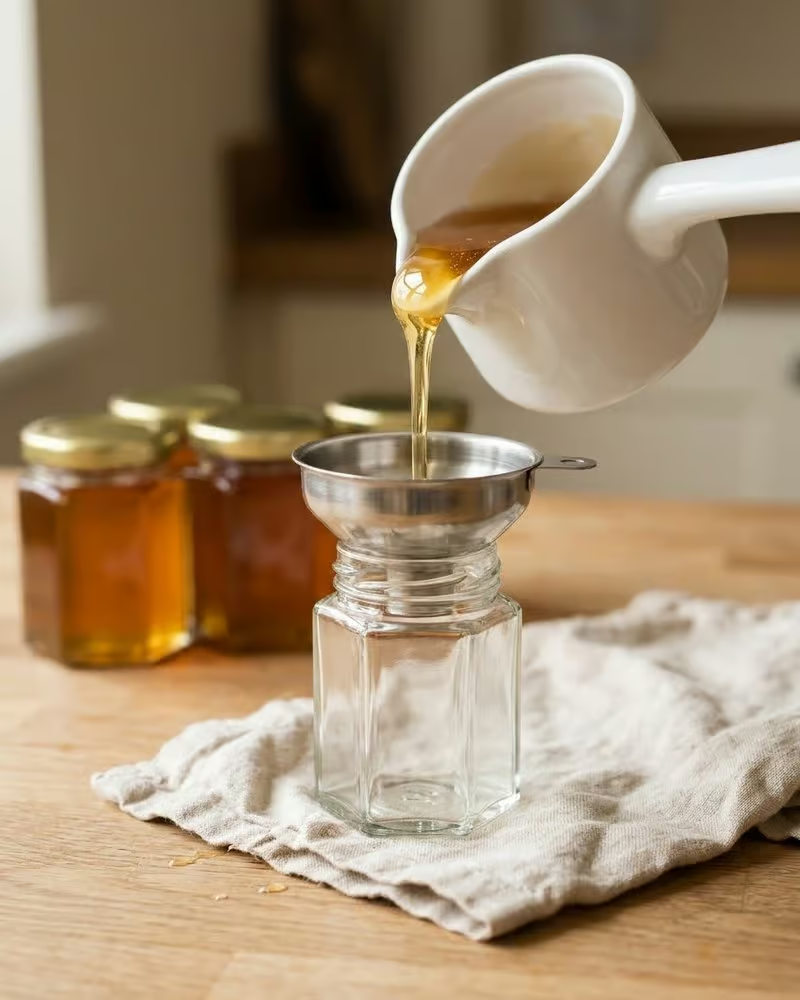
Favours from a few full jars. The small hexagons were filled the week before; the 280 g jar beside them is the one they came from.
礼品
迷你蜂蜜罐:伴手礼、圣诞袜小礼物和餐桌摆设,完美呈现
A mini jar of honey is the favour everyone likes and almost nobody does well: the honey is anonymous, the jar is half empty by the time it reaches the table, and the label says nothing a guest would want to know. This is the guide to doing it properly, whether you fill small jars yourself from a few full ones, buy whole jars and dress them, or put a single 280 g jar at each place. It also covers the one legal line that matters, which is the difference between giving honey away and selling it. We sell one size only, a 280 g jar (about 200 ml); the small jars in this guide are plain ones you fill yourself.
- For 30 to 60 favours, fill 30 ml hexagonal jars yourself from full jars: one 280 g jar fills six, with a funnel and ten minutes.
- For a place setting, use a whole jar with a name tag; it doubles as the favour and looks better than anything smaller.
- For a stocking, a full jar of a honey the person has never tasted beats three minis of one they have.
- If you give honey away you can label it how you like; if you sell it, even once, honey labelling law and food business registration apply.
SizesFilling your ownGift or tradeFavours, places, stockingsWhich honeyDressing the jar问题
What a mini jar actually holds
Jar suppliers sell by millilitres and honey is sold by grams, which is where the confusion starts. Honey is about 1.4 times as dense as water, so a 30 ml jar holds about 42 g of honey filled to the shoulder, and a 280 g jar is roughly 200 ml. The table below is what we use when a bride, a teacher or a corporate buyer asks how many jars to order.
| Jar | Honey it holds | Servings | Filled from one 280 g jar | Best use |
|---|---|---|---|---|
| Hexagon, 30 ml (the classic favour) | About 42 g | 2 teaspoons, or one generous slice of toast | 6 | Wedding favours, 40 guests and over |
| Hexagon or round, 45 ml | About 60 g | 3 to 4 teaspoons | 4 | Favours for smaller weddings, party bags for adults |
| Round, 110 ml | About 150 g | A week of porridge for one | Nearly 2 | Teacher gifts, Secret Santa, place settings on a budget |
| Our jar, 280 g | 280 g | About 14 tablespoons | It is the jar | Place settings, stocking fillers, the favour people keep |
Two practical consequences. A 30 ml favour is a taste, not a supply, so the honey inside has to be one worth tasting: a single-origin jar with a flavour the guest will notice, not a blend that could be anything. And filling to the shoulder matters, because honey settles and a jar filled to the lid line on Thursday looks short by Saturday.
Filling your own mini jars from full ones
This is the part most favour guides skip, and it is where favours go wrong: cloudy jars, lids that leak in a handbag, honey that has set hard by the wedding. Six steps, done once, a week ahead.
- Wash the jars and lids in hot soapy water, rinse, and dry them completely in a low oven or on a rack overnight. Any water left in the jar dilutes the honey where it sits, and honey above about 20 percent moisture can ferment; UK law caps honey at 20 percent for that reason (《2015年蜂蜜(英格兰)条例》,附表1). Our guide to 蜂蜜的水分含量 explains the number.
- Stand the full jars, lids loosened, in a bowl of warm tap water for 20 minutes so the honey pours; never a microwave or a boiling pan, which cooks a raw honey. Softening crystallised honey covers the gentle method if a jar has set.
- Use a small funnel or a jug with a lip and pour slowly to the jar’s shoulder, not the lid line. Wipe the thread with a dry cloth before the lid goes on; one drip on the thread is a sticky handbag later.
- Tighten lids by hand only. Leave the filled jars upright, uncovered, for an hour so air bubbles rise, then top up any that have settled.
- Store at room temperature in a dark cupboard, never the fridge. Honey crystallises fastest around 14 degrees, which is why cellars and cold spare rooms turn runny favours solid in a fortnight; a 2023 study of creamed honey found the smallest crystals formed at exactly that temperature and that cold is the single biggest factor (Meixner and colleagues, Foods, 2023). A warm kitchen cupboard keeps a runny honey runny for the weeks that matter.
- Tag and dress the jars the day before, not the week before: paper tags curl and twine loosens in a damp room. Transport upright in the box the empty jars came in.
If you are decanting a set honey, warm it only enough to spoon, fill the jars with a teaspoon and leave the surface rough; a 软磨蜂蜜 is in fact the easiest favour to transport because it cannot leak, and it holds a fingerprint of a bee stamp on the surface, which guests notice. The science of set honey explains why some jars set in weeks and others take a year.
Gift or trade: the one legal line
Honey you give away at your own wedding, hand to a teacher or tuck into a stocking is a gift, and you may label it as you please; a best-before date copied from the original jar and a “not for babies under one” line are the two things we would add. The moment honey is sold, or supplied regularly to the public even for free, the picture changes. The Food Standards Agency says that “if you supply food regularly, for free or otherwise, to the public, then you need to register as a food business”, at least 28 days before trading, and that “Registration of your food business is free and can’t be refused” (FSA, Starting a food business). Honey sold to a final consumer must also carry the name “honey”, the weight and the country of harvest: “No person may trade in honey unless the country of origin where the honey has been harvested is indicated on the label” (Honey (England) Regulations 2015, regulation 17). So a decanted favour for your own guests is fine; a stall of mini jars at the school fair is a food business, and the label is doing legal work.
The simplest way round all of it, for anyone ordering in volume, is to give whole jars that already carry a compliant label. Our 企业馈赠页面 handles orders for teams and clients, and 批发 covers anyone who intends to resell.
Favours, place settings and stockings
Wedding favours
Order jars two months out and honey three weeks out. Fill a week before, dress the day before. Count the children separately: they will take two.
Display them in a shallow crate or on a tiered stand by the exit, not at each place, so guests take them on the way out and the tables stay clear. Have a card that names the honey and where it came from; a favour with a story is the one that gets eaten rather than left in a drawer.
Place settings
A full 280 g jar at each place, name tag tied around the neck, does three jobs: it is the place card, the favour and part of the table. Tie a sprig of rosemary or a bay leaf under the twine and leave the menu card against it.
For a wedding breakfast, choose a honey that works with the toast course and the cheese board, and give the bar the recipe for our Bee Sting honey cocktail. Guests pour from their own jar.
Stocking fillers
A mini jar in a stocking is a tease. A full jar of a honey the person has never tasted is a present, and it is the size our customers come back for. For someone who already loves honey, the 探索三重奏 gives three jars to taste against each other.
Minis do have a Christmas job: three different varietals in 30 ml jars, labelled, as a tasting flight for a honey lover who has a favourite and has not met the others.
What we have learned from the orders
We have supplied honey for weddings from twenty guests to two hundred, for teachers at the end of term and for offices at Christmas, and the pattern is the same each time. The favours that get eaten are the ones with a card: which flowers, which county, which family. The favours that get left are plain gold lids with a sticker that says “love is sweet”. People will carry a jar home from a wedding if they know what is in it.
In our family the end-of-year gift was never a mini jar. My grandfather filled a full jar from the autumn harvest for the teacher, the priest and the postman, each one with the year written on the lid in pencil, and those jars were kept and brought back empty for the next year. A jar that comes back is the whole point of a good favour.
Which honey for a favour
A favour is tasted once, from a teaspoon, by someone who may never have had a honey that was not a supermarket blend. It should be unmistakably good and unmistakably itself. We fill favours with British wildflower honey: Midlands wildflower, raw and unpasteurised, delicate and floral with a grassy edge, and different from harvest to harvest because the batches are kept apart. It is the honey most people mean when they say they like honey, done properly, and it pours clean when fresh. Three jars at a time in the wildflower stock-up pack fill eighteen 30 ml favours.
For a winter wedding or a stocking for someone who likes strong flavours, 石南花蜂蜜 is the one guests talk about: dark, almost smoky, with a jelly-like texture that stands up in the jar and never leaks. For a clear jar that will sit on a sunny table for a day and must look bright all afternoon, 金合欢蜜 is the pale one that is slow to crystallise. A tasting flight of all three is the 英国蜂蜜套装 with soft set in place of acacia, or the 探索三重奏. Our older guides to honey gifts in the UK 和 artisan honey gift boxes go further on pairing a honey to a person.
The jar behind the favours
British wildflower honey, raw and single-origin from the Midlands. Our British honey supplier holds SALSA Certification. It is the jar we fill favours from, the jar we put at a place setting, and the first jar in most of our 蜂蜜礼品套装, including the six-jar 完整系列 for a household that will taste its way through them. Every jar is 280 g. Free UK delivery on 3 or more jars on any order type, standard delivery 2 to 5 working days, returns within 30 days unopened; 55 Google reviews at 4.9 stars. The whole range is in 这家店, ,以及一个 订阅费 keeps a gift going after Christmas.
野花蜂蜜 Gift setsDressing the jar
Glass, not plastic: honey in a plastic pot looks like a hotel breakfast. Hexagonal jars photograph better than round ones and stack in a crate without rolling. Gold or black lids both work; avoid white, which shows the first fingerprint. A square of fabric under the lid band is traditional and collects dust; a kraft tag on natural twine is cleaner and carries the information that matters: the honey, where it came from, the date, and a line for babies under one. Wooden dippers are charming and useless for a 30 ml jar; a tiny spoon tied to the neck gets used. Write the date on the tag: honey keeps very well and remains safe to eat well beyond its best-before date, so a dated jar is a gift that does not nag.
If the jars will sit on a table in a warm marquee, expect runny honey to thin and set honey to soften slightly; neither is a fault. If they will sit in a cold church porch for an afternoon, expect a runny honey to start clouding within a week afterwards, which is the crystallisation from the study above and is reversible in warm water. Our short guide to 结晶蜜 is the one to point guests to if they ask.
问题
How much honey do I need for 60 favours?
In 30 ml hexagons, 60 favours take about 2.5 kg of honey, which is ten 280 g jars with a little over for topping up. In 45 ml jars, allow fifteen jars. Order one spare jar in ten; a dropped jar the night before is not the moment to find out.
Can I fill the jars months ahead?
You can, but a runny honey filled in September may have set by a December wedding, especially in a cold storeroom. Fill a week or two ahead and keep the jars in a warm cupboard; if they do set, stand them in warm water for 20 minutes the day before.
Do I need a food hygiene certificate to make favours?
Not for your own wedding or for gifts: that is not trading. Selling the jars, or supplying them regularly to the public, makes you a food business and you must register with your local authority at least 28 days beforehand; registration is free.
Is it cheaper to fill my own or buy ready-filled minis?
Filling your own is usually cheaper per favour and lets you choose the honey, which is the point. Ready-filled minis save an evening and come labelled; the trade-off is that you rarely know what honey is inside. For fewer than twenty, buy whole jars and skip the minis.
What do I do with leftover favours?
Eat them, or decant them back into a clean full jar. Honey does not spoil in the cupboard; set favours are simply honey that has crystallised and are fine on toast as they are.