

 Français
  English (UK)
  Italiano
  简体中文
简体中文  한국어
한국어 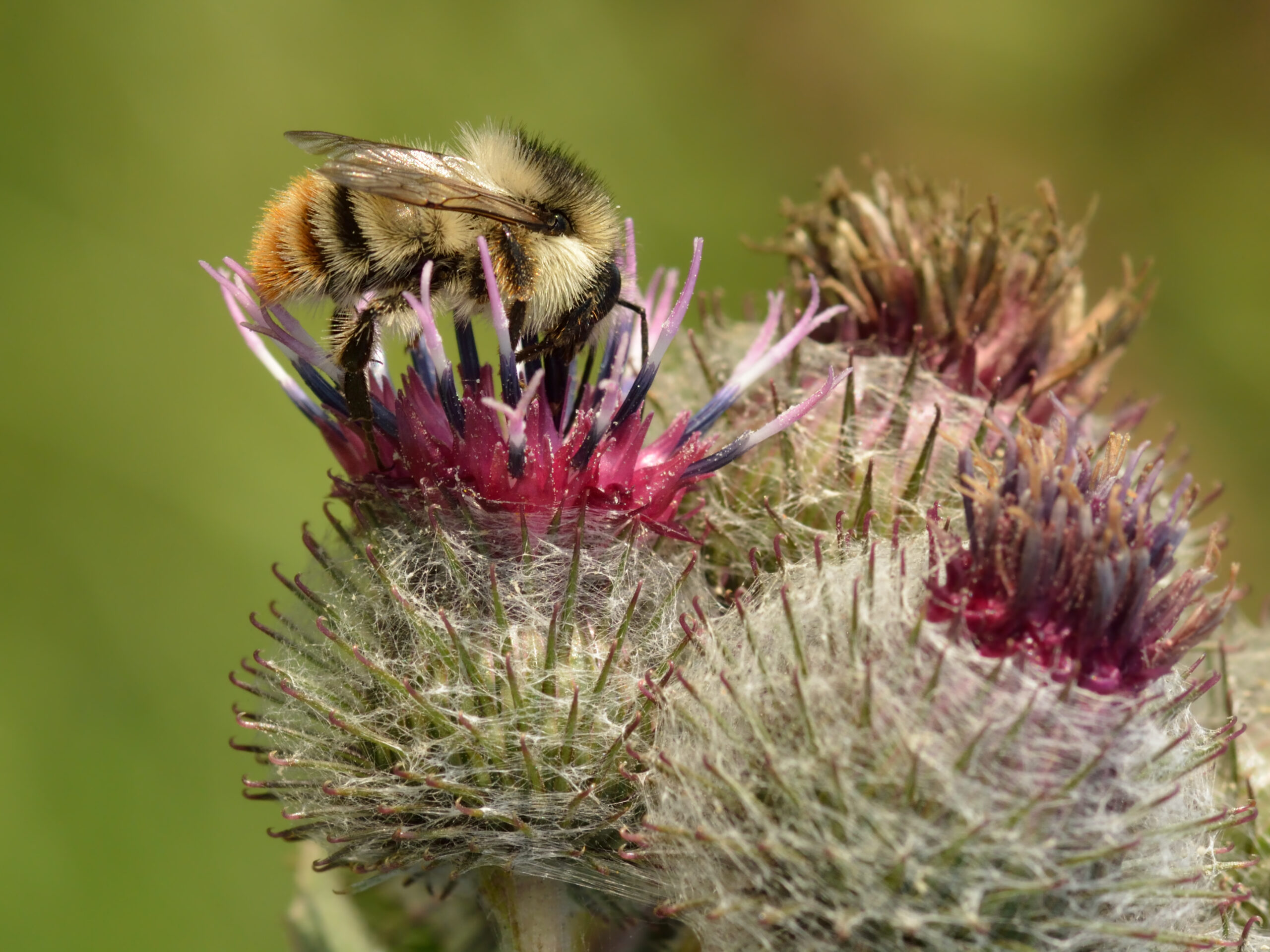
Ivar Leidus, CC BY-SA 4.0, via Wikimedia Commons
Shrill Carder Bee
Bombus sylvarum
Linnaeus, 1761 • Apidae • Thoracobombus
The shrill carder bee is one of the rarest and most threatened bumblebees in Britain. It takes its name from the unusually high-pitched buzz of its flight, distinctly shriller than other British bumblebees and audible before the bee comes into view. Bombus sylvarum Linnaeus, 1761 is a pale, greyish-green bee with a broad black band between the wings, an orange tail, and a delicate hovering flight style unlike any other British bumblebee. Once widespread across southern England, Wales and Ireland, it has undergone a catastrophic decline since the 1950s and now survives in only five isolated population areas in England and Wales. The Back from the Brink partnership programme led by the Bumblebee Conservation Trust is actively working to prevent its extinction. Understanding this bee, and what it needs to survive, matters: it is a flagship species for the restoration of flower-rich grassland across the British lowlands. Explore its remaining range on the UK Native Bee Species Map or read about carder bees worldwide in the World Bee Atlas.
Quick Facts
Taxonomy and Classification
The shrill carder bee was described by Carl Linnaeus in 1761. It belongs to the subgenus Thoracobombus, the carder bees, alongside the common carder bee (B. pascuorum), the moss carder bee (B. muscorum) and the brown-banded carder bee (B. humilis). The species name sylvarum is Latin for "of woods," though the bee is not primarily a woodland species; the name may reflect a collection locality rather than habitat preference.[1]
A very rare melanic form, f. nigrescens, was recorded a few times in East Sussex in the 1920s and reported again from Dungeness and Deal in 2011.[1] The shrill carder bee is also sometimes called the knapweed carder bee, reflecting its strong foraging association with knapweed and thistles.
| Kingdom | Animalia |
| Phylum | Arthropoda |
| Class | Insecta |
| Order | Hymenoptera |
| Family | Apidae |
| Tribe | Bombini |
| Genus | Bombus Latreille, 1802 |
| Subgenus | Thoracobombus Dalla Torre, 1880 |
| Species | Bombus sylvarum Linnaeus, 1761 |
Identification: The Shrill Buzz and the Hovering Flight
The shrill carder bee is one of Britain's most distinctive bumblebees once learned, but it requires attention because its colouring is more muted than most other species. It is overall pale, with a greyish or greyish-yellow tinge to the hair; a broad, clearly defined band of black hairs between the wings on the thorax; ill-defined darker bands on the abdomen; and a dull orange-yellow tail.[2] Queens are among the smaller British bumblebee queens at around 16 mm. Workers are often very small, sometimes as small as 8 to 10 mm, smaller than many other British bumblebee workers.
Two features set it apart even at a distance. The buzz is distinctly higher-pitched than other British bumblebees, a difference perceptible in the field once you know what to listen for. And the flight is different: workers move between flowers with a delicate, hovering quality quite unlike the more direct flight of larger species, described repeatedly in field guides as "dainty" or "dancing."[3]
Five Sites: The Catastrophic Decline
The scale of the shrill carder bee's decline in Britain is difficult to overstate. It was formerly locally frequent across much of England south and east of the Severn-Wash line, across coastal Wales and Ireland, with occasional records from southern Scotland. From the 1950s and 1960s onward, as agricultural intensification swept through the lowland landscape, the species retreated rapidly.[6] It was last recorded in Devon in 1978 and declared absent from Cornwall in 2005.[1]
The Bumblebee Working Group estimated a 75% decline in the species between the periods 1970 to 1990 and 1990 to 2001 alone.[4] By 1999 only seven population areas remained; by the mid-2020s the Bumblebee Conservation Trust recognised five. These are: the Thames Estuary (Essex and Kent sea-wall grasslands, brownfield sites, and grazing marshes, considered the largest surviving metapopulation); Somerset (levels and moors); the Gwent Levels in south Wales; Kenfig and Port Talbot on the South Wales coast; and south Pembrokeshire. At least two of these populations are considered to be worryingly low and declining.[5]
Thames Estuary, Somerset Levels, Gwent Levels, Kenfig–Port Talbot, and south Pembrokeshire. These are the only confirmed locations in England and Wales where the shrill carder bee persists. The Thames Estuary population, centred on sea-wall and grazing-marsh grasslands in Essex and Kent, is thought to be the largest.
Habitat: What the Shrill Carder Bee Needs
The shrill carder bee is a species of flower-rich lowland grassland, and its requirements are specific enough to explain both its former distribution and its current restricted range. It needs: a diverse sward with abundant legumes (particularly clovers, vetches, bird's-foot trefoil and red bartsia) and composites (knapweeds, thistles, scabiouses); tussocky grass structure for above-ground nesting; and a season-long succession of flowers from late May through to October, which is unusually late for a British bumblebee and requires sources that persist after most summer blossom has finished.[2]
The habitats where it persists are unimproved flood-defence grasslands, sea-wall meadows, grazing marshes, sand dunes, coastal levels and brownfield sites: places that have never been fertilised, reseeded or subjected to repeated early cutting, and therefore retain the botanical diversity the species requires. It is a flagship for the restoration of this kind of grassland, and conservation work for the shrill carder bee directly benefits dozens of other invertebrate species that share the same habitat requirements.[5]
A late colony: queens from May, workers to October
The shrill carder bee has an unusually late and long flight season for its size. Queens typically emerge from hibernation in late May or June, considerably later than most other British bumblebees. Workers remain active until October. This extended late-season presence makes it dependent on sources of late-summer and autumn forage that most grassland management regimes eliminate with August cuts.[3]
Foraging: Legumes, Knapweeds and Late Flowers
The shrill carder bee is a long-tongued species within Thoracobombus, enabling it to access longer corolla tubes. BWARS records a strong preference for legumes, particularly clovers (Trifolium spp.), melilots, vetches and everlasting-pea, alongside red bartsia (Odontites vernus), woundworts, thistles, knapweeds, scabiouses and various composites.[1] In its remaining sites, red clover is particularly important for workers and late-season individuals. Spring queens forage on dead-nettles, sallows and early legumes before founding a colony.
The late emergence of the colony and the October activity of workers mean the species is heavily dependent on late-season composites: devil's-bit scabious, field scabious, knapweed and late-flowering thistles and clovers that persist after most other bumblebee colonies have concluded. Management that cuts hay or mows meadows in August before these plants have set seed removes both the foraging resource and the structural habitat, and is considered one of the most damaging single management actions for the species.
Conservation: Back from the Brink
The shrill carder bee is the subject of a dedicated conservation strategy published by the Bumblebee Conservation Trust in 2024, developed as part of the Back from the Brink partnership programme funded by the National Lottery Heritage Fund. Partners include BWARS, Buglife, Natural Resources Wales, RSPB and Natural England.[5] The strategy identifies habitat restoration at landscape scale as the priority: not individual site management, but the creation of connected networks of flower-rich grassland that allow populations to expand and exchange individuals between sites.
Specific recommendations include: delayed cutting of grasslands within and around known sites; restoration of late-cutting hay meadow management (cutting after September rather than August); creation of new flower-rich grassland along linear habitat corridors including road verges, river banks and field margins; and agri-environment scheme uptake in landscapes around the five surviving populations.[5]
Is the shrill carder bee stable or declining in its remaining sites?
The Bumblebee Conservation Trust's 2024 Species Knowledge Review states that at least two of the five surviving population areas are "worryingly low and appear to be declining," while others show more stability or slight increase in response to conservation management.[5] IUCN lists the species as Least Concern at the European level, reflecting its wider continental range (where it is more common in central Europe), but this contrasts sharply with the critically threatened status it holds in Britain. The British population should be treated as distinct in conservation terms from the continental population.
Rare Bees and Raw Honey
The shrill carder bee makes no honey. What it does is pollinate, in habitats so botanically rich that the plants it visits connect the same ecological web that honeybee colonies depend on. While the shrill carder bee works legumes and composites in its five surviving grassland sites, our honeybee colonies work linden and acacia forests in Transylvania, collecting pollen and nectar from landscapes managed with care across six generations of family beekeeping.
Our Acacia Honey is the clearest expression of that work: pale, mild, slow to crystallise, gathered from the black locust forests of the Nistor family apiaries in Transylvania. If you want to explore the full range of what the Nistor family apiaries produce across the season, the Discovery Trio brings Acacia, Wildflower and Heather together in one gift.
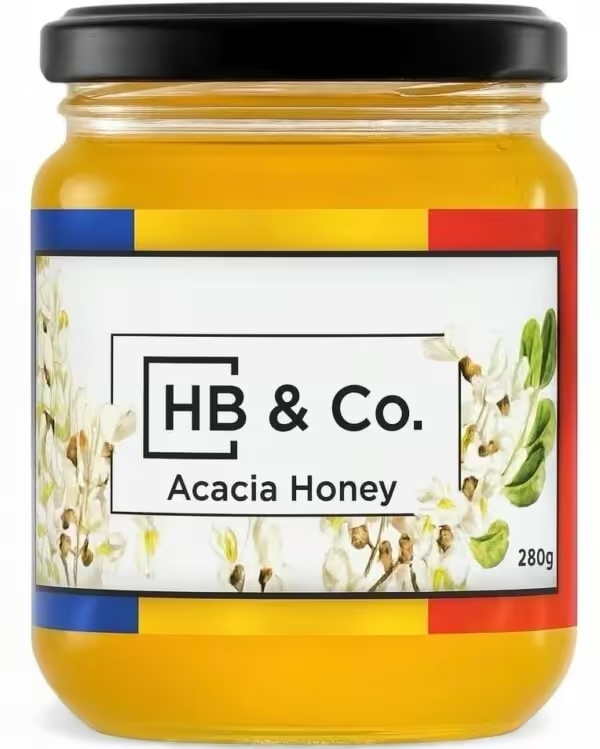
Pale, mild and slow to crystallise. Raw Transylvanian acacia honey from six generations of family beekeeping in the Nistor family apiaries. Cold-extracted. 280g.
Acacia, Wildflower and Heather in one box. Three of our most distinct raw honeys, 280g each.
Shop Discovery Trio
Raw single-origin honey every month. Acacia, Wildflower, Heather and more. From £8.79/month.
Start SubscriptionFrequently Asked Questions
How do I identify a shrill carder bee?
Listen first: the buzz is distinctly higher-pitched and shriller than any other British bumblebee. The bee itself is pale and greyish overall, with a broad band of black hairs between the wings, ill-defined darker banding on the abdomen, and a dull orange-yellow tail. Workers are very small, often 8 to 10 mm. The flight style is delicate and hovering compared with most bumblebees. If you are in one of the five known UK population areas and you hear a high-pitched buzz in a flower-rich grassland from June onwards, examine the bee carefully.
Where can I find shrill carder bees in the UK?
In five isolated population areas only: the Thames Estuary (Essex and Kent sea-wall grasslands and brownfield sites), Somerset Levels, Gwent Levels (south Wales), Kenfig and Port Talbot (South Wales coast), and south Pembrokeshire. It is absent from the rest of Britain. If you find a probable shrill carder bee outside these areas, record it immediately via iRecord or BWARS and contact the Bumblebee Conservation Trust, as any new records are of genuine conservation significance.
Why has the shrill carder bee declined so severely?
The primary cause is loss of flower-rich lowland grassland through agricultural intensification since the 1950s: reseeding, fertiliser application, drainage, and early cutting regimes that eliminate the botanical diversity the species needs. It requires a specific combination of legumes for foraging, tussocky structure for nesting, and a season-long flower succession from late May to October that includes late-summer composites. Intensified grassland provides none of these. The 75% decline estimated between 1970 and 2001 reflects the speed at which suitable habitat was eliminated.
What is the Back from the Brink programme?
Back from the Brink is a National Lottery Heritage Fund partnership programme focused on England's most threatened species. The Bumblebee Conservation Trust leads the shrill carder bee strand, working with BWARS, Buglife, Natural Resources Wales, RSPB and Natural England to develop and implement a landscape-scale conservation strategy. The programme focuses on habitat restoration, management advice for landowners, and expanding the network of suitable grassland around the five surviving population areas.
How can I help the shrill carder bee?
If you own or manage land near any of the five surviving population areas, consider delaying grassland cuts until after September, restoring flower-rich swards, and planting late-flowering composites and legumes such as red clover, knapweed and devil's-bit scabious. Support the Bumblebee Conservation Trust and Buglife conservation programmes. Record any sightings via BWARS or iRecord. The species' survival depends on landscape-scale habitat connectivity, which requires many landowners acting together.
Is the shrill carder bee extinct in Ireland?
It was formerly present in coastal parts of Ireland but has not been reliably recorded there in recent decades and is considered effectively extinct in Ireland. The Irish records came primarily from coastal grassland habitats that have since been degraded or lost. Its current Irish status is Regionally Extinct according to the National Biodiversity Data Centre.
Does the shrill carder bee make honey?
No. Like all bumblebees, colonies store only a few days' supply of nectar. There is no surplus and nothing to harvest. All commercial honey comes from managed honeybee (Apis mellifera) colonies.
Why is it called the knapweed carder bee?
Because of its strong association with knapweed (Centaurea spp.) and related composites as a foraging plant. The alternative common name knapweed carder bee reflects both the importance of knapweed in the diet and the carder behaviour of gathering moss and plant fibres for nest construction, shared with the other carder bees in subgenus Thoracobombus.
Sources and References
- Bees, Wasps and Ants Recording Society (BWARS). Bombus sylvarum Linnaeus, 1761: species account, distribution history, melanic form, decline, synonymy. bwars.com
- Buglife. Shrill Carder Bee (Bombus sylvarum): identification, habitat, UK distribution, conservation status. buglife.org.uk
- Bumblebee Conservation Trust. Shrill carder bee: species profile, flight season, hovering flight, foraging. bumblebeeconservation.org
- Edwards, M. (2001, in Benton, T. 2006). Bumblebee Working Group decline estimates: 75% decline of B. sylvarum between 1970–1990 and 1990–2001. Cited in: Bumblebee Conservation Trust (2024), Species Knowledge Review: Shrill carder bee in England and Wales. bumblebeeconservation.org
- Bumblebee Conservation Trust (2024). A Conservation Strategy for the Shrill Carder Bee (Bombus sylvarum). Back from the Brink / National Lottery Heritage Fund. Five surviving populations, landscape-scale strategy, management recommendations. bumblebeeconservation.org
- Powney, G. D. et al. (2019). Widespread losses of pollinating insects in Britain. Nature Communications 10:1018. doi.org