

 Français
  English (UK)
  Italiano
  简体中文
简体中文  한국어
한국어 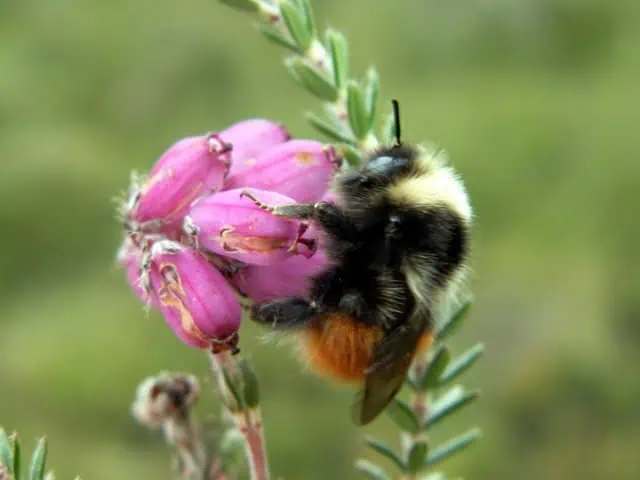
John Fielding, CC BY-SA 2.0, via Geograph / Wikimedia Commons
Bilberry Bumblebee
Bombus monticola
Smith, 1849 • Apidae • Pyrobombus
High on a Welsh hillside in late April, where bilberry bushes spread low across rocky ground between patches of bent grass and early heather, one of Britain's most striking bees is foraging. The bilberry bumblebee is small, compact, and brilliantly coloured: a bright lemon-yellow collar, a yellow band where the thorax meets the abdomen, and an orange-red tail covering the back half of the body. Bombus monticola Smith, 1849 is a boreo-alpine specialist, a bee of upland moors, mountain slopes and heather-and-bilberry habitats that stretch from Dartmoor to Shetland. It is declining, dependent on a narrow range of plants and a specific type of open moorland landscape, and one of the species most directly threatened by climate change in Britain. See where it is recorded on the UK Native Bee Species Map or explore its close relatives in the World Bee Atlas.
Quick Facts
Taxonomy and Classification
The bilberry bumblebee was described by Frederick Smith in 1849 from British material. It belongs to the subgenus Pyrobombus, a grouping of small to medium-sized bumblebees with a predominantly northern and montane distribution; its closest British relative is the early bumblebee (Bombus pratorum), which shares the same subgenus and also has an orange-red tail.[1] For much of the twentieth century, British specimens were confused with Bombus lapponicus (Fabricius, 1793), a closely related Scandinavian and Arctic species. Svensson (1979) separated the two taxa conclusively on the basis of male morphology and distribution.[2]
Two subspecies are recognised: B. monticola monticola (the nominate form found across the Palearctic range) and B. monticola scoticus Pittioni, 1942, described from Scottish material, which tends to show more extensive yellow colouration on the abdomen.[7] The species is entirely absent from Ireland as a native, having colonised naturally only in the 1970s and remaining restricted to a few upland sites in the north and east.
| Kingdom | Animalia |
| Phylum | Arthropoda |
| Class | Insecta |
| Order | Hymenoptera |
| Family | Apidae |
| Tribe | Bombini |
| Genus | Bombus Latreille, 1802 |
| Subgenus | Pyrobombus Dalla Torre, 1880 |
| Species | Bombus monticola Smith, 1849 |
| Subspecies | B. m. monticola; B. m. scoticus Pittioni, 1942 |
Identification
The bilberry bumblebee is one of the most distinctively coloured British bumblebees and, in its upland habitat, one of the easiest to identify. The key features are: a bright lemon-yellow collar on the front of the thorax; a narrow yellow band at the junction of the thorax and abdomen (on the scutellum edge); and an extensive orange-red abdomen covering at least the last two-thirds, from the second or third tergite to the tip.[3] The final tergite (the tail tip) is dark. Queens are the largest caste at 15 to 17 mm, compact in build with a broad head. Workers are 10 to 12 mm. Males are around 14 mm, with a conspicuously yellow-haired head that distinguishes them immediately from queens and workers.
Separation from similar species
Three other British bumblebees have orange or red tails: the red-tailed bumblebee (Bombus lapidarius), the early bumblebee (Bombus pratorum), and the male of the forest cuckoo bumblebee (Bombus sylvestris). The red-tailed bumblebee is larger, jet-black except for a vivid red tail, with no yellow on the thorax in workers and queens. The early bumblebee is smaller, with a more limited orange tail covering only the last two tergites and a much shorter colony season. B. sylvestris males can have an extensively red abdomen but have a very different build, with a larger and more box-shaped head, sparser fur, and unmodified hind legs characteristic of cuckoo bees.[3]
Habitat: The Upland Mosaic
The bilberry bumblebee is found almost exclusively in upland areas, typically above 300 metres, across northern and western Britain.[4] Its major British strongholds are the Scottish Highlands and Southern Uplands, the Welsh uplands, the Peak District, the North Pennines, the North York Moors, Dartmoor, and Exmoor. BWARS notes occasional sea-level records from northern England and Scotland, and males have been found on the Norfolk coast, possibly as Scandinavian vagrants.
The habitat it requires is not simply moorland but a mosaic: open heather moorland with bilberry-rich areas, adjacent flower-rich grassland or woodland edge providing additional foraging resources, and sallow or willow scrub for queen forage in early spring.[1] Landscapes that have been simplified by agricultural intensification at lower altitudes or by over-grazing or burning on the moor itself provide insufficient foraging diversity for a complete colony cycle. This mosaic requirement, more than any single plant, defines the habitat the species depends on.
BWARS records the bilberry bumblebee as having colonies of fewer than 50 workers, with a lifecycle of only 3 to 4 months. This is among the smallest and shortest colony cycles of any British bumblebee, making it more vulnerable than larger-colony species to single-season failures in forage availability.
The Bilberry Plant: Why One Species Defines the Bee
Bilberry (Vaccinium myrtillus), known as blaeberry in Scotland, is central to the ecology of this bumblebee at two critical points in the colony cycle. In spring, newly emerged queens feed heavily on bilberry flowers as one of their primary early pollen sources, alongside sallow catkins.[1] Bilberry provides pollen of high nutritional quality at a time when few other upland plants are in flower, and queens that cannot find sufficient bilberry may fail to found a colony successfully.
In mid to late summer, all castes return to bilberry: workers and males forage on bilberry fruit and late flowers alongside bell heather (Erica cinerea), which provides the principal late-season pollen source before the colony concludes. The species' formal common name in Scotland, the blaeberry bumblebee, reflects how strongly this association is perceived by naturalists and hill walkers in the uplands.
Bilberry is itself a heathland specialist, requiring well-drained, acidic soils and open, unshaded conditions. It declines with bracken encroachment, afforestation, over-grazing (which prevents establishment), and nitrogen deposition from atmospheric pollution, which shifts the competitive balance away from ericaceous plants. The fate of the bilberry bumblebee is therefore tied to the fate of bilberry, which is in turn tied to the fate of well-managed upland heath.[5]
Foraging Through the Season
Despite its association with bilberry, the bilberry bumblebee is polylectic and uses a range of plants through the season. BWARS records the following seasonal pattern: spring queens favour bilberry and sallow; early summer workers visit bird's-foot trefoil, clovers, raspberry, bramble, and self-heal; and mid to late summer workers and males concentrate on bell heather, bilberry, and later on devil's-bit scabious, cinquefoils, and thistles.[1]
The species has a short tongue, consistent with its subgenus Pyrobombus, and forages most effectively on open-structured flowers. It does not appear to nectar rob systematically in the way that B. lucorum and B. terrestris do, because the heathland flowers it visits are generally not deeply tubular. Water avens (Geum rivale) is recorded as a particular favourite for spring queens, an early-flowering upland plant often found at moorland edges and stream sides where the bee's territory meets rough grassland.
Decline, Threats and Climate Change
The bilberry bumblebee is declining in Britain. BWARS records a marked contraction in distribution throughout its former range, with losses particularly evident in southern England, where it formerly occurred on the higher Weald of Surrey, and in some Welsh upland sites.[1] Buglife describes it as a localised and declining species. It appears on the Scottish Biodiversity List as a species of conservation concern.
The primary long-term threat is climate change. The bilberry bumblebee is a boreo-alpine species, adapted to cool upland conditions. As average temperatures rise, the thermal envelope of suitable habitat contracts upwards; at some point, sufficient elevation simply ceases to exist in Britain's relatively low mountains. A 2019 modelling study of climate change impacts on British bumblebees found the bilberry bumblebee among those facing the most severe projected range contractions by 2080 under high-emissions scenarios.[6]
Habitat degradation compounds the climate threat. Overgrazing by sheep reduces both bilberry cover and the diversity of flowering plants in the upland mosaic. Muirburn (heather burning) managed poorly or too frequently reduces plant diversity and can remove bilberry entirely from a site. Atmospheric nitrogen deposition promotes rank grasses at the expense of heather and bilberry. Each of these pressures independently reduces the habitat value; together they accelerate range loss beyond what climate change alone would predict.[5]
A boreo-alpine distribution under pressure
Boreo-alpine species like the bilberry bumblebee evolved in cold northern and mountain environments and have no warmer refugia to retreat to as temperatures rise. Unlike lowland species that can shift northward, boreo-alpine species can only move upward, and at some point there is no higher ground available. BWARS records marked declines across the southern part of its British range.
Is Bombus sylvestris a confirmed cuckoo parasite?
BWARS states that it is "likely" that the forest cuckoo bumblebee (Bombus sylvestris) parasitises B. monticola, based on geographic overlap and the known host associations of B. sylvestris. However, confirmed nest parasitism has not been documented from British sites with the same rigour as for, say, Bombus vestalis on B. terrestris. The association is considered probable rather than proven, and B. rupestris (hill cuckoo bee) has also been suggested as a possible parasite. The parasitology of the bilberry bumblebee in Britain remains incompletely documented.[1]
Upland Bees and Upland Honey
The bilberry bumblebee and our Yorkshire Heather Honey share an ecosystem. The bee forages across the same upland mosaic of heather, bilberry, clover and late summer wildflowers that honeybee colonies work in August on the Yorkshire Moors. The bilberry bumblebee makes no honey: its small colony stores only enough for a few days. But the landscape that sustains it is the same landscape that produces the boldest honey in our range.
Heather honey has a characteristically strong, slightly bitter, toffee-like flavour unlike any other honey we produce. It thixotropic: it sets firm in the jar and loosens when stirred, a property unique to heather honey caused by high protein content. It is available only once a year, from a single summer harvest. Like the bilberry bumblebee, it belongs to the uplands, and to a season that does not last long.
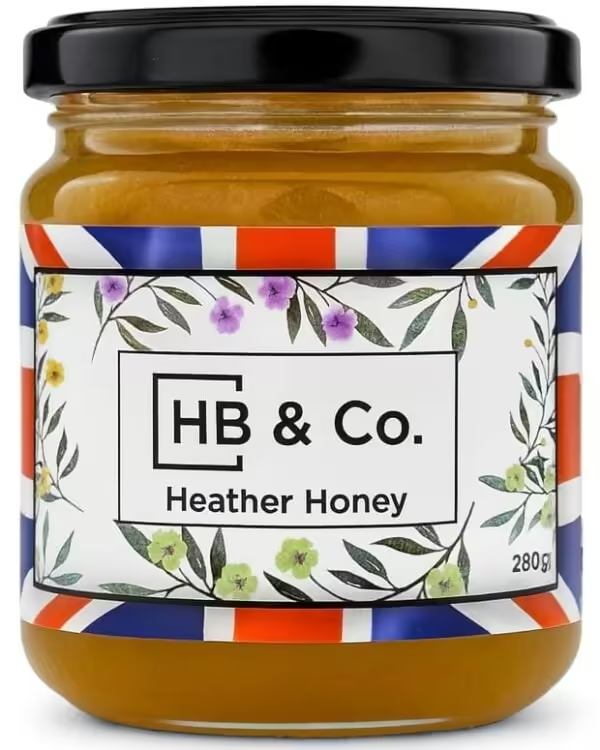
Bold, distinctive and thixotropic. Raw Yorkshire heather honey from the same upland moorland the bilberry bumblebee calls home. One moor, one harvest, one season. 280g.
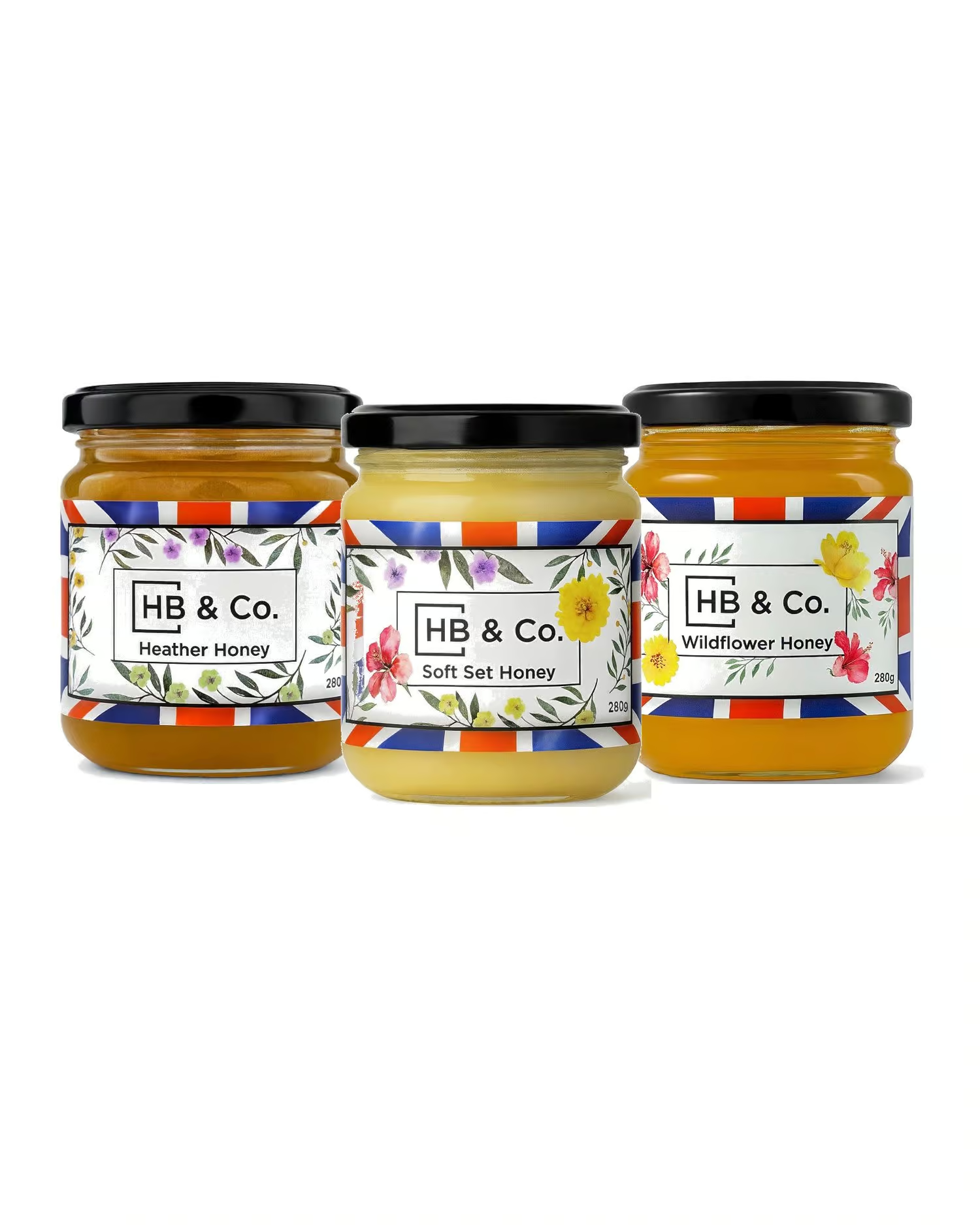
Wildflower, Soft Set and Heather from our SALSA-certified British supplier. Three landscapes, one gift.
Shop British Bundle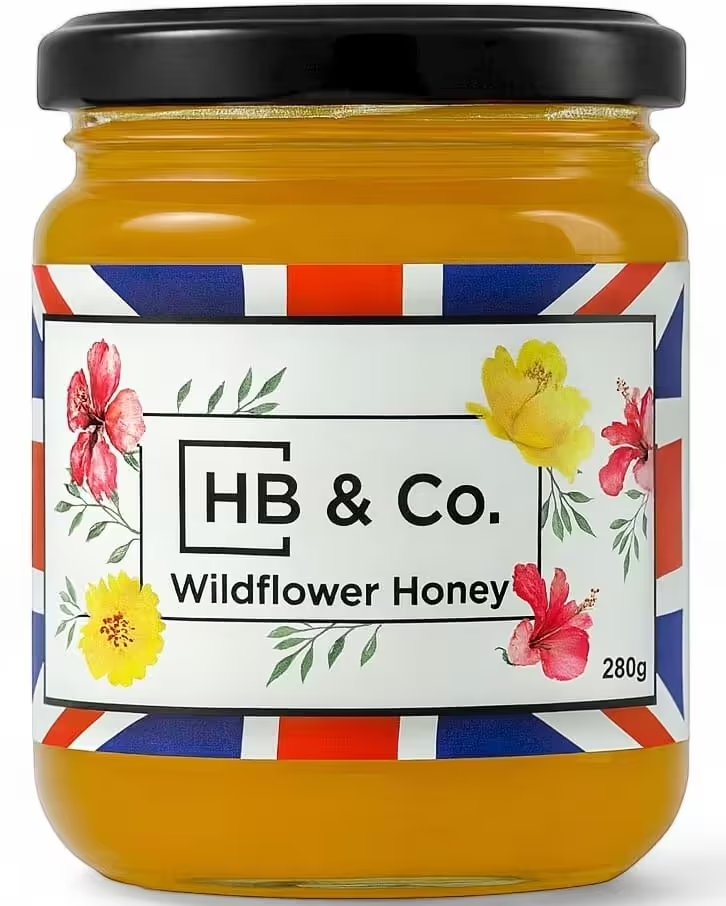
Raw single-origin honey every month. Heather, Wildflower, Acacia and more. From £8.79/month.
Start SubscriptionFrequently Asked Questions
How do I identify a bilberry bumblebee?
Look for a small, compact bumblebee with a bright lemon-yellow collar, a narrow yellow band at the thorax-abdomen junction, and an extensive orange-red abdomen covering at least the back two-thirds of the body. It is noticeably smaller and brighter than the red-tailed bumblebee (B. lapidarius), which is larger and entirely black except for the red tail. Males have yellow hair on the face. In its upland habitat, usually above 300 m, there is little to confuse it with.
Where can I find bilberry bumblebees in the UK?
On upland moorland, usually above 300 metres. Major sites include the Scottish Highlands and Southern Uplands, the Welsh uplands, the Peak District, North Pennines, North York Moors, Dartmoor and Exmoor. It is largely absent from the South East of England. Look for it in late April to August on bilberry, heather, bird's-foot trefoil and late-summer wildflowers in moorland habitats. See the UK Native Bee Species Map for recorded distribution.
Why is it called the bilberry bumblebee?
Because of its strong association with bilberry (Vaccinium myrtillus), a low-growing heathland shrub of upland acidic soils. Spring queens depend heavily on bilberry flowers for pollen at the start of the colony cycle, and all castes return to bilberry in late summer. In Scotland, where bilberry is commonly called blaeberry, the bee is correspondingly known as the blaeberry bumblebee. Its scientific name, monticola, means "mountain dweller."
Is the bilberry bumblebee endangered?
It is not officially listed as endangered in Britain, but it is declining and appears on the Scottish Biodiversity List as a species of conservation concern. It is assessed as Least Concern on the European Red List of Bees, but the British population is contracting at the southern end of its range. Climate change is considered the primary long-term threat, as warming temperatures reduce the extent of suitable cool upland habitat.
How does the bilberry bumblebee colony compare with other bumblebees?
It is one of the smallest and shortest-lived colonies among British bumblebees: fewer than 50 workers and a lifespan of only 3 to 4 months. By comparison, a buff-tailed bumblebee colony can reach 400 workers and last 6 months. The bilberry bumblebee's small colony size and short lifecycle may make it more vulnerable to poor seasons, since a single failure in forage availability can prevent the colony from producing any new queens.
What threatens the bilberry bumblebee?
Several interacting pressures: climate change (reducing the thermal envelope of suitable habitat as temperatures rise), overgrazing by sheep (which prevents bilberry establishment and reduces floral diversity), poorly managed heather burning (which can eliminate bilberry from a site), atmospheric nitrogen deposition (which promotes rank grasses over ericaceous heath plants), and afforestation of upland areas (which shades out open-ground moorland plants). The species requires a habitat mosaic, and the loss of any component can make an otherwise suitable upland site unsuitable.
Does the bilberry bumblebee make honey?
No. Like all bumblebees, colonies store only a small amount of nectar, enough for a few days. There is no surplus and nothing to harvest. All commercial honey comes from managed honeybee (Apis mellifera) colonies.
How can I help the bilberry bumblebee?
Support organisations working on upland habitat management: the Bumblebee Conservation Trust, Buglife's upland habitat projects, and land management bodies promoting bilberry-rich heathland. If you own or manage upland land, avoid over-grazing, manage heather burning carefully, and retain or encourage bilberry cover. Recording sightings via BWARS or iRecord contributes to mapping the species' current distribution, which is actively needed.
Sources and References
- Bees, Wasps and Ants Recording Society (BWARS). Bombus monticola Smith, 1849 species account: identification, distribution, habitat, foraging, decline, probable cuckoo parasite. bwars.com
- Svensson, B. G. (1979). Pyrobombus lapponicus (Fabricius, 1793) and P. monticola (Smith, 1849): type studies and separation. Entomologica Scandinavica 10:37–50. Original taxonomic separation of B. lapponicus from B. monticola. agris.fao.org
- Bumblebee Conservation Trust. Bilberry bumblebee (Bombus monticola): identification, confusion species, habitat. bumblebeeconservation.org
- Buglife. Bilberry Bumblebee (Bombus monticola): distribution, decline, conservation status. buglife.org.uk
- ScotLINK / Scotland's Nature Champions. Bilberry Bumblebee: threats from climate change, overgrazing, heather burning and nitrogen deposition. scotlink.org
- Powney, G. D. et al. (2019). Widespread losses of pollinating insects in Britain. Nature Communications 10:1018. doi.org
- GBIF. Bombus monticola Smith, 1849: occurrence records, taxonomy and subspecies. gbif.org