

 Italiano
  English (UK)
  Français
  简体中文
简体中文  한국어
한국어 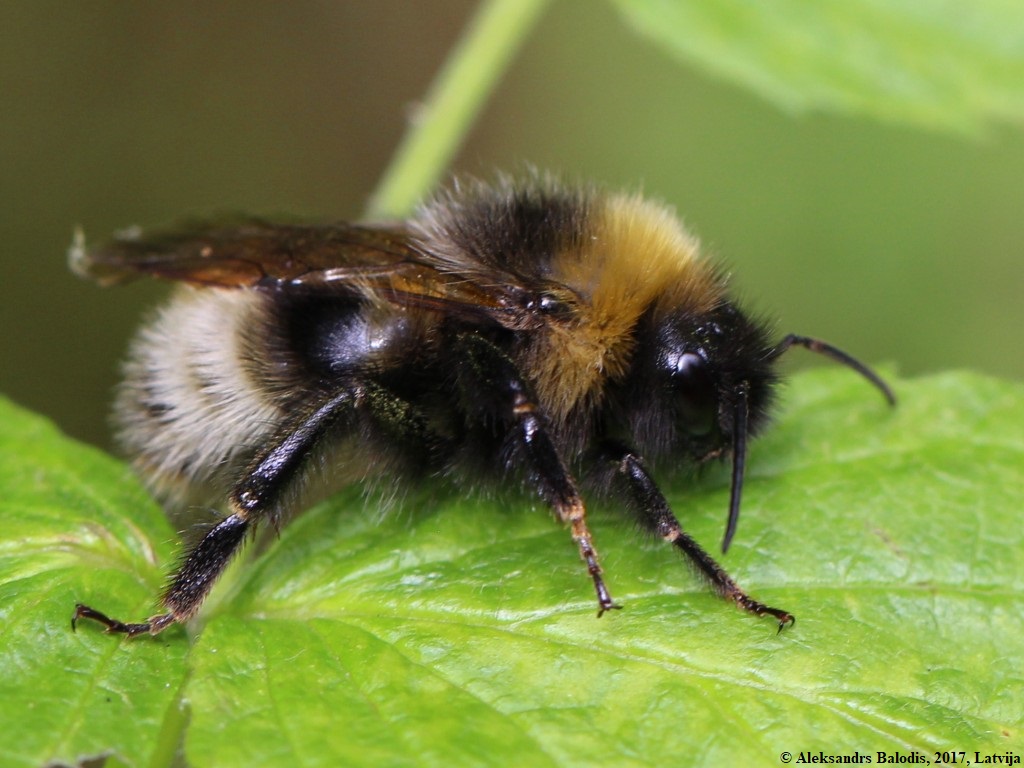
Gypsy Cuckoo Bee
Bombus bohemicus
Seidl, 1837 • Apidae • Psithyrus
The gypsy cuckoo bee makes no nest, raises no workers, collects no pollen and makes no honey. Instead, it invades established colonies of the white-tailed bumblebee complex, suppresses or kills the host queen, and uses the existing workers to raise its own reproductive offspring. Bombus bohemicus Seidl, 1837 is one of six cuckoo bumblebees recorded in Britain, and the one most strongly associated with upland, northern and western habitats, reflecting the distribution of its primary hosts: Bombus lucorum, B. cryptarum and B. magnus. Without workers of its own, it depends entirely on a functioning host colony: if the lucorum complex declines, so does the gypsy cuckoo bee. It is a species that tells you something important about the health of the bumblebee community it lives within. Explore its range on the UK Native Bee Species Map or read about cuckoo bees worldwide in the World Bee Atlas.
Quick Facts
Taxonomy: The Cuckoo Bumblebees
The gypsy cuckoo bee belongs to the subgenus Psithyrus, the cuckoo bumblebees. These were formerly treated as a separate genus until molecular evidence confirmed they are derived from within the bumblebee genus Bombus; they are now treated as a subgenus alongside the social bumblebee subgenera.[1] Six species of Psithyrus are recorded as breeding in Britain:
| Cuckoo species | Common name | Primary British hosts |
|---|---|---|
| Bombus bohemicus | Gypsy cuckoo bee | B. lucorum, B. cryptarum, B. magnus |
| Bombus vestalis | Southern cuckoo bee | B. terrestris |
| Bombus campestris | Field cuckoo bee | B. pascuorum |
| Bombus rupestris | Red-tailed cuckoo bee | B. lapidarius |
| Bombus sylvestris | Forest cuckoo bee | B. pratorum, B. jonellus |
| Bombus barbutellus | Barbut's cuckoo bee | B. hortorum, B. ruderatus |
Bombus bohemicus was described by Vinzenz Maria Seidl in 1837 from Bohemian material. The species name reflects the type locality. The synonymy is complex, including Psithyrus distinctus Perez, 1884 and Apis nemorum Fabricius 1775 (in part).[2]
| Kingdom | Animalia |
| Phylum | Arthropoda |
| Class | Insecta |
| Order | Hymenoptera |
| Family | Apidae |
| Tribe | Bombini |
| Genus | Bombus Latreille, 1802 |
| Subgenus | Psithyrus Lepeletier, 1833 |
| Species | Bombus bohemicus Seidl, 1837 |
Identification: Separating from Bombus vestalis
The gypsy cuckoo bee resembles its close relative the southern cuckoo bee (B. vestalis) closely enough that separation requires careful attention. Both are medium-large bees with yellow banding and a white tail carrying yellow side patches at the base. The critical shared characters that identify any cuckoo bumblebee are: darker wing membranes than non-cuckoo bumblebees, hairy hind tibiae in both sexes (no shiny, flattened pollen baskets), and sparser hair overall allowing the shiny black cuticle to show through.[3]
Separating bohemicus from vestalis
Females of B. bohemicus average slightly smaller than B. vestalis, with a broader, paler yellow collar that lacks the scattered black hairs found in vestalis. The yellow side patches at the base of the white tail are paler yellow in bohemicus than in fresh vestalis. The body hair in bohemicus is described as slightly fluffier and less intensely black. In males, genitalia provide a definitive separation. In females, microscopic examination of tergal surface pitting offers the best character: the pitting in bohemicus is shiny and smooth; in vestalis it is heavy and non-reflective.[3]
Distribution also helps: B. bohemicus has a northern and western bias, mirroring the distribution of its lucorum-complex hosts; B. vestalis is more southerly and associated with B. terrestris habitats. In southern England, a cuckoo bee with this pattern is more likely vestalis; in northern or upland sites, bohemicus.
The Invasion Strategy
Mated female gypsy cuckoo bees emerge from hibernation in April and May, several weeks after the host queens they target. By this time, a host colony of B. lucorum, B. cryptarum or B. magnus has already been founded, with the queen laying workers and building up the nest. The cuckoo female locates a suitable small colony, enters the nest entrance slowly, and spends time acquiring the nest's chemical signature before moving deeper.[4]
Once inside, the cuckoo female may fight with and kill the host queen, or she may suppress her through chemical manipulation of worker behaviour. Either way, she assumes reproductive dominance. The host workers continue to forage and provision the colony, but now raise the cuckoo's offspring: new females and males of B. bohemicus, all reproductives, none of which are workers. When these new cuckoos emerge, mate, and disperse, the colony declines and ends. New B. bohemicus females hibernate and repeat the cycle the following spring.[2]
Britain has six breeding cuckoo bumblebees, each matched to one or more host species: B. bohemicus on the lucorum complex; B. vestalis on B. terrestris; B. campestris on B. pascuorum; B. rupestris on B. lapidarius; B. sylvestris on B. pratorum and B. jonellus; and B. barbutellus on B. hortorum and B. ruderatus. Each cuckoo's fate is bound to its host's abundance.
Distribution and the Host Connection
The gypsy cuckoo bee is distributed across Britain wherever the lucorum complex is present in sufficient density to support parasitism. It has a pronounced northern and western bias, consistent with the stronger populations of B. cryptarum and B. magnus in upland and northern habitats, and is notably scarce or absent from parts of lowland south-east England where B. lucorum sensu stricto occurs but the complex's density may be lower.[2]
BWARS notes it may be showing distribution change consistent with climate change: its range may be shifting as the balance between the three host species changes. It is classified as Data Deficient on the IUCN Red List because precise population data are lacking, and declining in England based on NBN Atlas trend analysis.[5] In Ireland it is relatively common, particularly in the east.
A parasite that cannot outlast its host
Because B. bohemicus has no worker caste of its own and depends entirely on host colonies that have already been established, its population is capped by host availability. In years or areas where the lucorum complex does poorly, B. bohemicus populations follow. This makes it a useful indicator of host bumblebee health: finding gypsy cuckoo bees at a site confirms that sufficient lucorum-complex nests exist to support a parasite load.
Is Bombus bohemicus a generalist or specialist parasite?
BWARS states it parasitises B. lucorum specifically. Other sources, including the Flickr field notes and Beelife, describe it as parasitising all three members of the lucorum complex: B. lucorum, B. cryptarum and B. magnus. The northern and western distribution bias of B. bohemicus is more consistent with B. cryptarum and B. magnus as significant hosts than with B. lucorum alone, suggesting it is at minimum a complex-level generalist. The precise host preference within the complex has not been experimentally confirmed.[2]
Raw Honey and the Bees Behind It
The gypsy cuckoo bee makes no honey and collects no pollen. It exists entirely within the social structure of another bee's labour. The honeys we produce come from the opposite end of that spectrum: from honeybee colonies that are extraordinarily productive, storing far more honey than the colony needs, making a genuine surplus available for harvest.
Our Acacia Honey is the clearest example of that surplus: pale, mild and slow to crystallise, gathered from the Nistor family apiaries in Transylvania across six generations of beekeeping. Where the cuckoo bee exploits, the honeybee produces. The Discovery Trio brings Acacia together with Wildflower and Heather in one gift, spanning three landscapes and three harvests.
Pale, mild and slow to crystallise. Raw Transylvanian acacia honey from six generations of family beekeeping in the Nistor family apiaries. Cold-extracted. 280g.
Acacia, Wildflower and Heather in one box. Three of our most distinct raw honeys, 280g each.
Shop Discovery Trio
Raw single-origin honey every month. Acacia, Wildflower, Heather and more. From £8.79/month.
Start SubscriptionFrequently Asked Questions
What is a cuckoo bumblebee?
A cuckoo bumblebee is a social parasite that has lost the ability to found its own colony. Instead, it invades the nest of a host bumblebee species, suppresses or kills the host queen, and uses the host's workers to raise its own offspring. It has no worker caste of its own; it produces only new reproductive females and males. It also has no pollen baskets, as it never collects pollen for its own brood. Britain has six cuckoo bumblebee species, each paired with one or more host species.
How do I identify the gypsy cuckoo bee?
Look for a medium-large bumblebee with yellow banding, a white tail with yellow side patches at the base, darker wing membranes than true bumblebees, and hairy (not smooth and shiny) hind tibiae. Females have a broad pale yellow collar. The body hair is slightly sparser than in host species, allowing the shiny cuticle to show through. Separation from the similar southern cuckoo bee (B. vestalis) requires close examination: bohemicus has a broader, paler collar without scattered black hairs, and paler yellow tail-base patches that fade more quickly. Distribution context helps: B. bohemicus is more northerly and upland.
Which bees does the gypsy cuckoo bee parasitise?
The white-tailed bumblebee complex: Bombus lucorum (white-tailed bumblebee), Bombus cryptarum (cryptic bumblebee) and Bombus magnus (northern white-tailed bumblebee). Its northern and western distribution bias in Britain suggests it uses B. cryptarum and B. magnus as hosts particularly in upland areas. See the White-tailed Bumblebee profile for details on the lucorum complex.
When does the gypsy cuckoo bee fly?
Females emerge from hibernation in April and May. After invading a host nest, the colony produces new B. bohemicus females and males from June onwards. Males are seen foraging through to August. New females mate and enter hibernation by late summer. The overall flight season runs from April to August.
Where can I find gypsy cuckoo bees in the UK?
Wherever the white-tailed bumblebee complex is present in sufficient density, with a bias toward heath, moorland and upland areas in northern and western Britain. Look for foraging females on flowers in habitats where B. lucorum-complex queens are common. It is scarcer in south-east England and more frequent in Wales, northern England, Scotland and Ireland. See the UK Native Bee Species Map for recorded distribution.
Does the gypsy cuckoo bee have a sting?
Yes, females have a sting, which they use to fight and kill or subdue the host queen during nest invasion. They are not aggressive toward humans and will not sting unless handled. Males cannot sting.
How do cuckoo bumblebees differ physically from true bumblebees?
Three reliable physical characters: darker wing membranes (true bumblebees have clearer wings); hairy hind tibiae in both sexes rather than the smooth, flattened, shiny pollen baskets (corbiculae) of female true bumblebees; and sparser, less dense body hair, often allowing the shiny black cuticle to show through. These characters apply to all six British cuckoo bumblebee species. The absence of pollen baskets is the most consistently reliable single character in the field.
Does the gypsy cuckoo bee make honey?
No. It collects no pollen, builds no nest, and stores no nectar. Its offspring are raised entirely by the workers of its host colony. Only honeybees (Apis mellifera) store honey in commercial quantities.
Sources and References
- Cameron, S. A. et al. (2007). Phylogeny of bumblebees with special reference to North American fauna. Heredity 98:180–192. Psithyrus as subgenus of Bombus; cuckoo bee monophyly. doi.org
- Bees, Wasps and Ants Recording Society (BWARS). Bombus bohemicus Seidl, 1837: species account, synonymy, host species, distribution, invasion behaviour. bwars.com
- Bumblebee Conservation Trust. Gypsy cuckoo bumblebee: identification, separation from B. vestalis, cuckoo bee field characters. bumblebeeconservation.org
- Honk, J. van et al. (1981). Gypsy cuckoo bumblebee nest invasion strategy: chemical mimicry and queen suppression. Insectes Sociaux 28(1):93–110. Nest entry behaviour and queen suppression mechanism. doi.org
- Powney, G. D. et al. (2019). Widespread losses of pollinating insects in Britain. Nature Communications 10:1018. doi.org