

 Italiano
  English (UK)
  Français
  简体中文
简体中文  한국어
한국어 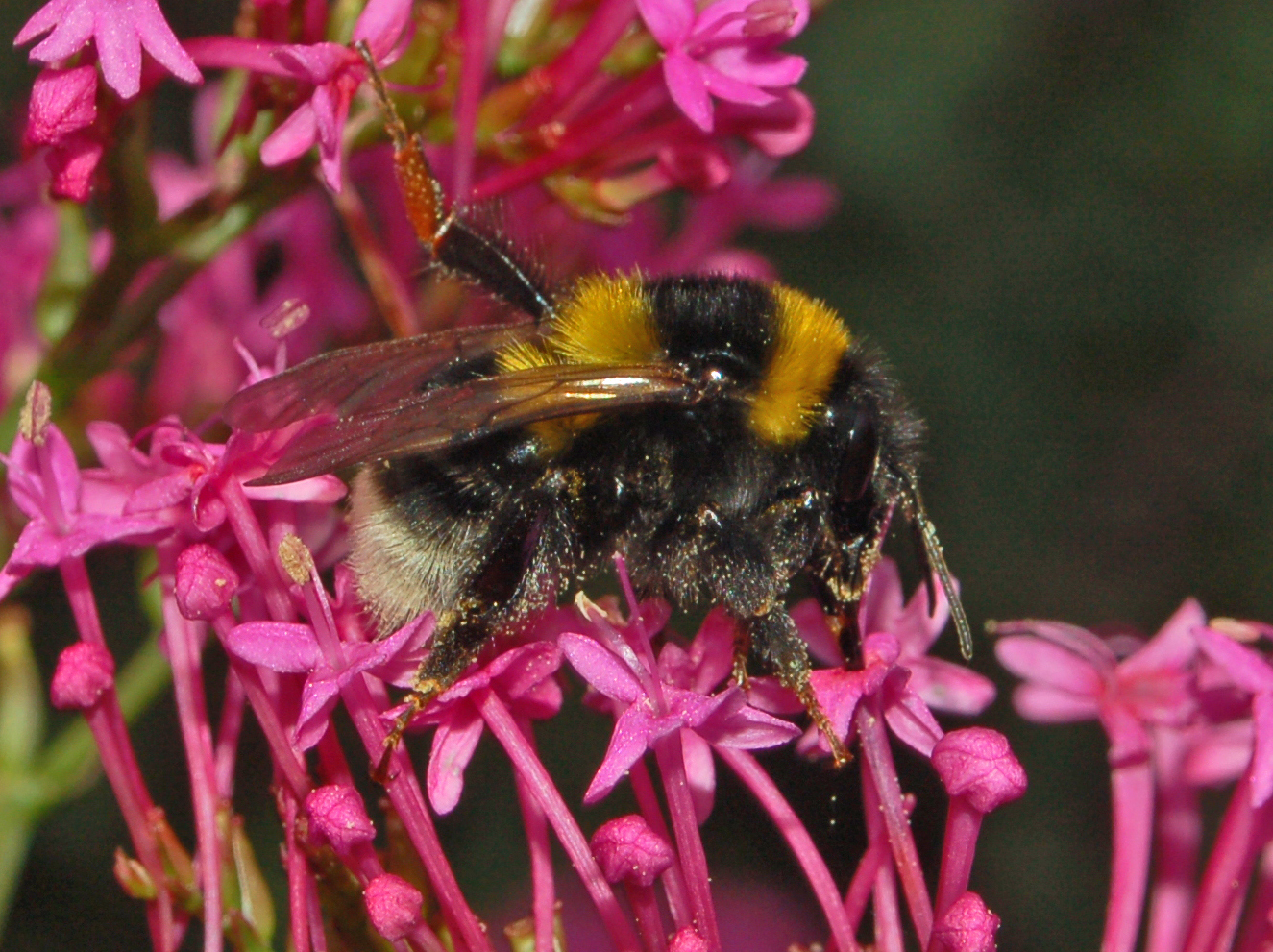
Large Garden Bumblebee
Bombus ruderatus
Fabricius, 1775 • Apidae • Megabombus
The large garden bumblebee is Britain's largest bumblebee, a long-tongued specialist of open flower-rich farmland and chalk grassland that has become one of the country's rarest. Bombus ruderatus Fabricius, 1775 looks almost identical to the garden bumblebee (B. hortorum), with three yellow bands and a white tail, but is larger, neater in appearance, and carries a face measurably longer in proportion. It has a habit unique among British bumblebees of flying with its tongue already extended, held outstretched before it as it approaches a flower. Once widespread across England and Wales, it has declined sharply and is now classified as Nationally Scarce, its remaining populations concentrated on chalk downland, coastal grasslands and flower-rich farmland in southern England. It is also a bee of global ecological significance, having been deliberately introduced to New Zealand in 1885 and Chile in 1982 to pollinate red clover crops, making it one of very few bumblebees to have been commercially deployed outside its native range. Explore its UK distribution on the UK Native Bee Species Map or read about bumblebees worldwide in the World Bee Atlas.
Quick Facts
Taxonomy and Classification
The large garden bumblebee was described by Johan Christian Fabricius in 1775. It belongs to the subgenus Megabombus alongside its closest relative, the garden bumblebee (Bombus hortorum). The two species are so similar that their separation caused significant confusion in recording for decades, and BWARS notes that many historical records attributed to B. hortorum may in fact represent B. ruderatus or vice versa.[1] DNA sequence data distinguishes them as clearly separate species, but morphological separation requires careful measurement and examination of characters that are only reliable in combination.[2]
The species is also known as the ruderal bumblebee, from the Latin ruderalis, meaning "of rubble or wasteland," a reference to the disturbed and open ground habitats with which it was associated historically. The melanic variety harrisellus is an all-black form in which yellow and white pigmentation is entirely absent; it is recorded most frequently in Britain and is considered diagnostic for ruderatus when found, as B. hortorum does not produce an equivalent melanic form.[1]
| Kingdom | Animalia |
| Phylum | Arthropoda |
| Class | Insecta |
| Order | Hymenoptera |
| Family | Apidae |
| Tribe | Bombini |
| Genus | Bombus Latreille, 1802 |
| Subgenus | Megabombus Dalla Torre, 1880 |
| Species | Bombus ruderatus Fabricius, 1775 |
| Melanic form | var. harrisellus (all-black) |
Identification: Separating from the Garden Bumblebee
The large garden bumblebee and the garden bumblebee (B. hortorum) share three yellow bands (collar, scutellum and first abdominal tergite) and a white tail, making them one of the most challenging species pairs in British bumblebee identification. Both are large, both are long-tongued, and both fly with the tongue partly extended. Several characters distinguish them, but none is fully reliable alone.[3]
The face measurement
The most reliable single character is the face length-to-width ratio. In B. ruderatus, the face is more than 1.5 times as long as it is wide; in B. hortorum, the face is long but does not reach this ratio. This requires a good close photograph or a specimen. In the field, an experienced observer can see that ruderatus looks subtly longer-faced and more "stretched" than hortorum, but this is subjective.[3]
Band pattern and coat
In B. ruderatus, the two yellow thorax bands tend to be more equal in width; in B. hortorum, the front collar band is usually broader than the rear scutellar band. The abdominal yellow band in B. hortorum often extends backwards onto the second tergite, while in B. ruderatus it tends to be more confined to the first tergite. The coat of B. ruderatus is noticeably neater and more even in hair length, giving queens a tidier appearance than the somewhat shaggy B. hortorum. In males, the hair around the mandibles is ginger in ruderatus and black in hortorum.[3]
The most reliable single character for separating Bombus ruderatus from Bombus hortorum: the face of ruderatus is more than 1.5 times as long as it is wide. This requires close examination or a good photograph. The all-black melanic form var. harrisellus is effectively diagnostic when found in Britain, as B. hortorum does not produce an equivalent form.
Britain's Largest Bumblebee: Size, Season and Behaviour
Queens of Bombus ruderatus reach 22 to 24 mm, making this Britain's largest bumblebee by body length. Despite this, it is much less frequently encountered than its smaller relative B. hortorum, reflecting both its genuine scarcity and the difficulty of confirming records without careful examination.[1]
The colony season is slightly later than that of the garden bumblebee. Queens emerge from April and are active through to October. Workers appear from May or June, and new queens and males from July onwards. Colony size is reported by Sladen (1912) as large, over 150 workers, but more recent sources including von Hagens (1994) give 50 to 100 workers, suggesting the higher figure may apply to exceptional colonies. The species nests underground, typically in old small mammal burrows, as with most other bumblebees.[1]
Distribution and Decline in Britain
Bombus ruderatus has always been more southerly in its British distribution than B. hortorum, recorded primarily in England north to Northumberland, with scattered records from Wales. It was formerly more widespread than it is now, though BWARS notes that the historical record is complicated by identification difficulties and that records not based on examined specimens cannot be fully trusted.[1]
Current strongholds include chalk downland in the South and South East, Salisbury Plain, the Thames Estuary grasslands and sea walls, and parts of East Anglia. It has been lost from large areas of its former range and is classified as Nationally Scarce B in Britain, a category indicating the species is recorded from fewer than 100 10-km squares. The decline is primarily attributed to loss of flower-rich grassland, particularly the dramatic reduction in red clover cultivation as a fodder crop since the mid-twentieth century.[4][6] Unlike its sister species B. hortorum, which tolerates gardens and urban habitats reasonably well, B. ruderatus is strongly associated with open agricultural and semi-natural grassland landscapes.
Introduced to New Zealand in 1885 to pollinate red clover
In 1885, Bombus ruderatus was deliberately introduced to New Zealand by the Canterbury Acclimatisation Society to pollinate red clover, which was failing to set seed without a long-tongued bee. The introduction was successful: B. ruderatus established, spread across both islands, and remains common there today. In 1982 it was introduced to Chile for the same purpose, and has since spread naturally into Argentina's Patagonia.[5]
Foraging: The Red Clover Specialist
Like the garden bumblebee, B. ruderatus has a very long tongue and visits deep-tubed flowers. BWARS lists it as one of only three British bumblebees that regularly visit foxgloves and honeysuckle through the legitimate floral entrance, the others being B. hortorum and B. pascuorum.[1] Its strong historical association with agricultural land is linked to red clover (Trifolium pratense), which requires a long-tongued bee to pollinate effectively and which was once a major component of British farming rotations.
The habit of flying with the tongue already extended before reaching a flower is documented by BWARS and is more consistently observed in B. ruderatus than in B. hortorum. It appears to be an energy-saving adaptation: by deploying the long tongue before arriving at the flower, the bee reduces the time spent stationary and vulnerable at each flower head.[1] Other recorded foraging plants include everlasting-peas, vetches, comfrey, woundworts, thistles, knapweeds, scabiouses and various deep-corolla garden plants.
How reliable are historical British distribution records for Bombus ruderatus?
BWARS explicitly states that the current distribution map "does not include records where a specimen has not been re-examined," because separation from B. hortorum in historical collections was unreliable.[1] This means the apparent historical range of the species may be artificially inflated by misidentifications, and the true extent of the decline is uncertain. Conversely, current records may undercount the species because many observers do not attempt confirmation. The true population trend since 1950 is therefore harder to quantify than for better-recorded species.
The Longest Tongue and Our Acacia Honey
Britain's largest bumblebee, with the longest tongue of any species in the country, forages from flowers that most other bees cannot reach. It makes no honey. But the deep-tongued connection to long-corolla flowers is something it shares with our spring honey landscape: the linden and acacia blossoms of Transylvania, where the Nistor family apiaries produce the honeys at the heart of HoneyBee & Co.
Our Acacia Honey is gathered from black locust forest in the same season that Bombus ruderatus queens are emerging and foraging on deep spring flowers. Pale, mild and slow to crystallise, it is the cleanest expression of single-origin raw honey we produce. For the full range of what the Nistor apiaries and our British supplier produce, the Discovery Trio brings Acacia, Wildflower and Heather together in one gift.

Pale, mild and slow to crystallise. Raw Transylvanian acacia honey from six generations of family beekeeping in the Nistor family apiaries. Cold-extracted. 280g.
Acacia, Wildflower and Heather in one box. Three of our most distinct raw honeys, 280g each.
Shop Discovery Trio
Raw single-origin honey every month. Acacia, Wildflower, Heather and more. From £8.79/month.
Start SubscriptionFrequently Asked Questions
How do I identify a large garden bumblebee?
Three yellow bands and a white tail, like the garden bumblebee, but larger (queens up to 24 mm), with a neater, more even coat and a face measurably longer than wide (more than 1.5 times as long as wide). Both species sometimes fly with the tongue extended before reaching a flower. In males, ginger hair around the mandibles distinguishes ruderatus from the black-mandibular-hair of B. hortorum males. All-black individuals (var. harrisellus) are effectively diagnostic for this species. Multiple photographs from different angles should be submitted with any record.
What is the difference between the large garden bumblebee and the garden bumblebee?
Both have three yellow bands and a white tail, and both have long tongues. The large garden bumblebee is larger, neater in coat, and has a face more than 1.5 times as long as wide; the garden bumblebee has a shorter face-to-width ratio and a slightly shaggier appearance. In males, mandibular hair colour differs (ginger in ruderatus, black in hortorum). Band proportions differ slightly. The large garden bumblebee is much scarcer, strongly associated with open farmland and chalk grassland rather than gardens. Some individuals cannot be separated in the field. Read the Garden Bumblebee profile for a full comparison.
Why was the large garden bumblebee introduced to New Zealand?
Red clover was introduced to New Zealand as a fodder crop but failed to set seed because there were no long-tongued bees native to New Zealand capable of reaching the nectar at the base of the deep corolla. In 1885 the Canterbury Acclimatisation Society introduced Bombus ruderatus specifically for red clover pollination. The introduction was successful and the species established across both islands, where it remains common today. It was later introduced to Chile (1982) for the same agricultural reason.
Where can I find large garden bumblebees in the UK?
On open flower-rich farmland, chalk downland and coastal grassland in southern and eastern England. Current strongholds include chalk downland in the South and South East, Salisbury Plain, Thames Estuary sea-wall grasslands and parts of East Anglia. It is absent from Scotland and largely absent from northern England and Wales. See the UK Native Bee Species Map for recorded distribution.
Why is the large garden bumblebee declining?
Primarily through loss of flower-rich open grassland and the near-disappearance of red clover from British farming rotations since the 1950s. Unlike its relative the garden bumblebee, the large garden bumblebee is not well adapted to gardens and urban habitats, requiring large areas of open semi-natural or agricultural grassland. Habitat fragmentation has reduced both colony numbers and the foraging range of remaining populations.
What is the all-black form of the large garden bumblebee?
The melanic variety harrisellus is an all-black form of Bombus ruderatus in which all yellow and white pigmentation is absent. It is recorded occasionally in Britain, particularly in the south. It is considered practically diagnostic for ruderatus when found, as the garden bumblebee (B. hortorum) does not produce a comparable all-black form. If you find an all-black large bumblebee with the general build and face shape of a garden-type bumblebee, photograph it carefully and submit the record to BWARS.
Does the large garden bumblebee make honey?
No. Like all bumblebees, colonies store only a few days' supply of nectar. There is no surplus and nothing to harvest. All commercial honey comes from managed honeybee (Apis mellifera) colonies.
Is the large garden bumblebee the same as the ruderal bumblebee?
Yes, they are two common names for the same species, Bombus ruderatus. The name "ruderal bumblebee" refers to its historical association with disturbed and open ground habitats (from Latin ruderalis, of rubble). The name "large garden bumblebee" highlights both its size and its similarity to the garden bumblebee. Both names are in common use; BWARS uses "large garden bumblebee" as the primary English name.
Sources and References
- Bees, Wasps and Ants Recording Society (BWARS). Bombus ruderatus Fabricius, 1775: species account, identification, tongue-extended flight, melanic form, colony size, foraging, distribution, decline. bwars.com
- Ellis, J. S. et al. (2006). Cryptic species identification: a simple diagnostic tool using HVR1 of the COI gene to discriminate between Bombus hortorum and B. ruderatus. Molecular Ecology Notes 6(3):540–542. doi.org
- Bumblebee Conservation Trust. Separation of Bombus ruderatus and Bombus hortorum: face ratio, band pattern, coat neatness, mandibular hair colour. bumblebeeconservation.org
- Goulson, D., Lye, G. C. & Darvill, B. (2008). Decline and conservation of bumblebees. Annual Review of Entomology 53:191–208. Red clover decline and long-tongued bumblebee losses. doi.org
- NatureSpot. Large Garden Bumblebee (Bombus ruderatus): New Zealand and Chile introductions, Patagonia spread, all-black form. naturespot.org
- Powney, G. D. et al. (2019). Widespread losses of pollinating insects in Britain. Nature Communications 10:1018. doi.org