

 Italiano
 English (UK)
 Français
 简体中文
 한국어

Two bakes from one dough: thin stars crisped for the tree, thicker trees pulled early to stay soft. The jar is the soft set honey that went into both.
Christmas baking
Honey Gingerbread: Christmas Biscuits That Stay Soft or Snap, Your Choice
Gingerbread made with honey instead of golden syrup bakes darker, smells of the hive as well as the spice, and softens in the tin over the days rather than going stale. A gift if you want chewy biscuits for the table, a nuisance if you want crisp ones for the tree. This recipe gives you both from one dough by changing only thickness and minutes. Melted method, a 45-minute chill, a cool oven, about 30 biscuits.
Crisp or soft: decide before you roll
Most honey gingerbread recipes promise one texture and quietly deliver the other a few days later. The reason is in the honey, explained below. The fix is to set the texture with the two variables you control.
Soft, for eating
Roll to 6 mm. Bake 9 to 10 minutes, until the edges are set but the centres still give under a fingertip. They firm as they cool and stay chewy for a week in a tin.
Crisp, for the tree
Roll to 4 mm. Bake 11 to 12 minutes, until evenly deep gold and a corner snaps cleanly once cool. Make the ribbon hole with a straw before baking. Store airtight or they soften again.
Honey gingerbread biscuits
Makes about 30 at 7 cm. Prep 20 minutes, chill 45 minutes, bake 9 to 12 minutes per tray.
Ingredienti
- 300 g plain flour
- 1 tsp bicarbonate of soda
- 2 tsp ground ginger
- 1 tsp ground cinnamon
- Quarter tsp ground cloves
- Quarter tsp fine salt
- A good pinch of black pepper
- 100 g unsalted butter
- 100 g soft set honey
- 60 g dark brown soft sugar
- 1 medium egg yolk
- Finely grated zest of half an orange (optional)
Metodo
- Dry bowlSift the flour, bicarbonate, spices, salt and pepper into a large bowl. The pepper is in the oldest English gingerbreads and it sharpens the ginger.
- FonderePut the butter, honey and sugar in a small pan over a low heat and stir until melted and dissolved. Do not let it boil. Leave off the heat for 10 minutes; hot honey would cook the yolk.
- CombinareBeat the yolk and zest into the warm honey mixture, pour it into the flour and stir until it comes together. Knead for half a minute into a smooth, slightly tacky ball. Too dry: a teaspoon of water. Too sticky: a tablespoon of flour.
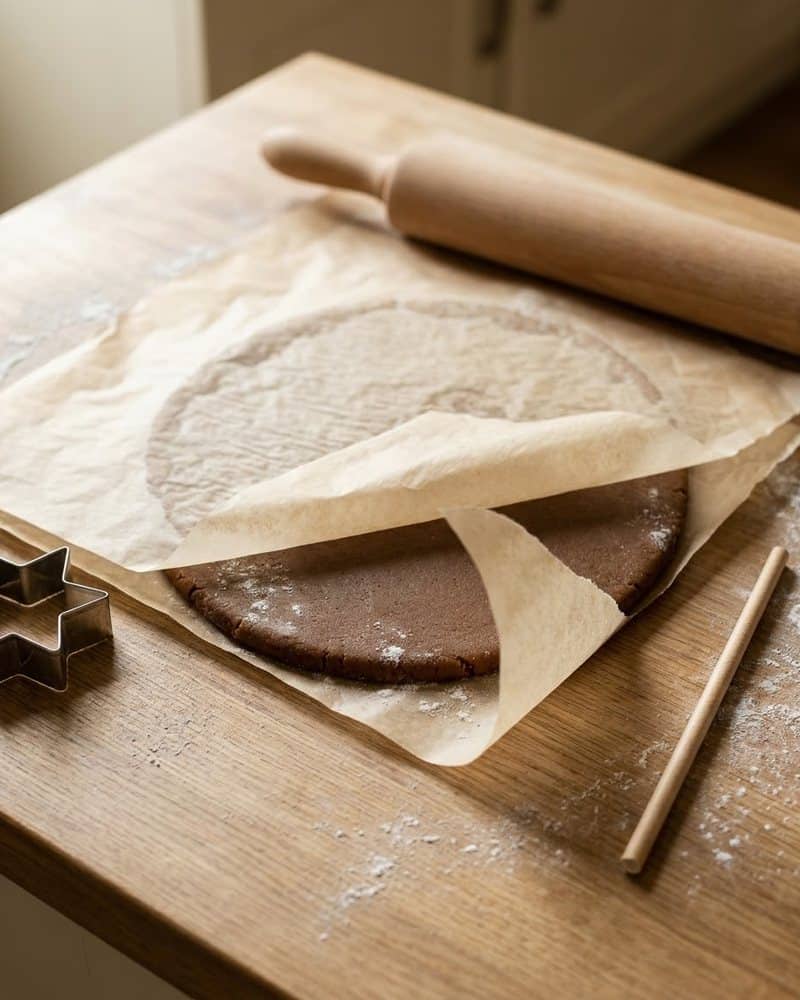
- FreddoFlatten into a disc, wrap, and chill for 45 minutes. This is the step most recipes skip and the reason their biscuits spread.
- Roll and cutHeat the oven to 170 degrees (150 fan). Roll between two sheets of baking paper to 4 mm for crisp or 6 mm for soft. Cut shapes, lift onto lined trays 3 cm apart, and chill the trays for 10 minutes.
- CuocereOne tray at a time on the middle shelf: 9 to 10 minutes for soft, 11 to 12 for crisp. The soft timing looks slightly underdone and that is correct. Honey biscuits colour fast in the last minute, so stay in the kitchen.
- Cool and storeFive minutes on the tray, then a rack. Ice only when completely cold. Soft biscuits go in a tin with paper between layers; crisp ones in a jar with a tight lid.
| Stage | Ora | What you are waiting for |
|---|---|---|
| Weigh and sift | 10 minutes | Spices evenly through the flour |
| Melt and cool | 5 + 10 minutes | Mixture warm, not hot, to the touch |
| Mix and knead | 5 minutes | A smooth ball that holds a thumbprint |
| Freddo | 45 minutes | Firm enough to roll without flour |
| Roll, cut, re-chill | 15 + 10 minutes | Clean edges on the shapes |
| Bake, per tray | 9 to 12 minutes | Soft: set edges, giving centre. Crisp: even deep gold |
| Cool before icing | 30 minutes | No warmth left in the biscuit |
| Total, two trays | About 2 hours 30 | Most of it hands-off |
Why honey gingerbread browns fast and softens later
Two things people notice the first time they swap honey for syrup: the edges catch a minute sooner than expected, and the crisp biscuits made on Saturday are bendy by Wednesday. Both come from one fact: most of the sugar in honey is fructose, which does not behave like the sucrose in caster sugar or the glucose in golden syrup.
Eva Crane, founder of the International Bee Research Association, wrote the clearest short account of this. Fructose reacts more strongly with amino acids at high temperatures than glucose does, so a fructose cake comes out of the oven darker than a sucrose one and has to come out earlier to avoid burning (Crane, “Learning about honey through fructose”, Bee World 63(4), 1982). Gingerbread has flour and a yolk to supply the amino acids, so 170 degrees does the job that 180 or 200 does for a syrup biscuit. The deep colour is the flavour, not a fault.
That sentence is the storage section of this article. Fructose pulls water from the air, so a crisp honey biscuit on a plate becomes a soft one, and a soft one in a sealed tin stays soft instead of drying out. Our guide to tenore di umidità del miele covers the same property from the jar’s side: it is why honey keeps very well and remains safe to eat well beyond its best-before date. A 2024 confectionery study saw the same chemistry: replacing 10 to 20 percent of the sugar in a boiled sweet with honey raised colour and hygroscopicity at every step (Yankova-Nikolova and colleagues, BIO Web of Conferences, 2024). A sweet is not a biscuit, so treat it as supporting evidence only.
Swapping honey into a syrup recipe you already use
Use the same weight of honey as golden syrup, drop the oven by 20 degrees and pull the biscuits two minutes earlier. Keep the bicarbonate: honey is mildly acidic, and bicarbonate neutralises it and gives the slight puff that makes gingerbread tender rather than glassy. If the recipe uses baking powder only, add half a teaspoon of bicarbonate per 300 g of flour. The sugar ratios for cakes are in our baking honey guide; miele contro zucchero covers what changes in the finished bake.
In our family the Christmas biscuits were honey because syrup was not in the house, and the grandmother who baked them rolled them thick and pulled them early, on purpose. The soft ones were for us.
The gingerbread that had no flour in it
Gingerbread was a honey food for centuries before it was a treacle one, and the earliest English versions were not baked at all. The Shakespeare Birthplace Trust’s Tudor gingerbread is honey warmed with black pepper, ginger, nutmeg and star anise, worked into stale brown breadcrumbs until the mixture will take no more, pressed into a tin and left a day to set (Shakespeare Birthplace Trust, “Tudor Gingerbread”, 2014). Their instruction for the honey belongs above every honey baker’s hob: “Very gently warm honey in a small saucepan with the spices. Heat until it is free flowing but not boiling.”
A recipe card from De Montfort University’s heritage centre in Leicester, written for children visiting a medieval castle site, describes the same food centuries earlier: ginger and bread bound with honey, served as a small sweet at feasts and shaped by hand (De Montfort University Heritage Centre, “Norman Nibbles” recipe card, 2023). Bread, honey, ginger: the name was literal.
A no-bake honey gingerbread for a wet afternoon
A small modern version of the Tudor method. Nothing goes in the oven, so children over one can make most of it.
- 120 g honey (soft set or wildflower)
- 1 tsp ground ginger, half a tsp cinnamon, a pinch of black pepper
- About 150 g fine dry crumbs from stale brown bread
Warm the honey and spices until the honey runs freely; do not boil. Stir in half the crumbs, then keep adding until the mixture stops absorbing them. Press into a lined 15 cm tin, or roll into walnut-sized balls, and leave an hour in the fridge. Cut into small squares. Dense, dark, peppery, and it tastes like the smell of a honey jar.
Which honey to use
At 100 g to 300 g of flour, the honey is a third of the dry weight of this dough, so it is tasted. We bake it with British soft set honey: Midlands wildflower honey crystallised slowly and churned until it spreads like butter, unpasteurised, minimally strained, no heat applied. It has enough body and a faint toffee note to stand up to two teaspoons of ginger and a pinch of pepper, where a very delicate honey disappears into the spice. And because it is already set, it weighs cleanly off a spoon without the long drip of a runny jar, which matters when a child is holding the scales. The science of set honey explains why a jar sets at all.
For a darker, almost treacly biscuit, use miele di erica and drop the brown sugar to 40 g; it is strong, slightly bitter and magnificent with cloves. For pale biscuits that are mainly a canvas for icing, use miele di acacia, slow to crystallise and mild enough to let the cinnamon lead; miele e cannella has its own article for a reason. A jar that has gone grainy is fine for any of these, since the honey is melted; ammorbidire il miele cristallizzato only matters for measuring a runny jar.
The honey in the biscuit
British soft set honey. Our British honey supplier holds SALSA Certification. It is one of the three jars in the Selezione "Baker’s Kitchen" with acacia and sunflower, in the Pacchetto di miele britannico with wildflower and heather, or three at a time in the stock-up pack. Every jar is 280 g. Free UK delivery on 3 or more jars on any order type, standard delivery 2 to 5 working days, returns within 30 days unopened; 55 Google reviews at 4.9 stars. The rest is in il negozio.
Miele morbido Honey gift setsRisoluzione dei problemi
- The shapes spread and the stars lost their points
- Warm dough. Chill the disc for the full 45 minutes and the cut shapes for 10 more on the tray, and roll between paper, not on a floured board. If it still spreads, knead in another tablespoon of flour.
- They came out hard enough to chip a tooth
- Rolled too thin for the soft timing, or the oven runs hot. Not wasted: a day in a tin with a slice of apple softens them.
- My crisp decorations went limp on the tree
- They always will, in a heated room, over two weeks. Keep a batch in a sealed jar and hang them when guests arrive. A coat of royal icing over the whole surface slows it by sealing the biscuit from the air.
Decorations, gifts and who they are for
For tree decorations, make the hole before baking with a drinking straw 1 cm from the edge, bake at the crisp timing, and thread with ribbon once iced and dry. They hang for a fortnight, then soften, which is the moment to eat them and bake again. For gifts, a dozen soft biscuits in a tin with a jar of the honey that went into them is the present we would want, and it is the logic behind our set regalo di miele: the Trio di scoperta for someone new to single-origin honey, the Selezione "Calore invernale" for whoever will bake the heather version, the Collezione completa for the household that will bake all three. Post the crisp ones, in a tin they cannot rattle in.
Freezing: the raw dough freezes for three months as a wrapped disc. Baked, un-iced biscuits freeze for a month and come back crisp after 10 minutes at 150 degrees.
Domande
Can I use honey instead of golden syrup in gingerbread?
Yes, weight for weight. Lower the oven by 20 degrees, pull the biscuits two minutes earlier, keep the bicarbonate and chill the dough.
Why are my honey gingerbread biscuits soft instead of crisp?
Rolled thicker than 4 mm, pulled before deep gold, or left in open air, where fructose absorbs moisture. Re-crisp for 5 minutes at 150 degrees and store in a sealed jar.
Can I make gingerbread men with this dough?
Yes. Roll to 5 mm, bake 10 to 11 minutes, and chill the cut figures for 10 minutes first or the limbs spread.
Does it need the egg yolk?
No. Replace it with a tablespoon of milk. The biscuit is a little more crumbly; the flavour is unchanged.
How far ahead can I make them?
Soft biscuits are best from day two to day seven in a tin; crisp ones keep three weeks sealed. The dough keeps three days in the fridge or three months frozen.