

 Italiano
  English (UK)
  Français
  简体中文
简体中文 
Honey science, explained for the jar in your hand
Honey Moisture Content: The One Number That Decides Whether Your Honey Keeps
A jar of honey that has gone bubbly and sour was not unlucky. It carried too much water. Here is what the moisture figure means, where the line is, and how to keep honey on the right side of it.
Most people never think about water in honey, because honey does not look wet. But moisture is the figure that food-standards bodies police most closely, the figure a careful beekeeper checks before extracting a single frame, and the figure that separates a jar that lasts from a jar that turns. The international standard for honey, the Codex Alimentarius, sets the ceiling at 20 percent for ordinary blossom honeys, with a small allowance for heather and a few honeydew types, in its Standard for Honey, CXS 12-1981. Everything below is about why that line exists and what it means for the jar on your shelf.
Where the line is
Why a few percent matters so much
The reason is not the water itself but what the water does to the sugar. Honey is a supersaturated solution: far more sugar is dissolved in it than plain water could ever hold, which is why it is thick, why it crystallises, and why almost nothing can live in it. Microbiologists describe this with a figure called water activity, the fraction of water in a food that is actually free for organisms to use. Honey's water activity sits around 0.5 to 0.6, while most bacteria need above 0.9 to grow, which is why honey has always been one of the few foods that keeps without refrigeration, as Snowdon and Cliver set out in their 1996 review of microorganisms in honey.
The exception is a group of yeasts that tolerate sugar unusually well. They arrive in honey naturally, on the bees, from the flowers and from the air, and they are harmless and dormant in dry honey. Give them enough free water and they do what yeasts do: eat sugar, produce alcohol and carbon dioxide, and turn the jar into a slightly fizzy, faintly boozy version of itself. That is the whole mechanism behind a "bad" jar. Nothing was added. Something was simply too wet.
How honey gets dry in the first place
Nectar arrives at the hive as a thin syrup, often 60 to 80 percent water. The bees do the drying. They spread the nectar across the comb in thin films, add enzymes from their own glands, and fan the air through the hive until enough water has evaporated. Only when the honey is ripe do they seal each cell with a wax cap, and that cap is the signal beekeepers have relied on for as long as there have been beekeepers, a process Thomas Seeley describes in The Wisdom of the Hive.
The single most common cause of wet honey is impatience: taking frames while cells are still open, because they look full. Uncapped honey can read three or four points higher than capped honey from the same hive, and once it is in a jar there is no bee to finish the job. Our rule in the family apiaries is that nothing is extracted from a frame that is not sealed. It costs us time in a good year and honey in a wet one, and it is the reason we can put a figure on the label with a straight face.
Climate, flowers and the number on the jar
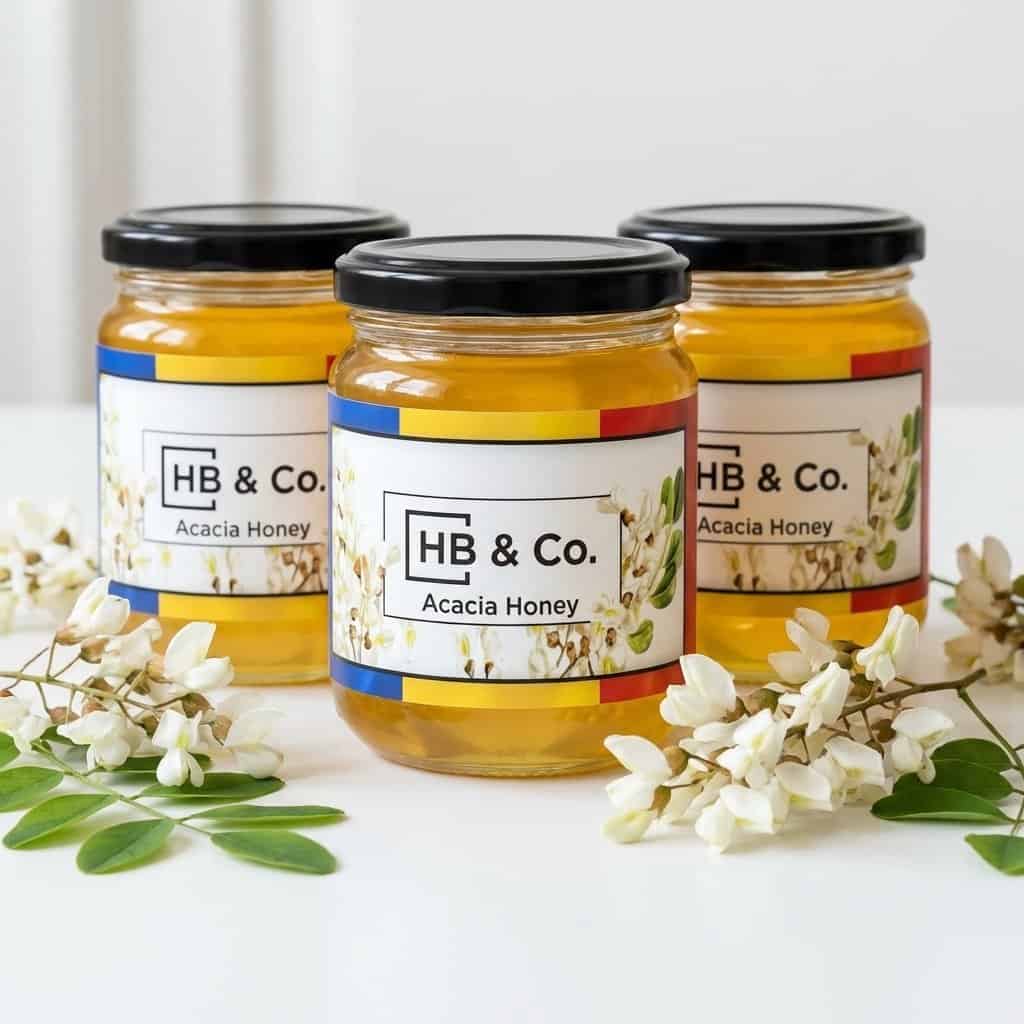
Not all honeys arrive at the same moisture, even when the bees have done everything right. Nectar from different flowers starts wetter or drier, and a humid summer slows the hive's evaporation. A 2023 study of Romanian honeys, the same varieties we sell, measured moisture between 12.2 and 18.7 percent across acacia, linden, sunflower and multifloral samples, all comfortably inside the safe zone, as reported in a study of botanical origin and honey characteristics. Acacia tends to sit at the dry end, which, together with its high fructose, is why it is also the honey in our range that is slowest to crystallise. Heather is the well-known exception in the other direction: its gel-like texture holds more water, which is exactly why the standards give it a higher ceiling.
Read your jar: three signs of fermentation, and what to do
- Foam or a fizz on the surface. Small bubbles collecting under the lid, or a slight hiss when opened, mean gas is being produced.
- A sour or beery smell. Honey should smell of its flowers. Alcohol or vinegar on the nose is yeast at work.
- Thinner, cloudier honey than the day you bought it. Fermentation consumes sugar, so the honey loosens.
If you see all three, the jar is a quality failure, not a safety scare: fermented honey is what mead is deliberately made from. It will not taste as it should, so use it in cooking where it will be heated, and store the next jar sealed in a cool cupboard. If you see none of them, what you have is almost certainly crystallisation, which is a good sign, and our guide to Perché il miele grezzo cristallizza explains it.
Keeping honey dry at home
Honey is hygroscopic: it pulls water out of the air. A jar left open in a steamy kitchen, or a lid returned loosely, will creep upward over months. The rules are simple. Keep the lid tight. Keep the jar away from the kettle and the hob. Use a dry spoon, never one that has been in tea or on a buttered knife. Room temperature is right; the fridge is not needed and only speeds crystallisation. Stored like that, raw honey keeps very well and remains safe to eat well beyond its best-before date, which is a legal formality rather than a countdown. And whatever the jar, never give honey of any kind to babies under twelve months.
For beekeepers: the refractometer, briefly
A honey refractometer reads the bend of light through a drop of honey and converts it to a moisture percentage in a few seconds; the dissolved sugar bends light more than water does. Calibrate it, take the drop from a mixed sample rather than one cell, and treat 18 percent as the working target with capped comb as the first check. It is the only instrument most of us will ever need for this, and it is worth every penny of its modest price.
What we test for
Every batch of our honey is checked for moisture before it is jarred, alongside the other markers that tell us it is what it says on the label. We publish the range rather than a single figure because honey is an agricultural product and no two harvests read the same.
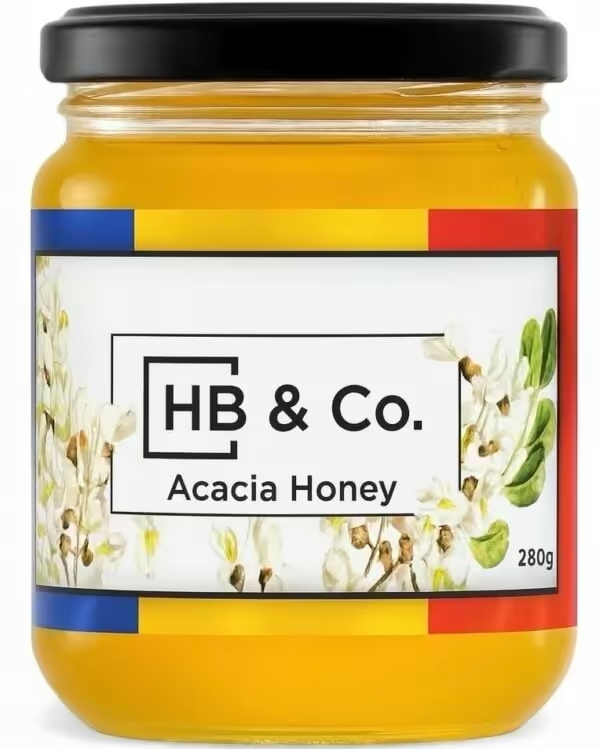
Miele di acacia grezzo
The honey this article keeps coming back to: the driest in our range, the slowest to set, and the one we recommend to anyone who wants a jar that will still be clear in a year's time. From our family's Transylvanian apiaries, harvested from capped comb, never heated above hive temperature.
Acquista il miele di acaciaDomande comuni
What is the ideal moisture content of honey?
Why has my honey gone fizzy or sour?
Is fermented honey safe to eat?
Does crystallised honey mean it has too much water?
How do beekeepers measure moisture in honey?
Does raw honey have more water than supermarket honey?
Fonti
- Codex Alimentarius Commission, Standard for Honey CXS 12-1981: the 20 percent moisture ceiling and the exceptions.
- Snowdon, J. A. and Cliver, D. O. (1996), Microorganisms in honey, International Journal of Food Microbiology 31, 1 to 26: water activity, osmophilic yeasts and fermentation.
- Botanical origin influence on honey physicochemical characteristics, 2023: moisture of 12.2 to 18.7 percent across Romanian acacia, linden, sunflower and multifloral honeys.
- Seeley, T. D. (1995), The Wisdom of the Hive: how colonies evaporate nectar and regulate the hive.
Honey that was dry before it was jarred
Six raw, single-origin honeys, every batch tested, harvested only from capped comb. Free UK delivery on orders of three jars or more.
Acquista il miele grezzoContinua a leggere
Part of our honey science series. Start at the HoneyBee & Co. home page, read i miti più comuni sul miele grezzo, meet the family on the pagina web, oppure scopri cosa dicono i clienti sul nostro pagina delle recensioni. Buying to keep? Our set regalo ship three or six jars, delivery included.